
What Is Injection Molding? The Complete B2B Guide

If your business sources plastic parts—for consumer electronics, automobiles, medical technology, or industrial equipment — injection molding will likely play a role in your supply chain. Injection molding is by far the most prolific plastic manufacturing process worldwide, producing billions of parts each year.

This guide covers what injection molding is, how it works step-by-step, which materials can be used, which industries use it, how much it costs, and helps you decide whether injection molding is right for your application. We aim to provide practical answers to real questions faced by B2B buyers, engineers, and procurement managers.

CKMOLD is an injection molding manufacture. We have been producing precision plastic parts and custom injection molds since 2002. Everything you read here is grounded in real-world experience running a production facility with over 22 years of injection molding knowledge.

1. What Is Injection Molding?

Injection molding is a manufacturing process in which molten plastic is injected at high pressure into a steel or aluminium mold. The plastic cools, solidifies, and takes the shape of the cavity. When the mold opens, the finished part is ejected—ready for your application or post-processing.

The process repeats many times per minute. Depending on the part size and material, the process repeats every 10 seconds to several minutes. Injection molding machines produce thousands or millions of identical parts with incredibly tight tolerances. That level of repeatability is injection molding’s main benefit.

Key fact: Injection molding represents about 32% of global plastic production by weight. No other manufacturing process has more impact on the plastics industry.

There are three core components to any injection molding operation:

  1. The injection molding machine — which melts the plastic and injects it into the mold
  2. The mold (or tool)—that precision steel cavity that shapes the part
  3. The plastic resin—the raw material, usually dry pellets or granules

Each of these is important to understand if you want to make informed sourcing decisions. We explain each in more detail below.

2. How Injection Molding Machine Works?

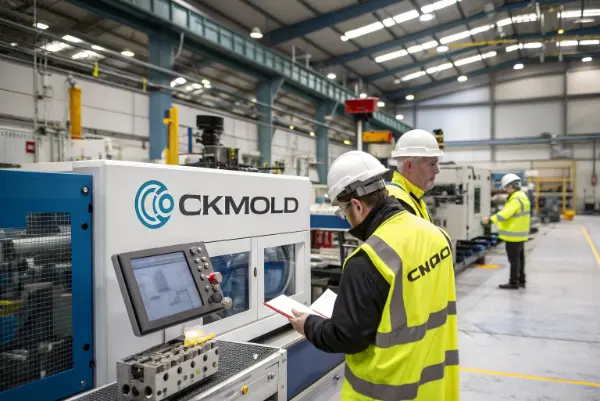
An injection molding machine can be separated into two distinct working areas. The injection unit, which heats and delivers the molten plastic—and the clamping unit, which opens and closes the mold.

2.1 The Injection Unit

Pellets of plastic drop into a hopper attached to the machine and fall by gravity into its heated barrel. Inside, a spiral screw rotates, moving the plastic through heated zones. The pellets liquify from friction and progressively melt into uniform, molten plastic.

Once fully molten, the screw moves forward—acting like a ram—injecting measured quantities of resin through the nozzle into the mold. The injection speed and pressure are precisely controlled to manage shear stress and fill the cavity.

2.2 The Clamping Unit

Injection molds have two sides or halves. They mount onto the injection molding machine between two large platens. One stationary. One moveable. A hydraulic or electric toggle moves the platens together, ‘clamping’ the mold with several tons of force.

Clamping forces range from 50 tonnes for tiny parts up to over 3,000 tonnes for the largest molds. Force is required to keep the mold halves tightly closed under the high pressures needed to inject molten plastic into the mold.

We have machines ranging from 50 to 1,000 tonnes clamping force here at CKMOLD. So we can build anything from tiny connectors to large automotive housings.

2.3 The Mold

Injection molds are engineered precision tools. Usually made from machined steel ( P20, H13, S136, or 1.2344 ) or aluminum. Aluminum molds are cheaper to build but offer shorter tool life. They are typically used for prototype molding or very low-production runs.

The mold is made of two parts — generally called the cavity side and the core side. The two sides meet at parting line.
Every aspect of part quality is determined by the mold. Surface finish. Dimensional tolerances. Cycle time. Long-term production reliability. Designing and building a good mold is critical; here at CKMOLD, we conduct a thorough Design for Manufacturability (DFM) check on every mold design before the first cutting starts.

3. The Injection Molding Cycle: 6 Stages Explained

Injection molding cycle can be broken down into six primary stages. Understanding these stages is important to help identify key influences on part quality, efficiency and cost.

Stage What Happens Typical Duration Key Parameters Controlled
1. Mold Clamping The two mold halves close and lock under clamping force. The cavity is sealed and ready for injection. 1–3 seconds Clamping force (tonnes), closing speed, low-pressure protection
2. Injection The screw advances, driving molten plastic through the nozzle and runner system into the cavity until approximately 95–99% full. 0.5–5 seconds Injection speed (mm/s), injection pressure (bar), melt temperature (°C)
3. Packing / Holding Holding pressure packs additional material into the cavity to compensate for volumetric shrinkage during cooling. Ends when the gate freezes. 3–10 seconds Holding pressure (bar), holding time (s), V/P switchover position
4. Cooling The part solidifies. Cooling channels carry temperature-controlled water or oil to extract heat from the steel. This stage represents 60–80% of total cycle time. 8–60+ seconds Mold temperature (°C), coolant flow rate, wall thickness (mm)
5. Mold Opening & Ejection The mold opens. Ejector pins push the solidified part free. A robot arm or gravity deposits it on a conveyor or in a collection bin. 2–5 seconds Ejector pin placement, draft angle, demolding speed
6. Reset The mold closes for the next cycle. The screw rotates to plasticise the next shot of material. 1–2 seconds Screw recovery time, back pressure, screw rotation speed

1. Mold Clamping

In mold clamping stage, mold is clamped at a pre-set tonnage which fully closes and holds the mold together to form cavity with no leakage or flash. Mold clamp time is usually 1–3 seconds. Typical control parameters are clamp tonnage, closing speed, and low pressure protection settings.

2. Injection

In injection stage, screw advances and molten plastic flows through nozzle and fills up the runner system and then fills the mold cavity to about 95-99%. Injection time varies from 0.5-5 seconds. Typical control parameters are injection speed (mm/s), injection pressure(bar), melt temperature(°C) which determine filling behavior and surface quality.

3. Packing / Holding

After the mold is filled with plastic, it enters into packing or holding stage, during which higher pressure is applied to pack more material into the cavity to compensate for material shrinkage as the material begins to cool down. Packing time is usually around 3-10 seconds. Typical control parameters are holding pressure, holding time, V/P switchover position. Holding position determines at which point during filling the machine switches from injection to holding.

4. Cooling

During cooling stage, plastic solidifies inside cavity. Mold temperature is controlled through cooling channels circulating water or oil at specified temperature through the mold to maximize heat extraction from the mold. Cooling time can range from 8-60+ seconds, but typically makes up about 60–80% of the entire cycle time. Mold temperature, coolant flow rate and part wall thickness are typical control parameters.

5. Mold Opening & Ejection

After the part has sufficiently cooled and solidified, the mold opens and ejector pins push the part out of the mold cavity. The part is then removed by a robot arm or fall into a chute for collection. Mold open time typically ranges from 2–5 seconds. Typical control parameters are placement of ejector pins, draft angles, and demolding speed.

6. Reset

Reset stage closes the mold to start the cycle again and rotates screw to plasticize next shot. Reset time is typically 1–2 seconds. Screw recovery time, back pressure, and screw rotation speed are important control parameters.
Real-world example
During actual production at CKMOLD, a typical ABS consumer electronic enclosure part with wall thickness of 2 mm would cycle between 25–35 seconds. For a production run of 100,000 parts, this translates into approximately 700 machine hours to 1,000 machine hours. Therefore, minimizing cycle time = minimizing part cost.

Why Cooling Dominates the Cycle

The plastic has low thermal conductivity. Heat from the molten plastic needs to travel through the part into the mold and into cooling channels filled with temperature-controlled water or oil. Thick walls take substantially longer to cool. A 3 mm thick wall can take 4 times longer to cool than a 1.5 mm wall.

Uniform wall thicknesses and heat dissipation are key. This is why minimizing and maintaining consistent wall thickness is an important design consideration. Not only does it reduce cycle time and cost — it also minimizes sink marks, warpage, and internal stresses.

  1. Materials Used in Injection Molding
    Injection molding works with an incredibly diverse range of plastics. Over 50 common engineering thermoplastics can be injection molded. Each with unique mechanical, thermal, optical, and chemical properties.

Here is a list of commonly-used plastics we mold here at CKMOLD. We will dig into each of these materials and share examples of applications they are used for later in the guide.

4.1 Thermoplastics vs Thermosets

Thermoplastics are by far the most common type of plastic used in injection molding. They have been engineered to melt when heated, then solidify when cooled. This means we can recycle sprues and runners from thermoplastic molding processes.

ABS, polypropylene (PP), polycarbonate (PC), nylon, PMMA, and high-density polyethylene (HDPE) are thermoplastics. Thermoplastics account for about 90% of all injection molded parts worldwide.

Contrary to thermoplastics, thermosetting plastics experience chemical change when molded. They can’t be melted once set. Silicone injection molding is the most well-known thermoset injection molding process. Often used for medical devices, automotive gaskets, seals and joineries, and consumer electronics buttons.

4.2 Material Selection Reference Table

The below table outlines approximate working parameters and common applications for the most common plastics we injection mold here at CKMOLD. These numbers are based on real production mold conditions. Exact values will vary by material grade, part geometry, and mold design.

Material Melt Temp (°C) Mold Temp (°C) Inj. Pressure (bar) Shrinkage (%) Common Applications
ABS 200–260 40–80 700–1400 0.4–0.8 Electronics housings, automotive trim, consumer goods
PP 200–280 20–60 800–1400 1.2–2.5 Packaging, automotive, containers, living hinges
PC 270–320 80–120 900–1600 0.4–0.7 Optical covers, safety shields, electronics enclosures
PMMA (Acrylic) 200–260 50–80 700–1200 0.4–0.7 Lenses, light guides, optical components, display covers
PA6 (Nylon) 230–280 60–90 800–1400 0.6–1.5 Gears, bearings, automotive under-hood parts
PA66 (Nylon) 260–300 60–100 800–1500 0.8–1.5 High-temp automotive connectors, structural parts
POM (Acetal) 185–215 60–90 700–1200 1.8–2.5 Precision gears, clips, snap fits, sliding components
HDPE 200–280 20–70 700–1200 1.5–3.0 Pipes, containers, water management, outdoor use
PVC (Rigid) 160–200 20–50 700–1200 0.1–0.5 Pipe fittings, medical tubing, cable conduit
TPE / TPU 180–220 20–50 500–1000 1.0–2.5 Seals, grips, flexible over-molded components

CKMOLD note: We mold all of the grades listed above as well specialty grades such as PEEK,PPS,LCP,COC, and medical / biocompatible grade materials. Please consult with us early if your project uses an unconventional material – drying times, mold steel and processing parameters change dramatically from grade to grade.

4.3 Why material drying matters

Most engineering plastics are hygroscopic which means they absorb atmospheric moisture. When moisture laden material enters the barrel without sufficient drying, steam results in silver streaks, bubbles, splay marks, and poor mechanical properties of the finished part. Don’t skip drying.
PA6 / PA66 (Nylon): 80–90°C, 4-6 hours
PC (Polycarbonate): 110–125°C, 4-6 hours
PMMA (Acrylic): 80–90°C, 3-5 hours
POM (Acetal): 80°C, 2-4 hours
ABS: 75–90°C, 2-4 hours

At CKMOLD we dry all hygroscopic materials in dehumidifying hopper dryers with built in moisture measurement prior to entering the barrel. Omitting this step is the number one reason for cosmetic defects in clear and engineering plastic parts — it’s the first thing we look for when trouble shooting a quality problem.

Want to know how much your part will cost to injection mold? Our free Injection Molding Cost Calculator quickly estimates unit prices based on part volume. You can also use it as a generic rule of thumb to compare costs against other manufacturing processes.

5. Key Process Parameters That Control Part Quality

There are six interdependent process parameters that determine if each part is good or scrap. An experienced process engineer will adjust and monitor all six parameters throughout each production run.

5.1 Melt Temperature

Melt temperature is temperature of the plastic leaving the screw into the nozzle. Too low and the melt is too thick to fill the cavity properly – resulting in short shots or flow lines / poor weld-line strength. Too high and the polymer degrades – resulting in discolouration; brittleness; and even hazardous off-gassing. Every material has an approximate processing window of ~40–60°C.

5.2 Mold Temperature

Mold temperature affects how quickly the part solidifies. It significantly impacts surface finish; dimensional stability; and residual stress in the part. High mold temperature = higher gloss finish and less stress but longer cycle time. Low mold temperature = faster cycle times but more flow marks; hazing; and warpage.
When molding optical grade acrylic (PMMA), CKMOLD typically runs molds between 60°C and 80°C – ensuring the glass-like finish required for many lighting and display components. When running high volume PP packaging jobs we typically run mold temperatures closer to 25–40°C to maximise output.

5.3 Injection Speed and Pressure

Injection speed is how quickly the cavity is filled. Too high causes jetting; burn marks; and excessive shear stress. Too low and the material cools too quickly before filling. At CKMOLD we use profiled injection speed – gradually ramping the speed to fill the cavity smoothly.
Once the cavity is ~95–99% full the process kicks over from injection pressure to holding (packing) pressure. The timing of this switch-over is extremely important – switch over too soon and you get sink marks / voids. Too late and you get flash / stress from over-packing. It’s one of the most obvious signs of an inexperienced molding house when they get this consistently wrong.

5.4 Cooling Time

Cooling time is primarily dependent on wall thickness, material thermal properties, and mold cooling channel design. As a rule of thumb cooling time is proportional to the square of wall thickness. A 3 mm wall will require ~4 times the cooling time of a 1.5 mm wall. See number 3 above.
Cooling time can be reduced 20–40% by using conformal cooling channels (channels that follow the contours of the part rather than running straight through the mold block). It’s much more expensive to tool but can greatly reduce per-part cost on high volume jobs.

5.5 Clamping Force

Clamping force must be greater than the force exerted by the injected plastic on the mold faces. Too little clamping force and you get flash. Too much and you wear out the mold prematurely. Calculated as follows:
Clamping Force (tonnes) = Projected Area (cm²) × Cavity Pressure (MPa) ÷ 10
Cavity pressure varies between materials but for most engineering plastics it falls between 20 and 40 MPa. A part with 200 cm² of projected area running at 30 MPa would require a clamping force of 600 tonnes.

6. Injection Mold Design: What B2B Buyers Should Know

The mold is typically the largest fixed cost involved in any injection molding project. Knowing the key mold design considerations will help you evaluate bids, negotiate effectively, and prevent unwanted surprises after tools is approved.

6.1 Number of Cavities

One cavity = one part per cycle. Lowest tooling cost; simplest to qualify; ideal for low volumes (<50k/year) or complex parts. Multi-cavity molds produce 2, 4, 8, 16+, identical parts per cycle. Cut per-part cost by a factor of X, but increases tooling cost and complexity X-fold. At CKMOLD we help our clients decide on optimal cavity count based on projected volume and target tool amortisation schedule.

6.2 Runner Systems

Cold runner systems are channels that solidify as they reach the cavity and are ejected along with each shot as scrap (or reground). Cheaper tooling; but creates material waste and gate marks on part.
Hot runner systems maintain the runner channels at molten temperature between shots. Adds cost to tooling but eliminates material waste and gate marks. Starts to pay for itself in material savings alone at volumes above ~100k parts per year.

6.3 Surface Finish Standards

Injection mold surface finish directly translates to part surface finish. Following are the surface finish standards most commonly used in injection molding:
SPI A-1: Mirror / diamond-buffed finish. Ra < 0.025 μm. Required for optical lenses and clear covers
SPI A-2 / A-3: High gloss. Standard for consumer electronics cosmetic surfaces
SPI B-1 to B-3: Satin to semi-gloss. Standard for most commercial parts
SPI C-1 to C-3: Matte finish. Common for industrial or structural parts
VDI 3400: German texture standard. VDI 3400-27 (Ra 2.24 μm) is a common automotive interior texture specification

6.4 Design for Manufacturability (DFM)

DFM is a formal engineering review of a part design prior to mold construction. The purpose is to identify manufacturability issues before tooling starts that may cause problems during production – and then make design changes that retain part function while optimising for tooling cost and defect reduction. Typical manufacturability issues we see day-to-day:
Inadequate draft angles – parts stick in mold and require excessive force to eject
Sharp changes in wall thickness – results in differential shrinkage; sink marks; voids
Sharp corners – stress riser; ideally all internal corners should have a minimum radius of ~0.5 mm
Undercuts – Features that prevent part from being ejected in straight pull. Requires side-actions or lifters which increase tooling cost.
Floating or unsupported long cores – moves under injection pressure causing inconsistent dimensional accuracy from shot-to-shot.

DFM is done at CKMOLD prior to mold design beginning and reviewed with client. The final DFM report is provided in writing before tools starts. That way our customers don’t run into expensive surprises after the steel is cut.

7. Industries That Use Injection Molding

Injection molding is universal – it’s used in every industry that requires plastic parts produced reliably and at scale. Below are the industries CKMOLD services regularly with typical parts, materials, and requirements.

Industry Typical Parts Common Materials Key Requirements
Consumer Electronics Housings, enclosures, screen bezels, connectors, buttons ABS, PC, PC/ABS, PP Cosmetic finish, tight tolerances, EMI shielding options
Automotive Interior trim, dashboards, lighting lenses, under-hood brackets, clips ABS, PP, PA6/66, PC, TPE Heat resistance, UV stability, PPAP documentation
Medical Devices Diagnostic housings, fluid handling, surgical instrument parts, optical windows PC, PMMA, COC, PP medical grade Biocompatibility, cleanroom, full traceability
LED Lighting Lenses, reflectors, diffusers, light guides PMMA, PC, PS Optical clarity, precise geometry, zero flow marks
Industrial Connectors, valves, pump components, structural housings PA, POM, PPS, PEEK Chemical resistance, mechanical strength, thermal stability
Consumer Goods Kitchen products, containers, garden items, packaging PP, PE, ABS, PS Low cost, colour accuracy, food-safe grades as required

8. Advantages and Limitations of Injection Molding

Injection molding is ideal for many projects but isn’t a fit for everything. Please read through the following comparison to ensure injection molding is the right process for your project before investing in tooling.

Advantages for B2B Buyers Limitations to Consider
Extremely low per-part cost at high volume High upfront tooling cost — $3,000 to $100,000+
Exceptional part-to-part consistency across millions of cycles Long lead time to first production parts — typically 4–8 weeks
Wide material choice — 50+ engineering thermoplastics Design changes after tooling is built are costly and slow
Complex part geometry achievable in a single cycle Not cost-effective for very low volumes (under ~1,000 parts)
Minimal post-processing required — parts emerge nearly finished Some geometries require complex, costly mold features
Excellent surface finish — gloss, texture, and optical clarity all achievable Moisture-sensitive materials need careful drying before molding
Highly automatable — 24/7 lights-out production possible Process expertise required — wrong parameters cause defects
Minimal material waste — sprues and runners are recyclable Colour changes require purging and downtime between runs

9. Injection Molding vs CNC Machining vs 3D Printing

We get asked this question often – and the answer always depends on volume, timeline, material requirements, part complexity, and budget. See the below table for how the three common manufacturing processes stack up.

Factor Injection Molding CNC Machining 3D Printing
Best production volume 10,000 – millions 1 – 5,000 1 – 500
Tooling / setup cost $3,000 – $100,000+ $500 – $5,000 None / minimal
Per-part cost at volume Very low Medium to high High per part
Lead time (first part) 4–8 weeks 3–10 days 1–3 days
Material options 50+ thermoplastics, silicone Metals, plastics, composites Polymers, resins, some metals
Tolerances achievable ±0.05–0.5 mm typical ±0.01–0.1 mm ±0.1–0.3 mm typical
Surface finish quality Excellent (mold-controlled) Excellent (machined) Fair to good (visible layers)
Part-to-part consistency Extremely high Very high Moderate
Ideal for Mass production of plastic parts Prototypes, metals, low volume Rapid prototypes, one-offs
CKMOLD capability Yes — core service Yes — in-house CNC Referral available

CKMOLD manufacturers are uniquely qualified to handle both injection molding projects as well as CNC machining because we offer both services in-house. We can prototype your part using CNC while designing the mold, then seamlessly transfer to injection molding for production. Engineering stays the same, as does your supplier account contact. No handoff risk.

10. How Much Does Injection Molding Cost?

Injection molding cost is broken into two categories: tooling cost (one-time, upfront) and per part cost (recurring cost / each unit). It’s important to understand both – and how they relate to each other at different production volumes.

10.1 Tooling Cost

Cost of tooling is dependent on mold complexity; cavity count; steel grade; part size; surface finish; and many other factors. From CKMOLD’s pricing history here are some ranges that prospective customers can expect to see:
Basic single-cavity mold, standard steel, basic surface finish: $3,000–$8,000
Medium-complexity mold with side-actions or hot runner: $8,000–$25,000
Multi-cavity production mold (4–8 cavities), hardened steel: $15,000–$60,000
High precision optical or complex multi-cavity mold : $30,000–$100,000+

China-based tooling will be 40–70% cheaper than European or North American counterparts. When working with an ISO certified, qualified manufacturer with proven quality controls that gap can be narrowed even further.

10.2 Per-Part Cost

Factors affecting per-part cost are material price; cycle time; cavity count; labour; and overhead. For a common ABS consumer electronics enclosure produced at CKMOLD, per part costs might look like the following:
1,000 parts : $1.50 – $4.00 per part
10,000 parts : $0.40 – $1.20 per part
100,000 parts : $0.10 – $0.40 per part
1,000,000 parts : $0.04 – $0.15 per part

This will vary widely with part weight; material; cycle time; cavity count; etc. The only way to know for certain is to submit your files/requires for a formal quote.

10.3 How to Get Quoted From CKMOLD

Include as much of the following info as possible with your enquiry to get a useful quote:

  • STEP or IGES 3D CAD files (preferred) — SolidWorks, Parasolid & ProE files are also accepted
  • Drawings with all important dimensions & tolerances marked
  • Material spec or description of function
  • Surface finish (SPI grade or VDI #)
  • Volume/year & target cost per-part if known
  • Country of destination & any certifications needed (UL, FDA, RoHS, REACH, PPAP)
  • Email your files to jerry@ckmold.com and we’ll have an engineer review your enquiry and provide a DFM report along with your quotation within 24–48 hours.

When you are sourcing parts for B2B applications, part quality needs to be assured for every production run — not just the initial approved samples. Here’s what injection mold quality control looks like at a professional manufacturing facility, and specifically how CKMOLD manages quality at every stage of production.

First Article Inspection (FAI)

The First Article Inspection consists of the sign-off process on the first samples produced from a new mold. CKMOLD measures all critical dimensions using calibrated coordinate measuring machines, verifies surface finish requirements are met, double-checks material certifications, and runs functional tests where applicable. 5–15 samples marked T1 are provided along with a full dimensional report before production starts.

In-Process Quality Control (IPQC)

During production, our team will take measurements at pre-defined intervals throughout each production run (generally every 2 hours) to verify all critical dimensions remain within tolerance. Measurements are performed using CMMs, Vernier calipers, and optical comparators. Any deviation from approved specifications is addressed by adjusting the process parameters before more bad parts are produced.

Common Molded Part Defects and Prevention Strategies

Sink marks — ensure holding pressure is high enough, parts have adequate cooling time, and wall thicknesses are uniform throughout the design
Weld lines — optimise gate location and melt temperature to minimise weld line appearance
Flash — ensure clamping force is sufficient to hold mold tightly, keep molds maintained, and monitor process parameters
Warpage — design mold cooling channels to be uniform, keep mold temperatures balanced, and anneal parts where necessary
Silver streaks / bubbles — use only dried material (mandatory drying step before every production run)
Short shots — optimise injection speed, injection pressure, and mold venting

12. Working With CKMOLD: Step-by-Step Process

CKMOLD has been running our own injection molding factory since 2002. We’ve delivered custom injection molded parts and tooling to customers all over the world including the USA, Europe, Australia, and Asia. Our injection molding machines range from 50 tonnes to 1,000 tonnes, and we have an extensive machining centre and toolroom to design and build our own molds.

Here’s an overview of what it looks like to work with CKMOLD, step-by-step.

Step 1— Send Us Your CAD Files
Upload or email us your 3D CAD files (STEP or IGES preferred), 2D drawings, material specs, volume estimate, and any other details you have. Our team will reply within 1 working day to acknowledge we received your enquiry.
Step 2— Receive Your DFM Review and Quote (24–48 hours)
Our engineers will assess your design for manufacturability and identify any parts or features that may cause production issues. This feedback is compiled into a written DFM report we will share with you. Our quote will include tooling cost, cost per-part at your expected volume, and estimated lead time.
Step 3— Approve Mold Design
We generate a full 3D model of the injection mold (including cavity and core) with runner system, cooling channels, and ejection system designed. This CAD model is shared for your approval before we start machining the molds. All final dimensions are confirmed at this point.
Step 4 — Mold Is Built (3–6 Weeks)
Once approved, the toolroom will machine, EDM-finish, grind and polish all mold components in-house. Most molds are completed in 3–5 weeks (simplex cavity) or 5–8 weeks (complex mold or molds with multiple cavities).
Step 5 — Receive T1 Samples & Approve Mold
We run the mold and take measurements of all critical dimensions on the first production run. This is known as the T1 sample. We’ll ship you 5–15 samples along with a complete dimensional report. Any adjustments needed are made on the mold before producing another set of trial samples (T2), and this process continues until you approve the samples.
Step 6— Production Begins & Parts Are Shipped
Once you approve the samples and molds, production runs will begin. Parts are packed in packaging appropriate for your parts and destination, then shipped worldwide via ocean freight, air, or express. Full documentation of material certifications, IPQC records, and packing lists is included with every shipment.

Why buyers love working with CKMOLD:

Why buyers love working with CKMOLD: Injection mold design and production are managed in-house by one team. One group of engineers owns your project from initial CAD file to delivered parts. There is no tool shop handing off to a separate molder. Simply one supplier you can trust.

7. When To Choose Injection Molding

A major consideration when choosing injection molding is the required production volume. There is a break-even point where injection molding becomes more cost-effective than other manufacturing processes. Learn more in our guide on when to use injection molding.

8. Conclusion

Injection molding is a manufacturing process used to create high-volume parts out of plastic. It works by injecting molten plastic into a steel mold where it cools and hardens into the shape of the cavity. Parts are ejected when the mold opens. The mold then closes, and the cycle repeats.

Injection molding machines can produce thousands or millions of identical parts every day. Parts produced this way are uniform in quality and generally cheaper than alternative processes at scale.

However, injection molding does come with high upfront costs. Both for the tooling (creating the mold) and production setup. These costs can be prohibitive for low-volume production runs.

CKMOLD is passionate about injection molding. We hope you found this guide helpful. Please get in touch if you have any questions about the process or would like help quoting your part.

Contact us today for a free quote on your next project.

Get a Quote Get a Quote

CKMOLD have capabilities on all of the materials shown in the table above as well specialty grades like PEEK, PPS, LCP, COC and medical/biocompatible resins. Please let us know early on if your design requires uncommon material as drying requirements, mold steel, and processing conditions change significantly from grade to grade.

FAQs

How long does it take to build a mold?

Somewhere between 3–8 weeks. Lead time for a single-piece steel mold at CKMOLD starts at 3 weeks for a basic part design running in a single cavity, and could take up to 8 weeks for a very complex part or a part that must be produced in multiple cavities. If your CAD design is final, we can get a mold ready to run in this timeframe. If you need the mold sooner, we can sometimes work with you to expedite the process — please ask.

Who owns the mold once it’s built?

The customer always owns the mold. You pay the bill, it’s your asset. CKMOLD will store the mold in our facility for free until production is complete. If you’d prefer to move the mold to another location or injection molding factory, we coordinate that process for you.

Can you produce injection molded parts in multiple colors?

Yes. Injection molding can be done in any color the base resin is available in. Color is added to the plastic in pellet form, known as masterbatch. We will match the color you need using Pantone or RAL as a reference. If the color representation is critical to your brand, we will provide samples for your approval before starting production. Note: transparent materials like PMMA and polycarbonate are more sensitive to color shifts than opaque materials.

Does CKMOLD have quality certifications?

CKMOLD practices quality management according to ISO 9001 standards. All of our material suppliers provide material certifications that include RoHS compliance. Where applicable, we can also furnish material certifications that comply with FDA or food-contact standards. CKMOLD has experience supporting customers who need suppliers to provide PPAP documentation.

Is injection molding used for prototyping?

Yes. As long as you don’t mind waiting 3–8 weeks and spending $3,000 to $100,000 on a tool. For small production runs to validate a design, machining parts or 3D printing are much more cost effective. But once your design is finalized, injection molding is the most economical manufacturing process for high volume production. For prototypes that need to look and feel like the final product, we have options for building molds out of aluminum — less expensive than steel, faster to produce, and can still produce hundreds of usable samples.

Ready to start your Injection Molding Project?
Upload your CAD files and let us get you quoted.

Facebook
Twitter
LinkedIn

Request A Quote for Your Projects!

Hi there! I’m Jerry, a proud dad and passionate at CKMOLD. With years of hands-on experience in the injection mold and CNC industry, I’ve grown from managing the smallest details on the shop floor to leading international projects with clients across Europe and the U.S.

At CKMOLD, we specialize in precision molds, plastic parts, and CNC solutions that help bring bold product ideas to life. I love solving complex challenges, building long-term partnerships, and pushing the limits of what great manufacturing can do.

Let’s connect, exchange ideas, and grow together—whether you’re looking for a reliable manufacturing partner or just want to talk shop!

Request a Quick Quote

Send your drawings and detailed requirements via:
Email: jerry@ckmold.com

Or fill out the contact form below:

We will contact you within one working day. Please pay attention to the email with the suffix “@ckmold.com”

Wait, We Have Something Special for You!

Join our mailing list and receive a 10% discount on your next mold or CNC project.