
Have you ever designed a perfect part, only to see the final products come out brittle, discolored, or with terrible mechanical properties? This frustrating cycle leads to high scrap rates, wasted material, and costly delays, making you suspect material degradation is the silent killer of your project’s success. The secret to stopping this isn’t a mystery; it lies in mastering three key process parameters: temperature, residence time, and shear.
To prevent plastic degradation during injection molding, you must precisely control the melt temperature to stay within the material’s recommended range. It’s also vital to minimize the time the plastic sits in the hot barrel (residence time) and manage the shear heat generated by screw speed and injection pressure. Properly balancing these three elements is the fundamental way to preserve the polymer’s molecular structure, prevent chemical breakdown, and ensure you produce strong, high-quality parts every single time.
Getting this balance right is where the art and science of molding truly meet. It’s one thing to know the theory, but another to apply it effectively on the factory floor, especially when production deadlines are tight. I’ve seen countless projects get derailed by degradation issues that could have been avoided with a bit more attention to the process fundamentals. Let’s dive into each of these critical factors one by one to see how you can master them. We’ll start with the most common culprit: temperature.
How Does Temperature Control Prevent Material Degradation?
Setting the barrel temperature too high seems like an easy way to improve flow, but it often backfires, causing burns and weak parts. You end up chasing your tail, adjusting one setting only to create another problem, all while your material is slowly breaking down inside the machine. Precise temperature control isn’t just about avoiding burns; it’s about protecting the long polymer chains that give the plastic its strength and integrity.
Temperature control prevents degradation by keeping the polymer melt within its specific, and often narrow, processing window. Every plastic has a temperature range where it melts and flows correctly. If you go above this range, the polymer chains start to break apart in a process called thermal degradation. This weakens the material, causing brittleness and discoloration. By maintaining the correct temperature profile across the barrel, you ensure the plastic melts uniformly without being overheated, thus preserving its intended properties.
When I was younger and just starting out, I learned this lesson the hard way. We were molding a batch of polycarbonate (PC) parts, and a senior engineer told me to "crank up the heat" to fill a complex feature. The parts filled, but they failed quality control because they were incredibly brittle. The high heat had broken down the PC’s molecular structure, destroying its famous impact strength. That experience taught me that the material datasheet isn’t a suggestion; it’s the law.
Beyond the Setpoint: A Deeper Look at Temperature
The temperature you set on the controller is just the starting point. True control means understanding the entire thermal journey of the plastic. Here are the key areas to focus on:
Barrel Temperature Profile
The barrel isn’t heated uniformly. It’s divided into zones, typically a rear zone, middle zones, and a front/nozzle zone. A "reverse profile," where the rear zone is hotter than the front, can sometimes cause issues by degrading material early. A standard "ascending profile" is usually safer:
- Rear Zone: Set just high enough to start melting the granules and allow the screw to convey them.
- Middle Zones: Gradually increase the temperature to ensure the plastic is fully melted.
- Front Zone: May be slightly lower to prevent drooling and degradation at the nozzle.
The Role of the Nozzle
The nozzle is a major hotspot. An improperly controlled or malfunctioning nozzle heater is a common source of thermal degradation. Material can get stuck here and "cook" between shots, leading to black specks and weakened material entering the mold.
Verifying Melt Temperature
Never trust the machine’s display alone. The most reliable method is to measure the actual melt temperature of the purged material using a pyrometer. This gives you the real data you need to make adjustments.
| Factor | Common Mistake | Best Practice |
|---|---|---|
| Barrel Profile | Using a single, high temperature for all zones. | Set a progressive profile based on the material datasheet. |
| Nozzle Heat | Forgetting to check the nozzle heater’s accuracy. | Regularly verify nozzle temperature and check for material hang-up. |
| Melt Temperature | Assuming the machine’s setpoint is the true melt temperature. | Physically measure the melt temperature of a purge shot with a pyrometer. |
Mastering temperature control is about being proactive. Don’t wait for defects to appear. Know your material, profile your barrel correctly, and always verify your actual melt temperature.
Why Is Managing Residence Time So Critical for Plastic Quality?
You’ve dialed in your temperatures perfectly, but your parts are still coming out discolored or brittle, especially after a machine stoppage. You’re facing the effects of excessive residence time, where the plastic is literally cooking in the barrel. This problem is especially sneaky because it can build up slowly, turning good parts into bad ones without any settings being changed. Understanding and controlling residence time is essential to protect your material’s integrity from shot to shot.
Managing residence time is critical because plastic begins to degrade the moment it melts. The longer the molten plastic sits in the hot barrel, the more its polymer chains break down, even if the temperature is within the recommended range. This leads to a loss of mechanical properties, changes in color, and reduced part performance. By minimizing residence time, you ensure that the material is processed and injected quickly, preserving its molecular structure and guaranteeing consistent, high-quality parts.
Controlling residence time is about more than just cycle time. It’s about matching the machine to the job. I once saw a client struggling with yellowing in ABS parts. Their temperatures were perfect. The problem? They were running a tiny shot size on a massive injection molding machine. The amount of plastic being injected was so small that most of the material in the barrel just sat there, shot after shot, getting progressively more degraded. The solution wasn’t to change the settings but to move the mold to a smaller, more appropriately sized machine.
Calculating and Controlling Residence Time
Residence time isn’t a setting on your machine’s control panel; it’s a result of several other parameters. You need to understand how they connect to manage it effectively. The core idea is to keep the plastic moving.
The Residence Time Formula
A good way to estimate residence time is with a simple calculation. While not perfectly precise, it gives you a solid benchmark:
*Residence Time (seconds) ≈ (Barrel Capacity in g) / (Shot Size in g) (Cycle Time in seconds)**
This formula shows the relationship clearly. To reduce residence time, you can either decrease barrel capacity (use a smaller machine) or decrease cycle time. The shot size is fixed by the part design.
Key Factors Influencing Residence Time
- Shot Size vs. Barrel Capacity: This is the most important factor. The "shot utilization" should ideally be between 25% and 75% of the barrel’s capacity. Below 25%, and the residence time becomes excessively long. Above 75%, and you may not have enough time to melt the plastic properly.
- Cycle Time: Longer cycle times mean the material for the next shot sits in the barrel longer. Any delays, like a stuck part or a machine pause, dramatically increase residence time and risk degradation.
- Machine Selection: As my story illustrated, using a machine that is too large for the mold is a primary cause of long residence times. Always match the machine to the mold, not the other way around.
| Component | Goal | Action to Take |
|---|---|---|
| Machine Sizing | Match shot size to barrel capacity (25%-75% utilization). | Before production, confirm the mold is on an appropriately sized press. |
| Cycle Consistency | Minimize delays and machine stoppages. | Optimize the process for stability and use robotics for part removal if possible. |
| Material Purging | Remove degraded material after any long pause. | After a stoppage of more than 5-10 minutes, purge several shots from the barrel before resuming production. |
Thinking about residence time forces you to see the injection molding process as a continuous flow. Any interruption in that flow puts your material at risk.
What’s the Role of Shear Control in Protecting Your Material?
Your temperatures are correct and your residence time is minimized, but you’re still seeing issues like burn marks or material breakdown. The hidden culprit could be shear. Many molders forget that heat doesn’t just come from the barrel heaters; it’s also generated internally as the plastic is sheared by the screw. This "shear heat" can easily push the melt temperature beyond its safe limit, causing degradation even when your controller settings look perfect.
Shear control protects your material by managing the frictional heat generated during the plasticizing and injection phases. As the screw rotates and pushes the plastic forward, the friction between the pellets, the screw, and the barrel generates significant heat. Excessive screw speed or high injection pressure creates intense shear, which can overheat and degrade the polymer. By controlling screw rotation speed and injection velocity, you control shear and prevent this invisible source of thermal damage, preserving the material’s properties.
I remember a project with a thin-walled Polystyrene (PS) part where we kept getting splay and silvery streaks, classic signs of degradation. The barrel temperatures were actually on the low end of the recommended range. We were stumped. Finally, an old-timer on the floor looked at our settings and pointed out our screw RPM was maxed out. We were trying to shorten the cycle time by recovering the shot as fast as possible. That high speed was generating so much shear heat that it was "boiling" the PS. We cut the screw speed in half, and the problem vanished instantly.
Taming the Forces of Shear
Shear is a necessary evil; you need it to melt and mix the plastic. The goal is not to eliminate it, but to control it. Uncontrolled shear is a direct path to material degradation.
Shear from Screw Rotation (Plasticizing)
During plasticizing, the screw rotates to convey material forward for the next shot. The faster it spins, the more shear heat it generates.
- High Screw Speed: Leads to rapid, uncontrolled melting and potential for localized overheating. It can also fail to melt the material uniformly.
- Low Screw Speed: Provides a gentle, homogenous melt but increases cycle time.
The key is finding a balance. Your screw recovery time should be just slightly less than your cooling time. This ensures the screw isn’t spinning unnecessarily fast.
Shear from Injection
During injection, the screw acts like a plunger, forcing material through the nozzle, sprue, runners, and gate. High injection speeds create extreme shear, especially as the plastic is forced through small restrictions like the gate.
- Injection Speed/Pressure: Setting these too high can superheat the material just before it enters the mold cavity. This is a common cause of "jetting" and gate blush, which are forms of material degradation.
- Gate Design: A small or poorly designed gate is a major point of high shear. The mold design itself can be the root cause of shear-related problems.
| Parameter | Impact on Shear | Optimization Strategy |
|---|---|---|
| Screw Speed (RPM) | High RPM = High Shear Heat | Set the screw to recover the next shot just before the mold opens. Avoid maxing out the RPM. |
| Back Pressure | High Back Pressure = More Shear, Better Mixing | Use the minimum back pressure needed for a consistent shot and good melt homogeneity. (e.g., 50-100 psi for most materials). |
| Injection Speed | High Speed = High Shear, especially at the gate. | Use a profiled injection speed. Start slow, speed up to fill, then slow down again at the end to pack. |
| Gate Size | Small Gate = Very High Shear | Ensure the gate is sized appropriately for the material type and part volume to minimize pressure loss and shear. |
Controlling shear requires you to think about both the machine settings and the physical constraints of the mold. It’s an interactive dance between speed, pressure, and design.
How Do You Integrate These Controls for Optimal Results?
You’ve learned how temperature, residence time, and shear individually impact your material. But in reality, they don’t operate in isolation. Changing one affects the others, creating a complex puzzle. Trying to fix one problem by aggressively adjusting a single parameter often creates a new issue elsewhere. The real challenge—and the key to true process mastery—is integrating these controls to work together in harmony.
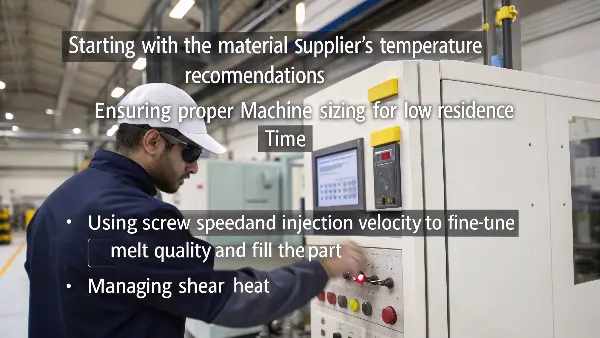
To integrate controls for optimal results, you must adopt a holistic, systematic approach to process optimization. Start with the material supplier’s recommendations as your baseline for temperature. Then, ensure the machine is properly sized to keep residence time low. Finally, use screw speed and injection velocity to fine-tune the melt quality and fill the part, managing shear heat. This balanced method prevents you from chasing problems and allows you to build a stable, repeatable process that protects material integrity.
I often use the analogy of tuning a car engine with my clients. You can’t just adjust the fuel intake without considering the air mixture and spark timing; the engine will run poorly. It’s the same with injection molding. I’ve seen engineers lower the barrel temperature (to fight degradation) but then max out the injection pressure to fill the part. This just replaces thermal degradation with shear degradation. The integrated approach means you make small, informed adjustments across all three areas instead of a large, reactive change in one.
A Practical Framework for Integrated Process Optimization
Building a robust process window requires a structured methodology. Instead of random guesswork, follow a logical sequence. The "Scientific Molding" or "Decoupled Molding" philosophy provides an excellent framework for this.
Step 1: Establish the Foundation (Temperature and Residence Time)
- Material First: Always begin with the material datasheet. Set your barrel temperatures to the middle of the recommended range.
- Machine Sizing: Verify that the shot size is between 25-75% of the machine’s barrel capacity. If not, you are fighting a losing battle against residence time from the start. This check must happen before you spend hours on process tuning.
- Verify Melt Temperature: Use a pyrometer to confirm your actual melt temperature matches the desired processing range. Adjust barrel heaters as needed.
Step 2: Control the Flow (Shear during Injection)
- Fill-Only Part (95-99% Full): Disable the pack and hold phase. Find the injection speed that fills the part without flashes, burns, or jetting. This isolates the filling phase and helps you understand the effect of shear from injection velocity. This is your "fill speed."
Step 3: Finalize the Details (Pack, Hold, and Recovery)
- Packing and Holding: Re-enable the pack/hold phase. Apply pressure to eliminate sinks and voids. This pressure should be optimized to perfect the part without overpacking it.
- Screw Recovery (Shear during Plasticizing): Adjust the screw speed (RPM) and back pressure. The goal is for the screw to finish recovering the next shot just before the mold is ready to open. This minimizes both the residence time of the fresh melt and the intensity of the shear heat.
| Stage | Primary Control | Secondary Control | Goal |
|---|---|---|---|
| 1. Foundation | Barrel Heaters | Machine Selection | Establish a stable, correct melt temperature and reasonable residence time. |
| 2. Filling | Injection Speed | Gate Design | Fill the part quickly and uniformly without causing shear degradation. |
| 3. Packing & Recovery | Pack/Hold Pressure, Screw Speed | Back Pressure, Cooling Time | Finalize part dimensions and prepare the next shot efficiently and gently. |
By following this integrated, step-by-step process, you stop guessing and start engineering. You build a stable process from the ground up, where each parameter works in concert with the others to protect the material and produce perfect parts consistently.
Conclusion
In the end, preventing material degradation isn’t about one magic setting. It’s about respecting the plastic and understanding how it behaves under heat and pressure. By carefully balancing temperature, minimizing residence time, and controlling shear, you create a process that is not only effective but also stable and repeatable. This holistic view transforms you from a machine operator into a true process expert, ensuring every part you produce meets the highest standards.