
Are high manufacturing costs eating into your profit margins? You’re constantly looking for ways to cut expenses, but you know that compromising on quality is not an option. A cheap part that fails can lead to warranty claims, recalls, and lasting damage to your reputation. The secret to real savings isn’t just about finding a cheaper supplier; it starts much earlier, with smart decisions made during the design phase.
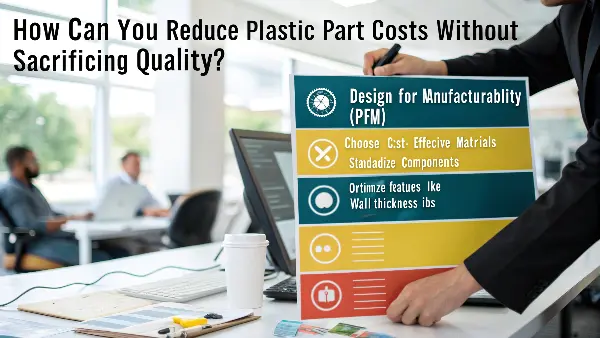
The best strategy for reducing plastic part costs without giving up quality is to zero in on Design for Manufacturability. Simplify part geometry. Choose the least costly material that can do the performance job. Standardize components. Optimize features, such as wall thickness and ribs. Making such strategic choices early in design can greatly reduce tooling complexity, material usage, and production cycle times-while preserving the structural integrity and performance of the part.
It sounds simple on paper, but the details are what make a difference between a good design and a great, cost-effective one. I’ve seen countless companies struggle with this balance, often over-engineering parts and driving up costs unnecessarily. But I’ve also helped clients save millions by applying a few core principles. Let’s break down the most impactful strategies you can use to see real results on your bottom line and master your molding process.
Is Choosing the Right Plastic the First Step to Saving Money?
You have a good design; however, the material that you are specifying is really stretching your budget. You search out less costly alternatives, yet you feel concerned. Will a lower-cost plastic withstand stress? Will it fail in the field and become a nightmare for your company? Changing materials can seem like a risky gamble, but it does not need to be that way. The key is a systematic selection process.
Indeed, selection of the appropriate plastic is a critical initial step to achieving major cost savings. Rather than over-specifying and relying on expensive resins by default, you must thoughtfully consider the true functional needs of a part. Consider factors such as mechanical stress, environmental exposure, and appearance. More often than one might expect, a less expensive commodity plastic or an alternative grade of an engineering plastic can satisfy all the necessary criteria. The result can be significant material cost reductions without sacrificing the quality and lifetime of the final product.

The biggest mistake I see is over-engineering. In their effort to achieve zero risk, engineers often choose a material far in excess of what the part actually needs. I once had a client, Michael, who designed a simple electronics enclosure using a high-performance polymer that was resistant to extreme temperatures and caustic chemicals. He would never face those conditions; it was an indoor office device. We talked through the solution, switching to a standard ABS plastic. The material was more than strong enough, looked great, and cut his material cost by over 60%. This is a common story. You need to systematically balance performance against price to avoid this.
Balancing Performance and Price
Start by creating a checklist of your part’s absolute requirements. What is the maximum temperature it will see? What loads must it bear? Does it need to be transparent or UV resistant? Once you have this list, you can find the most affordable material that checks all the boxes. Don’t pay for properties you don’t need. Look at the data sheets, but also talk to your molder. We have hands-on experience and often know of excellent, lower-cost alternatives that engineers might overlook. A simple consultation can save you thousands.
| Material Family | Relative Cost | Common Examples | Key Properties |
|---|---|---|---|
| Commodity | Low | PP, PE, PS | Good for general use, low strength |
| Engineering | Medium | ABS, PC, Nylon | Good balance of strength, temp resistance |
| High-Performance | High | PEEK, PEI (Ultem) | Excellent strength, chemical/temp resistance |
Can Simplifying Your Part’s Geometry Drastically Cut Costs?
You’re looking at your 3D model, and it seems perfect. It has all the features you need, and it looks sleek. However, every complex curve and sharp corner and all unnecessary features just add expense and complexity to the injection mold. You’re trying to build a cost-effective part, but the design itself might be inflating your tooling and production expenses without you even realizing it. The path toward a cheaper part often goes through making it simpler.
**Absolutely. One of the most powerful ways to decrease manufacturing costs is to simplify your part geometry. Complex designs with features like undercuts, intricate textures, or very sharp internal corners require more complex and expensive molds. These molds require side-actions, lifters, or slides, further increasing tooling costs and maintenance. Simplify your design to enable a straightforward two-part mold, and you will save significantly on tooling expenses, cut your cycle times, and reduce manufacturing defects.

The most expensive words in mold making are "we need a side-action." A side-action, or slide, is a moving part in the mold used to create an undercut or a feature that isn’t in the line of draw (the direction the mold opens). Every time you add one, you add thousands of dollars to the mold’s cost and complexity. You also add another potential failure point and increase the cycle time for every single part. I remember working with a customer on a housing that had snap-fit clips on the side. The initial design required four complex slides. We worked together to redesign the part, replacing the side snap-fits with clips that could be formed with pass-through cores in the main direction of pull. We slightly altered the assembly process, but it eliminated all four slides. The change saved them nearly 40% on the tooling cost and shaved seconds off every cycle, which added up to huge savings over a production run of 200,000 units.
Key Principles of Design Simplification
Think about how the part will be molded from the very beginning. The goal is to create a design that can be made with the simplest possible tool.
- Eliminate Undercuts: Scrutinize every feature. Can that hole be moved? Can that clip be redesigned? Ask yourself if the undercut is truly essential. If it is, explore alternatives like sliding shutoffs or pass-through cores that are simpler than a full slide mechanism.
- Combine Parts: Can you combine two or more parts into a single molded piece? This eliminates assembly costs and potential weak points. However, be mindful that this can also increase mold complexity, so it’s a careful trade-off.
- Use Standard Components: Instead of designing custom inserts or fasteners, use off-the-shelf hardware. This reduces part count and simplifies assembly.
By focusing on these principles, you design not just a part, but a cost-effective manufacturing process.
Optimize Mold Design for Lower Cost Per Piece without Sacrificing Quality
Imagine your plastic part has been engineered flawlessly. It’s as strong as necessary, with minimal amounts of material keeping production costs low. However, when it gets to the molding process, your part takes a long time to cool, can’t handle the fastest production cycles, or warps when ejected. Suddenly your ideal part cost has doubled due to an ill-suited mold design.
Areas of mold design control cycle time, scrap rate, downtime, and process stability. Injection pressure and packing time are increased when runners are unbalanced and cause uneven filling. Hot spots elongate cooling time and cause warpage when cooling channels are poorly located. Mold deflection due to improper parting line support or inadequate steel thickness causes flash and constant rework.
Structural rigidity, cooling efficiency, and flow symmetry are crucial elements of a mold designed for high productivity. Rigid molds with supported cavities do not deflect or shift during millions of injection cycles, eliminating mismatch and flash. Uniform and aggressive cooling lets the part solidify throughout at the same rate, and be ejected earlier without deformation. Symmetrical flow paths with balanced filling times keep mold pressures low and parts within tighter tolerances. When a mold has been designed right, it can be run at maximum speeds determined by the natural limits of the process. More pieces per hour are produced between stops, driving down the true cost per good part without affecting part quality.
Cycle Time Reduction Produces Parts Faster with Lower Cost
“Wait, didn’t you say reducing costs means producing more parts?” Of course. But decreasing cycle time is by far the quickest way to produce more parts. While your molding machine is running it is literally making you money. The longer the cycle time, the more each part costs simply due to the seconds it takes to produce. You can often cut your part cost in half by reducing the cycle time by 20%.
Most cycles are dominated by cooling. The cooling system can account for upwards of 50–70% of the cycle alone. In many cases, this means the injection molding machine is simply waiting on the thickest point of your part to reach the temperature at which it can be ejected, regardless of how quickly the rest of the part solidified.
Reducing cycle time means increasing efficiency so that the machine does not have to wait. You can do this by maximizing cooling so that heat is removed from the mold as quickly and uniformly as possible. This allows you to run faster and keeps your process stable. Even wall thickness, proper rib design, and strategically placed cooling channels allow the part to solidify faster with less differential shrink. Optimized ejection systems open the mold and clear the part quicker without sticking or warpage. Run your machine faster between stops, and you’ll increase output and lower your cost per unit without sacrificing part strength or aesthetics.
Why Is Uniform Wall Thickness So Critical for Cost and Quality?
You have a part designed with thicker areas that add strength where you think it’s needed. It seems logical, but these intuitive approaches will create a host of problems in the world of injection molding. You may start having sink marks, warping, or parts taking an inordinately long time to cool, driving up your cycle times and defect rates. And you wonder why this design appears to be strong onscreen but fails in production.
Uniform wall thickness is important because it provides uniform cooling and flow of the plastic within the mold. Non-uniform wall thickness often greatly affects cost and quality. Cooling rates will be much slower in the thicker sections of the part when compared to the thinner ones, leading to internal stresses, warping, voids, and other defects such as sink marks. Uniform thickness provides for faster cycle times, stability, less material use, stronger parts, higher quality, with fewer rejects.

This is one of the first things I look for when I review a client’s design. Inconsistent walls are a red flag for production headaches. Imagine pouring water into a tray with deep and shallow sections. The shallow parts will freeze first while the deep parts are still liquid. The same thing happens with molten plastic. The thick sections hold heat and shrink at a different rate as they cool. This internal tug-of-war is what bends the part out of shape (warping) or creates ugly depressions on the surface (sink marks). To compensate, a machine operator has to increase the cycle time, waiting longer for the thick section to cool. This directly increases the cost of every part you make. A few extra seconds per part can translate into thousands of dollars over a large production run. The solution isn’t to make everything thick; it’s to make everything consistent.
Best Practices for Wall Thickness
Achieving uniform walls is a core principle of good plastic part design. If certain areas of your part do need to be stronger, don’t just make the wall thicker. Use a better strategy.
- Rule of Thumb: Design all walls to be between 40% and 60% of the thickness of adjacent walls. An abrupt change from thick to thin is a recipe for disaster. If you must change thickness, make the transition gradual.
- Use Ribs, Not Thicker Walls: If you need to add stiffness or strength to an area, use ribs instead of increasing the overall wall thickness. Ribs use far less material and provide excellent structural support. Just be sure the ribs are designed correctly—typically 50-60% of the nominal wall thickness—to prevent sink marks on the opposite surface.
- Core Out Thick Sections: If a thick section is unavoidable due to functional requirements, core it out from the back side. This creates a more uniform wall section, saving material and reducing the risk of a sink mark on the cosmetic side of the part.
Keeping wall thickness consistent is a simple rule that pays huge dividends in part quality and cost efficiency.
Are Overly Tight Tolerances Secretly Inflating Your Costs?
Your design requires a number of features that must be built to very tight dimensions. As an engineer, you specify tight tolerances so everything fits and functions perfectly. However, when quotes come back from molders, they are significantly higher than you expected. You might also be experiencing high scrap rates during production as parts fail to meet these demanding specifications. You’re trying to guarantee quality, but you might be paying an unnecessary premium for precision that isn’t actually needed.
Yes, as already mentioned, over-specification of tolerances is one of the most significant hidden drivers of cost in plastic injection molding. High precision necessitates a more expensive mold constructed from higher-grade steel and with more precise machining. A more controlled molding process would be required with slower cycle times, increased quality inspection, and higher scrap rates. You can significantly reduce both tooling and part costs by relaxing tolerances on non-critical features and applying tight tolerances only when absolutely necessary to function.
I always tell my clients to think of tolerances in terms of money. Every zero after the decimal point costs you. A tolerance of ±0.1 mm is standard and relatively easy to achieve. But tightening that to ±0.05 mm can increase costs significantly. Going to ±0.02 mm might even double the cost of the mold and the part. Why? Because plastic is not a perfectly stable material. It shrinks as it cools, and the exact amount of shrinkage can vary slightly from shot to shot based on temperature, pressure, and even the humidity in the factory. Holding a very tight tolerance means fighting against the nature of the material itself. A molder has to use advanced process controls, spend more time on mold maintenance, and inspect parts far more frequently. Many parts that are perfectly functional will be rejected simply because they fall a hair outside an overly strict specification.
A Smarter Approach to Tolerancing
The key is to apply precision only where it matters. Don’t use a blanket tolerance for the entire part.
- Identify Critical Dimensions: Go through your design and identify the features that are truly critical for assembly or function. These are the only places that might need a tighter tolerance. For all other dimensions, use the standard, most generous tolerance your molder recommends.
- Understand Process Capability: Talk to your molder about the typical process capability for the material and machine they will be using. Design within that capability. Pushing for a tolerance that the process can barely hold will always be expensive.
- Consider Material Choice: Some plastics are more stable and predictable than others. Materials like ABS or Polycarbonate hold tolerances better than a soft, flexible material like Polypropylene. If tight tolerances are a must, ensure your material choice supports that goal.
Remember, the goal is to create a functional part, not a perfect one. By being strategic with your tolerances, you can ensure function without paying for precision you don’t need.
Gate/Runner Strategy Influences Cost and Part Quality
Gate and runner design has a direct influence on injection pressure, melt temperature, material waste, weld lines, warpage, and part aesthetics. An inappropriate gate design may induce jetting and subsequent weld lines, or cause excessive shear that requires higher melt temperature and injection pressure. High injection pressure leads to higher energy cost and wear on the mold. High melt temperature degrades material, causing cosmetic flaws and reduced part life.
Runner diameter and layout also influence part cost. Large runners use more material and create more regrind that must be managed. Small runners increase pressure drop which may result in short shots. Hot runner technology can eliminate runner waste, but adds tooling costs and requires ongoing maintenance. The decision to use large vs. small runners, cold vs. hot, must be balanced against part volume, raw material cost, and required quality. Optimizing gate and runner design reduces pressure drop across the system, results in stable filling characteristics, reduces scrap, and can decrease cycle time. This balanced approach provides both low part cost and consistent part quality.
Eliminating Parts Lowers Total Cost of Assembly
Each discrete part in an assembly requires its own tooling, inventory management, and quality assurance. Multiple components require fasteners and adhesives, and take longer for operators to assemble. As part count increases, the probability of failure due to missed bolts or improper fit also increases. If a molded part can replace several components, fasteners and assembly steps can be eliminated. With fewer parts to manage, companies can significantly reduce direct labor and production lead time.
Part consolidation should be considered during any product redesign. Merging parts together may require a more complex mold with side actions, but in many cases, a clever designer can reduce the total number of tools. When parts are consolidated, the assembly becomes more dimensionally accurate due to the lack of tolerance stack-up. Consolidation also allows load paths to flow continuously through the part, increasing structural performance. The end result is a simplified product with lower manufacturing and assembly costs.
What Role Does Moldflow Simulation Play in Cost Avoidance?
Moldflow allows designers to preview the molding process before any tooling is purchased. Injection, pack, and cool simulations show how the plastic will flow into every detail of the mold. Once the analysis is complete, engineers can identify problematic areas that may lead to defects. Issues like air traps, weld lines, unbalanced flow, high pressure drop, and non-uniform cooling can be costly after the tool is built. Fixing mistakes on a finished mold runs far quicker than fixing them in Moldflow.
Simulation also helps identify the best location for gates, runner size, cooling lines, and more. By simulating warpage and shrinkage, designers can modify the mold to compensate. Moldflow indirectly affects part cost by reducing scrap rate and shortening time to production. By catching problems before they are built, moldflow allows customers to avoid unnecessary cost.
Conclusion
Reducing the cost of your plastic parts doesn’t have to mean settling for lower quality. The biggest cost savings result from smart, strategic decisions made early on in the design process. Pay attention to material selection, geometry simplification, consistent wall thickness, and prudent use of tolerances to cut tooling and production costs significantly. These DFM principles result in an overall more efficient process with fewer defects and a superior final product for your customers.