
Product development for babies is a huge responsibility. You are worried about choosing a material that is sturdy enough for everyday use yet completely safe for a baby. You make a wrong choice, and the effect might be drastic on the end-user and the reputation of your firm. It is a daunting task to strike a balance between strength, cost, and above all, safety.
Selecting plastics for injection molded baby products requires a broader review than choosing a strong or inexpensive resin. The product may be touched, mouthed, dropped, washed, heated, assembled with other materials and used repeatedly by a vulnerable end user. Material selection should therefore consider intended contact, small-part risk, impact, fatigue, odor, cleaning, temperature, colorants, additives and the regulations or standards applicable to the target market.
Related CKMOLD resources: DFM analysis, production injection molding, mold testing and validation.
The ideal strategy is to choose plastics that are labeled BPA-free, phthalate-free, and USDA-approved for contact with foods. Materials such as Polypropylene (PP), food-safe Silicone, and some Thermoplastic Elastomers (TPEs) are ideal options. You should generally ask for safety documentation from your material provider and keep in mind the end use of the product. For instance, items that are chewed on or subjected to heat have greater requirements for safety and stability ratings. Choosing these certified materials first is the starting point for the development of a safe baby item.

What are the key safety standards you must meet for baby product plastics?
You are creating a new baby spoon and the stakes are high. You understand that the material must be safe, yet “safe” becomes a relative term. What exact regulations must you comply with? Do the US and Europe have varying regulations? Failing to notice one standard may result in a flop for a product, expensive recall, or worse. It is a litany of acronyms and legal specifications.
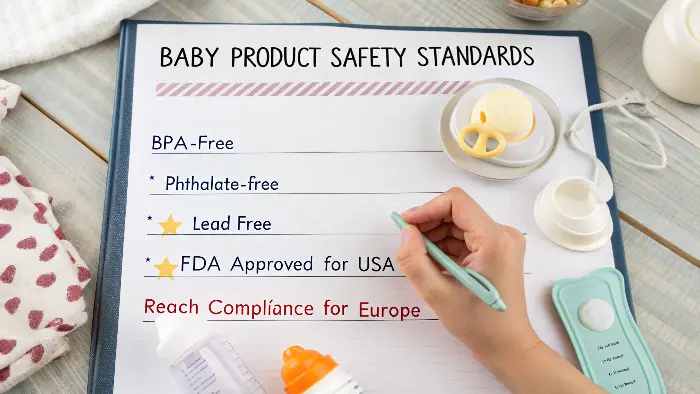
For baby products, you must comply with essential safety requirements like being lead-free, phthalate-free, and BPA-free. For selling in the USA, materials must be FDA (Food and Drug Administration) compliant for food contact. For European markets, materials must be compliant with REACH (Registration, Evaluation, Authorisation and Restriction of Chemicals) and associated EFSA (European Food Safety Authority) directives. Verify these certifications at every level with your raw material provider for strict compliance and end-product safety.
Breaking Down the Core Safety Acronyms
When we talk about safety, a few terms come up again and again. It’s crucial to know what they mean and why they matter for baby products.
- BPA (Bisphenol A): This is a chemical that was widely used to make certain plastics and resins. The problem is that it can seep into food or beverages from containers. Studies have linked it to potential health effects on the brain and prostate gland of fetuses, infants, and children. For baby products, “BPA-Free” is not a suggestion; it’s a market requirement.
- Phthalates: These are chemicals used to make plastics more flexible and harder to break. They are often found in soft PVC. Like BPA, they can leach out of the product and have been linked to health concerns. Generally specify phthalate-free materials, especially for any part a baby might put in their mouth.
- FDA (U.S. Food and Drug Administration): The FDA regulates materials that come into contact with food. If you’re designing a baby bottle, plate, or spoon, the plastic must be “FDA food-contact grade.” This means the agency has reviewed it and deemed it safe for its intended use.
- REACH (Registration, Evaluation, Authorisation and Restriction of Chemicals): This is a European Union regulation. It’s much broader than FDA rules and manages the risks of a huge list of chemical substances. If your product will be sold in Europe, compliance is mandatory.
Think of these standards as your design guardrails. They keep you on the path to a safe and successful product.
What are the most common injection moulding materials and their properties?
Injection molding uses a wide range of materials, but a few plastics dominate because of their strength, flexibility, cost-effectiveness, and versatility. Here’s a clear breakdown of the most common injection molding materials.
1. Polypropylene
Polypropylene is one of the most widely used plastics in injection molding because of its low cost and excellent versatility. It has a high strength-to-weight ratio, making it lightweight yet durable. PP offers outstanding resistance to moisture, chemicals, and fatigue, which is why it’s commonly used in items that need to bend repeatedly, such as living hinges on bottle caps. It also has a relatively high melting point compared to other plastics, so it can withstand hot liquids, making it suitable for food storage containers. Its recyclability further boosts its popularity in consumer goods, automotive interiors, and household products.
2. Polyethylene (PE) – HDPE & LDPE
Another favorite in injection molding is polyethylene, specifically in the high-density (HDPE) and low-density (LDPE) grades. The former is harder, stiffer, and less prone to impact and is best used in bottles, pipes, and bins in industry. The latter is softer and easy to mold into thin films or thin products like squeeze bottles and plastic bags. These two grades of PE are highly resistant to chemicals and moisture and are best used in packaging, consumer products, and health products. PE is less heat-resistant compared to some engineering plastics but is very important in manufacturing because it is very affordable and versatile.
3. Polystrene
There are two types of polystyrene in general usage: Polystyrene (General Purpose Polystyrene or GPPS) and High-Impact Polystyrene (HIPS). GPPS is translucent in appearance and is hard and relatively inexpensive but is brittle. This characteristic has an application in CD cases or in clear food packaging. HIPS is less clear and is tougher, due to the addition of rubber-based additives to increase impact strength. PS is light in weight and is easy to mold. This is why it is used in disposable goods and packaging and in appliances in dwelling units. It is not very strong as a material but is economical and has good moldability. This is why it has been used in high-volume consumer products.
4. Polyvinyl Chloride
PVC is very versatile and is available in rigid and flexible grades. The rigid PVC is strong, hard, and is resistant to weather and is best used in construction products such as pipes, window frames, and fittings. The flexible PVC is achieved by incorporating the addition of plasticizers and is soft and pliable and is employed in products such as medical tubing, wire insulation, and floors. PVC is very resistant to chemicals and oils and abrasions and is flame-retardant by itself.
5. Polycarbonate
Polycarbonate is one of the strongest and toughest plastics and is optically clear to boot, so it has become a glass replacement in many applications. Polycarbonate is temperature-resistant and has very high dimensional stability and so retains its form when subjected to stress. PC finds an application in applications demanding toughness and transparency like safety goggles, protective visors, automotive headlights and in medical instruments.
6. Nylon
Nylon is a tough engineering plastic with high wear and abrasive and impact resistance. It is an ideal material for demanding applications such as gears and other bearing parts and automotive engine parts. One of the distinct characteristics of nylon is it has a tendency to absorb moisture present in the environment to some degree and it has an impact on the strength and dimensional stability but it is less brittle than other plastics.
7. Thermoplastic Elastomers (TPE)
TPEs are a family of materials that combine the elasticity of rubber with the processability of thermoplastics. They are soft, flexible, and can be stretched repeatedly without losing their shape. Unlike traditional rubber, TPEs can be melted and reprocessed, making them more environmentally friendly. They are commonly used for grips, seals, footwear, medical devices, and soft-touch overmolding on tools and electronics. TPEs offer excellent comfort, resilience, and resistance to chemicals and weathering, which makes them suitable for both consumer and industrial applications.
Which plastics are the top choices for safe and durable baby products?
You have your safety standards in mind, but now you face a catalog of hundreds of plastic resins. Which one is actually the best for your project? One material might be safe but too brittle. Another might be durable but difficult to mold. Choosing the wrong one can lead to production issues, failed drop tests, or a product that just doesn’t feel right in a parent’s hand.
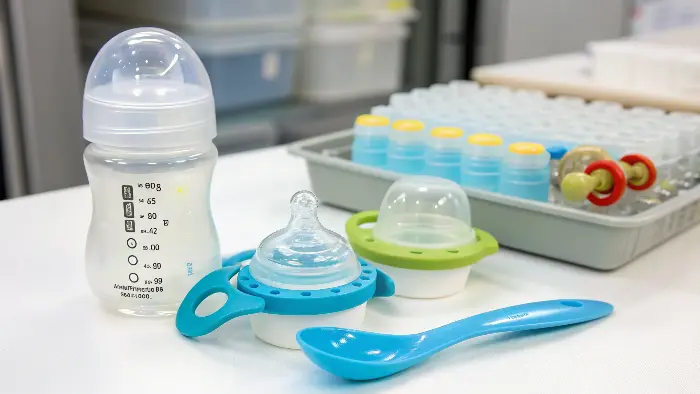
Polypropylene (PP) is a workhorse due to its balanced stiffness, heat resistance, and safety for bottles and containers. Food-grade Silicone is ideal for soft goods like pacifiers and spoon ends because it has high temperature stability and pliability. Thermoplastic Elastomers (TPEs) are ideal for overmolded grips and soft-feel applications. Tritan is a high-end, glass-like material that is famously known for extreme impact resistance and clarity and is ideal for luxury bottles.
Comparing the Leading Materials
Let’s put the top contenders side-by-side. As a designer, you need to weigh these factors to match the material to your product’s specific needs.
| Feature | Polypropylene (PP) | Food-Grade Silicone (LSR) | Thermoplastic Elastomer (TPE) | Tritan™ Copolyester |
|---|---|---|---|---|
| Primary Use | Bottles, containers, plates, toy bodies | Pacifiers, bottle nipples, spoon tips, teethers | Overmolded grips, soft-touch elements, flexible toys | Premium bottles, sippy cups |
| Key Benefit | Cost-effective, rigid, good chemical resistance | Very flexible, high heat resistance, inert | Soft-touch feel, good for overmolding | Glass-like clarity, extremely tough, stain-resistant |
| Safety | Naturally BPA-free, easily sourced as FDA-compliant | Highly stable, hypoallergenic, BPA/Phthalate-free | Many grades are BPA/Phthalate-free and FDA-compliant | BPA-free, BPS-free, Phthalate-free |
| Durability | Good fatigue resistance, but can be brittle in cold | Excellent, doesn’t degrade easily | Good, but can vary widely between grades | Exceptional impact and shatter resistance |
| Heat Resistance | Good for hot-fill and dishwashers (up to ~100°C) | Excellent (can exceed 200°C), good for sterilizing | Varies, generally lower than PP or Silicone | Good, dishwasher safe (up to ~90°C) |
| Moldability | Very easy to process in standard injection molding | Requires specific LSR molding process and tooling | Generally easy, great for two-shot molding | Requires high heat and specific mold considerations |
When you’re in your CAD software designing the part, think about its life. Will it be dropped? Chewed on? Put in the dishwasher every day? Answering these questions will point you directly to the right material in this chart.
How can your injection molding process impact the final product’s safety?
You chose a qualified safe plastic. You designed flawlessly. Did you realize, however, that the production process itself may allow for hazards to creep in? The wrong mold-releasing agent, improper processing temperature, or dirty equipment may allow contamination that jeopardizes the integrity of that material you strived for. This is a lurking hazard that many a designer fails to see, possibly invalidating everything you did in material selection.
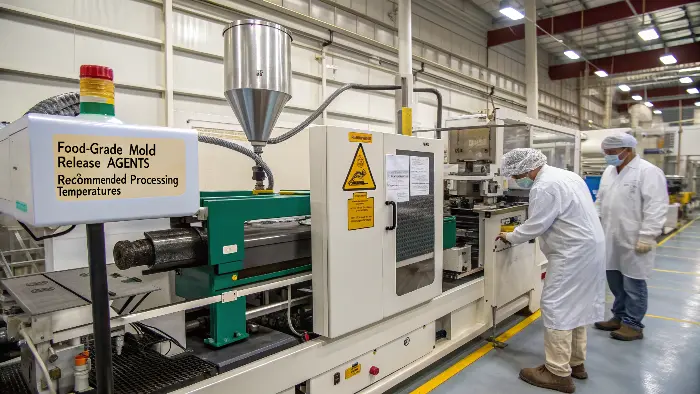
A controlled injection molding procedure is essential. Only use food-grade mold releasers, or preferably, engineer the mold for releaserless release. Make sure the processing temperature falls within the material supplier’s specified range to exclude thermal degradation and the formation of undesirable byproducts. The use of a dedicated, clean press and a regular purging routine for the barrel are necessary to exclude cross-contamination with other plastics, particularly those that are non-certified.
Key Process Control Points for Safety
To ensure the molded part is as safe as the raw material pellet, you need to control several key stages of the injection molding process.
1. Material Handling and Preparation
Before the plastic even gets to the machine, it can be contaminated.
- Dedicated Storage: Store certified baby-safe materials in a separate, marked area away from general-purpose or recycled plastics.
- Clean Drying: If the material needs to be dried, use a dedicated, clean dryer. Don’t use the same dryer that was just used for a black, glass-filled nylon.
- No Regrind: For baby products, I strongly advise against using any regrind (recycled plastic from previous runs). Even if it’s from the same material, the reheating process can alter its properties and it increases contamination risk. Use 100% virgin material only.
2. The Molding Machine and Tooling
This is where the magic happens, but also where risks can hide.
- Mold Design: A well-designed mold with proper draft angles and a high-polish surface (like an SPI-A2 finish) can eliminate the need for mold release agents. This is the best-case scenario.
- Processing Parameters: Every material has a “process window” of ideal temperature, pressure, and injection speed. Running the material too hot can cause it to break down, potentially releasing volatile organic compounds (VOCs). Running it too cold can create internal stresses, making the part weaker.
- Machine Purging: The screw and barrel of the molding machine must be thoroughly cleaned. This involves using a specific purging compound and then flushing the machine with the actual virgin material until all traces of the previous plastic and the purging compound are gone.
Think of your manufacturing partner as a chef. You’ve given them the best, freshest ingredients (your certified plastic). Their job is to use clean tools and the right recipe (process control) to create a safe and delicious meal (your final product).
How do you properly select and use colorants for baby products?
You desire that baby item to be bright and eye-catching, yet the addition of color brings in another unknown. How are you supported the lovely red or bright blue you desire is totally safe? A generic industrial color concentrate may leach heavy metals or other poisons into the plastic. This is a crucial element that may convert a-safe starting material into a dangerous finished product.
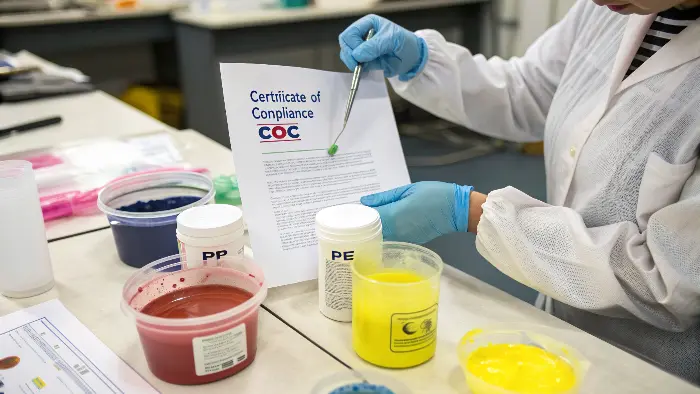
Generally ensure colorants are specifically designed and tested for toys or for direct food contact. The masterbatches should be devoid of heavy metals such as lead, cadmium, and mercury. Insist on a certificate of compliance (CoC) for the colorant material per se, excluding the base resin. The carrier resin in the masterbatch should be acceptable for your base plastic and be a safe material per se, i.e., PP or PE.
Best Practices for Coloring Baby Products
Adding color safely is a systematic process. It’s not as simple as just picking a color from a chart. Here’s how I approach it to ensure safety and quality.
1. Sourcing Certified Color Masterbatch
The color in plastic parts comes from a concentrated mix of pigment and a carrier resin, called a masterbatch.
- Specify the Standard: When you talk to a supplier, don’t just ask for “red.” Ask for “a red masterbatch compliant with FDA 21 CFR and EN 71.” EN 71 is the European toy safety standard, which has strict limits on heavy metals.
- Review the TDS and MSDS: Generally get the Technical Data Sheet (TDS) and Material Safety Data Sheet (MSDS) for the colorant. These documents will list the ingredients and safety information. Look for any red flags.
- Check the Carrier Resin: The pigment is “carried” in a base plastic. This carrier must be compatible with your main material. For example, if you are molding a PP part, the colorant should have a PP or a universal PE (Polyethylene) carrier. Using an incompatible carrier can cause delamination or weak spots in the final part.
2. Controlling the Process
How you mix the colorant in is just as important as what it’s made of.
- Let-Down Ratio (LDR): This is the ratio of masterbatch to natural resin. A typical LDR is 25:1 to 50:1 (or 4% to 2% masterbatch). It’s crucial to use the correct LDR recommended by the supplier. Using too much colorant is not only wasteful but can also negatively affect the physical properties and safety profile of the final part.
- Proper Mixing: The colorant must be mixed evenly with the base resin. This is usually done with an automatic doser right at the molding machine. Poor mixing can lead to color streaks and inconsistent part performance.
- Color Consistency: For brand consistency, you need the color to be the same from the first part to the millionth. This requires a high-quality masterbatch and a tightly controlled molding process.
Here is a simple checklist for your next project:
| Checkpoint | Action Required |
|---|---|
| Certification | Obtain CoC for the colorant (FDA, EN 71, etc.). |
| Heavy Metals | Confirm the colorant is free from lead, cadmium, mercury, etc. |
| Carrier Resin | Verify compatibility with your base material. |
| Let-Down Ratio | Use the manufacturer’s recommended LDR. |
| Documentation | Keep all certificates on file for your product’s technical file. |
Following these steps ensures that your product’s color is a source of delight, not a hidden danger.
Why we use Injection Molded Parts for the Baby Product Industry?
Baby product industry necessitates materials and processes of production that focus on safety, hygiene, durability and accuracy. The injection molding has emerged as one of the surest solutions in this industry since it is able to provide products that are of high safety and quality standards.
As a business, injection molding is cost-effective in mass production. After the creation of the mold, the manufacturers are able to make high quantities of baby products in a short period of time and at a fairly low unit cost. It also provides room to be creative and the companies can create lightweight, aesthetically-pleasing and ergonomic products which can be enjoyed by both parents and babies.
CKMOLD – A Reliable Supplier of injection molding of baby products
Speaking of the trustworthy providers in this area, CKMOLD can be considered a professional company in injection molding that has experience in manufacturing high-quality components in sensitive markets such as baby care. They are specialists in the design and production of precision molds, which are made out of safe, durable, and certified materials which can be accepted in accordance with international safety standards. The developed facilities and experiences in CKMOLD mean that all the products satisfy the high-hygienic, durability and aesthetic needs.
CKMOLD has offered customized injection molding solutions that strike a balance between safety, functionality and affordability- something that cannot be compromised in the baby product market.
Map Every Contact and Exposure
Identify skin contact, mouth contact, food contact, saliva, detergent, sterilization, heat, UV, sweat and repeated handling. Separate rigid structure from soft-touch, grip or sealing components. Each material and color system should have evidence appropriate to its intended role and destination market.
Control Mechanical and Small-Part Risk
Impact strength is only one part of safety. Review fatigue, tear, bite resistance, snap-fit retention, hinge life, sharp edges, flash, burrs and any component that could detach. Design the assembly so foreseeable misuse does not create a hazardous small part or accessible sharp feature.
Choose Materials for Cleaning and Heat
Products may be washed, boiled, steam-cleaned, sterilized or exposed to warm liquids. Check dimensional retention, odor, hydrolysis, chemical resistance, color stability and stress cracking after the actual cleaning cycle. A resin that survives a short temperature exposure may not survive repeated cycles.
Design the Mold to Protect the Product
Parting lines, gates, ejectors, slides and venting should be placed so they do not create hazardous edges or difficult-to-clean pockets. Control flash and gate vestige, use suitable draft and support flexible parts during ejection. Mold maintenance is part of product safety.
Validate Materials and the Complete Assembly
Test molded parts and assemblies for impact, drop, bite or pull force as applicable, fatigue, cleaning, odor, appearance, dimensional fit and required market compliance. Document resin lot, color, process, mold revision and inspection results so a production issue can be traced and corrected.
Choosing Plastics for Injection Molded Baby Products: Buyer Review Checklist
- Map mouth, skin, food, heat, cleaning, sterilization, UV and assembly exposures.
- Evaluate impact, fatigue, tear, bite, flash, sharp edges and small-part retention.
- Check material, colorant, additive, odor and chemical evidence for the target market.
- Design gates, parting lines, ejectors, slides and surfaces for safe handling and cleaning.
- Validate production-like parts and assemblies under foreseeable use and misuse conditions.
FAQ
Is a BPA-free label enough for a baby product?
No. A product also needs appropriate evaluation of other additives, colorants, mechanical hazards, cleaning, heat, odor and destination-market requirements.
Why test the assembly instead of only the molded part?
Edges, hinges, inserts, seals, snaps and bonded components can change safety and durability; the user interacts with the complete assembly.
Conclusion
The selection of the correct plastic to use on baby products is not a joke. It is not limited to material specifications. You have to begin with certified-safe unleaded plastics such as PP or silicone. Next, it is important to take control of the whole production process, including the use of colorants that are food-grade and a clean molding environment. With the emphasis on the safety of each and every step, you can be sure that you have developed products that are both durable, beautiful, and reliably safe to be used by children.