
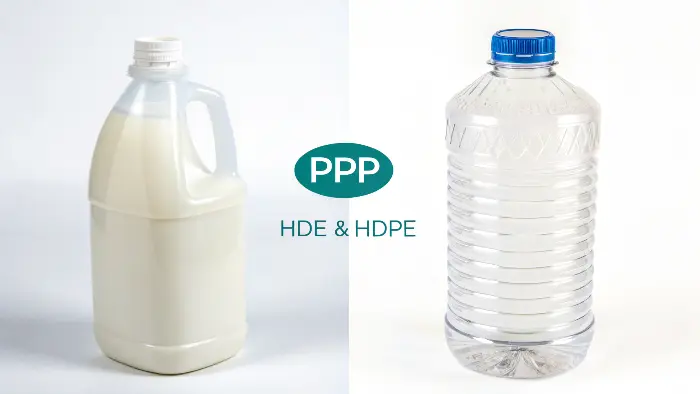
Choose HDPE or PP for a food container from the exact use case and commercial grade, then validate the molded container and closure. A family-level rule such as “PP for heat, HDPE for cold” is a screening clue, not a release decision.
HDPE and PP are both widely considered for food containers, but they offer different balances of stiffness, impact, heat performance, chemical resistance, hinge fatigue, appearance and shrinkage. The better choice depends on container shape, lid system, fill temperature, food chemistry, microwave or dishwasher use, drop exposure, transparency target and production process. A material comparison should end with a tested container, not a generic polymer ranking.
Related CKMOLD resources: mold design, production injection molding, mold testing and validation.

Is PP Always Stiffer Than HDPE?
Do not select HDPE or PP from a family-wide property table. Modulus and impact vary with grade, copolymer structure, molecular weight, filler, color, temperature, conditioning and test method. Compare current supplier data for the exact candidate grades at the product’s use temperature, then test the molded container and closure.
Stiffness is only one design input. A container may need drop resistance, hinge fatigue, seal retention, squeeze behavior, environmental stress-crack resistance and dimensional stability after filling and cleaning. Wall/rib geometry and molding orientation can change the result as much as the polymer family.
Primary sources checked: FDA — Food Types and Conditions of Use (intended food, temperature and contact-time framework); FDA — Regulatory Status of Food-Contact Components (component identity, authorization and use limitations); EUR-Lex — Consolidated Regulation (EU) No 10/2011 (EU plastics, documentation and migration framework). The cited scope still has to be matched to the exact grade, tool, product and destination market.

How Should Temperature and Food Use Be Evaluated?
Define hot fill, microwave/reheat claim, freezer or refrigerator use, dishwasher cycles, food type, oil/fat content, contact time and mechanical load. Melting point does not establish container performance: load, heat-deflection behavior, creep, seal geometry and local hot spots matter.
For the U.S., match every component to the intended food type and FDA condition of use. For the EU, review the exact formulation and finished article under the applicable plastics and migration framework. Neither PP nor HDPE is automatically suitable for every heating or food condition. The separate FDA and EU food-contact evidence guide explains how to structure that market-specific file.

Compare Accepted-Container Cost, Not Resin Price Alone
Use current quotations for the exact grade and color; there is no reliable universal 5–15% PP/HDPE price order. Calculate resin per accepted container from molded weight and yield, then include cavities, cycle, energy, scrap, inspection, lid/label/assembly, packaging and freight.
If a material permits a thinner wall, verify drop, top load, sealing, migration and dimensional performance before booking a saving. A lighter nominal CAD model is not an accepted production result.

How Do PP and HDPE Containers Differ in Practice?
PP is commonly considered for rigid tubs, caps and living hinges; HDPE is common in bottles and containers needing toughness and chemical resistance. These are application patterns, not guarantees. Appearance, feel, permeability, shrinkage, hinge performance and stress cracking depend on the exact grade and process.
Approve the complete package: body, lid, seal, color/label, product fill and distribution cycle. Request grade declarations, mold/process records and container-level leak, drop, top-load, closure and thermal tests matched to the destination market.

Compare Stiffness, Impact and Feel
HDPE can provide toughness and chemical resistance with a characteristic balance of stiffness and flexibility. PP can offer lower density, useful stiffness, hinge fatigue and higher service-temperature options in selected grades. Actual feel and performance depend on grade, wall thickness, orientation, fillers, cooling and the container geometry.
Match Heat and Cleaning Requirements
For hot-fill, microwave, dishwasher or repeated wash cycles, define the temperature profile and duration. PP is often considered where heat capability and living-hinge performance matter, while HDPE may be attractive for toughness and chemical resistance. Validate dimensional retention, odor and sealing after the actual cycle.
Design for Shrinkage and Flatness
Both materials can show differential shrinkage that affects base flatness, lid fit and seal performance. Wall transitions, ribs, corners, gate location, cooling balance and ejection must be designed together. Thick areas can create sink or internal stress, while long flat surfaces can warp.
Consider Food, Color and Appearance
Review the intended food type, oils, acids, pigments, additives, regrind policy, odor and surface requirements. A translucent or natural appearance may reveal flow lines or contamination more readily. The compound and color system need the same food-contact and traceability discipline as the base polymer.
Choose Through Container-Level Testing
Evaluate leakage, drop, compression, stacking, lid torque or snap force, hinge cycles, heating, cooling, cleaning, odor and dimensional fit as relevant. Test the container and closure together with production-like resin, color, mold and process conditions.
HDPE vs. PP for Food Containers: Buyer Review Checklist
- Define heat, impact, stiffness, chemical, hinge, transparency, cleaning and food-contact requirements.
- Compare exact HDPE and PP grades using the actual wall, closure and container geometry.
- Review shrinkage, flatness, gate, cooling, ejection and sealing features during DFM.
- Control additives, color, regrind, odor, material lots and traceability.
- Validate the complete container and closure for leakage, drop, heating, cleaning and fit.
FAQ
Is PP generally better than HDPE for food containers?
No. PP may offer advantages for heat or hinge requirements, while HDPE may fit toughness and chemical-resistance needs; the exact grade and container decide.
Why can food-container lids stop fitting after molding?
Shrinkage variation, cooling imbalance, warpage, gate orientation, material lot and thermal conditioning can change the relationship between lid and container.
Conclusion
In the end, there is no single “best” material between HDPE and PP. The right choice is generally the one that best fits the specific needs of your product. The decision comes down to a few key questions: Does it need to handle heat or cold? How important are stiffness and clarity? And what is the true cost-per-part? By carefully analyzing these factors, you can confidently select the right material for a successful, reliable, and cost-effective food container.