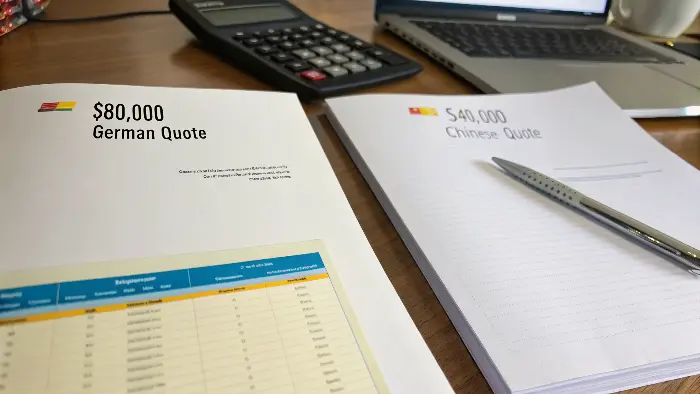
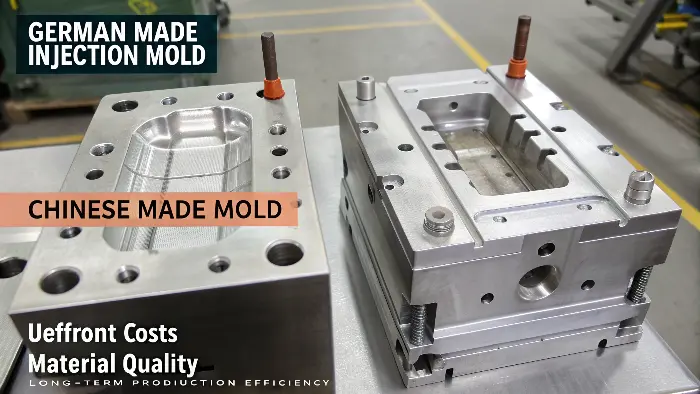
A German and a Chinese mold can be compared fairly only after specifications, responsibilities, delivery terms and acceptance evidence are normalized. Country of origin alone does not determine steel, precision, automation or lifecycle value.
Comparing a German-made injection mold with a mold sourced from China requires more than comparing two tooling quotations. The commercial decision includes engineering time, communication, steel and component specification, trial corrections, inspection, shipping, customs, maintenance, ownership and the cost of a delayed launch. A lower or higher initial quote can be rational depending on the tool complexity, quality risk, production location and level of project control.
Related CKMOLD resources: export injection mold manufacturing, DFM analysis, mold testing and validation.
Why Do Two Mold Quotations Differ?
Country is not a mold specification. Mold cost is driven by released geometry, cavities, resin/fillers, component steel and heat treatment, hot runner, actions, surface, tolerances, trials, inspection, expected service, ownership, documentation and destination interfaces. Engineering hours and commercial risk are included differently by each bidder.
Ask every supplier for a written mold concept and line-item scope. A premium can be justified by measurable deliverables; a low quote may be valid when the design is simpler. Neither conclusion follows from nationality alone.
Primary sources checked: ICC — Incoterms Rules (delivery, cost and risk allocation terminology). The cited scope still has to be matched to the exact grade, tool, product and destination market.
How Should You Establish a Mold Budget?
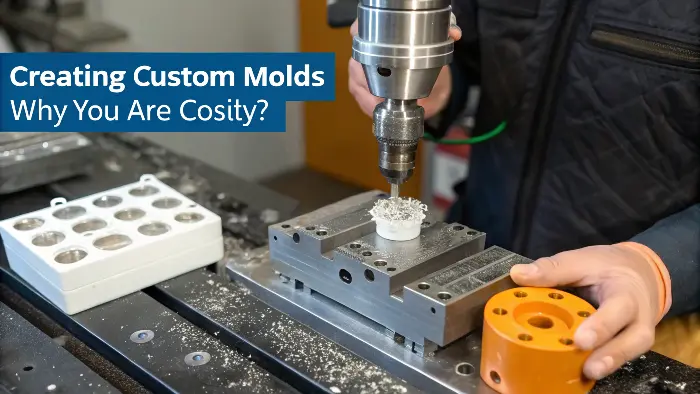
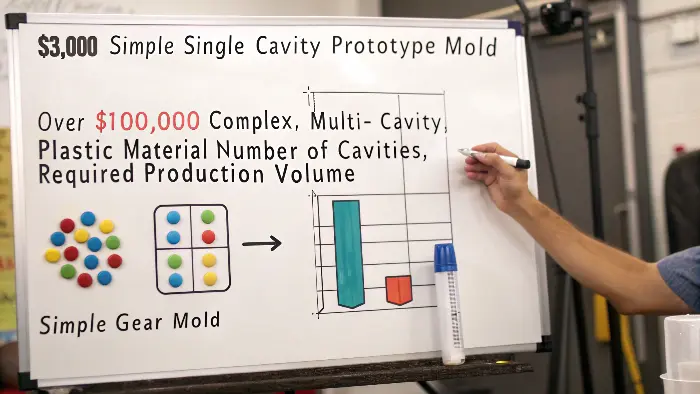
Do not use a universal $5,000–$100,000 range as a purchasing fact. Obtain quotations from the same controlled RFQ and separate design, tool, components, trials, changes, inspection, packaging, freight, duty/tax responsibility and support. Use the cost estimator for a preliminary tooling budget only.
For a decision, add expected correction, transfer, downtime, inventory and maintenance exposure. Record currency, exchange-rate date and the ICC Incoterm so price ownership is not ambiguous.
How Should German and Chinese Supplier Quotes Be Compared?
Normalize supplier-specific evidence rather than assigning capability to a country. Compare the same CAD revision, mold concept, steel/components, process assumptions, trial/inspection package, change allowance, IP/ownership, destination press, shipment term, documentation, warranty limits and recovery plan.
| Evidence stream | Comparable question |
|---|---|
| engineering | Are risks, shrinkage, gates, cooling, actions and interfaces documented? |
| build | Can steel, heat treatment, components, subcontracting and revisions be traced? |
| validation | Are resin, machine, process, samples, CTQs and correction cycles defined? |
| handoff | Are as-built files, spares, maintenance, controller data and transfer support included? |
| commercial | Are currency, Incoterm, freight, duty, ownership and change authorization identical? |
Use a Risk-Adjusted Cost Model
Total program cost = quoted deliverables + approved changes + logistics/import + launch/transfer + expected maintenance/downtime + accepted-part production cost. Accepted-part production cost should use cavities, demonstrated cycle, uptime and yield. Keep assumptions in a worksheet and run low/expected/high cases.
Do not add invented engineering hours or regional hourly rates. Replace each placeholder with the actual supplier quotation or an explicitly labeled internal planning assumption.
Which Sourcing Costs Are Commonly Excluded?
Check design changes, extra trials, independent inspection, travel or remote witnessing, freight, insurance, customs, destination setup, spare parts, local repair, software/controller interfaces, storage and production MOQ. The issue is not that these are uniquely “China costs”; it is whether each bidder’s Incoterm, responsibilities and exclusions are explicit.
Build a line-item comparison and assign an owner and evidence requirement to each item. Unknowns should remain visible as risk ranges rather than being hidden in a country premium or discount.
Why Might One Supplier Quote Less?
A lower quote can result from scope, labor and overhead, exchange rate, purchasing network, capacity, automation, commercial strategy or excluded deliverables. It can also reflect a simpler valid solution. Verify which explanation applies to the named supplier.
Use a risk-adjusted matrix, not “Germany for critical work and China for everything else.” The winner is the supplier whose evidence, total exposure and recovery plan best fit the program.
Define What the Quote Actually Includes
List cavities, mold base, steel, hot runner, slides, lifters, standard components, surface finish, spare parts, sampling, inspection and packaging. Two suppliers may use the same word—production mold—but include different tool life, tryout scope or documentation. Normalize the scope before comparing numbers.
Add Engineering and Communication Cost
A complex tool may require repeated design reviews, translation, tolerance clarification and cross-functional approvals. The best source is not simply the one with the lowest hourly rate; it is the supplier that can identify risk early and convert decisions into controlled drawings, revisions and acceptance records.
Compare Quality Evidence and Correction Risk
Review steel certificates, component brands or equivalents, machining capability, measurement equipment, mold-flow practice, trial reports and corrective-action response. Estimate the cost of a second trial, a steel change, a moved gate or a late dimensional correction. Evidence reduces uncertainty before the mold arrives.
Model Logistics and Ownership
Include transport, insurance, customs, export documents, delivery buffer, installation support and the cost of moving the mold between countries. Confirm who owns the mold, CAD data, spare parts and maintenance records. A tool that must be shipped for every correction may have a different total cost from one supported near production.
Use a Risk-Adjusted Decision Matrix
Score each option for tool complexity, annual volume, required life, cosmetic risk, tolerances, launch date, internal engineering capacity and supplier support. A local premium may be justified for rapid feedback or a highly critical tool; an experienced China source may be attractive when export control, remote validation and documentation are strong.
German-Made Mold vs. China Sourcing: Buyer Review Checklist
- Normalize cavity, steel, hot-runner, components, sampling and inspection scope before comparison.
- Include engineering, communication, revisions, travel, logistics, customs and delivery buffer.
- Review quality evidence and estimate the cost of trial corrections or delayed approval.
- Document tooling ownership, CAD release, spare parts, maintenance and transfer rights.
- Choose by risk-adjusted total cost instead of initial quotation alone.
FAQ
Are German-made molds generally more expensive overall?
Not necessarily. Initial tooling price is only one component; correction risk, logistics, support, tool life and production impact can change the total cost.
What should be compared between a German and Chinese mold quote?
Compare tool scope, steel, components, cavities, life, sampling, inspection, lead time, ownership, shipping, support and correction responsibility.
Conclusion
Neither Germany nor China is a mold specification. Compare suppliers on one controlled RFQ, normalize technical and commercial scope, calculate risk-adjusted total program cost and require evidence for build, validation, ownership and handoff. Keep country-related logistics or support factors explicit instead of turning them into quality stereotypes.