
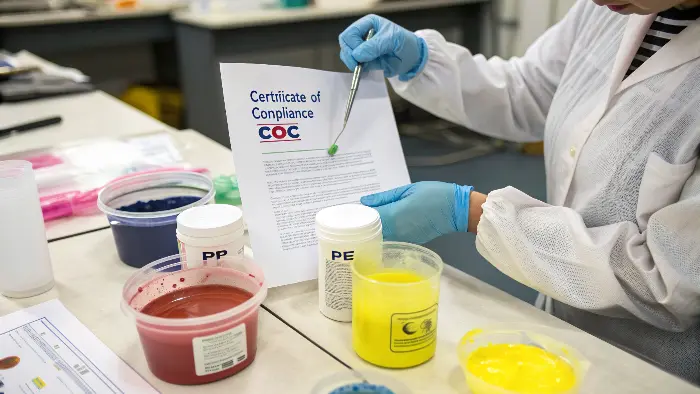
There is no universal “safe baby-product plastic.” Start with the product category, age group, foreseeable use, destination market and exact material formulation, then validate the complete molded product against the applicable hazards and requirements.
Selecting plastics for injection molded baby products requires a broader review than choosing a strong or inexpensive resin. The product may be touched, mouthed, dropped, washed, heated, assembled with other materials and used repeatedly by a vulnerable end user. Material selection should therefore consider intended contact, small-part risk, impact, fatigue, odor, cleaning, temperature, colorants, additives and the regulations or standards applicable to the target market.
Related CKMOLD resources: DFM analysis, production injection molding, mold testing and validation.

Start With Product Category, Age and Market
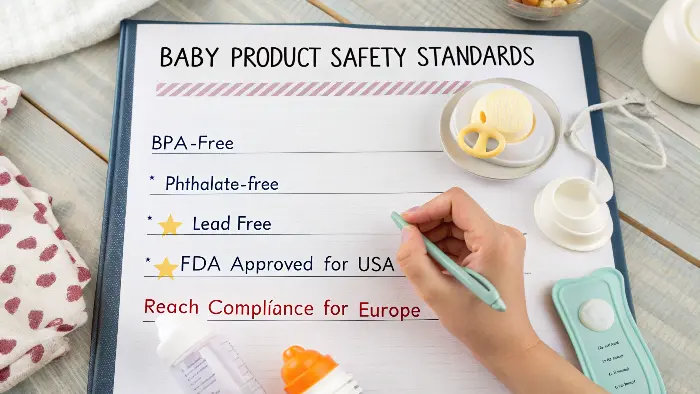
A baby product is not compliant because its resin is called BPA-free or food grade. Identify the product category, intended age, mouthing/feeding or food-contact use, accessible components, foreseeable abuse, cleaning/sterilization, destination market and responsible manufacturer/importer.
In the U.S., covered children’s products may require testing by a CPSC-accepted laboratory and a Children’s Product Certificate. Small-parts and phthalate requirements have defined product/component scopes; they are not universal material labels. Food-contact components must also match FDA authorization and intended conditions of use. Other markets require their own legal review and evidence.
Create a compliance matrix that lists each component, material/grade/color, applicable rule, test method, sample configuration, responsible party and retained record.
Primary sources checked: CPSC — Children's Product Certificate (testing and certification duties for covered children's products); CPSC — Small Parts Guidance (age/use-specific small-parts requirements and certification); CPSC — Phthalates FAQ (scope of phthalate restrictions for covered products/components); FDA — Regulatory Status of Food-Contact Components (component identity, authorization and use limitations); FDA — Food Types and Conditions of Use (intended food, temperature and contact-time framework). The cited scope still has to be matched to the exact grade, tool, product and destination market.
Screen Materials Against the Actual Exposure
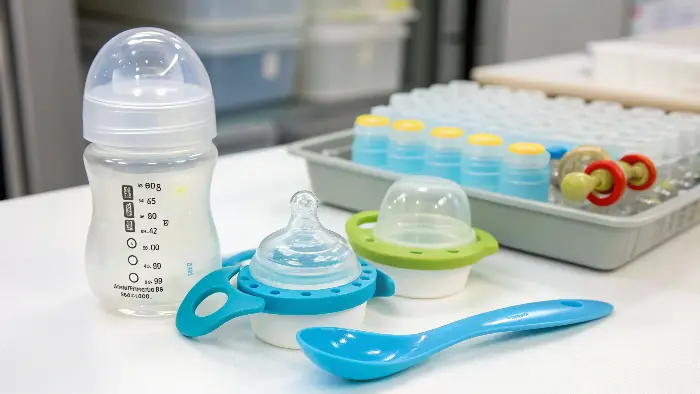
PP, PE, copolyesters, silicones/TPEs and other polymers can each fit particular components, but family names do not establish safety, heat resistance or durability. Compare exact commercial grades and all additives/colorants against contact, temperature, cleaning, bite/drop loads, hinge/seal function and regulatory documentation.
| Component question | Evidence needed |
|---|---|
| food/liquid contact | grade/formulation identity, intended food/temperature/time and applicable declaration |
| mouthing or accessible soft part | component scope, chemical restrictions and use/abuse test configuration |
| hot cleaning/sterilization | repeated-cycle dimensional, seal, odor and mechanical performance |
| small detachable feature | age classification, foreseeable-use/abuse result and assembly retention evidence |
How Should Candidate Plastics Be Compared?
Shortlist exact grades, then mold representative parts and test the assembly. Use a requirements matrix for contact/temperature, impact, bite or pull loads, flexibility, transparency, odor, cleaning, chemical exposure, color, dimensional stability and end-of-life claim.
No material is universally “top.” A transparent copolyester may fit a clear rigid body; PP may fit a hinge or opaque cup; a qualified elastomer may fit a seal. The design, additives, interfaces and validation decide.
How Can Manufacturing Affect Product Evidence?
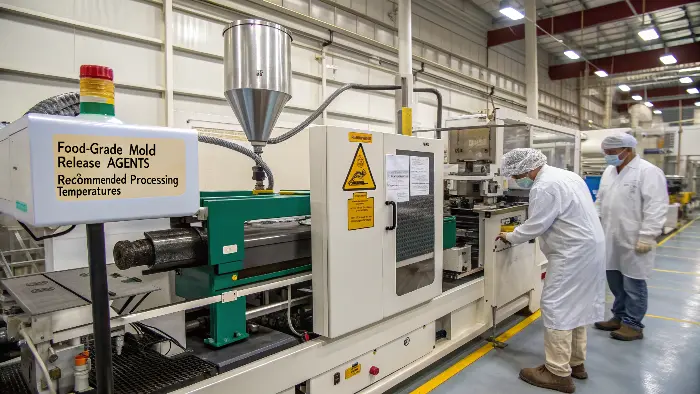
Control resin and color lots, storage/drying, approved regrind policy, purge/segregation, melt history, contamination, flash, sharp edges, gate vestige and assembly. A qualified raw material can still produce an unacceptable part when the process changes composition, dimensions or mechanical performance.
Record mold revision, cavity, machine, process, inspection and lot. Validate production-like assemblies after the intended cleaning and use/abuse exposures.
How Should Colorants Be Qualified?
Specify color concentrate supplier/code, carrier compatibility, let-down range, ingredients/declarations needed for the product, change control and lot traceability. Review colorant effects on flow, weld lines, shrinkage, light/heat aging, odor and migration where relevant.
Do not rely on a “heavy-metal-free,” “FDA” or “EN 71” marketing phrase without the exact component scope, test basis and destination-market interpretation.
Why Can Injection Molding Fit Baby-Product Components?
Injection molding can provide repeatable geometry, controlled assemblies and traceability at production volume, but it does not make a component safe by itself. Design out sharp edges and detachable hazards, control gates, flash and parting lines, verify material and color lots, and validate the complete assembly under intended and foreseeable use.
What Evidence Should a Molding Supplier Provide?
Request a controlled material/color BOM, supplier declarations, lot traceability, mold/process records, cavity-level inspection, assembly/test plan, nonconformance handling and change notification. A general claim of baby-product experience is not a substitute for those records.
Submit product category, age range, destination markets, intended contact, cleaning/sterilization, loads, exact material candidates, annual quantity and CTQs through the RFQ page. Send CAD separately to jerry@ckmold.com after the form when needed.
Map Every Contact and Exposure
Identify skin contact, mouth contact, food contact, saliva, detergent, sterilization, heat, UV, sweat and repeated handling. Separate rigid structure from soft-touch, grip or sealing components. Each material and color system should have evidence appropriate to its intended role and destination market.
Control Mechanical and Small-Part Risk
Impact strength is only one part of safety. Review fatigue, tear, bite resistance, snap-fit retention, hinge life, sharp edges, flash, burrs and any component that could detach. Design the assembly so foreseeable misuse does not create a hazardous small part or accessible sharp feature.
Choose Materials for Cleaning and Heat
Products may be washed, boiled, steam-cleaned, sterilized or exposed to warm liquids. Check dimensional retention, odor, hydrolysis, chemical resistance, color stability and stress cracking after the actual cleaning cycle. A resin that survives a short temperature exposure may not survive repeated cycles.
Design the Mold to Protect the Product
Parting lines, gates, ejectors, slides and venting should be placed so they do not create hazardous edges or difficult-to-clean pockets. Control flash and gate vestige, use suitable draft and support flexible parts during ejection. Mold maintenance is part of product safety.
Validate Materials and the Complete Assembly
Test molded parts and assemblies for impact, drop, bite or pull force as applicable, fatigue, cleaning, odor, appearance, dimensional fit and required market compliance. Document resin lot, color, process, mold revision and inspection results so a production issue can be traced and corrected.
Choosing Plastics for Injection Molded Baby Products: Buyer Review Checklist
- Map mouth, skin, food, heat, cleaning, sterilization, UV and assembly exposures.
- Evaluate impact, fatigue, tear, bite, flash, sharp edges and small-part retention.
- Check material, colorant, additive, odor and chemical evidence for the target market.
- Design gates, parting lines, ejectors, slides and surfaces for safe handling and cleaning.
- Validate production-like parts and assemblies under foreseeable use and misuse conditions.
FAQ
Is a BPA-free label enough for a baby product?
No. A product also needs appropriate evaluation of other additives, colorants, mechanical hazards, cleaning, heat, odor and destination-market requirements.
Why test the assembly instead of only the molded part?
Edges, hinges, inserts, seals, snaps and bonded components can change safety and durability; the user interacts with the complete assembly.
Conclusion
Baby-product material selection begins with category, age, contact, cleaning and destination-market requirements. Qualify every material, color and component; control molding and assembly; and validate mechanical, chemical and use/abuse risks on the finished product. No generic “safe” resin label replaces that evidence.
Children’s-Product Compliance Sources
Define the product’s age grade and intended use before selecting a test plan. The CPSC toy-safety business guidance explains the U.S. ASTM F963 framework, while the CPSC phthalates guidance identifies covered toys, child-care articles, limits and certification duties.