
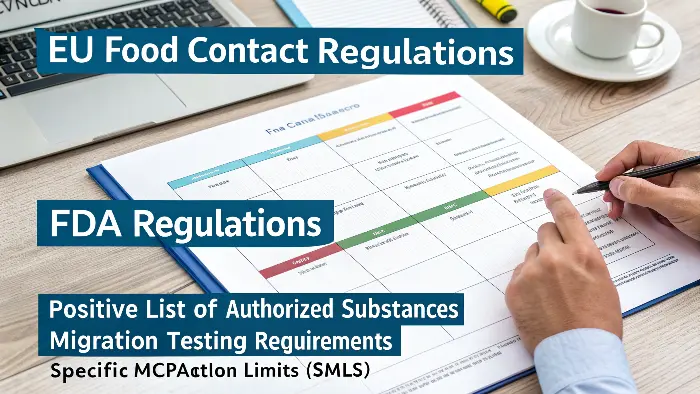
FDA and EU food-contact support begins with a defined use, exact bill of materials and market-specific evidence. Controlled molding and traceability preserve that basis; they do not turn a generic resin or process into an approval.
Supporting FDA or EU food-contact requirements for injection molded parts is a product-and-supply-chain responsibility, not a label that can be assigned to plastic alone. The finished article, intended food type, temperature, contact time, colorants, additives, processing history, mold cleanliness and manufacturing records all matter. Requirements vary by market and application, so the project should combine qualified materials, documented processing and appropriate regulatory review.
Related CKMOLD resources: mold testing and validation, production injection molding, mold design.

Is Injection Molding Itself Food-Safe?
Injection molding is a manufacturing process, not a food-safety approval. A defensible food-contact program combines the regulatory status of every material component, intended food and conditions of use, hygienic handling, controlled processing, traceability and finished-article evidence.
Qualify the exact resin, additives, colorants and any regrind policy. Then control contamination, material segregation, drying/handling, process settings, cleaning/changeover, tool maintenance and lot records. The evidence required depends on the product, market and intended use.
Primary sources checked: FDA — Food Types and Conditions of Use (intended food, temperature and contact-time framework); FDA — Regulatory Status of Food-Contact Components (component identity, authorization and use limitations); EUR-Lex — Consolidated Regulation (EU) No 10/2011 (EU plastics, documentation and migration framework). The cited scope still has to be matched to the exact grade, tool, product and destination market.

What Does FDA Status Mean for a Food-Contact Plastic?
The FDA does not provide one universal “food-grade plastic” certificate for every molded article. Determine the regulatory status of each component and whether its authorization or exemption covers the intended food type, contact time and temperature. Supplier statements must identify the exact grade and relevant limitations; a polymer-family name is insufficient.
Colorants, additives, processing aids, recycled content, adhesives and other components may change the assessment. The finished article must be manufactured consistently with the qualified formulation and conditions.

How Does a Molder Support a Food-Contact Compliance File?
- Define use: food type, temperature, duration, repeated use, microwave/hot fill and cleaning.
- Control the bill of materials: exact grades, colorants, additives, suppliers, lots and approved substitutions.
- Control production: segregation, handling, cleaning/changeover, process window, traceability and nonconformance records.
- Verify the article: dimensions/function plus applicable migration or other tests using a defensible worst-case rationale.
- Retain evidence: declarations, supplier statements, test reports, change control and instructions/limitations.
How Do “Food Grade,” “FDA Compliant” and “Food Safe” Differ?
“Food grade” is often used commercially, but it is not enough to identify the legal basis or use conditions. “FDA compliant” should be tied to the exact component status and intended use, not used as an unconditional product label. “Food safe” is a conclusion about the complete article in its actual application and therefore also depends on design, manufacture, misuse limits and evidence.
Ask for the exact grade declaration, cited authorization, restrictions, formulation/change-control status and evidence connecting the production article to the tested or assessed configuration.

How Does the EU Plastics Framework Differ?
EU Regulation 10/2011 uses an authorized-substances framework for plastic food-contact materials and articles, with applicable restrictions, migration requirements, supporting documentation and a declaration of compliance through relevant supply-chain stages. The current consolidated text and amendments must be checked for the date and product involved.
U.S. and EU evidence is not interchangeable. Build a market-specific matrix covering materials, intended use, tests or calculations, declaration fields, traceability and labeling/instructions.

What Should a Buyer Require From Any Molding Supplier?
- exact approved material/color/additive list and substitution control;
- lot traceability and certificates or declarations tied to that list;
- cleaning, changeover, regrind and contamination-control procedures;
- tool maintenance and lubricant controls;
- production inspection plan and retained records;
- finished-article validation plan for the claimed markets and use conditions.
Request these deliverables in the RFQ and quality agreement. Do not accept a logo, generic resin statement or factory description as a substitute for product-specific evidence.
Define the Intended Food-Contact Use
Record whether the part contacts dry, aqueous, acidic, alcoholic or fatty food, along with temperature, duration, repeated use, microwave or hot-fill exposure and surface area. A resin acceptable for one use may not be suitable for another, and the final article should be evaluated under its intended conditions.
Qualify Resin, Additives and Color
Request supplier declarations, grade identification, additive information, lot traceability and the applicable food-contact evidence for the destination market. Do not assume that a generic polymer name, recycled content or color masterbatch is automatically acceptable. The compound, pigment and processing aid must be considered together.
Design for Cleanable, Low-Retention Surfaces
Mold and part design should reduce crevices, trapped residue, rough unintended surfaces, dead spots and difficult-to-clean geometry. Gate vestige, weld lines, flash, parting lines and surface texture should be reviewed for both function and hygiene. Smooth, inspectable tooling surfaces support repeatable cleaning and maintenance.
Control the Manufacturing Environment
Prevent contamination through material segregation, covered storage, clean hoppers, controlled regrind policy, documented purge and planned mold maintenance. Record resin lot, color lot, machine, mold revision, process settings and inspection results. Traceability makes a compliance claim supportable when questions arise.
Validate the Finished Article
Depending on the application and market, evaluation may include migration, sensory, odor, extractables, dimensional, thermal, cleaning, aging and functional tests. Use production-like material, mold, color and process conditions. Regulatory specialists or qualified laboratories should confirm the applicable test plan and interpretation.
Support FDA and EU Food-Contact Requirements for Injection Molded Parts: Buyer Review Checklist
- Define food type, temperature, contact time, repeated use and destination market before material selection.
- Collect grade, additive, colorant, lot and supplier food-contact documentation.
- Design mold and part surfaces to reduce contamination retention and cleaning difficulty.
- Control storage, regrind, purge, maintenance, segregation and batch traceability.
- Validate the finished article with a market-appropriate test plan and qualified review.
FAQ
Does food-grade resin automatically make a part compliant?
No. The final article, additives, color, processing, intended food contact and destination-market requirements must also be reviewed and supported.
Should food-contact parts use regrind?
Only when the material, process, quality system and applicable requirements allow it and the policy is documented; the decision should not be made by cost alone.
Conclusion
Supporting FDA and EU food-contact requirements begins with a defined use and exact bill of materials, then extends through controlled molding and finished-article evidence. Keep U.S. and EU bases distinct, document limitations and changes, and require traceable records from material supplier through production.
Primary U.S. and EU Food-Contact References
Use the FDA method for determining component regulatory status for the intended U.S. use and the European Commission food-contact materials portal for the EU framework, plastics rules, GMP and documentation route.