
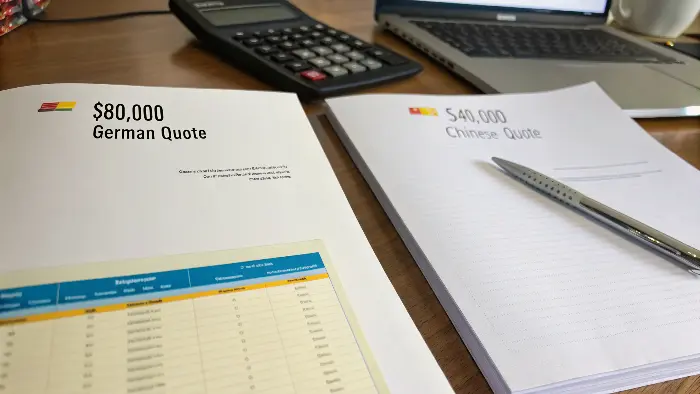
You require a new injection mold, and you are torn between two significantly different quotes. One is from Germany and is exact, professional, yet ridiculously costly. The other, essentially from China, is significantly cheaper yet begs the question as to quality and risk. The wrong decision would result in taking a budgetary blow or, worse, a duff mold that leaves your production line stalled. The aim of my article is to dissect the actual costs involved in both.
Comparing a German-made injection mold with a mold sourced from China requires more than comparing two tooling quotations. The commercial decision includes engineering time, communication, steel and component specification, trial corrections, inspection, shipping, customs, maintenance, ownership and the cost of a delayed launch. A lower or higher initial quote can be rational depending on the tool complexity, quality risk, production location and level of project control.
Related CKMOLD resources: export injection mold manufacturing, DFM analysis, mold testing and validation.
The actual cost disparity between a German and a Chinese tool extends well beyond labor costs. German tools are very expensive up-front for high-end European steel, ultra-high precision tooling, and significant automation investments, yielding tools designed for high-volume production and extended tooling service. Chinese tools are cheaper for low-skilled labor, vast domestic supply chain competition, and favorable government policy for the sector. The actual cost of ownership, however, also includes shipping costs, communication, and possible modifications, and the best solution relies on the particular requirements for your project.
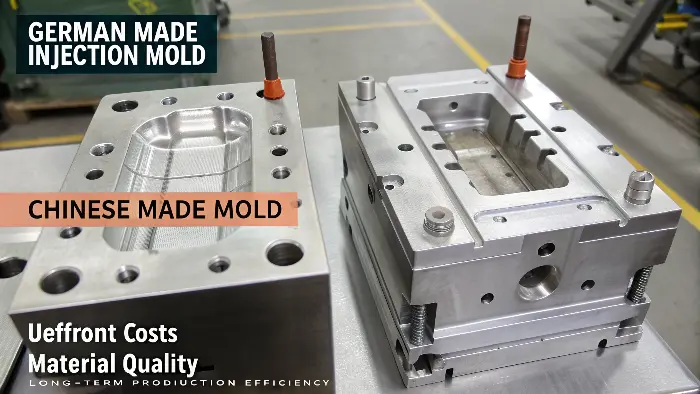
To really understand this comparison, we first need to look at what goes into the cost of any mold, regardless of where it’s made. The sticker price can be shocking if you’re new to this, and it’s easy to feel like you’re being overcharged. But a custom mold isn’t an off-the-shelf product; it’s a piece of precision machinery. So let’s start by breaking down why they cost what they do, and then we can fairly compare the two regions.
Why do custom molds cost so much?
You are holding a tiny plastic piece that takes pennies to make, yet you’ve been quoted thousands, or even hundreds of thousands, for a mold to produce it. It seems an entirely unnecessary cost, and you question the project altogether. I want to lift the veil and reveal to you the vast amount of craftsmanship, precision, and massive machinery that goes into creating a simple-seeming mold. It’s a transformation from a steel block to a production powerhouse.
Molds are costly since they are one-shot deals that are not mass-produced, each one a bespoke high-precision machine that is designed for a single part. The price includes skilled design and engineering, high-cost high-grade tool steel, and hundreds of precision machineman-hours on CNC mills, EDM machines, and grinders. It also includes the very skilled labor involved in hand-polishing, fitting, and assembling dozens or hundreds of parts. You are basically ordering a one-off piece at the industrial equipment level that is built on the assumption that it must make millions and millions of replicated parts with unbelievable precision.
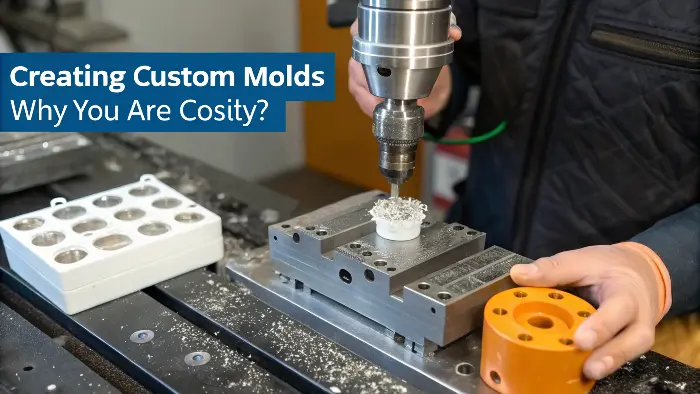
A mold is much more than just a cavity in a block of metal. I’ve been in this industry my whole life, from my first job on the factory floor to running my own company, and the craftsmanship still amazes me. To justify the cost, you have to understand the journey.
The Journey from Design to a Finished Mold
Here’s a simplified look at the steps involved, each adding to the final cost:
When you add up the cost of the steel, the machine time, and the wages for the highly skilled engineers and toolmakers, you begin to see why a custom mold is a significant investment.
How much does it cost to have a mold made?
You need a mold for a new product but are stumped on how to budget. You are quoted anywhere from a few thousand to a hundred thousand or more, and setting up the financial planning for your project appears to be guesswork. Without a rough estimate, you cannot even determine if a product is economically viable. I’ll give you a realistic breakdown on the price range and what are the essential elements that will shift a project from one extreme end to the other.
A prototype injection mold can range anywhere from $3,000 for a low-end, one-piece, simple prototype mold to $100,000 or more for a high-end, multiple-piece, high-production hardened steel mold. The cost at finished price is dependent on the size and complexity required for the part, the type of plastic being molded (which determines the steel for the mold), the number of cavities, and the volume required for production (mold life). For instance, a low-end simple gear may require a $5,000 tool, while a high-end, large, and complex electronics housing may require a $60,000+ tool.
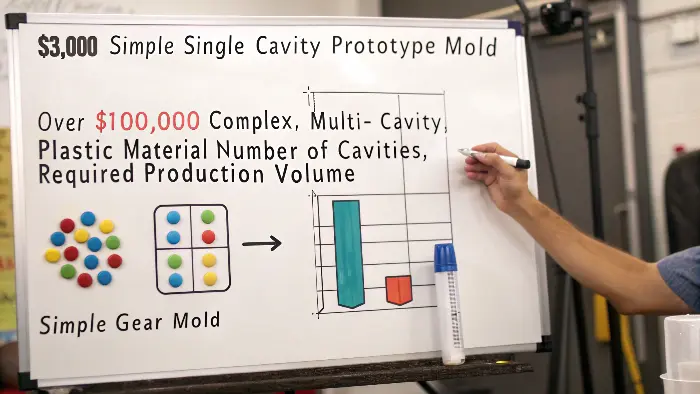
The question “how much does a mold cost?” is like asking “how much does a car cost?”. The answer is generally, “it depends.” A simple sedan is very different from a high-performance supercar. Molds are the same.
What Influences the Price Range?
| Factor | Low-Cost Example ($3k – $10k) | Mid-Range Example ($10k – $40k) | High-Cost Example ($40k+) |
|---|---|---|---|
| Part Complexity | Simple, flat, open-and-shut design. No undercuts. | Some undercuts requiring 1-2 sliders or lifters. | Multiple complex mechanisms, lifters, sliders, threads. |
| Part Size | Small part, like a bottle cap or a small gear. | Medium-sized, like a TV remote casing or a mouse shell. | Large part, like a storage tote, chair seat, or car bumper. |
| Mold Steel | Pre-hardened P20, or Aluminum for prototypes (<10k shots). | Hardened P20, 718H for medium production runs (<500k shots). | Hardened H13, S136 Stainless for high-wear or corrosive materials (>1M shots). |
| Cavitation | Single cavity (one part per cycle). | 2 to 8 cavities. | 16, 32, or more cavities for very high volume production. |
- Part Size: This is the most obvious factor. A larger part requires a larger mold, which means a bigger block of steel, a larger mold base, and more time on larger machines.
- Part Complexity:This is the hidden cost driver. If your part has features like clips, holes on the side, or threads, the mold can’t just be a simple “open and shut” design. It needs “sliders” or “lifters,” which are moving parts within the mold that slide into place to form the feature and then slide out of the way before the part is ejected. Each moving part adds significant design, machining, and fitting time. The mold required four complex sliders, almost doubling the cost compared to a similar-sized open-and-shut part.
- Mold Steel & Production Volume: Are you making 5,000 parts or 5 million? For low volumes, we can use softer, easier-to-machine steel like P20. For high-volume production, you need extremely hard, durable steel like H13 that has been heat-treated. Harder steel is more expensive and takes much longer to machine, driving up the cost. If you’re molding a material like PVC, which is corrosive, you’ll need stainless tool steel like S136, which is even more expensive.
- Cavitation: If you need millions of parts quickly, you can’t wait for a single-cavity mold to run one part at a time. We build multi-cavity molds that produce 4, 8, 16, or even 64 parts in a single cycle. While a 4-cavity mold isn’t four times the price of a 1-cavity mold (they share a mold base), it is significantly more complex and expensive.
How can we compare China’s Injection Mold Costs to Global Alternatives?
China Injection Mold Cost vs. Global Competitors.
In deciding on where to source injection molds, it is imperative to know the difference in the costs around the world. A realistic comparison of the cost of manufacturing moulds in China and other key areas is presented below:
China vs. USA
Costs of injection moulds in China are usually 20-50 years cheaper than in the United States. This disparity is propelled by reduced labor expenses, competition in material pricing as well as reduced overhead liabilities. Although the U.S suppliers might be superior in their proximity and IP protection benefits, the Chinese vendors tend to be ahead in turnaround speed, and pricing efficiency, particularly in small- to mid-volume projects.
China vs. Europe
European-made molds – in particular German, French or Italian – are characterised by their accuracy but can be significantly more expensive than their Chinese counterparts, 30-60%. This premium is mostly contributed to by high labor rates and rigid regulatory conditions. Chinese molds provide the suitable compromise between quality and cost to a lot of manufacturers.
China vs. Southeast Asia
Such nations as Vietnam, India, or Thailand are becoming less-costly sources of moulds. Nevertheless, China usually has a lead in quality control, tooling sophistication and supply chain maturity. The prices can be similar, though the Chinese manufacturers of molds are usually more likely to complete complicated or highly accurate tasks.
How to calculate mold cost?
You must price a new project, yet you cannot wait for weeks for official quotes to be received back from suppliers. You require a dependable way to estimate the cost of the mold today so that you may make a determination if the project is economic. Guesswork is a formula for disaster as a hidden cost of the mold may eliminate your margins. The following is a realistic strategy that we use on the inside to develop rapid and surprisingly accurate ballpark estimates that we present to our clients.
One common method for estimating mold cost is to lay it out in its base components: Material Cost + Machining Cost + Labor Cost + Overhead. Material cost is the cost of the steel. Machining cost is the guessed-at hours for CNC, EDM, etc., times the shop rate. Labor accounts for the skilled assembly and fitting. Another, rougher, simpler approach is to rank your part by size and complexity and use historical experience on similar projects for a starting point and make adjustments for details such as steel type and cavitation.
There’s no magic formula that will give you a suitable number to the dollar, but you can get very close by thinking like a mold maker. The price of every mold is essentially the sum of its parts and the time it takes to put them together. I walk through this mental checklist every time I quote a new project for a client like the buyer, who needs reliable numbers for his business planning.
A Practical Estimation Breakdown
To get a solid estimate, you need to consider the four main cost buckets. Let’s create a framework you can use.
| Cost Component | What it Includes | Key Factors Influencing Cost |
|---|---|---|
| 1. Material Cost | The mold base (a standardized frame), the core/cavity steel blocks, and standard components like ejector pins, springs, and screws. | The overall physical size of the mold (driven by part size), and the grade of steel required for your production volume and plastic type. |
| 2. Processing (Machining) Cost | Time on the machines: CNC milling, high-speed CNC for precision, EDM for fine details, wire cutting, and grinding. | Part complexity is the biggest driver here. More features, complex surfaces, and tight tolerances mean significantly more machine hours. |
| 3. Assembly & Labor Cost | The time a skilled mold maker spends hand-fitting all the components, polishing surfaces, assembling sliders and lifters, and wiring hot runners. | The number of moving parts in the mold. A simple mold might take 20 hours to assemble; a complex one could take over 100 hours. |
| 4. Overhead & Trial Cost | Project management, design engineering time, facility costs, profit margin, and the cost of the T1 mold trial (machine time, plastic, labor). | The shop’s efficiency, location (which affects overhead), and how many revisions are anticipated. |
Let’s try a quick, simplified example. Imagine you have a medium-sized electronics housing, about 6×4 inches, with a few clips on the sides.
- Material: I’d estimate the mold base and P20 steel would cost around $2,500.
- Machining: The complexity requires sliders. I’d estimate around 80 hours of total machine time (CNC, EDM). If a shop’s blended machine rate is $50/hour, that’s $4,000.
- Labor: This mold would likely need about 60 hours of skilled assembly and polishing. At a labor rate of $40/hour, that’s $2,400.
- Overhead & Trial: A good rule of thumb is to add about 20-30% for overhead, profit, and the trial run. Let’s add 25% of the subtotal ($8,900), which is $2,225.
Total Estimated Cost: $2,500 + $4,000 + $2,400 + $2,225 = $11,125.
This is a very rough method, but it forces you to think about the specific drivers and gets you into a realistic ballpark.
How to calculate the hidden costs to Watch Out for when sourcing custom Molds from China?
Certain Unobvious Expenses to be Mindful of when You Outsource to China to Get Custom Molds.
China can be a clever move toward sourcing custom molds, a strategy that can save initial costs, provide the latest technology of tooling, and increase production in a short period. But attractive as the first quotes can be, a few externalities can be found which must be taken into consideration by the buyers to prevent the cost overrun as well as time loss on the project.
There are most common hidden costs that you should be alert of as shown below;
Modifications and Revisions of the design.
Manufacturers might need to modify the CAD files so that they can adapt the mold to manufacturing. These design modifications may lead to additional design expenses or re-equipment costs. Several amendments take short fuses when not negotiated in advance.
Selection and Upgrades of Material.
The underlying price usually has low cost steel grades such as P20. Extra costs are expected to be incurred on mold; should your mold be of greater durability (H13, S136, or stainless). Selecting the correct steel is also very important due to the fact that low quality of materials can be used that will decrease the life of molds, and, hence, increase the long-term costs.
Surface Coating and Finishing.
Such processes as polishing, etching texture, chrome plating, or EDM finishing may be quoted separately. When your item needs cosmetic fixing (such as a glossy finish or intricate detailing), such undisclosed expenses may add up to a considerable fee.
Sampling and Testing Fees
The Chinese manufacturers of molds typically charge to send test samples (T1, T2 trials) and deliver them abroad. These costs can easily skyrocket in case several deliveries are required to make the mold consistent.
Freights, Customs and Import Duty.
Molds are heavy and they normally weigh hundreds of kilograms. Air freight is quick and expensive, but sea freight has port handling, customs clearance and duty charges which are not necessarily quoted. These logistics costs are usually underestimated by buyers.
Communication and Time Zone Delays.
Although it is not a direct monetary cost that needs to be covered, miscommunication and time zone differences can result in extra development cycles, bumped up time-to-market and indirect costs.
Maintenance and Spare Parts
When the mold has been shipped, future maintenance and repair and any additional replacement costs of any part will entail the possibility of returning to China or paying excessive services locally. This is what has been frequently ignored during the budgeting process.
Unstated Minimum Order Quantities (MOQs).
Other mold makers would charge low prices of molds but charge high production MOQs to cover the margins. This may make a difference in terms of unforeseen inventory and warehousing costs in case your order is lower than expected.
After Sales Support and Warranty Limitations.
Numerous suppliers have few or no warranties. After the delivery of the mold, it may not cover any problems such as early wear, shrinkage problems or misaligned cavities-all of which you end up paying to make correct.
Inquire of your supplier of a breakdown of all the possible costs (including revisions, shipping, trial run, and after-sale service) before committing. You should generally include a minimum of 10-20% of buffer in your budget in case of unexpected costs.
Why is it cheaper to manufacture in China?
You’ve done the math, you have the sophistication, but you have two quotations in front of you. The German one is $80,000 and the Chinese one is $40,000. You are drawn to the savings and yet apprehensive. The quality is that close? There has to be a catch. You feel that the lower price means that corners are being cut that are just going to cost you in the end. I have grown my company by answering just that question for my clients, and I’ll tell you the fundamental reasons for the price difference.
Manufacturing molds in China is cheaper primarily due to significantly lower labor costs for highly skilled engineers and toolmakers. Additionally, China has a massive, hyper-competitive, and deeply integrated supply chain for everything from tool steel to standard components, which drives down material and parts costs. Government support for manufacturing and incredible economies of scale also contribute. While German molds excel in automation and extreme precision, Chinese shops effectively leverage their vast skilled labor force to deliver excellent quality and complex assemblies at a lower price point.
For years, people assumed “Made in China” meant low quality. That is an outdated and dangerous stereotype in the mold industry. Today, the top shops in China produce world-class molds that serve major global brands. The cost difference isn’t about quality compromises anymore; it’s about fundamental economic and structural differences. Having worked with clients sourcing from both regions, I can tell you the choice is about finding the right fit for your specific project, not about good vs. bad.
Germany vs. China: A Head-to-Head Cost Comparison
Let’s put them side-by-side to see where the money really goes. This is the breakdown I give to business owners like the buyer to help them see beyond the final price tag.
| Factor | German Molds | Chinese Molds | The “So What?” for You (The Business Owner) |
|---|---|---|---|
| Labor Cost | Very high hourly rates for engineers and toolmakers (€60-€100/hr). | Significantly lower hourly rates ($15-$30/hr). | This is the single biggest reason for the price difference. A mold that takes 300 hours of labor is drastically cheaper to build in China. |
| Automation | Highly automated processes. Machines run 24/7 with minimal supervision. High capital investment. | A blend of modern CNC and more reliance on skilled manual labor for fitting, polishing, and assembly. | German cost is driven by machine investment; Chinese cost is driven by labor. China’s approach can be more flexible for complex assembly. |
| Material Sourcing | Premium European steel (e.g., Böhler) is the standard. It’s excellent but expensive. | Access to high-quality local steel (e.g., from LKM) or can import European steel at a competitive price. | The raw material cost gap is narrowing, but the overall Chinese supply chain for components (hot runners, pins) is much more cost-effective. |
| Overhead & Scale | Higher general business overheads. Shops are often highly specialized. | Lower overhead costs and a massive industry scale with thousands of competing shops. | This competition in China drives down prices and offers you, the buyer, a huge range of options at different price points. |
| Engineering Focus | Uncompromising focus on longevity, minimal maintenance, and lightning-fast cycle times for 10M+ shot molds. | A pragmatic focus on balancing cost with quality to precisely meet project specifications. High flexibility for changes. | Choose Germany for mission-critical, ultra-high-volume parts where every millisecond of cycle time counts over a decade. Choose China for almost everything else where an excellent cost-performance ratio is key. |
The true cost, however, also includes “soft costs.” When sourcing from China, you must factor in communication (time zone differences), project management, shipping logistics, and potentially travel for on-site visits. But for many projects, the 40-60% cost savings far outweighs these manageable challenges, especially when you work with a reliable partner who bridges that gap for you.
Define What the Quote Actually Includes
List cavities, mold base, steel, hot runner, slides, lifters, standard components, surface finish, spare parts, sampling, inspection and packaging. Two suppliers may use the same word—production mold—but include different tool life, tryout scope or documentation. Normalize the scope before comparing numbers.
Add Engineering and Communication Cost
A complex tool may require repeated design reviews, translation, tolerance clarification and cross-functional approvals. The best source is not simply the one with the lowest hourly rate; it is the supplier that can identify risk early and convert decisions into controlled drawings, revisions and acceptance records.
Compare Quality Evidence and Correction Risk
Review steel certificates, component brands or equivalents, machining capability, measurement equipment, mold-flow practice, trial reports and corrective-action response. Estimate the cost of a second trial, a steel change, a moved gate or a late dimensional correction. Evidence reduces uncertainty before the mold arrives.
Model Logistics and Ownership
Include transport, insurance, customs, export documents, delivery buffer, installation support and the cost of moving the mold between countries. Confirm who owns the mold, CAD data, spare parts and maintenance records. A tool that must be shipped for every correction may have a different total cost from one supported near production.
Use a Risk-Adjusted Decision Matrix
Score each option for tool complexity, annual volume, required life, cosmetic risk, tolerances, launch date, internal engineering capacity and supplier support. A local premium may be justified for rapid feedback or a highly critical tool; an experienced China source may be attractive when export control, remote validation and documentation are strong.
German-Made Mold vs. China Sourcing: Buyer Review Checklist
- Normalize cavity, steel, hot-runner, components, sampling and inspection scope before comparison.
- Include engineering, communication, revisions, travel, logistics, customs and delivery buffer.
- Review quality evidence and estimate the cost of trial corrections or delayed approval.
- Document tooling ownership, CAD release, spare parts, maintenance and transfer rights.
- Choose by risk-adjusted total cost instead of initial quotation alone.
FAQ
Are German-made molds generally more expensive overall?
Not necessarily. Initial tooling price is only one component; correction risk, logistics, support, tool life and production impact can change the total cost.
What should be compared between a German and Chinese mold quote?
Compare tool scope, steel, components, cavities, life, sampling, inspection, lead time, ownership, shipping, support and correction responsibility.
Conclusion
The actual price of a mold is not what is on the quote. It is a computation of short-term investment against the value in the long run. German molds are the epitome of automation and life span, an investment of massive and mission-critical production. Chinese molds provide an unmatched combination of quality, flexibility and cost to the vast majority of business requirements. The correct decision is based upon a clear eyed assessment of your part, volume, budget, and business objectives.