Rapid Tooling vs. Production Tooling: When Should You Choose an Aluminum Mold Over Steel?

You have a great product idea and you need injection molded parts, but you’re facing a classic dilemma. The high upfront cost and long lead times of traditional steel tooling feel like a massive barrier. This delay can kill your project’s momentum, letting competitors get to market first, while making the wrong choice could mean wasting thousands of dollars and months of valuable time on a tool that doesn’t fit your needs.

Select an aluminum tool for rapid tooling when parts are required fast for prototype builds, test markets, or low quantities, usually under 10,000 units. Aluminum is quickest to machine and cheaper and is best for proving the design prior to investing in an expensive steel tool. For high quantities, for parts that are overly complex and demand extreme precision, or for use with abrasive plastics, a robust production steel tool is the required and eventually cheaper alternative in the end. The choice has a direct effect on the speed and cost of your project and ultimately its success.

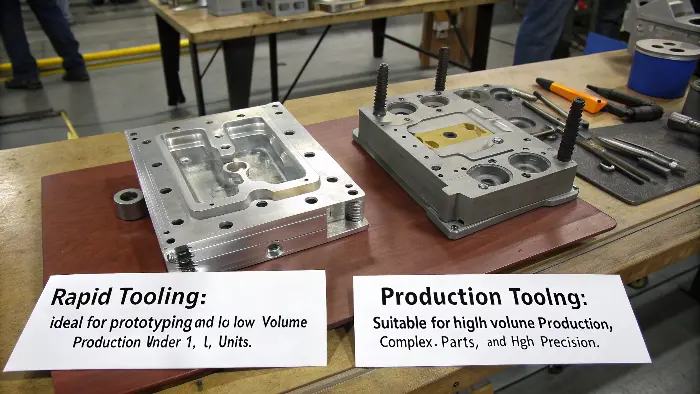
An aluminum mold half next to a steel mold half, showcasing the material difference.

This is a very initial choice and one of the most crucial ones you will make during product development. It determines your budget, your schedule and your scalability. I have witnessed hundreds of thousands of business owners, including yourself, fumbling over this decision. It may be puzzling but it does not need to be. We can subdivide it further, and in this way you can make the right decision concerning your project with full confidence. The first thing to do is to make a crystal clear understanding of what these terms mean.

What Really Defines Rapid Tooling and Production Tooling?

The terms "rapid tooling" and "production tooling" get thrown around quite readily in our company, without quite a bit of definition. The lack of definition has the potential to lead to extreme misconceptions amongst your suppliers. You can end up with a tool that doesn’t quite meet your needs for speed, cost, or lifespan. I have witnessed companies buy a whole production tool when a far less costly, faster prototype tool was indeed required for their near-term goals.

Rapid tooling, and often aluminum-made, is about hastening the preparation of molds for prototype and low-production runs. The idea is to get usable parts in a short time for verification and testing. Production tooling, normally hardened steel, is meant to be durable and for high-capacity production. The idea is to produce hundreds of thousands, or millions, of reproducible parts for a protracted period. The essential difference is purpose: speed and verification versus durability and high-capacity production.

A CNC machine cutting an aluminum block for rapid tooling.

The Philosophy Behind Rapid Tooling

Think of rapid tooling as a sprint. The entire process is optimized for one thing: speed. The goal isn’t to build a tool that will last for a decade; it’s to build a tool that can get you parts next month. This is why 7000-series aluminum is a popular choice. It’s soft enough to be machined incredibly quickly, sometimes 30% faster than steel. This reduction in CNC machining time is the single biggest factor in its speed and lower cost.

To make the whole thing go that much faster, rapid molds are frequently kept simple. They may have simpler cooling channels or manual inserts in lieu of fully automated side-actions. The thinking is "good enough for now." Ideal for when you want to prove the form, fit, and function of a new part, or if you want a few thousand units to prove the market. That’s our "bridge tooling"—bridging the gap between prototype and production.

The Philosophy Behind Production Tooling

Whereas rapid tooling is a sprint, production tooling is a marathon. It’s meant for longevity. The choice material is always steel, be it P20 (a pre-hardened steel for small-to-mid-range quantities) or H13 (a hard tool steel for ultra-high quantities). They are sturdy, long-lasting against wear, and resilient against the tremendous pressure and temperature of injection molding for hundreds, if not millions, of cycles.

The design of a production tool is also far more robust. Engineers spend significant time optimizing cooling channels to reduce cycle time by seconds, which adds up to massive savings over a run of 500,000 parts. Every aspect, from the steel type to the ejection system and surface finish, is engineered for maximum efficiency and longevity. This is an industrial asset designed to be a workhorse on the factory floor.

It’s More Than Just the Material

The distinction is about intent. You can make a "rapid" tool out of P20 steel if you simplify the design, and you can make a higher-quality "production" tool out of aluminum if you use the best grade and don’t cut corners. However, the most common pairing is aluminum for rapid tooling and steel for production tooling because their material properties align perfectly with these goals.

Here’s a simple table to summarize the core differences:

Feature Rapid Tooling (e.g., Aluminum) Production Tooling (e.g., Steel)
Primary Goal Speed, Design Validation, Low Volume Longevity, High Volume, High Precision
Common Material 7075 Aluminum, P20 Steel Hardened Tool Steel (P20, H13, S7)
Lifespan (Shots) 1,000 – 50,000+ 100,000 – 1,000,000+
Lead Time 1 – 4 Weeks 5 – 12+ Weeks
Design Complexity Often simplified, basic cooling Highly optimized cooling, complex actions
Best Use Case Prototypes, Bridge Tooling, Market Tests Mass Production, Abrasive Materials

A comparison of Aluminum and Steel Injection Molds

In case of injection molding, the type of mold material is a critical decision towards cost, lead time, volume and quality of parts. The most popular two options are aluminum and steel and each has its own advantages based on the requirements of the project.

Cost and Initial Investment

Aluminum Molds: These are cheaper to make because they can easily be machined. Available in low to medium production runs, and where cost is of the essence especially in prototypes.

Steel Molds: This is more expensive initially due to the machining difficulty but the longevity is worth the investment when it is used on large production volumes.

Lead Time (Rapidity of Production Establishment)

Aluminum Molds: It is quicker to manufacture and this can save 20-30 lead time. This renders them suitable to quick prototyping or when there is a time constraint of launching a product.

Steel Molds: They take more time to machining and finishing. They are however capable of supporting large scale production without the need to be maintained often after being done.

Durability and Lifespan

Aluminum Molds: Sfter material, wearable, and not suitable with abrasive and high-temperature resins. Generally have a tens of thousands of cycles.

Steel Molds: Very tough and can work with abrasive material, can be molded with a high level of pressure, and can be used in millions of cycles with the right attention.

Part Quality and Surface Finish.

Aluminum Molds: Good thermal conductivity will lead to a shorter cooling time, which will decrease the cycle time. Nevertheless, they are likely to be susceptible to scratches and surface defects with time.

Steel Molds: Are capable of very polished finishes and are also repeatable in quality of part during extended runs. Less prone to destruction and distortion.

Maintenance and Repair

Aluminum Molds: The material is not as hard and therefore, it is easier to alter or repair. This comes in handy during the early development of the product.

Steel Molds: Are harder to adjust but less repair is needed since they are more tough.

Volume Suitability of production.

Aluminum: Ideal with low to mid production runs (up to 50,000 parts at most with complexity).

Steel: Ideal for high production (hundreds of thousands of parts to millions of parts), long term.

Select aluminum molds due to speed, cost-effectiveness and prototyping. Select steel molds with the purpose of durability, uniformity of parts, and large volumes of production.

How Do Cost and Lead Time Truly Compare Between Aluminum and Steel Molds?

Every project lives and dies by its budget and its deadline. You need to know exactly how your mold choice will impact both of these critical factors. Underestimating the cost or the time it takes to get your tool can completely derail your product launch. I’ve seen promising ventures run out of cash before they even get to production, or miss their critical market window because they were waiting for a tool that took too long to build.

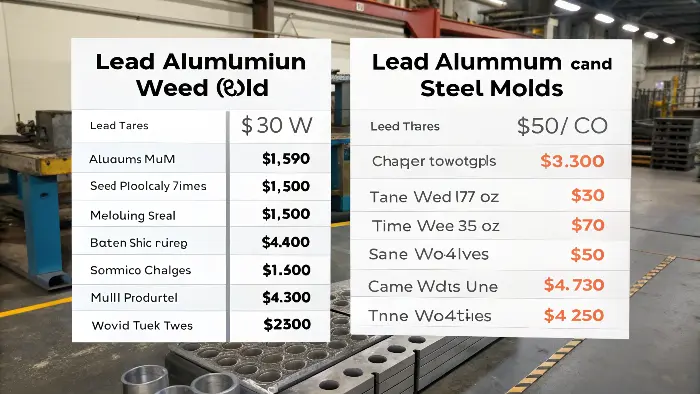
An aluminum mold costs 30-50% less and ships in 1-4 weeks compared to 5-12+ weeks for a steel one. Savings are due to cheaper cost raw material and greatly accelerated machining times—aluminum is considerably less hard than steel. The time savings are also due to accelerated and oftentimes simpler mold designs. The savings are short-term and may be misleading if high volume production is done, for cost per unit from a durable steel mold becomes considerably lower with a high volume production.

A calendar with a short timeline highlighted for aluminum and a long one for steel.

Breaking Down the Cost

Let’s get specific about where the money goes. The total cost of a mold isn’t just one number; it’s a combination of factors.

  1. Material Cost: A block of high-grade 7075 aluminum is significantly less expensive than a comparable block of P20 or H13 tool steel. This provides an immediate upfront saving.
  2. Machining Time: This is the biggest driver of cost. A CNC machine can cut through aluminum like butter compared to steel. This means fewer machine hours are needed to create the mold cavity. Fewer hours directly translate to lower labor costs and faster turnaround. I’d estimate that machining an aluminum mold can take up to a third less time than an identical one in steel.
  3. Design & Finishing: Rapid tools made from aluminum are often simpler. They might have a more basic polish or fewer automated components, which reduces the time spent on finishing and assembly. A production steel tool, especially one requiring a mirror polish (SPI-A1), needs hours of skilled manual labor to finish, which adds to the cost.

The True Cost: Amortization Per Part

The upfront cost is only half the story. As a business owner, you need to think about the amortized cost of the tool over the life of the product. Let’s look at a simple, practical example.

Factor Aluminum Mold Steel Mold
Upfront Mold Cost $5,000 $15,000
Mold Lifespan 10,000 parts 500,000 parts
Cost Per Part (Mold) @ 10k units $0.50 $1.50
Cost Per Part (Mold) @ 100k units Not Possible (New mold needed) $0.15
Cost Per Part (Mold) @ 500k units Not Possible (50 new molds needed) $0.03

As you can see, the aluminum mold is cheaper if you only need 10,000 parts. But as soon as your volume increases, the durability of the steel mold makes it vastly more cost-effective on a per-part basis. This is a critical calculation for any business plan. I remember working with a client who was launching a new consumer electronic device. He was in a rush for a trade show. We made him an aluminum mold in three weeks. He got 5,000 parts, went to the show, and based on the feedback, discovered a critical design flaw. Because he only invested in an aluminum tool, he was able to make the change and then order the final, expensive steel tool with confidence. The aluminum tool saved him from a six-figure mistake.

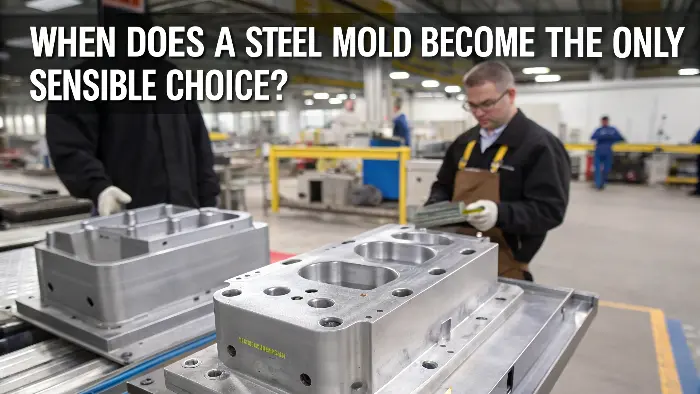
When Does a Steel Mold Become the Only Sensible Choice?

Aluminum molds are wonderful with their lower price and remarkable speed, and they are tempting to look at as a solution for each and every project. But that is a dangerous thing to assume. Going with aluminum when your project actually requires steel is a disaster.

Picture your mold collapsing in the middle of a crucial production run, bringing a grinding halt to your whole operation, generating whopping delays, and making you purchase a new tool anew. The money initially saved disappears in a flash.

A steel tool is the only logical option if you are planning for high-volume production (more than 50,000 parts), if your part design contains tight tolerances and is very complex, or if you are dealing with abrasive materials such as glass-filled nylon. Steel’s hardness and strength guarantee mold durability, reproducible part quality for hundreds of thousands of cycles, and resistance to severe plastics wear. Steel is the benchmark for reliability and lower ultimate cost per part for any long-term manufacturing strategy.

A close-up of a hardened steel mold cavity showing intricate details and a polished surface.

The High-Volume Production Mandate

An injection mold is a machine that endures incredible forces. With every cycle, it’s subjected to thousands of pounds of clamping pressure and scorching hot plastic. Aluminum, being a softer metal, simply wears out faster under this stress. The parting lines can begin to wear down, causing flash (thin, unwanted plastic) on the parts. The cavity surfaces can get dinged or deformed, affecting the final part quality.

For any production run expected to exceed 50,000 units, steel is the default choice. A well-made P20 steel mold can easily last for 100,000 to 500,000 shots. A hardened H13 steel mold can go for over a million shots with proper maintenance. This reliability is non-negotiable when you have large purchase orders to fill. A production line shutdown because of a failed mold is a business owner’s nightmare.

Dealing with Abrasive and High-Temp Materials

Although not all plastics are created equal. Whereas straightforward commodity plastics such as Polypropylene (PP) or Polyethylene (PE) prove to be quite soft on a mold, numerous engineering-grade plastics are not. Glass fiber (as in GF-Nylon) and mineral filled resins are very abrasive. When this molten material flows into the mold it serves as sandpaper, scrubbing the surfaces of the metal, particularly at the gate where the plastic is injected.

These materials will destroy an aluminum mold, sometimes in only a few thousand cycles. Critical dimensions will vary, the texture will be stripped away. The only material capable of enduring such abuse and being used to ensure consistency in parts is hardened tool steel.

The Precision and Complexity Factor

Steel offers superior stability, which is crucial for parts with very tight tolerances. It expands and contracts less with temperature changes than aluminum, ensuring that every part that comes out of the mold is virtually identical, from the first shot to the 500,000th.

Furthermore, if your part design includes complex mechanisms like sliders, lifters, or delicate core pins, steel provides the necessary strength and rigidity. These moving components need to align perfectly every single time. The robustness of steel ensures these mechanisms function reliably for hundreds of thousands of cycles without failing. Aluminum simply lacks the structural integrity for this kind of long-term, complex mechanical action.

Considerations to make when making a choice between aluminum or steel mold

Choosing the correct mold material is not merely a matter of price comparisons but rather a matter of striking a balance between a number of factors that are influential on the process of production, the quality of the parts, and the gross profitability in the long run. The following are the key considerations:

Production Volume

When the number of low-to-medium runs (a couple of thousand to tens of thousands of parts) is anticipated, aluminum will most likely be adequate.
In the case of volumes of high production (hundreds of thousands or even millions), steel is more stable, as it has better wear resistance.

Part Complexity

Simple components having fewer features can be easily molded using aluminum.
Steel molds are more appropriate for complex parts that have strict tolerances, fineness of textures, or delicate details.

Material Choice

Abrasive plastics (such as PP, PE, ABS) may be used in aluminum molds without difficulty.
Steel molds are needed with abrasive or glass-filled resins since they would soon wear out aluminum.

Budget and Lead Time

Aluminum molds are cheaper to make and machine quicker, hence suitable for start-ups, prototyping, and cost-sensitive projects.
Steel molds need a larger investment but provide long-term savings during large-scale production.

Finish and Aesthetics of Surface.

Aluminum is better in terms of cooling faster and shorter cycle times.
Steel molds are the best in producing high-gloss or precision finishes that cannot be affected by the thousands of cycles.

Future Modifications

In case alterations in design are likely in the early design, aluminum is more easily altered.

Steel is stiffer and therefore adaptations are hard and expensive, though it offers stability in the final designs.

Use aluminum molds when you need low production volume, speed and cost are important.

Select steel molds when durability, consistency of quality, and scalability are required, and production is to be long-term.

What Material and Design Factors Influence Your Mold Choice?

The choice between aluminum and steel isn’t a simple one of quantity and speed. The fundamental nature of your part—the shape of your part, how it’ll work, and what plastic you make it out of—plays a massive part. Overlooking these very details can lead you to choose a mold that cannot produce your part correctly. You may end up selecting a tool that wears out too soon or doesn’t get a finish that meets specifications, essentially losing your initial capital and sending you scrambling back to the drawing board.

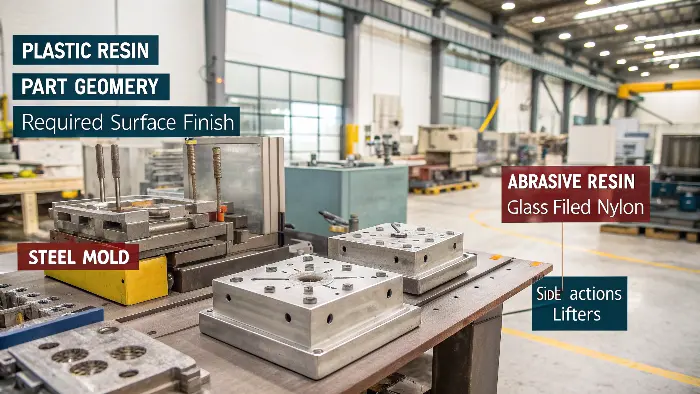
Key elements that should impact your choice are the plastic resin, the part shape, and desired surface finish. Abrasive resins such as glass-filled nylon require steel for strength. Small, open-and-close geometries are appropriate for aluminum, while intricate parts that have side action or lifters are best served by the strength of steel. When a high-polish, mirror finish (SPI-A1) is required, hardened steel is in order, for aluminum is inadequate hard material to retain such a fine finish for an extended period.

A collection of different plastic parts with varying complexity, textures, and colors.

Your Choice of Plastic Resin

The material you choose for your part has a direct impact on the mold. Think of it as a partnership; the tool and the plastic must be compatible. Some plastics are easygoing, while others are demanding.

  • Commodity Resins (PP, PE, PS): These are generally low-temperature, non-abrasive plastics. They are very forgiving and can run well in an aluminum mold, even for moderate volumes (10,000 – 50,000 shots).
  • Engineering Resins (ABS, PC, Acetal): These materials often require higher melt temperatures and pressures. While they can be used in high-grade aluminum tools for prototyping, steel is strongly recommended for any production volume to ensure mold life and part consistency.
  • Abrasive & High-Temp Resins (Glass-Filled Nylon, PEEK, Ultem): These materials are the bullies of the plastic world. They are highly abrasive, corrosive, or require extremely high temperatures. Using an aluminum mold with these is not an option. You absolutely must use a high-quality, hardened tool steel like H13 or S7 to prevent rapid mold destruction.

The Impact of Part Geometry

The shape of your barbs is very important.

  • Simplified, Open-and-Shut Configurations: If your item is quite simple, e.g., a plain lid or container that could be shaped by the two pieces of a molding opening and closing, an aluminum tool is frequently sufficient.
  • Complex Features: Whenever your part contains undercuts, threads, or clips, you’ll require side-actions (or sliders) and lifters. They are moving parts within the mold that must cooperate with extreme precision for millions and millions of cycles. Steel possesses the strength and resistance to wear that these parts must be able to perform for the long term. Aluminum is just too soft and would wear down under stresses of complex moving parts.

Surface Finish Requirements

The final look and feel of your part are determined by the finish of the mold cavity. The Society of the Plastics Industry (SPI) has standards for this.

  • SPI A-Grade (High-Polish/Mirror Finish): This requires the mold steel to be hardened and then painstakingly polished by hand. Aluminum is far too soft to achieve or maintain a true mirror polish; it will scratch and dull very quickly. Hardened tool steel is the only choice for A-grade finishes.
  • SPI B-Grade (Semi-Gloss): This is a fine-grit polish. It can be achieved well on P20 steel and, in some cases, on high-quality aluminum for short runs, but it will hold up much longer on steel.
  • SPI C/D-Grade (Matte/Textured): These finishes are typically achieved by bead blasting or chemical etching. Both aluminum and steel can be textured, but the texture will last significantly longer and remain sharper on a steel tool, especially with higher production volumes.

Conclusion

The selection of an aluminum or steel mold is not concerning which is better or which is better but what is right and suitable to your particular project. It all depends on your short and long term objectives. Aluminum is unbelievably fast and less expensive in initial cost, plus it is the ideal material to use in prototypes, market testing, and low volume bridge production. Steel offers the unparalleled durability, accuracy and wear life needed in high volume production. A critical and close examination of your volume, material, complexity and finish requirements can enable you to make a brilliant, strategic investment that will enable the success of your project.

Facebook
Twitter
LinkedIn

Request A Quote for Your Projects!

Hi there! I’m Jerry, a proud dad and passionate at CKMOLD. With years of hands-on experience in the injection mold and CNC industry, I’ve grown from managing the smallest details on the shop floor to leading international projects with clients across Europe and the U.S.

At CKMOLD, we specialize in precision molds, plastic parts, and CNC solutions that help bring bold product ideas to life. I love solving complex challenges, building long-term partnerships, and pushing the limits of what great manufacturing can do.

Let’s connect, exchange ideas, and grow together—whether you’re looking for a reliable manufacturing partner or just want to talk shop!

Request a Quick Quote

Send your drawings and detailed requirements via:
Email: jerry@ckmold.com

Or fill out the contact form below:

We will contact you within one working day. Please pay attention to the email with the suffix “@ckmold.com”

Wait, We Have Something Special for You!

Join our mailing list and receive a 10% discount on your next mold or CNC project.