
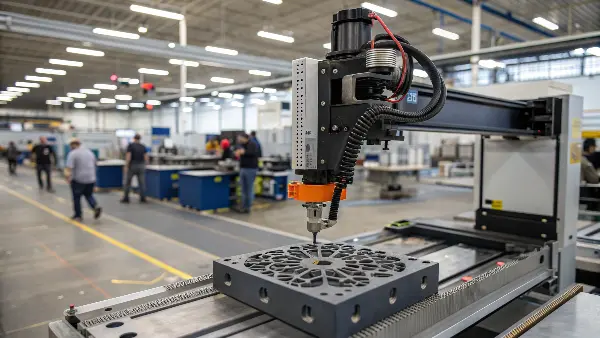
Are you tired of the long lead times and high costs associated with traditional steel injection molds, especially for prototypes or small production runs? This delay often means you spend a fortune just to test a new part, risking your budget and missing crucial market windows. Imagine being able to create functional molds in-house within days, not months, giving you the speed and flexibility to innovate faster and more affordably.
3D-printed tooling can shorten the path from CAD to molded samples, but a printed mold is not automatically a replacement for a production steel tool. Printed cavity materials, machine pressure, melt temperature, part geometry, cycle count, venting, clamping and ejection define the feasible envelope. Ejector pins and load-bearing mold components often require a different material or a hybrid design.
Related engineering resources: rapid tooling | prototype injection molding | mold testing and validation
Yes, you can absolutely 3D print your own injection molds, and even components like ejector pins, for specific applications. This method is a material change for rapid prototyping, low-volume production, and bridge tooling. By using high-temperature resistant photopolymer resins with technologies like SLA or DLP, you can create molds that withstand the injection process for dozens or even hundreds of shots. This dramatically cuts down development time and tooling costs compared to traditional CNC machining of aluminum or steel.
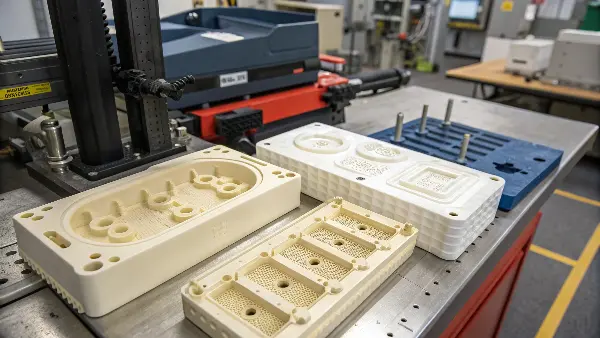
The idea of printing a plastic tool to create plastic parts might sound strange, but it has become a powerful strategy for businesses like yours. It’s about being smarter and faster. When you’re developing a new product, speed is everything. Getting a physical part in your hands to test form, fit, and function can be the difference between success and failure. 3D printed molds bridge the gap reliably, letting you validate a design with the actual production material before committing tens of thousands of dollars to steel tooling.
Can you 3D print a mold for injection molding?
You’ve heard the buzz about 3D printed molds, but you’re naturally skeptical. Can a plastic mold really stand up to the intense heat and pressure of the injection molding process? The fear of a mold failing mid-cycle, wasting expensive material, and potentially damaging your equipment is a valid concern that holds many people back. But the key isn’t just knowing it’s possible; it’s understanding the right applications, materials, and processes to ensure success.
Absolutely. 3D printing an injection mold is not only possible but has become a mainstream practice for rapid prototyping and short-run manufacturing. Using technologies like Stereolithography (SLA) and Material Jetting, companies create molds from durable, heat-resistant photopolymer resins. These molds are suitable for testing new designs, creating samples for trade shows, or producing a few hundred parts while your final steel production mold is being manufactured. It’s a powerful tool for slashing development cycles from months down to mere days.
To truly understand the value, you need to look beyond the idea of a simple “plastic mold.” Modern 3D printing technologies and materials have advanced significantly. The process is straightforward: you design your mold in CAD, print it using a high-resolution printer with a specialized high-temperature resin, then post-cure it to maximize its strength and thermal resistance. This finished mold can then be fitted into a standard master mold base and put into an injection molding machine.
Comparing Mold Technologies
The choice between a 3D printed mold and a traditional metal one depends entirely on your project’s goals.
| Feature | 3D Printed Molds (Resin) | Traditional Molds (Aluminum/Steel) |
|---|---|---|
| Lead Time | 1-5 Days | 3-12 Weeks |
| Cost | $100 – $1,500 | $3,000 – $100,000+ |
| Lifespan (Shots) | 10 – 500+ | 5,000 – 1,000,000+ |
| Best For | Prototyping, bridge tooling | Mass production, high-volume runs |
| Design Changes | Easy and cheap to iterate | Very expensive and time-consuming |
| Material Choice | Limited to lower-temp plastics | Virtually any thermoplastic |
This technology isn’t here to replace steel molds—it’s here to complement them. Use it to work out design kinks, test market viability, and get your product moving while the “real” tooling is in progress.
Can you make pins with a 3D printer?
You know that an injection mold is more than just a cavity; it’s a complex assembly of components, with ejector pins being some of the most critical. So, if you’re printing the mold, can you also print these small, functional parts? You might worry that a printed pin would be too weak, snapping under the force of ejection or wearing down after just a few cycles. This could lead to damaged parts and costly downtime, defeating the purpose of rapid tooling.
Yes, you can definitely make pins and other small mold components with a 3D printer. For applications like ejector pins in a 3D printed mold, you can print them from the same durable, high-temperature resin used for the mold itself. While they won’t have the longevity of hardened steel pins, they are more than capable of handling the ejection forces for the limited lifespan of a prototype mold. This allows for fully printed, integrated mold assemblies, further simplifying and accelerating the prototyping process.
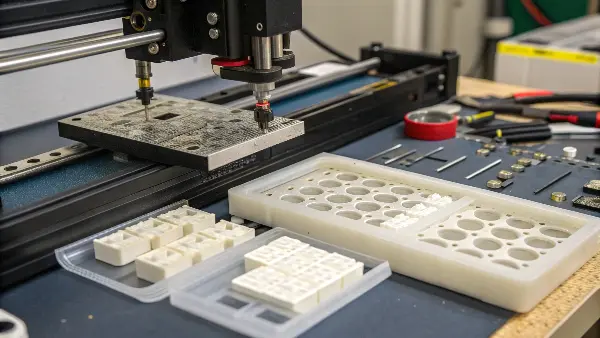
The ability to print pins alongside your mold core and cavity is a huge advantage. It means you can create custom-shaped pins to match complex part geometry without needing to machine them separately. Think about conformal cooling channels or uniquely shaped lifters; these are elements where 3D printing truly shines. When I work with designers, we often discuss integrating components to reduce assembly time. Printing the pins as part of the overall mold design file streamlines the entire workflow. You simply design, print, and assemble.
Of course, there are some important considerations for success.
Key Factors for 3D Printing Mold Pins
- Material Selection: You need a material with high tensile strength and stiffness. The same high-temp photopolymers used for the mold are often the best choice, as they are designed to withstand heat and pressure. For applications requiring higher wear resistance, some advanced engineering-grade FDM materials could also be considered, though they may lack the fine resolution of SLA.
- Print Orientation: How you orient the pin on the build plate is critical to its strength. Pins should generally be printed vertically (along the Z-axis) to ensure the layer lines are perpendicular to the ejection force. This maximizes their compressive strength and prevents them from snapping along a layer line.
- Post-Processing: Proper cleaning and post-curing are non-negotiable. Post-curing with UV light fully solidifies the resin, maximizing its mechanical properties and temperature resistance. An under-cured pin will be soft and fail almost immediately.
While you wouldn’t use a 3D printed ejector pin in a steel production mold expected to run a million cycles, it’s the suitable solution for a 3D printed mold designed for 100 shots. It’s about matching the technology to the application.
What is the most profitable thing to 3D print?
As a business owner, you’re generally looking for a return on investment. If you’re considering investing in 3D printing, you’re not just thinking about the technology, but how it can boost your bottom line. You might wonder if you should be printing trinkets or phone cases to sell online. The reality is that the market for simple consumer products is saturated, and the real value of 3D printing often lies hidden from the public eye, deep within the industrial manufacturing process itself.
The most profitable things to 3D print are not consumer gadgets, but high-value industrial tools like custom jigs, fixtures, and, as we’ve discussed, prototype injection molds. These items create profitability by dramatically reducing production costs and accelerating time-to-market. A 3D printed fixture that saves a few seconds on an assembly line can translate into thousands of dollars in savings annually. A printed mold that helps you win a multi-million dollar contract by delivering prototypes weeks ahead of competitors provides an astronomical return on investment.
The profit from 3D printing in a manufacturing setting isn’t usually direct revenue from selling a printed part; it’s indirect profit from efficiency gains and risk reduction. Project teams should think of 3D printers not as product-making machines, but as problem-solving machines. The true value comes from identifying bottlenecks in your current workflow and using 3D printing to eliminate them. It’s about creating custom solutions that are reliably tailored to your specific needs, something that was once prohibitively expensive.
Avenues for Profitability in Industrial 3D Printing
- Accelerated Product Development: This is the most significant area. As discussed with 3D printed molds, cutting weeks or months from your development cycle is invaluable. It allows you to be first to market, respond faster to customer feedback, and perform more design iterations, resulting in a better final product.
- Custom Tooling and Manufacturing Aids: Every factory floor has unique challenges. Need a custom jig to hold a part for drilling? A fixture for quality control inspection? A specialized end-of-arm tool for a robot? Traditionally, these would be machined from metal, costing thousands and taking weeks. With a 3D printer, an engineer can design and print a solution in a day for a fraction of the cost.
- On-Demand Spare Parts: Machine downtime is a profit killer. Waiting for a replacement part for an older machine can halt your entire production line. With 3D printing, you can print a replacement part on-demand, getting your line back up and running in hours instead of days or weeks.
The most profitable item is the one that solves your most expensive problem. For my clients in product development, that item is often the prototype injection mold.
What is illegal to print on a 3D printer?
When you bring a powerful manufacturing tool like a 3D printer in-house, you also take on new responsibilities. It’s exciting to think about the endless possibilities, but it’s also natural to wonder about the limits. You wouldn’t want your company to accidentally get into legal trouble by printing something you shouldn’t. The fear of unknowingly violating a law, patent, or copyright is a real concern for any responsible business owner adopting this new technology.
Legally, the primary restrictions on 3D printing revolve around printing firearms, patented inventions, and copyrighted materials without permission. Specifically, federal and state laws in the U.S. heavily regulate or ban the printing of untraceable firearms (so-called “ghost guns”). Furthermore, intellectual property law means you cannot legally reproduce an object protected by a patent, or a creative work protected by copyright, without explicit license from the owner. Generally ensure you have the rights to any design you print.
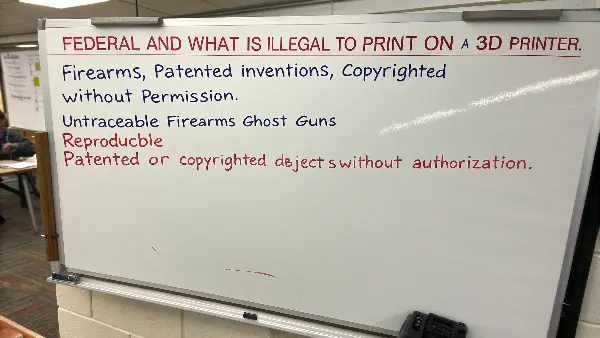
Let’s clarify these areas so you can operate with confidence.
Key Legal Areas to Consider
- Firearms and Weapons: This is the most publicized and regulated area. The Undetectable Firearms Act and various state laws place strict controls on creating firearms that don’t contain metal and lack serial numbers. As a commercial enterprise focused on industrial parts, this is an area to avoid completely. Your company policy should explicitly forbid the printing of any firearm components.
- Patented Objects: A patent gives an inventor the exclusive right to make, use, and sell their invention for a set period. If you download a CAD file for a patented product and print it, even for internal use, you could be liable for patent infringement. This is why it’s crucial to either design your parts in-house or use files from reputable sources where the licensing is clear. When a client sends us a file, our first step is generally to ensure they own the IP or have the right to produce it.
- Copyrighted Works: Copyright protects artistic and creative expressions, like sculptures, figurines, or character models. You can’t just download a 3D model of a famous cartoon character and print it for commercial purposes without a license from the copyright holder (e.g., Disney).
Best Practices for Your Business
To stay on the right side of the law, it’s simple: only print parts that you have designed yourself, that are open source, or for which you have explicit permission from the intellectual property owner. For a manufacturing business, 99.9% of your work will fall into the first category, making this a non-issue in day-to-day operations.
Define the Intended Run Before Choosing the Technology
A few proof-of-concept shots, a design review sample and a low-volume bridge run have different requirements. Estimate shot count, material temperature, clamp force, injection pressure, cycle time and part acceptance. Printed tooling is most useful when the value of speed exceeds the limits on life and finish.
Choose a Printed Material for the Heat and Load
Thermoplastics, photopolymers, composite-filled materials and printed metals behave differently under heat, pressure and repeated clamping. Check softening, creep, layer adhesion, chemical compatibility and dimensional stability. Do not use a material’s room-temperature strength as a proxy for a heated mold.
Treat Ejector Pins as Load-Bearing Hardware
Ejector pins experience compression, bending, friction and repeated thermal cycling. Standard metal pins or a hybrid insert may be safer than printing the pins, especially near thin walls or high ejection force. Add support, clearance and a way to replace worn hardware.
Design for Venting, Cooling and Release
Printed surfaces may be rough or porous, and layer orientation can create leakage or weak planes. Add deliberate vents, draft, release direction and simple cooling or allow longer cycles. Avoid deep cores, sharp shutoffs and complex slides until the tool has demonstrated stability.
Validate Safely and Measure Tool Wear
Start with low-risk materials and conservative conditions, use shielding and proper machine procedures, and inspect the printed mold after each run. Track flash, deformation, cavity dimensions, surface change and ejection. Move to metal tooling when the part or run length exceeds the printed tool’s evidence.
You 3D Print an Injection Mold? What Works and What Does Not: Buyer Review Checklist
- Estimate shots, material temperature, pressure, clamp load, cycle and acceptance needs.
- Select printed or hybrid tooling materials from heated strength, creep and wear.
- Use metal or replaceable ejector hardware where repeated load requires it.
- Design draft, vents, cooling, surface sealing and simple release paths.
- Run conservatively, inspect after shots and define the transition to production tooling.
Frequently Asked Questions
Can a 3D-printed mold produce production-quality parts?
It can produce useful prototypes or limited-run parts in suitable conditions, but surface, dimensional stability, cycle and tool life must be demonstrated for the exact application.
Should ejector pins be 3D printed too?
Often standard metal pins or hybrid inserts are better for repeated compression, wear and alignment. The correct choice depends on force, temperature and run length.
Conclusion
In summary, 3D printing your own injection molds and components is not science fiction; it’s a practical, powerful strategy for any business serious about agile product development. It offers incredible speed and cost savings for prototyping and short-run production. By understanding the right materials, processes, and legal boundaries, you can use this technology to solve expensive problems, reduce your time-to-market, and gain a significant competitive edge in your industry.