

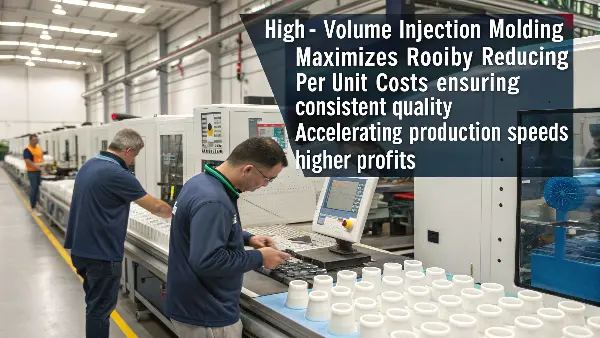
You have a great product, but producing it at scale presents a huge challenge. High upfront costs for tooling and slow production cycles are eating into your profits and delaying your market entry. Every day you wait, competitors are catching up. You’re worried about quality control issues from unreliable methods ruining your brand’s reputation. High-volume injection molding is the answer. It slashes your per-unit cost, ensures consistent quality, and gets your product to market faster.
High-volume injection molding improves ROI when the complete manufacturing system produces accepted parts reliably. Cavity count and piece price matter, but yield, cycle, uptime, material loss, labor, inspection, maintenance, packaging, logistics and inventory often determine the real return. A sound ROI model uses accepted output and total ownership cost rather than dividing mold price by annual quantity.
Related engineering resources: production injection molding | multi-cavity molds | export injection molds
High-volume injection molding services maximize your Return on Investment (ROI) by significantly lowering the cost per part through economies of scale. This method uses highly durable, multi-cavity molds to produce millions of identical parts quickly and efficiently. The high initial tooling investment is offset by the drastically reduced unit cost and rapid production speeds, leading to higher profit margins and a faster path to market for large-scale projects. This ensures consistent quality, minimizing waste and rework costs.
This sounds great in theory, but what does it really mean for your business? The jump to high-volume production is a big step. It involves careful planning, significant investment, and choosing the right partner. Understanding the key factors will help you make a smart, profitable decision for your company’s future.
What Kinds of Molds Are Used for High-Volume Production?
You’re ready for mass production, but you are not sure about the tooling. Choosing the wrong type of mold can lead to constant repairs, poor-quality parts, and production delays, which can cost you a lot of money. Imagine your production line stopping because the mold failed after just 100,000 cycles when you needed millions. This could cause huge financial losses and damage your reputation. For high-volume projects, you need strong, precisely made molds that are built to last.
High-volume production primarily uses steel molds, specifically SPI Class 101 molds. These are the highest quality and most durable molds, built to withstand over one million production cycles. They are typically made from hardened tool steels like H-13, S-7, or stainless steel. These molds often feature multiple cavities, complex cooling channels, and hot runner systems to maximize efficiency, reduce cycle times, and ensure consistent part quality across massive production runs.
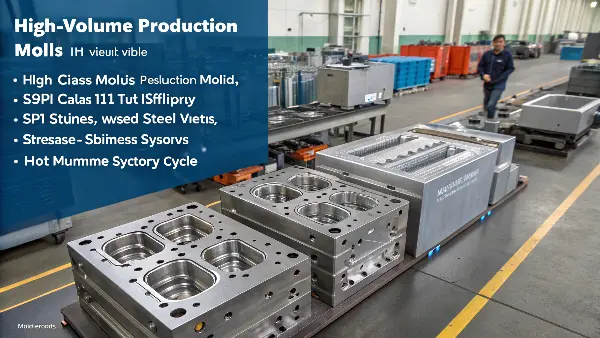
The Gold Standard: Class 101 Molds
The Society of the Plastics Industry (SPI) classifies molds from Class 101 to 105 based on their expected lifespan. For any serious high-volume project, a Class 101 mold is the only way to go. These molds are supported for one million cycles or more. They are built from the best materials, like hardened P20, H-13, or S-7 tool steel, which resist wear and tear from constant use. The high initial cost is an investment in reliability and uninterrupted production.
Key Features for Maximum Efficiency
High-volume molds are not just about durable materials; they are engineered for speed and consistency. Here are the common features:
- Multi-Cavity Design: Instead of making one part at a time, these molds often have 4, 8, 16, or even more cavities. This dramatically increases output per cycle.
- Hot Runner Systems: A hot runner system keeps the plastic molten all the way to the cavity gate. This eliminates the “runner” scrap seen in cold runner systems, reduces cycle time, and improves part quality.
- Advanced Cooling: Consistent temperature control is critical. These molds have complex cooling channels designed to cool the part quickly and evenly, which shortens cycle times and prevents defects like warping.
How Does Part Design Impact High-Volume Molding Costs?
You have a suitable design on paper, but turning it into a million physical parts is another story. A design that isn’t optimized for manufacturing can lead to sky-high mold costs, high defect rates, and slow production. Every small design flaw is magnified a million times over in high-volume production, eating away at your profit margins. The solution is to think about manufacturing from the very beginning. This is where Design for Manufacturability (DFM) becomes your most valuable tool.
Part design directly impacts high-volume molding costs by influencing mold complexity, material usage, and cycle times. A well-optimized design, following Design for Manufacturability (DFM) principles, simplifies the mold structure, reduces material waste, and allows for faster production cycles. Key considerations like uniform wall thickness, proper draft angles, and minimized undercuts can drastically lower both the initial tooling investment and the ongoing per-part cost, making the entire project more profitable and efficient.
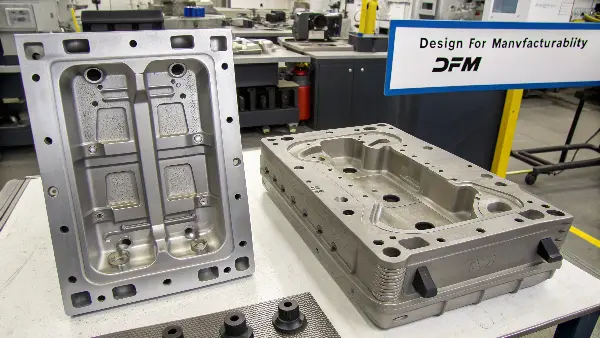
A useful principle is that the most expensive mistake is the one made on the drawing board. In high-volume molding, a simple design tweak can save tens of thousands of dollars over the life of a project. Before a single piece of steel is cut for a mold, we need to analyze the part design from every angle. It’s a critical step that separates successful projects from failing ones. This proactive approach ensures we build an efficient process, not just a functional part.
The Power of DFM
Design for Manufacturability (DFM) is a process where engineers review a part design to make sure it can be produced efficiently and reliably. For injection molding, this means focusing on a few key areas:
- Uniform Wall Thickness: This is probably the most important rule. If walls are too thick, they take longer to cool and can lead to sink marks. If they are uneven, the part can warp as it cools. Keeping walls consistent ensures a stable, predictable process.
- Draft Angles: A small taper, or draft angle, on vertical walls is essential. It allows the part to be ejected from the mold easily without drag marks or damage. Even a one-degree angle can make a huge difference.
- Radii and Corners: Sharp internal corners create stress points in the part and in the mold, which can lead to cracks. Adding a small radius (fillet) to these corners makes the part stronger and the mold more durable.
Costly Features to Avoid
Some design features dramatically increase mold complexity and cost. While sometimes necessary, you should generally question if they are truly needed.
- Undercuts: These are features that prevent the part from being ejected straight out of the mold. They require complex mechanisms like side-actions or lifters, which add thousands to the mold cost and slow down the cycle time.
- Complex Textures: High-detail or very deep surface textures can be difficult to mold cleanly and may require more expensive mold finishing processes.
- Strict Tolerances: While precision is important, unnecessarily tight tolerances can significantly increase manufacturing costs. We generally ask if the specified tolerance is critical for the part’s function.
What Material Selection is Best for Mass Production?
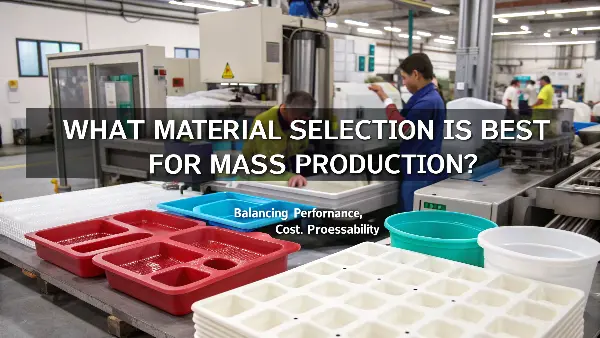
You need to choose a plastic for your product, but the options seem endless. Picking the wrong material can lead to product failure, regulatory issues, or unnecessarily high costs. The material needs to meet your functional requirements, but using an expensive engineering plastic when a simple commodity resin would do is like burning money with every part you produce. This is a balancing act between performance, cost, and processability, and getting it right is key to profitability.
For mass production, the best material selection balances performance, cost, and processability. Commodity plastics like Polypropylene (PP), Polyethylene (PE), and Polystyrene (PS) are often ideal due to their low cost and ease of molding. They are suitable for a wide range of consumer products. For applications requiring higher strength, heat resistance, or specific properties, engineering plastics like ABS, Polycarbonate (PC), or Nylon are used. The final choice depends on the product’s specific requirements and budget constraints.
Commodity Plastics: The Workhorses
For many high-volume applications, commodity plastics are the go-to choice. They are inexpensive, widely available, and generally easy to process. This makes them suitable for products where cost is a primary driver.
| Material | Key Characteristics | Common Applications |
|---|---|---|
| Polypropylene (PP) | Low cost, flexible, good chemical resistance | Food containers, packaging, automotive parts |
| Polyethylene (PE) | Very low cost, tough, excellent moisture barrier | Bottles, bags, toys |
| Polystyrene (PS) | Inexpensive, rigid, easy to mold | Disposable cups, cutlery, electronics housings |
| ABS | Good impact strength, rigidity, and surface finish | LEGO bricks, keyboard caps, power tool casings |
Engineering Plastics: When Performance is Key
When a product needs to withstand high temperatures, significant stress, or harsh chemical environments, we turn to engineering plastics. These materials offer superior mechanical and thermal properties, but they also come with a higher price tag. They are often used in automotive, medical, and industrial applications where reliability is non-negotiable. Examples include Polycarbonate (PC) for its impact strength and optical clarity, and Nylon (PA) for its excellent wear resistance and durability. The key is to justify the higher cost with a genuine performance requirement. Getting this right ensures your product is not over-engineered, which directly protects your profit margin.
When Should You Transition from Prototyping to High-Volume Molding?
You’ve successfully created a prototype and validated your design. Now, the big question is when to pull the trigger on expensive production tooling. Moving too soon can be a disaster if the market isn’t ready, leaving you with a huge investment and no sales. Waiting too long means your competitors could beat you to market, capturing the customers you were targeting. This decision is a critical moment for your business, and it’s filled with risk and uncertainty.
You should transition from prototyping to high-volume molding once you have achieved three key milestones. First, you must have a finalized and validated design, confirmed through functional prototypes and DFM analysis. Second, you need clear market validation, such as strong pre-orders or commitments from buyers, that justifies the investment. Finally, your production forecast must show that the per-part cost savings from high-volume molding will deliver a strong ROI compared to lower-volume methods.
Making the leap to high-volume production is one of the most exciting and nerve-wracking steps for a business owner. I’ve been there myself. It’s the moment your idea becomes a real, scalable product. But excitement doesn’t pay the bills. The decision must be based on data and a clear strategy, not just gut feeling.
The Green Lights for Mass Production
Hitting the “go” button on a Class 101 mold is a major financial commitment. Before you do, make sure you can check off these boxes.
- Design Freeze: Your part design should be completely finalized. Any changes after the steel mold is cut are extremely expensive and time-consuming. You need to be 100% confident that the design you’re tooling is the one you’re taking to market. This means all your functional and aesthetic testing with prototypes should be complete.
- Market Validation: Do you have proof that people will buy your product? This could be from a successful crowdfunding campaign, significant pre-orders from distributors, or strong interest from major retailers. Without this validation, you are gambling that a market exists.
- Financial Breakeven Analysis: You need to do the math. Calculate the an investment for the mold and the per-part price for high-volume production. Compare this to the cost of alternative methods like 3D printing or soft tooling. Determine the exact number of units you need to sell to break even on your tooling investment. If that number looks realistic and achievable based on your market validation, you are in a good position to move forward.
Model Accepted Parts Per Hour
Calculate cycle, cavities, availability, scrap, changeover and inspection capacity. A theoretical cycle is not the same as sellable output. Use actual machine and tool data where available, and separate planned maintenance from unplanned downtime so improvement efforts target the largest loss.
Optimize the Tool for the Business Case
Compare cavity count, runner type, hot-runner complexity, cooling, automation and spare inserts. A high-cavity tool may maximize output but can increase balancing and repair exposure. A modular design can protect uptime if a local wear area is replaceable without a full tool rebuild.
Reduce Material and Process Loss
Review part mass, runner mass, purge, startup scrap, color changes, regrind rules and process window. A lightweight design is useful only when stiffness, function and yield remain acceptable. Stable fill and pack also reduce the hidden cost of sorting and rework.
Automate the Decisions That Protect Quality
Use sensors, vision, cavity monitoring, pick-and-place, poka-yoke and traceability where they address a known loss. Automation should trigger a clear reaction—hold, alarm, stop, segregate or inspect—rather than simply collecting data no one uses.
Plan Maintenance and Supply Together
Schedule mold cleaning, lubrication, wear inspection, spare inserts, hot-runner service and gauge calibration around demand. Keep critical material, packaging and replacement parts available. The best ROI includes recovery time after a fault and the cost of a missed customer shipment.
How High-Volume Injection Molding Services Improve ROI: Buyer Review Checklist
- Calculate accepted parts per hour using cycle, cavities, uptime, scrap and changeover.
- Compare cavity, runner, cooling, automation and modular maintenance options.
- Control part mass, runner, purge, color change, startup scrap and regrind.
- Use monitoring only when it connects to a defined quality reaction.
- Include maintenance, spares, packaging, logistics and downtime recovery in ROI.
Frequently Asked Questions
What is the most important high-volume ROI metric?
Accepted parts per hour or per shift is often more useful than nominal cycle because it includes downtime, scrap, changeover and inspection constraints.
Can automation reduce ROI?
Yes, if it adds complexity without addressing a real loss. Automation creates value when it improves quality, uptime, labor, traceability or recovery in a measurable way.
Conclusion
High-volume injection molding is a powerful tool for achieving scale and profitability. It maximizes your ROI by driving down per-part costs, ensuring consistent quality, and enabling rapid production. By focusing on the right mold type, optimizing your part design for manufacturability, and making smart material choices, you can unlock its full potential. Knowing when to make the transition is key to turning a great product into a market success.