
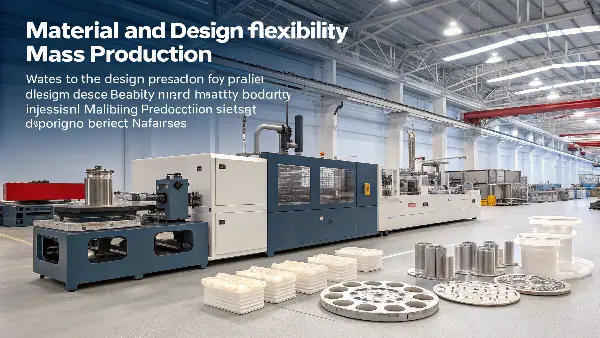
Why Is Injection Molding the Go-To Choice for Mass Production?

Are you struggling to scale your product manufacturing without costs spiraling out of control? You need a method that produces high-quality parts quickly and consistently, but finding the right one is tough. The wrong choice can lead to high per-unit costs, slow production times, and inconsistent quality, ultimately hurting your bottom line and reputation. Injection molding is the solution for scaling up production efficiently.

Injection molding is the best method for mass production because it offers an unbeatable combination of speed, cost-effectiveness, and precision at high volumes. Once the initial mold is created, you can produce hundreds of thousands, or even millions, of identical parts at a very low cost per unit. The automated process ensures rapid cycle times and consistent quality, making it the most reliable and economical choice for businesses looking to scale their manufacturing operations effectively and predictably.

An assembly line showing plastic parts being produced by an injection molding machine.

Choosing the right manufacturing process is one of the biggest decisions you’ll make for your product. It affects everything from your budget to your time-to-market and the final quality of what you deliver to customers. Many processes work well for small batches, but they break down when you need to produce thousands of units a day. Let’s break down exactly why injection molding stands out as the champion of mass production and see if it’s the right fit for your business.

What Makes Injection Molding So Cost-Effective for Large Volumes?

Are you watching your production costs increase as you try to scale up? Many manufacturing methods have a high variable cost, meaning each new part costs nearly as much as the first. This makes true mass production financially challenging, forcing you to choose between raising prices or accepting lower profit margins. You need a way to lower the per-unit cost as your volume grows.

Injection molding is incredibly cost-effective for large volumes because the high initial investment in the mold (tooling) is spread across thousands or millions of parts. This amortization drastically reduces the cost per unit. Additionally, the process is highly automated, which minimizes labor costs, and it produces very little material waste, as unused plastic can often be reground and reused. These factors combine to make it the most economical choice for high-volume production runs.

A graph showing the cost per part decreasing as production volume increases for injection molding.

I’ve worked with many business owners like Michael who are a bit hesitant about the upfront cost of a high-quality steel mold. It can seem like a big number at first. But the conversation changes when we start looking at the total cost of ownership over a full production run. It’s a classic case of investing strategically to save massively in the long run. Let’s dive deeper into how these costs break down and why that initial investment pays for itself so quickly.

Breaking Down the Costs

The key to understanding injection molding’s cost efficiency is amortization. Think of the mold as a long-term asset. While it might cost tens of thousands of dollars, it’s built to last for a million cycles or more.

Cost Factor Initial Stage (Low Volume) Mass Production Stage (High Volume) Explanation
Tooling (Mold) Cost High Very Low (per part) The initial mold cost is divided by the total number of parts produced. More parts mean a lower cost per part.
Material Cost Moderate Low Buying raw plastic pellets in bulk for mass production significantly reduces the cost per kilogram.
Labor Cost Moderate Very Low The process is highly automated. A single operator can oversee multiple machines, reducing labor costs per unit.
Cycle Time N/A Very Low Fast, automated cycles mean more parts are produced per hour, further reducing the allocated cost of labor and overhead.

The Ripple Effect of Automation

Automation is the engine of injection molding’s low cost. Once a mold is set up in a machine, it can run 24/7 with minimal human supervision. This not only cuts down on direct labor bills but also eliminates errors and inconsistencies that come with manual processes. I remember a client who switched from a more labor-intensive method. Their per-unit labor cost dropped by over 80%, which completely transformed their product’s profitability. This efficiency is the foundation of scalable manufacturing.

How Does Injection Molding Achieve Unmatched Speed and Efficiency?

Is your current production method too slow to meet market demand? Falling behind schedule means missed opportunities and unhappy customers. When a new product takes off, you need to be able to ramp up production immediately, not wait weeks or months for parts to slowly trickle off the assembly line. This bottleneck can be the single biggest barrier to your company’s growth.

Injection molding achieves incredible speed through rapid cycle times, often lasting just a few seconds from injecting the plastic to ejecting a finished part. This is possible due to highly optimized machinery and multi-cavity molds that produce several parts in a single cycle. The process is also fully automated, allowing machines to run continuously, 24/7, with minimal downtime. This consistent, high-speed output is unmatched by other manufacturing methods.

A close-up of a multi-cavity mold opening to eject multiple finished parts at once.

Speed isn’t just about how fast one part can be made; it’s about how quickly you can get 100,000 parts shipped to your distribution center. When I first started in this industry, I was amazed at how a factory could go from raw plastic pellets to a truckload of finished products in a single day. This level of efficiency is a game-changer for any business that relies on physical products. Let’s look at the mechanics behind this incredible speed.

The Anatomy of a Fast Cycle

The "cycle time" is the total time it takes to produce one "shot" of parts. This is the core metric for speed in injection molding. A typical cycle involves closing the mold, injecting the molten plastic, holding pressure, cooling the part, opening the mold, and ejecting the parts.

Key Factors Driving Speed:

  • Automation: The entire cycle is computer-controlled. There are no manual steps to slow things down. The precision of the machine ensures every cycle is exactly as fast as the last.
  • Cooling System Design: Cooling is often the longest part of the cycle. A well-designed mold has intricate cooling channels that run water or oil through it to solidify the plastic part as quickly as possible. This is one area where expertise in mold design really shines.
  • Multi-Cavity Molds: Why make one part when you can make eight, sixteen, or even sixty-four at the same time? Multi-cavity molds multiply the output of each cycle. For a small, simple part, a 32-cavity mold running on a 20-second cycle can produce nearly 5,000 parts per hour from a single machine.
  • Hot Runner Systems: In traditional molds, there’s a "sprue" and "runners" that channel plastic to the part cavities. This plastic has to be cooled and ejected, adding to cycle time and creating waste. Hot runner systems keep the plastic molten right up to the part, eliminating this step and enabling even faster cycles.

I always advise my clients that a small investment in a better cooling design or a hot runner system can pay for itself in weeks through faster production and reduced waste.

Can You Really Maintain High Quality Across Millions of Parts?

Are you worried that scaling up production will lead to a drop in quality? It’s a common fear. When you’re making parts by the million, even a tiny inconsistency can result in a mountain of defective products. This hurts your brand’s reputation, leads to costly returns, and can destroy customer trust. You need a process that guarantees every part is as perfect as the first.

Yes, injection molding is exceptional at maintaining extremely high quality and tight tolerances across millions of parts. The process uses a robust steel mold as a master template, ensuring every part is a perfect replica. The automated, computer-controlled process parameters—such as temperature, pressure, and injection speed—are precisely managed. This eliminates human error and guarantees a level of consistency that is nearly impossible to achieve with other manufacturing methods at scale.

A quality control inspector using calipers to measure a plastic part, with countless identical parts in the background.

I’ve seen firsthand how consistency builds a brand. One of my long-term clients in the consumer electronics space, much like Michael, built his entire business on the reliability of his products. He knew that his customers expected every device to look, feel, and function identically. We achieved that by using high-precision molds and a tightly controlled process. This level of repeatability is not an accident; it’s engineered into the injection molding process itself. Let’s explore how.

The Pillars of Consistency

Three main elements work together to ensure part-to-part consistency in injection molding. If you compromise on any one of these, quality will suffer.

1. The Mold: Your Master Copy

The mold is the heart of the process. It’s a negative of your final part, machined from hardened steel to incredibly tight tolerances (often within 0.001 inches).

  • Durability: A high-quality P20 or H13 steel mold can withstand the intense pressure and temperature of millions of cycles without wearing down or changing shape. This ensures that the millionth part produced is dimensionally identical to the first.
  • Precision: The details, textures, and features of your part are physically cut into the steel. This means features are replicated perfectly every single time, without variation.

2. The Process: Controlled and Repeatable

The injection molding machine is a sophisticated piece of equipment that controls every variable with digital precision.

  • Parameter Control: Injection pressure, melt temperature, cooling time, and shot size are all programmed and monitored. The machine makes micro-adjustments in a closed-loop system to ensure every single shot is identical.
  • Elimination of Human Error: Once the process is dialed in, the machine takes over. There’s no risk of an operator getting tired or making a mistake that affects part quality.

3. The Material: Stable and Predictable

Modern thermoplastic materials are engineered for consistency.

  • Standardization: Resin manufacturers provide detailed datasheets specifying the exact melt flow rate, shrinkage, and other properties. This allows us to predict exactly how the material will behave and adjust the process for optimal results.

This trifecta—a precision mold, a controlled process, and stable material—creates a manufacturing ecosystem where consistency isn’t just a goal; it’s the natural outcome.

How Does Material and Design Flexibility Benefit Mass Production?

Do you feel limited by manufacturing processes that only work with a few materials or can’t handle complex shapes? This can stifle innovation and force you to compromise on your product’s design, performance, or appearance. To stay competitive, you need a process that can bring your most creative ideas to life without forcing you back to the drawing board.

Injection molding offers enormous flexibility for mass production through its compatibility with a vast range of thermoplastic polymers, each with unique properties. You can choose materials that are rigid, flexible, heat-resistant, or transparent. Furthermore, the process excels at producing highly complex geometries, intricate details, and thin-walled sections in a single step. This allows for the consolidation of multiple components into one stronger, lighter, and more cost-effective part.

A collection of various injection molded parts showing different colors, textures, and complex shapes.

I always get excited when a client brings me a challenging design. They often think it’s impossible to manufacture at scale. Many times, they’re coming from the world of CNC machining or 3D printing, where complexity directly equals cost and time. I love showing them how injection molding can not only produce that complex part but do it in seconds. This freedom opens up a new world of possibilities for product development.

Unlocking Design Freedom

The ability to create complex shapes is one of injection molding’s greatest strengths. Because the material is injected as a liquid, it can fill tiny, intricate features of a mold that would be difficult or impossible to create with other methods.

Key Design Advantages:

  • Part Consolidation: You can combine multiple, separate parts into a single, more robust molded component. I worked on a project for an electronics enclosure that was originally made of five stamped metal and machined plastic pieces. We redesigned it as a single molded part. This eliminated assembly steps, reduced weight, and lowered the total cost by 40%.
  • Complex Geometries: Features like bosses for screws, reinforcing ribs, living hinges, and snap-fit connectors can be molded directly into the part. This adds functionality without adding manufacturing steps or cost.
  • Variety of Finishes: You can achieve different surface finishes directly from the mold. Whether you need a high-gloss, matte, or textured surface, it can be polished or etched into the mold steel itself, saving you from secondary finishing operations.

A World of Materials

The sheer number of available materials for injection molding is staggering. This allows you to precisely match the material to the application’s requirements.

Material Category Common Examples Key Properties Typical Applications
Commodity Polymers Polypropylene (PP), Polyethylene (PE) Low cost, flexible, good chemical resistance Packaging, containers, toys
Engineering Polymers ABS, Polycarbonate (PC), Nylon (PA) Strong, stiff, good impact and heat resistance Automotive parts, electronic housings, gears
High-Performance PEEK, Ultem (PEI) Extreme heat and chemical resistance, very strong Aerospace, medical implants, industrial
Elastomers Thermoplastic Polyurethane (TPU) Flexible, rubber-like, abrasion-resistant Phone cases, soft-touch grips, seals

This flexibility means you are never stuck with a "one-size-fits-all" solution. You can choose the exact combination of design features and material properties to create the best possible product for your customers.

Conclusion

In summary, injection molding is the undisputed leader for mass production for clear reasons. It delivers an exceptional mix of low per-unit cost, high-speed output, and unwavering quality. This powerful combination allows businesses to scale confidently, meet market demand, and maintain profitability. When your goal is to produce thousands or millions of identical parts, there is simply no other process that balances these critical manufacturing variables so effectively.

Facebook
Twitter
LinkedIn

Request A Quote for Your Projects!

Hi there! I’m Jerry, a proud dad and passionate at CKMOLD. With years of hands-on experience in the injection mold and CNC industry, I’ve grown from managing the smallest details on the shop floor to leading international projects with clients across Europe and the U.S.

At CKMOLD, we specialize in precision molds, plastic parts, and CNC solutions that help bring bold product ideas to life. I love solving complex challenges, building long-term partnerships, and pushing the limits of what great manufacturing can do.

Let’s connect, exchange ideas, and grow together—whether you’re looking for a reliable manufacturing partner or just want to talk shop!

Request a Quick Quote

Send your drawings and detailed requirements via:
Email: jerry@ckmold.com

Or fill out the contact form below:

We will contact you within one working day. Please pay attention to the email with the suffix “@ckmold.com”

Wait, We Have Something Special for You!

Join our mailing list and receive a 10% discount on your next mold or CNC project.