Finding a mold supplier is easy, but finding a true partner is hard. You might face delays, poor quality, or communication breakdowns that hurt your business. You need a manufacturer who understands your goals and delivers consistent results.
The right injection molding partner is not simply the lowest quotation or the factory with the largest machine list. The supplier must understand the product risk, explain DFM tradeoffs, control tool building and trials, produce traceable quality evidence and support the program after launch. Selection should test capabilities with project-specific questions rather than generic claims.
Related engineering resources: injection molding services | export injection molds | contact CKMOLD
To select the right partner, you must evaluate their technical expertise, quality control systems, and transparency. Look for experience in your specific industry, the ability to handle your volume requirements, and a clear understanding of material properties. Ask for references and case studies to verify their track record.

It is not just about the lowest price. It is about trust and capability. If you choose the wrong partner, you will pay more in the long run.
What Factors Determine If You Should Injection Mold a Part?
Do you really need injection molding for your project? If you choose this process for the wrong volume, you will waste money on expensive tooling. You need to know if the numbers make sense for your business.
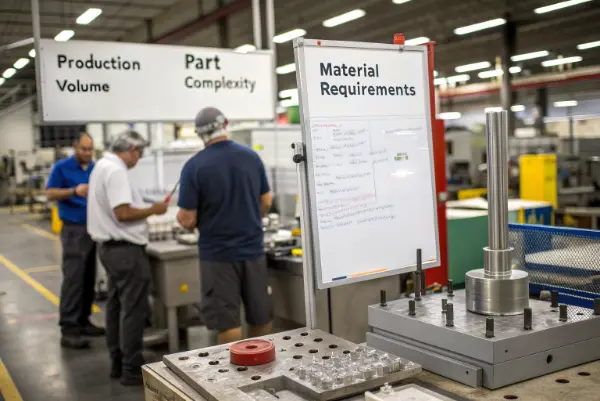
You must consider production volume, part complexity, and material requirements. High initial tooling costs make injection molding best suited for medium to high-volume runs where the per-unit cost drops significantly. Additionally, complex geometries that are difficult to machine often require molding.
Here is a breakdown of when to choose molding:
| Factor | When to Choose Injection Molding | When to Avoid It |
|---|---|---|
| Volume | High volume (Thousands to millions). | Low volume (Under 500 units). |
| Cost | You have a budget for upfront tooling. | You need zero upfront investment. |
| Speed | You can wait for the mold (4-8 weeks). | You need parts tomorrow. |
| Quality | You need suitable surface finishes. | Rough prototypes are acceptable. |
Another factor is the material. Some high-performance plastics can only be processed through injection molding. You cannot easily machine them without stress marks. Also, think about the geometry. If your part has complex internal features, machining might be impossible. A good partner will tell you the truth. At CKMOLD, if A common observation is a client’s volume is too low, I suggest other methods. I want to help them grow, not just take their money for a mold they do not need.
What General Considerations Must Designers Keep in Mind for Plastic Components?
A design that looks good on a computer screen might fail in the factory. If your designer ignores the rules of plastic, you will get warped parts and sink marks. You need to design specifically for the manufacturing process.
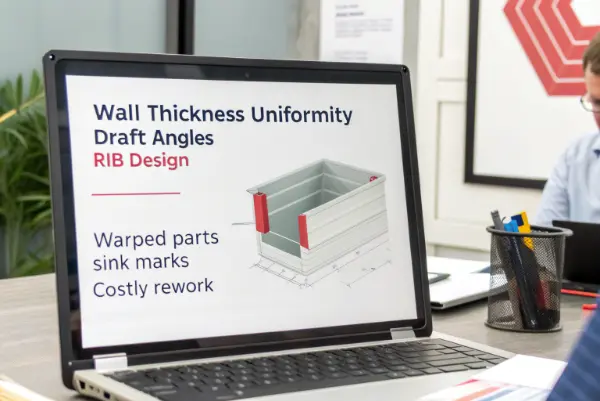
Designers must prioritize wall thickness uniformity, draft angles, and rib design. Uniform walls prevent warping and sink marks, while proper draft angles ensure the part ejects cleanly from the mold. Ignoring these leads to costly rework.
Here are the key areas to focus on:
- Draft Angles: You cannot have vertical walls. You need a slight slant, called a draft angle. This lets the part slide out of the metal mold. Without it, the part sticks and gets drag marks. I usually recommend at least 1 to 2 degrees of draft.
- Ribs and Bosses: These add strength and allow for screws. But if they are too thick at the base, you get sink marks on the other side. The rule of thumb is that the rib thickness should be about 60% of the main wall thickness.
- Corner Radii: Sharp corners cause stress. Plastic flows better around curves. Adding a radius to corners makes the part stronger and the mold easier to fill.
During project review, I generally perform a DFM (Design for Manufacturability) review. This is where we catch these issues before we cut steel. A partner who just builds what you send them is dangerous. You need a partner who reviews your design and suggests changes to improve quality and lower costs.
What Are the 4 Critical Variables in Injection Molding?
Does your supplier understand the science behind the machine? Molding is not just squishing hot plastic into a hole. It requires precise control of physics. Without this control, your parts will vary in size and strength.
The four key variables are temperature, pressure, time, and speed. The plastic melt temperature affects flow, pressure ensures the mold fills completely, time dictates cooling and cycle rates, and injection speed impacts surface finish and filling patterns.
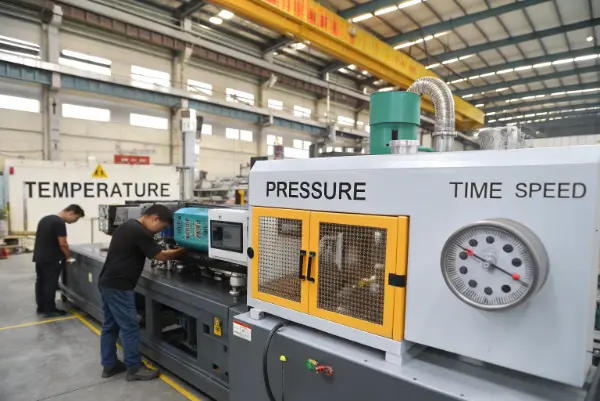
I spent years on the factory floor, and I learned that these four variables are like a recipe. If you change one, you change the result. A good molding partner monitors these constantly.
- Temperature: This includes the barrel temperature and the mold temperature. If the plastic is too cold, it won’t fill the mold (short shot). If it is too hot, it degrades and becomes weak. The mold temperature controls how the surface looks. A hotter mold usually gives a glossier finish.
- Pressure: There are two types. Injection pressure pushes the plastic in. Holding pressure keeps it there while it shrinks. If the holding pressure is too low, the part shrinks too much and dimensions go out of spec.
- Time: Time is money, but you cannot rush physics. The cooling time is the longest part of the cycle. If you eject the part too soon, it warps. A reliable partner optimizes this time without sacrificing quality.
- Speed: This is how fast the screw moves forward. If you go too fast, the friction burns the plastic (jetting or burn marks). If you go too slow, the plastic freezes before the mold is full.
You should ask your potential partner how they control these variables. Do they have automated monitoring? Do they keep records for each batch? In my trading company, we ensure that every machine is calibrated. We want the first part and the millionth part to be exactly the same. This consistency comes from mastering these four variables.
What Are the Criteria for Selecting the Right Injection Molding Machine?
Using the wrong machine for your mold is a recipe for disaster. If the machine is too small, the mold opens up during injection. If it is too big, you waste energy and degrade the material. Size matters in manufacturing.
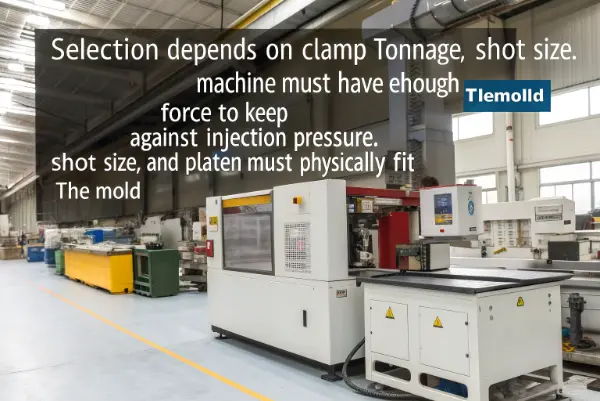
Selection depends on clamp tonnage, shot size, and platen size. The machine must have enough clamping force to keep the mold closed against injection pressure. The shot size must match the part volume, and the platen must physically fit the mold.
When you visit a supplier, look at their machines. Do they have a wide range of sizes? This is important. You cannot run a tiny part on a massive machine effectively. The plastic sits in the heated barrel for too long and starts to break down. This is called “residence time.”
Here is how we match a mold to a machine:
- Clamp Tonnage: This is the force that holds the mold closed. We calculate this based on the projected area of your part. Generally, you need 2 to 5 tons of force for every square inch of the part. If the machine is weak, the pressure of the plastic forces the mold open. This creates “flash,” which is extra thin plastic on the edges that you have to trim off. Flash kills efficiency.
- Shot Size: This is the maximum amount of plastic the machine can inject at once. You typically want your part to use between 20% and 80% of the machine’s capacity. If you use less than 20%, the control is poor. If you need more than 80%, you might run out of plastic before the mold is full.
- Tie Bar Spacing: The mold has to physically fit inside the machine. The tie bars are the large columns that guide the machine. If your mold is wide, you need a machine with wide spacing.
At CKMOLD, Project teams should ask about the “equipment list.” A partner with only 100-ton machines cannot help you if your product grows and you need a larger mold. You want a partner with a diverse fleet. This ensures that as your business scales, they can scale with you. It is about having the right tool for the job.
Normalize Scope Before You Compare Suppliers
A low quotation is not comparable when suppliers include different tool construction, sampling, documentation, ownership or production responsibilities. Issue one controlled RFQ package and require every bidder to list assumptions, exclusions and deviations.
| Evidence before award | What a buyer should see | Why it matters |
|---|---|---|
| DFM sample | Parting, gate, ejection, wall/draft, undercuts, critical dimensions and open risks | Shows whether the supplier can explain decisions, not only quote steel |
| Tool scope | Cavities, steel/components, runner, cooling, actions, spares, ownership and destination-press interface | Prevents unlike tooling packages from being compared as one price |
| Trial and acceptance | T1/T2 quantities, process record, dimensional/cavity report, material, appearance and sign-off rules | Defines when learning becomes an accepted tool |
| Production quality | Material and cavity traceability, control plan, gauges, reaction plan and change approval | Tests whether the supplier can sustain the result |
| Delivery and lifecycle | Packaging, export documents, maintenance, repair response, spare inserts and data handover | Moves the comparison from purchase price to program risk |
Ask for redacted examples where customer confidentiality applies: a DFM page, mold-design review, trial report, dimensional report, corrective-action record and change notice. Verify that the examples reflect a representative mold and that the proposed team can explain them. A certificate or equipment list alone does not prove execution.
Use the CKMOLD RFQ form to submit the same scope used for competing bids. After the form, email CAD and the dimensioned drawing to jerry@ckmold.com with company, project, revision and units.
Assess Engineering and DFM Depth
Send a representative part and review how the supplier discusses walls, material, gates, parting, cooling, ejection, tolerances and failure modes. Strong partners explain consequences and alternatives. A checklist without reasoning provides little evidence of engineering judgment.
Audit Tooling and Trial Control
Clarify whether design and machining are in-house or managed externally, how steel and components are verified, and how trials are documented. Review tool ownership, drawings, maintenance, spare inserts, change approval and transfer capability.
Verify Quality Systems With Examples
Ask for a sample dimensional report, material traceability, cavity records, control plan, gauge method, nonconformance response and corrective-action example. Certifications may support the system, but project evidence shows how it operates in practice.
Check Capacity and Supply Resilience
Evaluate machine fit, available capacity, automation, material handling, maintenance, utilities, backup plans, packaging and logistics. Confirm how forecasts, rush demand, downtime and supplier shortages are communicated and recovered.
Test Communication Before Award
Observe response quality during RFQ, DFM and sample review. Confirm technical and commercial owners, language, meeting rhythm, escalation path and approval records. A partner relationship is safer when decisions are visible and problems are reported early.
Select an Injection Molding Partner for a B2B Program: Buyer Review Checklist
- Challenge the supplier with project-specific DFM and failure-mode questions.
- Review tool design, build, trial, ownership, maintenance, spares and transfer controls.
- Inspect traceability, reports, gauges, control plans and corrective-action evidence.
- Confirm machine fit, capacity, automation, materials, backup and logistics.
- Define technical owners, communication cadence, escalation and approval records.
Frequently Asked Questions
What should buyers compare beyond injection molding price?
DFM quality, tool scope, accepted-part assumptions, inspection, maintenance, change control, packaging, logistics, capacity and recovery support.
Is an audit necessary before awarding a mold?
For important programs, an on-site or remote evidence-based audit can reveal how the supplier actually manages engineering, quality, tooling and production risks.
Conclusion
Selecting the right partner requires looking at feasibility, design support, process control, and equipment capability. You need someone who asks the right questions and understands your business goals. Choose a partner who values transparency and quality as much as you do.