
Choosing the wrong manufacturing method for your plastic parts is a costly mistake. You might spend thousands on tooling you do not need, or you might pay too much per unit because you stuck with prototyping methods for too long. You need to know exactly when to switch processes to save money and ensure quality.
The best plastic manufacturing process is the one that meets the product’s material, geometry, tolerance, surface, quantity, schedule and lifecycle needs with acceptable risk. Injection molding is powerful at repeatable scale, while machining, additive manufacturing, casting and thermoforming can be better at other stages or geometries. A process matrix prevents a familiar method from becoming the default answer.
Related engineering resources: injection molding services | prototype injection molding | rapid tooling
Injection molding is the best choice for high-volume production where low unit cost and high repeatability are required. While methods like 3D printing and CNC machining are superior for prototypes or low volumes, injection molding becomes the most economical solution once you need more than 500 to 1,000 units. It offers the widest range of material options and surface finishes compared to other plastic manufacturing technologies.
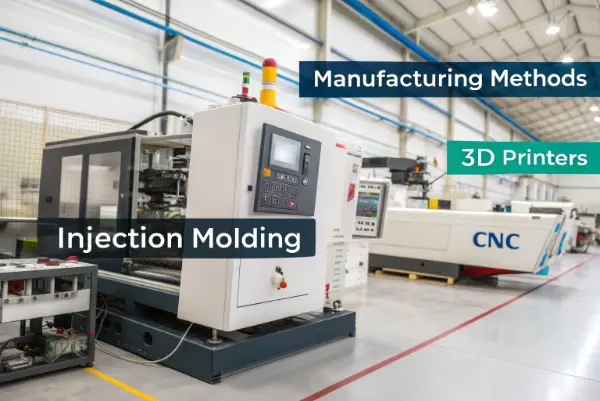
Many business owners I meet get stuck in the decision phase. They look at the high upfront cost of a steel mold and get scared. They try to force other methods to work for production, but that usually hurts their profit margins in the long run. To help you make the right choice for your business, I will break down the differences between injection molding and the four most common alternatives.
Injection Molding vs. 3D Printing: When Should You Make the Switch?
Are you still printing your production parts because you want to avoid tooling costs? This is a common trap that eats into your profit margin.
3D printing is ideal for rapid prototyping and complex geometries that cannot be molded, but it is slow and expensive per unit. Injection molding requires an initial investment in tooling, but the cost per part drops significantly as volume increases. You should switch to injection molding when your order volume exceeds 500 units to ensure structural integrity and speed.
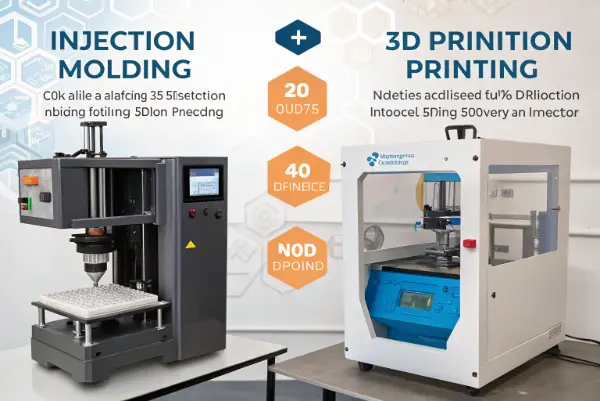
However, 3D printing has limits. The biggest issue is time and material properties. A 3D printed part is built layer by layer. This means it is often weaker in one direction (anisotropic). If your consumer electronics product drops on the floor, a printed case might crack along the layer lines. Injection molded parts are solid and uniform (isotropic). They are much stronger.
Also, think about speed. A printer might take 3 hours to make one casing. An injection molding machine can make that same casing in 30 seconds. If you need 10,000 units for a holiday launch, 3D printing cannot keep up. You have to look at the “Break-even Point.” This is the moment where the cost of the mold pays for itself because the unit price is so low.
Here is a simple breakdown of how the costs and features compare:
| Feature | 3D Printing | Injection Molding |
|---|---|---|
| Setup Cost | Low (No tooling required) | High (Mold design and machining) |
| Unit Cost | High (Constant regardless of volume) | Low (Decreases as volume rises) |
| Speed per Part | Slow (Hours) | Fast (Seconds) |
| Material Strength | Weaker (Layer adhesion issues) | Strong (Solid, uniform material) |
| Surface Finish | Rough (Layer lines visible) | Smooth (Mirror or textured finish) |
Injection Molding vs. CNC Machining: Which Offers Better Precision?
Do you need tight tolerances and high-strength engineering plastics for your components? You might be debating between cutting the plastic away or molding it into shape.
CNC machining is a subtractive process that offers incredible precision and no tooling costs, making it suitable for low-volume, high-strength structural parts. Injection molding is faster and produces less waste, making it better for mass production. Choose CNC for quantities under 500 or for parts requiring tolerances that molding cannot consistently hold.
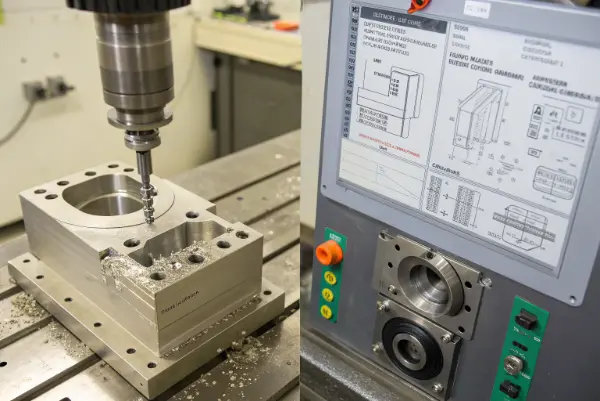
CNC machining is often the next step after 3D printing but before full-scale molding. In my trading company, A practical approach is to CNC machining to clients who need 50 to 100 parts for beta testing. The parts look and feel like the final product because they are made from the real block of material, not printed layers.
The main difference here is how the part is made. CNC is “subtractive.” You start with a big block of plastic and cut away what you don’t want. This creates a lot of waste. If your part design is complex, you might turn 60% of that expensive plastic block into chips on the floor. Injection molding is “additive” in a different way—you only melt the material you need (plus a little for the runner system, which can often be recycled).
For consumer electronics, surface finish is key. CNC machining leaves tool marks—tiny swirls where the cutter moved. You have to sand and polish these out by hand, which adds labor cost. An injection mold can be textured or polished once. Every part that comes out of that mold will have that specified finish automatically.
However, CNC wins on changes. If you find a mistake in your design, you just change the code on the computer. If you find a mistake after making a steel mold, you have to weld the steel and re-cut it. That is expensive. That is why I generally tell the buyer and my other clients: “Measure twice, cut once.” Make sure your design is frozen before you cut steel.
| Comparison Point | CNC Machining | Injection Molding |
|---|---|---|
| Waste Material | High (Subtractive process) | Low (Runners can be recycled) |
| Design Changes | Easy (Change the program) | Difficult (Modify the steel mold) |
| Tolerance | Very High (+/- 0.005mm is possible) | High (Dependent on shrinkage) |
| Geometry | Limited by tool access | Can handle complex undercuts |
| Best Volume | 1 – 500 parts | 1,000+ parts |
Injection Molding vs. Blow Molding: How Do You Handle Hollow Parts?
Are you designing a bottle, a container, or a hollow tube for your product line? You cannot use standard injection molding for these shapes because you cannot get the metal core out.
Blow molding is specifically designed for creating hollow plastic parts like bottles, tanks, and containers. Injection molding creates solid parts or open-shelled parts like caps and casings. If your design is a completely enclosed hollow shape, you must use blow molding; for everything else, injection molding is usually the superior choice.
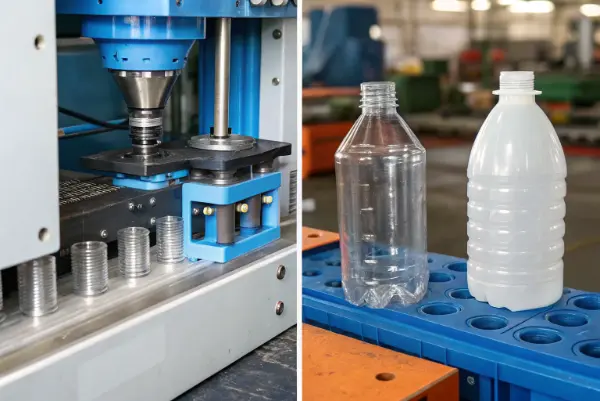
Blow molding works like blowing up a balloon. A tube of hot plastic (called a parison) drops down. A mold closes around it, and air is blown inside. The plastic expands to hit the walls of the mold. Because of this, you cannot control the wall thickness reliably. The corners might be thinner than the sides. Injection molding is different. We inject plastic into a precise gap between two steel plates. The wall thickness is controlled exactly by the steel.
For your business, the buyer, you deal with consumer electronics. You probably won’t use blow molding often unless you are making packaging or perhaps a specific type of fluid reservoir. But it is important to know the difference. Injection molding allows for high detail, sharp corners, and ribs for strength. Blow molding is for volume and storage.
Usually, these two processes work together. Look at any water bottle. The bottle is blow molded. The cap is injection molded. The cap needs threads that are very precise to stop leaks. Blow molding is not precise enough for tight threads. If you have a project requiring both, you often need two different partners or a large factory that has both divisions.
| Feature | Blow Molding | Injection Molding |
|---|---|---|
| Primary Use | Hollow objects (Bottles, Tanks) | Solid or Open objects (Caps, Cases) |
| Wall Thickness | Variable (Stretches like a balloon) | Precise (Defined by the mold) |
| Precision | Lower | Very High |
| Tooling Cost | Moderate | High |
| Cycle Time | Fast | Fast |
Injection Molding vs. Thermoforming: Which is Best for Large Parts?
Do you need to make large, simple plastic trays or covers without spending a fortune on heavy steel molds? Thermoforming might be the alternative you are looking for.
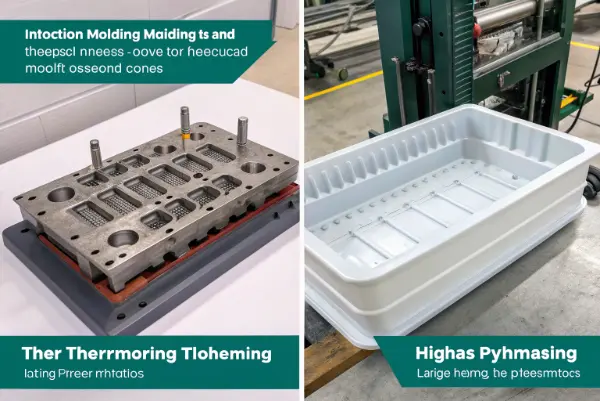
Thermoforming (or vacuum forming) heats a plastic sheet and sucks it over a mold, making it ideal for large, simple parts and packaging trays with lower tooling costs. Injection molding injects molten plastic at high pressure, allowing for complex details, ribs, and bosses that thermoforming cannot achieve. Choose thermoforming for large, thin-walled parts where high detail is not required.
Thermoforming is a process you see every day but might not notice. The plastic tray inside a box of chocolates? That is thermoforming. The inner liner of your refrigerator door? That is often thermoforming too.
The main advantage here is the mold cost. In injection molding, the mold must withstand tons of pressure. It has to be made of high-grade steel and have two sides (core and cavity). In thermoforming, the pressure is just vacuum suction. The mold only needs to be on one side, and it can be made of cheaper aluminum or even wood for prototypes. This makes the entry cost much lower.
However, as a business owner focusing on quality, you need to know the limitations. Thermoforming cannot make “features” on the back of the part. You cannot add screw bosses, ribs for strength, or snap-fits directly in the process. You would have to glue them on later, which looks cheap and adds labor. Injection molding creates all those features in one shot.
Also, thermoforming is limited to a constant sheet thickness. If you start with a 3mm sheet and stretch it over a deep shape, the corners might end up being only 1mm thick. Injection molding fills the cavity completely, so you can choose to make corners thicker for strength if you want. For consumer electronics housings, injection molding is often the winner because you need those internal mounting points for your circuit boards.
| Feature | Thermoforming | Injection Molding |
|---|---|---|
| Process Pressure | Low (Vacuum) | High (Hydraulic/Electric ram) |
| Tooling Material | Aluminum (Cheaper) | Tool Steel (Expensive) |
| Part Detail | One side only | Both sides (Complex features) |
| Secondary Ops | Trimming required | Parts come out finished |
| Best Application | Packaging, Large panels | Structural parts, Housings |
Injection Molding
Best suited to repeatable parts whose volume can justify tooling. It supports integrated ribs, bosses, textures, inserts and multiple cavities, but requires draft, gates, parting, cooling, process development and change discipline. Unit economics improve with accepted volume.
CNC Machining
Useful for low quantities, tight interfaces and production-like stock materials without a dedicated mold. Tool access, fixturing, waste and cycle limit geometry and scale. It does not reproduce molded shrinkage, weld lines or fiber orientation.
Additive Manufacturing
FDM, SLA, powder-bed and other methods offer fast iteration and geometric freedom. Orientation, surface, porosity, support, material selection and post-processing affect fidelity. They are often strongest for prototypes, fixtures and specialized low-volume parts.
Casting and Forming
Urethane casting can produce multiple appearance or functional samples from a master, while thermoforming can suit large thin shells. Material range, wall distribution, trimming, tooling and tolerances differ from molding. Compare the actual finished-part requirement.
Calculate Break-Even With Accepted-Part Cost
Do not use a universal volume threshold to switch from machining or additive manufacturing to injection molding. When both routes deliver the same approved function and quality, a simple economic screen is:
Break-even quantity = (injection-mold tooling and launch cost − alternative setup cost) ÷ (alternative accepted-part cost − molded accepted-part cost).
The denominator must be positive. If molding does not save cost per accepted part, this equation has no positive payback point. Keep schedule, design-change risk, capacity and qualification risk outside the formula and review them separately.
| Illustrative input | Amount | Boundary |
|---|---|---|
| Mold tooling and launch | USD 18,000 | Demonstration assumption, not a CKMOLD quotation |
| Alternative setup | USD 1,000 | Same released geometry and quality scope |
| Alternative accepted-part cost | USD 18.00 | Includes scrap, inspection and required finishing |
| Molded accepted-part cost | USD 4.00 | Includes resin, molding, scrap, inspection and required secondary work |
| Calculated break-even | (18,000 − 1,000) ÷ (18 − 4) = 1,214.3 | Economic crossover begins at approximately 1,215 accepted parts |
Build cost from accepted output, not machine price alone: include setup, tooling amortization, material, scrap/rework, inspection, secondary operations, packaging and logistics on the same basis. Use the injection mold cost estimator only for a preliminary tooling budget, then request an engineering review of geometry, cycle, yield and production cost through the RFQ page.
Build a Weighted Process Decision
Score annual and lifetime volume, revision risk, material fidelity, geometry, tolerance, surface, lead time, investment, labor, scrap, assembly and certification. Hybrid paths—printing, then rapid tooling, then production molding—often reduce total risk better than one method used from concept to scale.
Injection Molding vs. Other Plastic Manufacturing Methods: Buyer Review Checklist
- Define volume, revision risk, resin, geometry, tolerance, surface and lead time.
- Compare tooling, labor, scrap, inspection, assembly and accepted-part cost.
- State which process behaviors the prototype or low-volume route cannot represent.
- Include supply, certification, maintenance and future change requirements.
- Consider hybrid development paths instead of forcing one process across all stages.
Frequently Asked Questions
When does injection molding usually beat 3D printing?
When volume, repeatability, production resin, surface, cycle and integrated geometry justify tooling; the exact break-even depends on the part and quality plan.
Can one product use several plastic processes?
Yes. Prototypes, bridge quantities, fixtures and final production may use different processes as long as evidence and revisions are controlled.
Conclusion
There is no single “best” manufacturing method. It all depends on your volume, your budget, and the geometry of your part. If you are in the prototyping phase, stick to 3D printing or CNC machining. If you are making hollow containers, go with blow molding. But if you are ready for mass production of precise, strong, and complex parts for your electronics business, injection molding is the gold standard. At CKMOLD, we help you navigate these choices to ensure you master molding right.