Related engineering resources: injection molding services | export injection molds | contact CKMOLD

Illustrative scenes; they do not document a particular CKMOLD machine fleet, audit or customer project.
Does the Supplier Justify the Manufacturing Route?
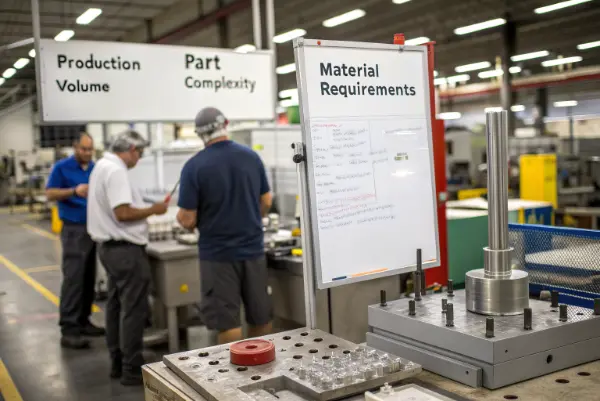
Ask for a comparison using your exact resin, geometry, annual and lifetime quantities, design maturity and acceptance requirements. There is no universal 500-part cutoff: Protolabs documents molding services without a minimum order quantity, showing why the tooling route and commercial scope matter. This is an example of another supplier’s offering, not a CKMOLD price or lead-time promise. Compare the resin evidence using the exact grade and test conditions in the thermoplastic data-sheet review.
| Decision | Evidence to request | Reason to reconsider |
|---|---|---|
| Volume and cost | Tooling, setup, accepted-part cost and repeat-order assumptions | Tool cost cannot be justified at forecast demand, or demand is too uncertain |
| Design maturity | DFM risks, prototype results and expected revision cost | Frequent changes may make temporary tooling, machining or printing more suitable |
| Schedule | Dates for design approval, tool build, trial, correction and release | The complete approval path cannot meet the required date |
| Material and function | Exact grade, process availability and finished-part tests | An alternative process cannot reproduce the required material or performance |
Complex geometry is not automatically moldable; undercuts, tool access, release and assembly may require design changes. Ask the bidder to explain what is feasible and what remains unproven.
Can the Supplier Explain the DFM Tradeoffs?
Request a marked-up DFM review that connects wall transitions, ribs, bosses, draft, radii, gates and ejection to your functional and cosmetic requirements. Uniform walls and draft can reduce risk; they do not guarantee freedom from sink, warpage or release marks.
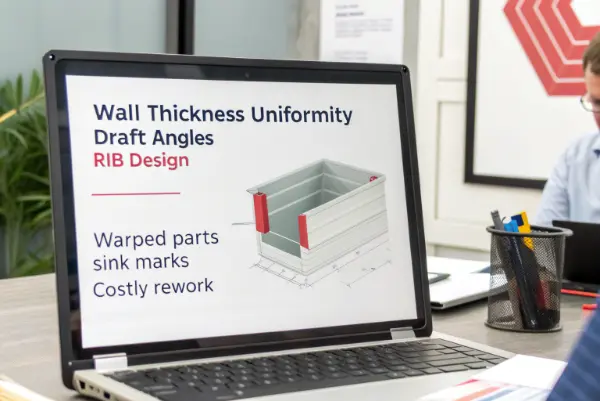
Ask why each proposed dimension suits the exact resin, texture, draw depth, tool action and acceptance limit. Generic draft angles or rib-to-wall ratios are screening guidance, not release criteria. The supplier should identify tradeoffs, unresolved risks and the sample tests needed before approval.
Can the Supplier Demonstrate Process Control?
Temperature, pressure, time and speed are useful categories, but a four-item list does not prove control. Request a trial record linking material grade and drying, cavity identity, measured process conditions and accepted-part results.
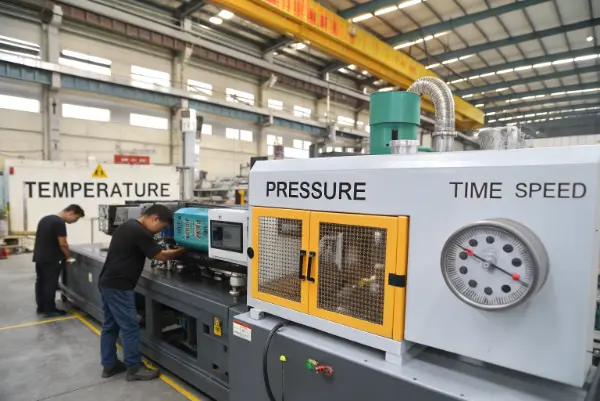
Ask how the supplier separates fill and pack behavior, establishes cooling and ejection limits, monitors drift and responds to abnormal results. Burn marks, jetting and short shots have different possible mechanisms; “too fast” is not a complete diagnosis. Review measurement-system evidence, an approved process window and a reaction plan through the production quality-control framework. A calibration claim should be supported by applicable instrument records. Evaluate proposed monitoring and inspection technology against the defect it must detect and the response it enables.
Does the Proposed Press Fit This Tool and Process?
Request a machine-to-mold compatibility sheet for the proposed production press and any backup press. It should cover total projected cavity and runner area, estimated cavity pressure, clamping force, injection pressure and rate, shot volume, plasticizing capacity, mold dimensions, mold-height limits, daylight, ejector travel, mounting and utility connections.
KEYENCE’s clamping-force explanation relates cavity pressure to total projected cavity and runner area. A universal tons-per-square-inch rule is not a substitute for that project-specific basis and trial validation. Likewise, the appropriate shot and residence-time window depends on resin, barrel/screw configuration, recovery, cycle and the machine and resin manufacturers’ guidance.
A broad machine list does not prove that a suitable press is available for your program. Verify the named press, capacity allocation, material handling and contingency plan. The export-mold interface checklist is also relevant when the tool will run at a different factory.
Normalize Scope Before You Compare Suppliers
A low quotation is not comparable when suppliers include different tool construction, sampling, documentation, ownership or production responsibilities. Issue one controlled RFQ package and require every bidder to list assumptions, exclusions and deviations.
| Evidence before award | What a buyer should see | Why it matters |
|---|---|---|
| DFM sample | Parting, gate, ejection, wall/draft, undercuts, critical dimensions and open risks | Shows whether the supplier can explain decisions, not only quote steel |
| Tool scope | Cavities, steel/components, runner, cooling, actions, spares, ownership and destination-press interface | Prevents unlike tooling packages from being compared as one price |
| Trial and acceptance | T1/T2 quantities, process record, dimensional/cavity report, material, appearance and sign-off rules | Defines when learning becomes an accepted tool |
| Production quality | Material and cavity traceability, control plan, gauges, reaction plan and change approval | Tests whether the supplier can sustain the result |
| Delivery and lifecycle | Packaging, export documents, maintenance, repair response, spare inserts and data handover | Moves the comparison from purchase price to program risk |
Ask for redacted examples where customer confidentiality applies: a DFM page, mold-design review, trial report, dimensional report, corrective-action record and change notice. Verify that the examples reflect a representative mold and that the proposed team can explain them. A certificate or equipment list alone does not prove execution.
Use the CKMOLD RFQ form to submit the same scope used for competing bids. After the form, email CAD and the dimensioned drawing to jerry@ckmold.com with company, project, revision and units.
Assess Engineering and DFM Depth
Send a representative part and review how the supplier discusses walls, material, gates, parting, cooling, ejection, tolerances and failure modes. Strong partners explain consequences and alternatives. A checklist without reasoning provides little evidence of engineering judgment.
Audit Tooling and Trial Control
Clarify whether design and machining are in-house or managed externally, how steel and components are verified, and how trials are documented. Review tool ownership, drawings, maintenance, spare inserts, change approval and transfer capability.
Verify Quality Systems With Examples
Ask for a sample dimensional report, material traceability, cavity records, control plan, gauge method, nonconformance response and corrective-action example. Certifications may support the system, but project evidence shows how it operates in practice.
Check Capacity and Supply Resilience
Evaluate machine fit, available capacity, automation, material handling, maintenance, utilities, backup plans, packaging and logistics. Confirm how forecasts, rush demand, downtime and supplier shortages are communicated and recovered.
Test Communication Before Award
Observe response quality during RFQ, DFM and sample review. Confirm technical and commercial owners, language, meeting rhythm, escalation path and approval records. A partner relationship is safer when decisions are visible and problems are reported early.
Select an Injection Molding Partner for a B2B Program: Buyer Review Checklist
- Challenge the supplier with project-specific DFM and failure-mode questions.
- Review tool design, build, trial, ownership, maintenance, spares and transfer controls.
- Inspect traceability, reports, gauges, control plans and corrective-action evidence.
- Confirm machine fit, capacity, automation, materials, backup and logistics.
- Define technical owners, communication cadence, escalation and approval records.
Frequently Asked Questions
What should buyers compare beyond injection molding price?
DFM quality, tool scope, accepted-part assumptions, inspection, maintenance, change control, packaging, logistics, capacity and recovery support.
Is an audit necessary before awarding a mold?
For important programs, an on-site or remote evidence-based audit can reveal how the supplier actually manages engineering, quality, tooling and production risks.
Conclusion
Selecting the right partner requires looking at feasibility, design support, process control, and equipment capability. You need someone who asks the right questions and understands your business goals. Choose a partner who values transparency and quality as much as you do.