
How Do You Choose the Right Thermoplastic for Your Injection Molding Project?

Struggling to pick the perfect plastic for your next part? The sheer number of thermoplastics can be overwhelming, and making the wrong choice leads to failed parts, wasted time, and blown budgets. You need a material that meets all your design requirements without creating production headaches.

To choose the right thermoplastic, first define your part’s key requirements. Consider its mechanical stress, operating temperature, chemical exposure, transparency needs, and budget. For example, use Polypropylene (PP) for low-cost, flexible parts like containers. Choose Acrylonitrile Butadiene Styrene (ABS) for durable electronic housings. Select Polycarbonate (PC) for high-impact, clear components like safety glasses. A clear understanding of the application is the most critical step in material selection.

A colorful array of plastic pellets used for injection molding

I’ve seen countless projects over the years, and the story often starts the same: a designer has a brilliant idea, but the material choice becomes a major roadblock. It’s easy to get lost in complex data sheets filled with technical jargon. But I’m here to tell you it doesn’t have to be that complicated. We can break it down together. My goal is to give you the practical knowledge I’ve gained on the factory floor and in my business, so you can confidently select the best material every single time. Let’s walk through the most common thermoplastics used in our industry.

When Should You Use Common Plastics Like Polypropylene (PP) and Polyethylene (PE)?

Are you designing a product that needs to be affordable and produced in massive quantities? Commodity plastics like Polypropylene (PP) and Polyethylene (PE) are often the default choice, but their low cost can sometimes mask limitations in strength or temperature resistance, leading to parts that warp or fail under stress.

You should use Polypropylene (PP) and Polyethylene (PE) for high-volume, cost-sensitive applications that don’t require extreme mechanical strength or heat resistance. PP is ideal for living hinges, food containers, and automotive parts due to its excellent chemical resistance and flexibility. PE, especially HDPE, is perfect for bottles, pipes, and toys because of its impressive impact strength and low moisture absorption. They are the workhorses of the molding world.

A collection of everyday plastic items like bottles and containers

When I first started in the mold industry, the sheer volume of PP and PE parts we produced was staggering. From simple bottle caps to complex car bumpers, these two materials were everywhere. They are the foundation of modern manufacturing for a reason. But understanding their differences is key to using them effectively. They might seem similar, but their specific properties make them suitable for very different jobs. Let’s break down where each one truly shines and what you need to watch out for during the design phase.

Understanding the "Workhorse" Plastics

At their core, PP and PE are polyolefins. This family of plastics is known for being lightweight, chemically resistant, and easy to process. This ease of processing is a huge deal in manufacturing because it means faster cycle times and lower energy costs, which translates directly to a lower price per part.

  • Polypropylene (PP): Think of PP as the most versatile player on the team. Its biggest claim to fame is its fantastic fatigue resistance. This is why it’s the only material you can use to design a "living hinge"—that thin section of plastic that connects a container to its lid and can be bent millions of times without breaking. I’ve seen it used for everything from toolboxes to condiment bottle caps.
  • Polyethylene (PE): PE is more of a specialist, and it comes in several variants. The two you’ll encounter most are High-Density Polyethylene (HDPE) and Low-Density Polyethylene (LDPE). HDPE is rigid and strong, making it perfect for milk jugs, cleaning agent bottles, and pipes. LDPE is the opposite; it’s very flexible and soft, which is why it’s used for things like plastic bags and squeeze bottles.

Key Design Considerations

When you’re working with these materials, shrinkage is a big factor you need to account for in your mold design. They have relatively high and variable shrinkage rates, so getting the dimensions right requires experience and careful calculation.

Property Polypropylene (PP) High-Density Polyethylene (HDPE)
Key Advantage Excellent fatigue resistance (living hinges) High strength-to-density ratio
Common Uses Containers, automotive parts, textiles Bottles, pipes, plastic lumber
Typical Shrinkage 1.5% – 2.5% 1.5% – 3.0%
Temperature Limit ~100°C (212°F) ~80°C (176°F)
UV Resistance Poor (requires additives) Poor (requires additives)

Both materials are also susceptible to UV degradation. If your part will be used outdoors, you absolutely must specify a UV-stabilized grade. I learned this the hard way early in my career on a project for outdoor furniture. We used a standard PP grade, and within a year, the parts became brittle and started cracking. It was a costly lesson in the importance of matching the material grade to the environment.

Why is ABS the Go-To Plastic for Consumer Electronics and Prototypes?

You have a great design for a new electronic device, but you need a housing that is tough, looks good, and won’t break the bank. You’re worried that other plastics might be too brittle or won’t hold the precise dimensions needed for a perfect fit. This is a common challenge where material choice is critical to success.

ABS (Acrylonitrile Butadiene Styrene) is the go-to plastic for consumer electronics and prototypes because it offers a balanced combination of toughness, impact resistance, and rigidity at a low cost. Its excellent surface finish and ability to be easily colored or plated make it ideal for aesthetic parts like keyboard keys and printer casings. For prototyping, it’s strong enough to create functional test parts that closely mimic the final product’s properties.

A sleek black computer mouse and keyboard made from ABS plastic

Working with product designers like Jacky, I’ve seen firsthand why ABS is so popular. It’s like the Swiss Army knife of plastics. It’s strong enough to protect the delicate electronics inside a device, it can be molded into complex shapes with fine details, and it takes color and texture beautifully. When a client comes to me with a new handheld gadget, ABS is almost always the first material we discuss. It hits that sweet spot of performance and cost that makes so many products possible. Let’s dive deeper into what makes it so special.

A Deeper Look at the ABS Trifecta

ABS is a terpolymer, which means it’s made from three different monomers: Acrylonitrile, Butadiene, and Styrene. Each one brings something important to the table, and changing the ratio of these components allows manufacturers to create different grades of ABS with specific properties.

  1. Acrylonitrile: This component provides chemical resistance and thermal stability. It’s what helps the plastic stand up to heat generated by electronics and resist damage from household cleaning agents.
  2. Butadiene: This is a rubbery substance that delivers toughness and impact strength. It’s the reason an ABS phone case can absorb the shock of a drop without shattering. It gives the material its resilience.
  3. Styrene: This provides the rigid structure of the plastic and, most importantly, gives ABS its glossy, attractive surface finish. It also makes the material easy to process in an injection molding machine.

This unique combination is what gives ABS its all-around great performance. You get strength from the Styrene and Acrylonitrile, and toughness from the Butadiene. It’s a true engineering plastic, but at a price point that’s much closer to commodity plastics.

Practical Applications and Molding Advice

For a designer, this means you can create parts that look premium without a premium price tag. Think about LEGO bricks—they are a perfect example of ABS in action. They have precise dimensions, a great feel, vibrant colors, and they are tough enough to last for decades.

When molding ABS, there are a few things to keep in mind.

Design Aspect Recommendation for ABS Why It Matters
Wall Thickness Maintain a uniform thickness (1.5mm – 3mm) Prevents sink marks and warping. ABS is prone to this if thickness varies too much.
Draft Angles 1 to 2 degrees minimum Ensures easy ejection from the mold, preserving the high-quality surface finish.
Gating Use tab or submarine gates where possible Hides the gate mark on non-cosmetic surfaces, crucial for electronic housings.
Drying Must be dried for 2-4 hours at 80°C ABS is hygroscopic (absorbs moisture). Wet material will cause splay marks on the surface.

I always stress the importance of drying ABS to my clients. We once had a batch of beautiful enclosures that came out of the mold with silver streaks all over them. The operator had forgotten to run the material dryer. We had to scrap the entire run. It’s a simple step, but skipping it can ruin your final product’s appearance.

What Makes Polycarbonate Ideal for High-Impact and Transparent Parts?

You’re designing a part that needs to be crystal clear, like a lens or a protective cover, but it also has to withstand significant impacts without breaking. Glass is too heavy and brittle, and other clear plastics like acrylic scratch too easily or lack the necessary toughness. This is a classic engineering problem where material choice is everything.

Polycarbonate (PC) is ideal for high-impact and transparent parts due to its unique combination of incredible toughness, excellent optical clarity, and good heat resistance. It has an impact strength over 200 times that of glass, making it virtually unbreakable. This makes it the perfect choice for safety glasses, machine guards, automotive headlights, and reusable water bottles where both visibility and durability are non-negotiable.

A clear, strong machine guard made of Polycarbonate

I remember a project for a medical device company that needed a clear housing for a portable scanner. The device would be used in busy hospitals and was likely to be dropped. The client initially considered acrylic for its clarity, but we knew it would crack on the first impact. We switched to Polycarbonate. The final product was not only perfectly clear, allowing doctors to see internal indicators, but it was also tough enough to survive repeated drop tests. PC saved the project. Let’s explore why it’s such a powerful material.

Unmatched Toughness and Clarity

The magic of Polycarbonate comes from its molecular structure. It gives the material an amorphous quality, which is why it’s transparent. But unlike other clear plastics, it also has extreme ductility, allowing it to absorb a huge amount of energy before fracturing. This is why it’s used for bullet-resistant glass (when laminated) and riot shields.

For product designers, this opens up a world of possibilities. You can design thin-walled parts that are both lightweight and incredibly robust.

  • Optical Properties: PC has excellent light transmission, very close to that of glass. It can be easily molded into complex shapes like lenses and light pipes for directing LEDs in electronic devices.
  • Temperature Resistance: It maintains its properties over a wide range of temperatures, with a heat deflection temperature of around 135°C (275°F). This is much higher than acrylic or ABS, making it suitable for applications like automotive headlight lenses that get hot.

Challenges and Best Practices in Molding PC

While Polycarbonate is an amazing material, it can be tricky to work with. It requires very high processing temperatures and is extremely sensitive to moisture. Just like with ABS, proper drying is not optional—it’s mandatory.

Parameter Guideline for Polycarbonate Consequence of Failure
Drying Dry for 4-6 hours at 120°C (250°F) Incomplete drying causes splay, bubbles, and severely reduced impact strength.
Melt Temperature 280°C – 320°C (535°F – 610°F) Too low results in poor flow; too high can cause material degradation.
Mold Temperature 80°C – 120°C (175°F – 250°F) A hot mold is essential for achieving a glossy surface finish and minimizing internal stresses.
Chemical Resistance Poor against certain oils and solvents Avoid contact with substances like brake fluid or acetone, which can cause cracking.

One of the biggest challenges with PC is its susceptibility to stress cracking. If you design sharp internal corners or have residual stress from the molding process, the part can develop cracks over time, especially when exposed to certain chemicals. We always advise clients to use generous radii on all internal corners (at least 0.5 times the wall thickness) to distribute stress and prevent this from happening. It’s a small design detail that makes a huge difference in the long-term reliability of a Polycarbonate part.

How Does Nylon’s Strength and Wear Resistance Benefit Mechanical Parts?

You’re designing a gear, a bearing, or another moving part that will be under constant friction and load. You need a material that won’t wear down quickly, can handle the stress, and doesn’t require constant lubrication. Using the wrong material will lead to premature failure, noisy operation, and a reputation for unreliability.

Nylon (Polyamide or PA) benefits mechanical parts through its exceptional wear resistance, high strength, and low coefficient of friction. This unique combination allows it to replace metal in many applications like gears, bushings, and rollers, resulting in quieter operation, reduced weight, and no need for external lubrication. Its toughness and ability to absorb impacts also prevent catastrophic failure under sudden loads, making systems more reliable.

A set of white plastic gears and bearings made from Nylon

I’ve worked on many projects where we replaced bronze bushings with ones made from Nylon 6/6. The results were always impressive. The machines ran quieter, the maintenance schedule was reduced because we eliminated the need for grease, and the overall cost was lower. Nylon is one of those materials that really solves problems for engineers. It’s tough, slippery, and surprisingly strong. It’s the perfect bridge between standard plastics and metal for many mechanical applications. Let’s get into the specifics of why.

The Engineering Powerhouse: Nylon

Nylon is a semi-crystalline plastic, and this structure is what gives it such great mechanical properties. There are many types of Nylon, but the two you’ll encounter most often in injection molding are Nylon 6 (PA6) and Nylon 6/6 (PA6/6). They are very similar, but PA6/6 generally has slightly better mechanical properties and a higher melting point, making it a bit more robust for demanding applications.

  • Self-Lubrication: Nylon has a naturally low coefficient of friction. This means parts can slide against each other with very little resistance, which is perfect for gears and bearings. This property can be enhanced even further by adding fillers like molybdenum disulfide (MoS2) or PTFE.
  • Strength and Stiffness: For a plastic, Nylon is very strong and rigid, especially when reinforced with glass fibers. Glass-filled Nylon grades are commonly used for parts that need to bear significant loads, like power tool housings and engine components.
  • Toughness: Nylon is not brittle. It can absorb significant impact and vibration without cracking, which is a critical safety feature in mechanical systems.

The Critical Role of Moisture

The single most important thing to understand when designing with Nylon is its relationship with water. Nylon is hygroscopic, meaning it absorbs moisture from the air. This is both a weakness and a strength.

Condition Effect on Nylon Design Implication
Dry As-Molded Strong, stiff, but more brittle The part will be at its most rigid state right out of the mold. Dimensions are smallest.
Conditioned (Absorbed Moisture) More flexible, tougher, higher impact strength The part will become less brittle and more durable. It will also swell slightly.

This dimensional change is crucial. I once saw a project fail because the designer specified a very tight tolerance for a Nylon bushing. The part fit perfectly right after molding. But after a few weeks in a humid environment, the bushing swelled and seized onto the shaft it was meant to rotate on. The designer didn’t account for the moisture absorption. For critical dimensions, you must design for the "conditioned" state of the material, not the "dry as-molded" state. This means allowing for a slight increase in size as the part reaches equilibrium with the surrounding humidity. This is a lesson you only want to learn once.

How Do You Select the Best Material from All These Options?

You’ve learned about the unique strengths of different plastics, from the affordability of PP to the toughness of PC. But when a new project lands on your desk, how do you move from a list of requirements to a final, confident material choice? The risk of over-engineering with an expensive plastic or under-engineering with a weak one is real.

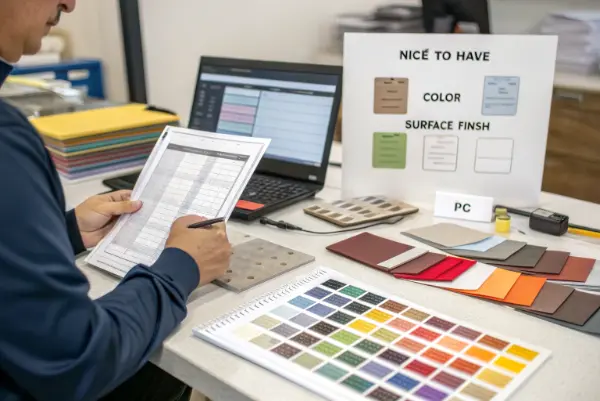
To select the best material, use a systematic process. First, list all non-negotiable requirements like operating temperature, impact strength, and chemical exposure. Second, create a list of "nice-to-have" features like color or surface finish. Then, filter materials that meet the non-negotiables. From that shorter list, compare the remaining candidates based on cost and processability to find the one that offers the best overall value for your specific application.

A flowchart showing a decision-making process for material selection

I always tell my clients to think of material selection like hiring someone for a job. You wouldn’t hire an accountant to do a welder’s job, even if they are very smart. You need the right skills for the specific task. The same goes for plastics. There is no single "best" plastic—only the best plastic for your part. This structured approach removes the guesswork and ensures you’re making a decision based on data and logic, not just habit. Let’s walk through that process in more detail.

A Practical Checklist for Material Selection

When a new project begins, I grab a piece of paper or open a spreadsheet and start listing the requirements. I break it down into four key categories. This helps ensure nothing gets missed.

1. Mechanical Requirements

This is about how the part will be physically used.

  • Load: Will it bear a constant load (tensile strength)? Will it be hit or dropped (impact strength)?
  • Flexibility: Does it need to bend without breaking (flexural modulus)? Does it need a living hinge?
  • Friction: Will it slide against another part (wear resistance)?

2. Thermal Requirements

This defines the environment the part will live in.

  • Operating Temperature: What is the maximum continuous temperature it will experience?
  • Thermal Expansion: Will it be assembled with other materials (like metal) that expand at different rates?

3. Environmental and Chemical Requirements

This covers external factors that could degrade the part.

  • UV Exposure: Will the part be used outdoors?
  • Chemical Contact: Will it be exposed to oils, acids, solvents, or cleaning agents?
  • Moisture: Will it operate in a humid environment or be submerged in water?

4. Aesthetic and Cost Requirements

This deals with the look, feel, and business side of the project.

  • Clarity: Does the part need to be transparent?
  • Color and Finish: Does it need a specific color or a high-gloss surface?
  • Cost: What is the target price per part? This often narrows down the options very quickly.

By answering these questions honestly, you create a profile of your ideal material. For example, if you need high impact strength AND transparency, your list immediately shortens to Polycarbonate. If you need a living hinge and low cost, you’re looking at Polypropylene. This methodical approach turns a daunting decision into a simple process of elimination, leading you to the right choice every time.

Conclusion

Choosing the right thermoplastic is a critical step that defines the success of your project. By understanding the core properties of common materials like PP, ABS, PC, and Nylon, you can make informed decisions. Start by clearly defining your part’s mechanical, thermal, and environmental needs. This methodical approach will guide you to the most effective and cost-efficient material, ensuring your design performs exactly as you intended.

Facebook
Twitter
LinkedIn

Request A Quote for Your Projects!

Hi there! I’m Jerry, a proud dad and passionate at CKMOLD. With years of hands-on experience in the injection mold and CNC industry, I’ve grown from managing the smallest details on the shop floor to leading international projects with clients across Europe and the U.S.

At CKMOLD, we specialize in precision molds, plastic parts, and CNC solutions that help bring bold product ideas to life. I love solving complex challenges, building long-term partnerships, and pushing the limits of what great manufacturing can do.

Let’s connect, exchange ideas, and grow together—whether you’re looking for a reliable manufacturing partner or just want to talk shop!

Request a Quick Quote

Send your drawings and detailed requirements via:
Email: jerry@ckmold.com

Or fill out the contact form below:

We will contact you within one working day. Please pay attention to the email with the suffix “@ckmold.com”

Wait, We Have Something Special for You!

Join our mailing list and receive a 10% discount on your next mold or CNC project.