
Designing medical devices is a high-stakes game. You might worry about strict regulations, patient safety, and the fear of a product recall destroying your reputation. Choosing the right material is the first and most critical step to avoid these disasters.
Medical-grade polyethylene is a specific class of thermoplastic verified for biocompatibility and safety in healthcare applications. It meets strict standards like USP Class VI and ISO 10993 to ensure it does not harm living tissue. This material is widely used for implants, surgical tools, and packaging because it resists chemicals and is very durable.

I have worked in the mold industry for years, and I have seen many projects fail simply because the material selection was wrong. It is not just about picking a plastic; it is about picking a solution that keeps patients safe and keeps your business compliant. Let’s look at the specific questions you need to answer to get this right.
What defines medical-grade polyethylene?
You might wonder if there is really a big difference between the plastic used for a milk jug and the plastic used for a surgical tool. The answer is yes, and misunderstanding this difference can lead to serious legal and safety issues for your company.
Medical-grade polyethylene differs from standard commercial grades because of its rigorous testing, traceability, and purity levels. To be classified as medical-grade, the material must pass FDA regulations and often USP Class VI testing. This ensures there are no harmful additives or leachables that could react with the human body.
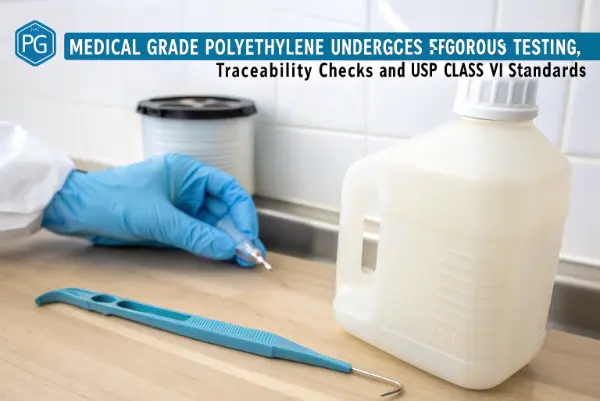
When we talk about "medical-grade," we are not just talking about the physical properties of the plastic. We are talking about a paper trail. In my experience running CKMOLD, I often tell clients that in the medical field, if you cannot prove where the material came from, the product does not exist.
Commercial polyethylene often contains release agents, antioxidants, or plasticizers that make processing easier. In a toy or a trash can, these are fine. In a blood bag or a hip implant, these additives can leach out and poison a patient. Medical-grade polyethylene is manufactured to limit these impurities. It undergoes strict quality control measures that commercial grades do not.
Here is a breakdown of the key differences:
| Feature | Commercial Polyethylene | Medical-Grade Polyethylene |
|---|---|---|
| Purity | Standard | High (Low extractables) |
| Additives | Various for processing | Restricted/Biocompatible |
| Traceability | Lot number usually available | Full chain of custody required |
| Certification | General specs | USP Class VI, ISO 10993, FDA DMF |
| Cost | Low | High (due to testing/liability) |
You must also consider the "No Change" policy. Suppliers of medical-grade resins guarantee they will not change the formula without giving you significant advance notice (often 12 to 24 months). This allows you to re-validate your device. Commercial suppliers can change their formula whenever they want to save money. For a medical device manufacturer, an unannounced material change is a nightmare. It creates liability. If a patient gets sick, the blame falls on you. So, paying the premium for medical-grade is actually an investment in your company’s safety.
Which types of polyethylene are best for medical devices?
There are several types of polyethylene, and it can be confusing to know which acronym—LDPE, HDPE, or UHMWPE—fits your specific product. Choosing the wrong density can result in a part that breaks under stress or is too stiff for its intended use.
The best type of polyethylene depends on the application: Low-Density Polyethylene (LDPE) is ideal for flexible tubing and packaging, High-Density Polyethylene (HDPE) works best for rigid containers and prosthetics, and Ultra-High Molecular Weight Polyethylene (UHMWPE) is the standard for high-wear implants like artificial joints.
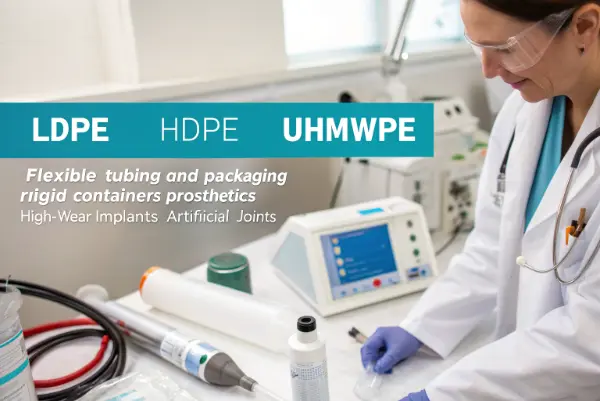
To make the right choice, you need to look at the mechanical requirements of your product. I recall a project where a client wanted to use HDPE for a squeezable dropper bottle because they wanted it to be durable. The problem was, HDPE was too stiff. We switched them to LDPE, and the product worked perfectly. You have to match the material personality to the job.
Low-Density Polyethylene (LDPE)
This material is soft, flexible, and transparent. It has a lower tensile strength but high ductility.
- Best for: Intravenous (IV) tubing, catheter parts, flexible packaging, and squeeze bottles.
- Why: It can bend without cracking and is easy to seal.
High-Density Polyethylene (HDPE)
This is the tough brother of LDPE. It has a high strength-to-density ratio. It is harder and more opaque.
- Best for: Pharmaceutical bottles, caps, surgical trays, and some prosthetic components.
- Why: It provides a strong barrier against moisture and chemicals. It protects the contents very well.
Ultra-High Molecular Weight Polyethylene (UHMWPE)
This is the superhero of the polyethylene family. It has extremely long molecular chains, which makes it incredibly tough and resistant to abrasion.
- Best for: Orthopedic implants (like the cup in a hip replacement), wear surfaces, and surgical cables.
- Why: It is self-lubricating and does not wear down easily, even when rubbing against metal bone replacements inside the body.
Here is a simple way to visualize the selection process:
| Material Type | Flexibility | Wear Resistance | Typical Application |
|---|---|---|---|
| LDPE | High | Low | Tubing, Bags |
| HDPE | Low | Moderate | Caps, Containers |
| UHMWPE | Very Low | Extremely High | Joint Implants |
When I advise business owners, I ask them to think about the environment the part will live in. If it needs to slide, use UHMWPE. If it needs to hold liquid safely, use HDPE. If it needs to bend, use LDPE. It sounds simple, but getting this wrong at the design stage is expensive to fix later.
Why is biocompatibility crucial for manufacturing safety?
You might think that if a plastic is strong enough, it is good enough, but in medicine, the body’s reaction to the material is the most important factor. If you ignore biocompatibility, your product will fail regulatory audits, or worse, cause severe health complications for patients.
Biocompatibility ensures that the medical device interacts safely with the human body without causing toxic or immunological responses. Adhering to standards like ISO 10993 is mandatory to verify that the polyethylene will not cause irritation, sensitization, or cytotoxicity during patient contact.
Biocompatibility is not a single test. It is a series of evaluations. The deeper the contact with the body, the stricter the rules. This is where critical thinking is necessary for a business owner. You need to categorize your device correctly to know which tests you need.
There are three main categories of contact:
- Surface Devices: These touch the skin (like a brace).
- External Communicating Devices: These touch blood or tissue but enter from the outside (like a catheter).
- Implant Devices: These go inside the body and stay there (like a hip joint).
Polyethylene is generally biologically inert. This means it is "lazy" chemically—it does not want to react with things. This is a huge advantage. However, the process of making the part can ruin this. If you use a dirty mold, or a machine that has oil leaks, you contaminate the surface. Even if the raw PE is biocompatible, the finished part might fail the test.
The ISO 10993 Standard
This is the global bible for biocompatibility. For polyethylene, you usually focus on:
- Cytotoxicity: Does it kill cells?
- Sensitization: Does it cause an allergic reaction?
- Irritation: Does it irritate the skin or tissue?
I had a conversation with a client who wanted to use a cheaper, recycled polyethylene for a handle on a surgical tool. I had to stop him. Recycled plastics have unknown histories. You cannot guarantee biocompatibility with recycled material. For medical safety, you must use virgin resin. The risk of failing an ISO 10993 test—and the cost of the lawsuit if a patient gets an infection—is far higher than the savings on material costs. Always prioritize the "biological safety" over the "mechanical safety" when dealing with human lives.
How does sterilization impact polyethylene choices?
Making a medical device is one thing, but making it sterile so it can actually be used in a hospital is another challenge entirely. If you choose a sterilization method that your material cannot handle, you will end up with warped, brittle, or discolored parts before they ever reach a patient.
Sterilization compatibility is a key factor in material selection, as different methods affect polyethylene differently. While Ethylene Oxide (EtO) gas is generally safe for all types, high-temperature autoclaving can melt LDPE, and Gamma radiation can cause cross-linking or discoloration in HDPE if not stabilized.
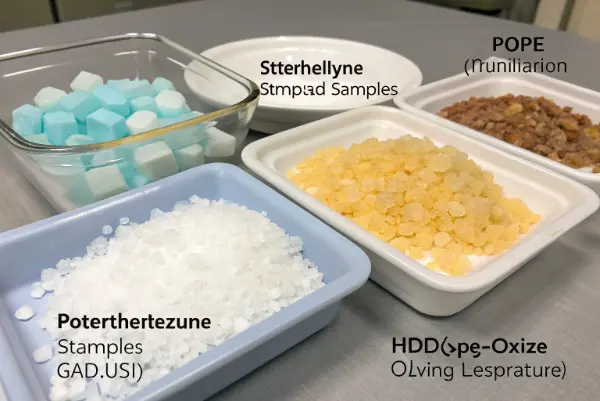
This is a practical logistics problem. You need to know how the hospital or the packaging facility will clean your product. I have seen perfectly designed parts ruined because the designer did not account for the heat in the sterilization cycle.
Ethylene Oxide (EtO)
This is a gas process. It is done at lower temperatures.
- Impact on PE: Very low. It is excellent for LDPE, HDPE, and UHMWPE.
- Drawback: It takes a long time (days) to gas off the toxic residue. It is a slow process for your supply chain.
Gamma Radiation / E-Beam
This uses radiation to kill bacteria. It is fast and penetrates packaging.
- Impact on PE: This is tricky. Radiation can make polyethylene stronger (cross-linking) or it can make it brittle and yellow (degradation).
- Solution: You must specify "Radiation Stabilized" grades of polyethylene. If you use standard grades, your white medical device will turn an ugly yellow color, and customers will think it is old or dirty.
Autoclave (Steam)
This uses high heat and pressure. It is very common in hospitals for reusable tools.
- Impact on PE:
- LDPE: Will melt. Do not use it.
- HDPE: Can handle some lower temp cycles, but risks warping.
- UHMWPE: Generally okay, but repeated cycling can affect dimensions.
- Warning: If your product is "single-use," you do not need to worry about autoclaves. If it is "reusable," you must pick a material that survives heat.
Comparison Table for Sterilization
| Method | LDPE Suitability | HDPE Suitability | UHMWPE Suitability |
|---|---|---|---|
| EtO Gas | Excellent | Excellent | Excellent |
| Gamma Ray | Good (needs stabilizer) | Good (needs stabilizer) | Good (improves wear) |
| Autoclave | Poor (Melts) | Fair/Poor (Warps) | Fair |
As a business owner, you need to define the "Lifecycle" of the product. Is it used once and thrown away? Use EtO or Gamma. Is it a surgical tray used every day? You might need a special grade of HDPE or switch to a different plastic like Polypropylene. Polyethylene is great, but it is heat-sensitive. Always plan the end of the line (cleaning) at the beginning of the design.
What are the key manufacturing challenges with medical PE?
Even if you pick the right material and pass all the safety tests, you still have to manufacture the part efficiently. Polyethylene behaves in specific ways inside a mold that can cause headaches if you are not prepared for them.
Manufacturing medical PE presents challenges like high shrinkage rates and warping, which require precise mold design and cooling control. Additionally, strict cleanliness protocols must be followed during injection molding to prevent contamination and maintain the medical-grade status of the final component.
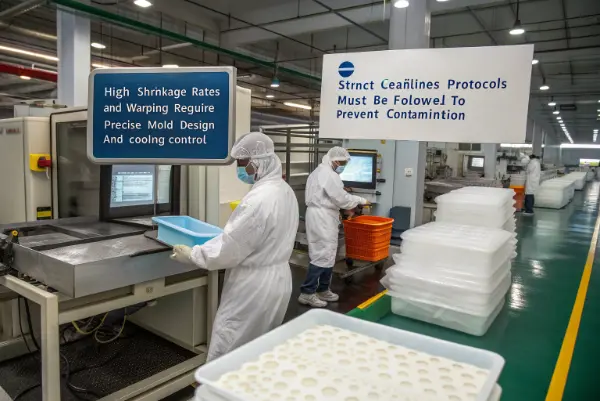
When we mold polyethylene at CKMOLD, shrinkage is the first thing we calculate. Polyethylene is a semi-crystalline plastic. This means when it cools down from a liquid to a solid, the molecules pack together very tightly. This causes the part to shrink significantly—often 1.5% to 3.0%.
Managing Shrinkage and Warpage
If the mold is not designed with this shrinkage in mind, your final part will be too small. Worse, if the part has different wall thicknesses, one area will shrink faster than another. This creates internal stress, and the part will warp or twist like a potato chip.
- The Fix: We use uniform wall thicknesses in the design. We also place cooling channels in the mold very strategically to ensure the whole part cools at the same even rate.
The Cleanroom Requirement
Medical parts cannot be made in a dirty factory. Dust, oil, or metal shavings in the air can settle on the hot plastic and become embedded in the part.
- The Fix: Manufacturing must happen in a cleanroom (usually ISO Class 7 or 8). This is a controlled environment with air filters.
- My Insight: I had a client trying to save money by molding medical housings in a standard industrial shop. They had a 20% rejection rate because of "black specs" (dust) in the white parts. We moved them to a cleanroom environment. The cost per hour was higher, but the rejection rate dropped to near zero. The total cost per usable part actually went down.
Machining vs. Molding
For UHMWPE, you often cannot injection mold it because it is too thick and does not flow. You have to machine it (cut it) from a block.
- The Challenge: UHMWPE is slippery and tough. It is hard to clamp down, and it creates long, stringy chips that clog the CNC machines. You need specialized tooling and experienced operators to machine it without creating surface defects that could harbor bacteria.
Manufacturing medical PE is a balance of science and hygiene. You need a partner who understands not just how to melt plastic, but how to control the environment it is born in.
Conclusion
Medical-grade polyethylene is a powerful material that balances safety, durability, and versatility, but it requires careful handling. From choosing between LDPE and UHMWPE to ensuring biocompatibility and mastering the molding process, every detail matters. By understanding these standards and working with an experienced manufacturer, you can ensure your medical devices are safe, compliant, and successful in the market.
CKMOLD Engineering Update: Medical-Grade Polyethylene: Standards, Applications and Qualification
The phrase medical-grade polyethylene is useful only when it points to a controlled grade, supplier specification and evidence package for an intended device. Polyethylene may serve in packaging, fluid-handling, housings, caps, containers or other components, but application suitability depends on contact, mechanical function, sterilization, extractables, cleanliness, manufacturing controls and the regulatory pathway of the complete device.
Related engineering resources: production injection molding | mold testing and validation | contact CKMOLD
Official reference resources: FDA ISO 10993-1 biocompatibility guidance | FDA biocompatibility resource center
Use Standards Within a Risk Framework
ISO 10993-1 is commonly used as a framework for biological evaluation within risk management, but it is not a universal test checklist. Contact nature, tissue, duration, available chemistry and prior evidence influence which endpoints need evaluation. Device-specific guidance and target-market requirements still apply.
Map Polyethylene Family to Application
LDPE, LLDPE, HDPE and specialty polyethylene grades offer different flexibility, stiffness, toughness, sealing and stress-crack behavior. Select from the component’s load, wall, connection, fluid, barrier, temperature and assembly needs rather than from the word polyethylene alone.
Qualify Chemistry and Manufacturing Inputs
Review base polymer, catalysts or residues, stabilizers, pigments, processing aids and any additives reasonably expected to affect the finished article. Control suppliers, lots, material handling, mold release, lubricants, regrind, cleaning and contamination.
Test the Actual Device Condition
Prepare test articles representative of molding, assembly, cleaning, packaging and sterilization. If a different test article is used, document the rationale. Include dimensional, leak, impact, seal, torque, aging or other functional tests alongside biological evaluation where relevant.
Build a Defensible Technical File
Retain specifications, supplier declarations, risk assessment, test reports, sample preparation, process records, deviations and change approvals. The file should explain why the grade and manufacturing route are suitable for the intended application, not merely collect certificates.
Engineering and Sourcing Checklist
- Classify contact nature, duration, tissue and device-specific requirements.
- Select PE family and grade from load, flexibility, seal, fluid and temperature needs.
- Control additives, pigments, lots, regrind, lubricants, cleaning and contamination.
- Test representative molded, assembled, cleaned, packaged and sterilized articles.
- Maintain specifications, risk rationale, reports, deviations and change approvals.
Search Intent Takeaway
Medical-grade polyethylene is an evidence package around an exact material and device use. Standards guide the evaluation, while finished-device risk and manufacturing controls determine the qualification scope.
Need a practical review? Discuss design, material and validation requirements with the CKMOLD injection molding team, then contact CKMOLD with your part and application details. Regulatory requirements should be confirmed for the exact product and target market.
Frequently Asked Questions
Does ISO 10993 require the same tests for every polyethylene device?
No. The evaluation is risk-based and depends on contact type, duration, device category, chemistry, prior evidence and applicable guidance.
What makes a PE grade 'medical grade'?
The term should be supported by a controlled supplier specification, formulation and documentation suitable for the intended device; it is not a universal regulatory approval.
Why test functionality after sterilization?
A component can remain biologically acceptable yet lose impact, sealing, fit or dimensional performance after sterilization or aging.