
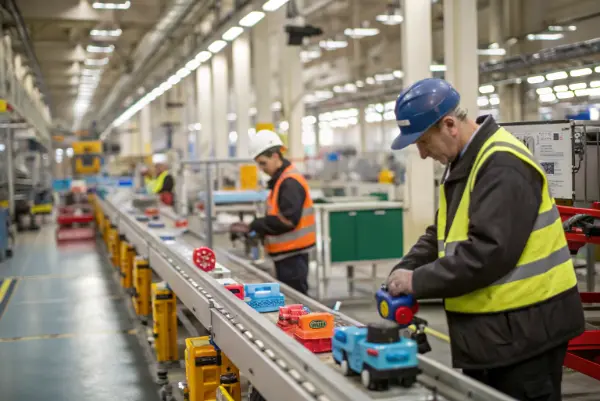
Every parent worries about what goes into their child’s mouth. Every toy manufacturer worries about a recall that could destroy their business. You might be holding a colorful plastic block right now and wondering if it is actually safe. Is the material cheap and toxic, or is it durable and harmless? It is a stressful question for both families and factory owners.
Manufacturing a safer PE toy requires converting product-safety requirements into material, mold, process, assembly and inspection controls. The molding line must prevent contamination and weak welds; the tool must avoid sharp flash and fragile features; the assembly must retain small components; and the quality plan must verify abuse performance and traceability. Safety is sustained batch by batch, not established once at prototype approval.
Related engineering resources: mold design | production injection molding | mold testing and validation
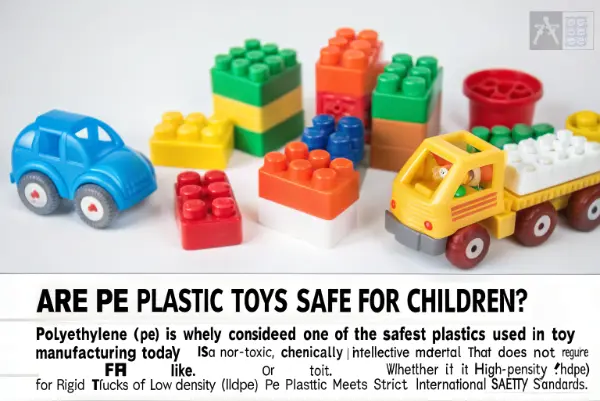
Polyethylene (PE) is widely considered one of the safest plastics used in toy manufacturing today. It is a non-toxic, chemically inert material that does not require dangerous additives like phthalates or BPA to function. Whether it is high-density (HDPE) for rigid trucks or low-density (LDPE) for squeezable figures, PE plastic meets strict international safety standards, including FDA and EN71 regulations, making it an excellent choice for children’s products.
However, saying a material is “generally safe” is not enough for a serious business owner or a concerned parent. We need to look at the chemistry, the regulations, and the molding process itself. If you get the grade of plastic wrong, or if the manufacturing process is flawed, even safe materials can become problems.
What Exactly is Polyethylene (PE) and Why is it Used in Toys?
You see this plastic every single day, but you might not know its name. Is it really the best option for making toys?
Polyethylene is the most common plastic in the world because it is simple, stable, and incredibly versatile. In the toy industry, we use it because it creates products that are tough enough to be thrown across a room but safe enough to be chewed on. It resists moisture, does not break easily into sharp shards, and is very cost-effective to mold.
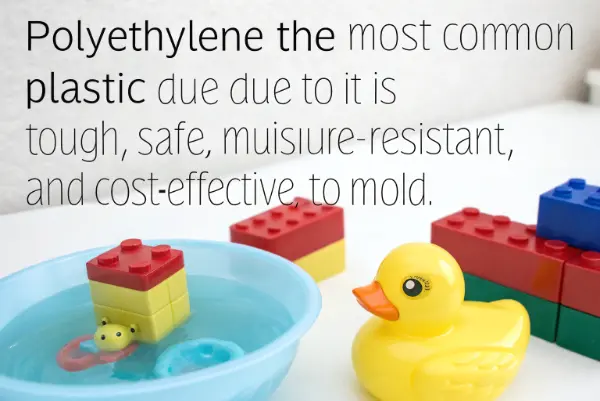
The beauty of PE lies in its simplicity. It is made from ethylene. The chemical bond is very strong. This makes the plastic “inert.” In simple terms, it does not want to react with other things. It does not react with saliva. It does not react with soap. It stays stable. This is crucial for toys. When a child bites a toy, you do not want chemicals leeching out. Because PE is so stable, we do not need to add a lot of strange chemicals to make it work.
Here is a breakdown of why manufacturers love it:
| Feature | Benefit for Toys |
|---|---|
| Chemical Inertness | Does not react with cleaning agents or saliva. |
| Impact Resistance | Won’t shatter like glass or brittle plastics (PS). |
| Lightweight | Easy for small toddlers to lift and play with. |
| Recyclable | Good for the environment and easy to re-grind in production. |
During project review, design molds for toys, we often choose PE because it flows well into the mold. It fills the cavities evenly. This leads to fewer defects and a smoother surface finish, which is safer for little hands.
Is There a Difference Between HDPE and LDPE regarding Safety?
You will often see the recycle triangle with a number 2 or a number 4 on toys. Does this number change the safety level?
Both High-Density Polyethylene (HDPE) and Low-Density Polyethylene (LDPE) are chemically safe for children, but they serve different physical purposes. HDPE is rigid and strong, used for tricycle wheels and blocks, while LDPE is softer and more flexible, used for squeezable toys. Neither type is inherently toxic, but the choice depends on how the child will interact with the toy.
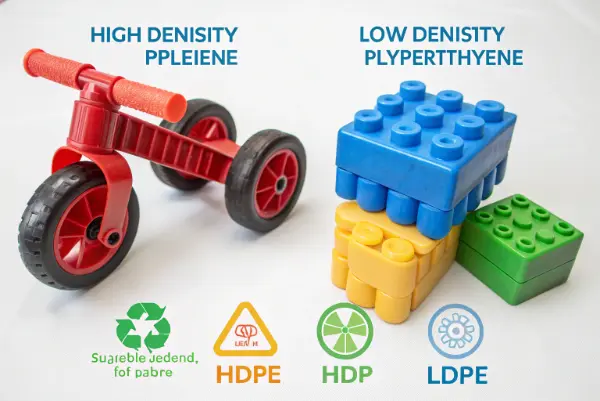
I have had many discussions with business owners like the buyer who are confused about which grade to pick. They assume “High Density” means “Higher Quality” or “Safer.” That is not really the case. It is about the molecular chains. Imagine a box of neatly folded shirts; that is HDPE. It is packed tight. Now imagine a box of shirts thrown in messily; that is LDPE. There is more space between the molecules.
Safety-wise, they are twins. They come from the same parent material. However, from a mold design perspective, they behave differently.
- HDPE (Number 2): This is the tough guy. We use this for heavy-duty toys. Think of ride-on cars, big construction trucks, or solid building blocks. It is hard. It can withstand high temperatures better. It is very resistant to cracking. If a child throws an HDPE block, it might hurt the floor, but the block will be fine.
- LDPE (Number 4): This is the soft sibling. It has more branching in its chemical chain. We use this for parts that need to snap together or bend. It is often used for soft play balls or flexibility hinges on a toy.
The safety risk does not come from the material itself, but from how it breaks. LDPE is tough but can tear if it is very thin. HDPE is very strong but very rigid. When we design the mold, we have to account for shrinkage. HDPE shrinks a lot when it cools. If we do not calculate this right, the toy warps. A warped toy might have sharp edges. So, while the chemistry is safe, the engineering ensures the physical safety. At CKMOLD, we focus heavily on cooling lines in the mold to ensure the HDPE sets reliably flat and smooth.
Do PE Toys Contain BPA or Phthalates?
This is the big question that scares every parent. We hear these acronyms in the news constantly. Does PE plastic hide these chemicals?
No, pure Polyethylene toys generally do not contain Bisphenol A (BPA) or Phthalates. BPA is typically used in Polycarbonate to make it clear and hard, and Phthalates are used in PVC to make it soft. Since PE is naturally flexible and does not need to be transparent like glass, these harmful additives are unnecessary and are rarely added during the manufacturing process.
Let me clear up a common misconception. Many people think “Plastic is Plastic.” They assume if one plastic has BPA, they all might. This is like saying all food has peanuts. It depends on the recipe.
BPA (Bisphenol A) is a building block for Polycarbonate (PC) and epoxy resins. PC is that hard, clear plastic that looks like glass. PE is naturally waxy and translucent or opaque. We do not need BPA to make PE. Chemically, they are totally different families. So, you can confidently say your PE toys are BPA-free.
Phthalates are plasticizers. We use them to make brittle plastics soft. The most common culprit is PVC (Polyvinyl Chloride). PVC is naturally hard (like a drain pipe). To make a rubber ducky out of PVC, manufacturers add phthalates. But PE? PE is naturally compliant. LDPE is already soft. We do not need to add plasticizers to it. It saves money and it saves headaches regarding regulations.
However, we must be critical thinkers here. While the resin is safe, we must watch out for cross-contamination.
- Recycled Material: If a factory uses recycled plastic that was not sorted well, a bit of PVC or PC could get into the mix.
- Colorants: The plastic pellets are clear or white. We add masterbatch (color). You must ensure the colorant carrier is also free of heavy metals and toxins.
- Additives: sometimes UV stabilizers or anti-static agents are added.
When I source materials or advise clients, I demand the MSDS (Material Safety Data Sheet). We check the additives. For a high-quality product, you stick to virgin PE resin or certified clean regrind. This ensures that the claim “BPA and Phthalate Free” is 100% true, not just a guess.
How Does the Manufacturing Process Affect Safety?
You can have the best material in the world, but can you ruin it during production?
Yes, the manufacturing process plays a critical role in the final safety of the toy. If the molding temperature is too high, the PE can degrade and release fumes or weaken the part. Furthermore, using low-quality release agents or unclean machines can contaminate the surface of the toy. Proper process control is just as important as material selection.
Another hidden factor is the “Mold Release Agent.” Sometimes, to get the plastic out of the metal mold, workers spray a chemical on the mold. It is like greasing a baking pan. If they use a cheap, industrial spray, that chemical is now on the surface of the baby’s toy. That is bad.
At CKMOLD, and for any responsible manufacturer, we look at:
- Venting: Does the air escape the mold? If not, the air burns the plastic (diesel effect).
- Temperature Control: We keep the barrel temperature precise so the plastic melts but does not burn.
- Cleanliness: The hopper (funnel) must be clean. No dust from the last job.
- Mechanical Safety: We design the mold to avoid “flash.” Flash is that thin, razor-sharp extra plastic that squeezes out of the cracks. On a toy, flash can cut a child’s finger. Good mold design prevents this.
We also have to think about “Gate Vestige.” This is the little bump left where the plastic entered the mold. If it is sharp, it is dangerous. We have to design the mold so this spot is hidden or automatically trimmed. Manufacturing is not just about melting pellets; it is about controlling every variable to ensure the physical and chemical safety of the final product.
What Regulations Should US and EU Buyers Look For?
If you are importing or manufacturing, what papers do you actually need to see?
To ensure PE toys are legal and safe, you must verify compliance with specific regional standards. In the United States, toys must meet ASTM F963 standards and be CPSIA compliant. In Europe, they must pass the EN71 safety standard tests. These certifications confirm that the PE material and the finished toy are free from heavy metals, physical hazards, and banned chemical substances.
Navigating regulations can feel like walking through a maze. But for a business owner like the buyer, this is the shield that protects your company. You cannot just trust a supplier’s word. You need lab reports.
USA: ASTM F963 & CPSIA
The Consumer Product Safety Improvement Act (CPSIA) made ASTM F963 mandatory. It is not a suggestion; it is the law.
- Heavy Metals: They test the PE for lead, antimony, arsenic, etc. Even though PE doesn’t have these naturally, the colorants might.
- Physical Properties: They drop the toy. They pull on it. If the PE is brittle and breaks into small parts, it fails.
- Labeling: You need tracking labels. If a batch is bad, you need to know which mold and which day it came from.
Europe: EN71
This is often considered even stricter.
- EN71-3 (Chemical Migration): This specifically looks at what chemicals move from the plastic to the child (like if they suck on it). PE usually passes this easily because, as we discussed, it is inert.
- Flammability: PE burns. It is like candle wax. The standard does not say “cannot burn,” but it controls how fast it burns. You do not want a toy to burst into flames instantly.
A mold maker help my clients by designing for these tests. For example, if I know a toy needs to pass a drop test for ASTM, I might suggest adding ribs inside the part to strengthen the PE wall. Or I might suggest a specific radius on the corners to avoid sharp points.
Safety is a partnership. The material (PE) is the foundation. The Mold Design (CKMOLD’s job) is the structure. The Regulation is the final inspection. When all three align, you have a product that builds a brand’s reputation rather than ruining it.
Official reference resources: CPSC toy safety business guidance
Lock the Bill of Materials
Approve resin, color masterbatch, additives, labels, inks, fasteners and packaging components. Define prohibited substitutions and regrind rules. Incoming identification and lot records prevent an apparently similar material from entering production without review.
Design the Mold for Robust Features
Place gates and weld lines away from clips, handles, loops and impact-loaded regions. Use suitable radii, walls, vents, cooling and ejection to reduce brittle defects, flash and distortion. Parting and shutoffs should remain maintainable over the planned tool life.
Control Molding and Assembly
Monitor material, temperature, fill, pack, cooling, weight and cavity trends. Define flash, burn, contamination and short-shot limits. Use fixtures, torque or insertion controls and poka-yoke for assembled parts that could detach or create pinch or sharp hazards.
Test Abuse and Age-Related Risks
Apply relevant drop, impact, torque, tension, flex, small-part, edge or other product-specific tests. Inspect how the part and assembly fail after conditioning. The acceptance should reflect the intended age group and applicable market requirements.
Maintain Production Evidence
Use first-off approval, periodic checks, cavity identity, gauge control, test samples, tracking labels where required and nonconformance segregation. Revalidate after resin, color, tool, process or assembly changes that can affect safety.
Manufacture Safer PE Plastic Toys for Children: Buyer Review Checklist
- Lock resin, colors, additives, inks, hardware, packaging and regrind rules.
- Protect loaded features with gate, weld-line, wall, vent, cooling and ejection design.
- Control weight, cavity trends, flash, burns, contamination and assembly retention.
- Run age- and product-appropriate abuse and accessibility tests.
- Keep lot, cavity, test, tracking, nonconformance and change records.
Frequently Asked Questions
Why can a safe prototype become an unsafe production toy?
Tool wear, material substitution, weak weld lines, assembly drift, flash or poor traceability can change the production article after initial approval.
Are pigments and printing part of toy safety?
Yes. Accessible colorants, inks and coatings are part of the finished toy and should be included in applicable chemical and durability evaluation.
What should trigger revalidation?
Changes to resin, color, additive, supplier, tool, cavity, process, assembly, label or intended age/use should be assessed for safety impact.
Conclusion
Is PE plastic safe for children’s toys? The answer is a confident yes. It is one of the most chemically stable, non-toxic, and durable materials available to us today. It does not rely on harmful additives like BPA or Phthalates. However, safety is not just about the raw material. It requires precise mold design, clean manufacturing processes, and strict adherence to ASTM and EN71 standards. If you want to build a successful toy brand, starting with PE is a smart choice—just make sure you have the right manufacturing partner to handle it correctly.