
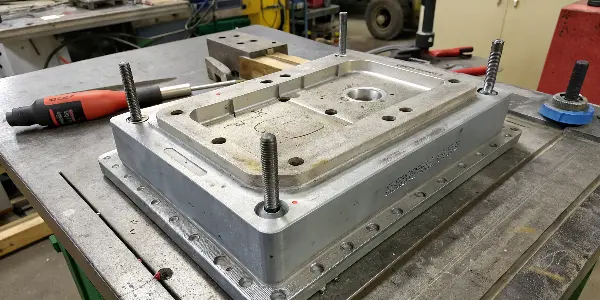
Have you ever examined a newly formed plastic component, and noticed to your dismay a few little unsightly spots upon its surface? These scars are usually created due to ejector pins and they may spoil otherwise consistent product and result in expensive rejects. It is a typical aggravation of manufacture. The answer usually thrives in your first choice of material, which determines how easily something is going to be taken out of its mold.
Plastic material choice influences ejector-pin marks because each resin shrinks, stiffens, grips the core and responds to temperature differently. Crystallinity, filler, moisture, friction, modulus, wall thickness and processing temperature change the force required to release the part. A mold that ejects cleanly with one grade may show marks or distortion after a material change.
Related CKMOLD resources: mold design, production injection molding, mold testing and validation.
The plastic material selected has a direct impact on the required ejection force as well as the probability of ejector pin marks. Highly shrinkable material, low flow rates, or increased elasticity have the tendency to entrap the core of the mold. This needs a higher ejection force which may leave the pins with marks, dents or even turned whitish on the plastic surface. On the other hand, materials that flow well, have low shrinkage and natural lubricity flow out easier, which means less force is needed and there is no possibility of cosmetic defects.
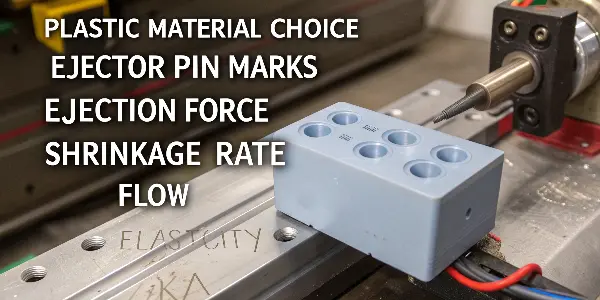
Understanding the link between your material and potential ejection issues is crucial for any project’s success. It’s not just about avoiding ugly marks; it’s about ensuring a smooth, efficient, and cost-effective production run. The deeper you dive into how specific material properties behave inside the mold, the more control you’ll have over the final quality of your parts.
The system-level sequence is explained in Ejector Pin Mark Root-Cause Analysis: Release Load, Timing and Support. This supporting guide concentrates on how the resin and its condition influence release load.
What an Ejector Pin Mark on a Plastic Product Actually Is?
Your product is a fabulous concept and you have a mold made but when you take the initial samples, there are small holes that look like circles on them. You may ask, could it be that the mold is imperfect and is it the process that is misguided. These signs usually lead to the stage of ejection. To unravel the mystery behind this, it is best to first see what these marks are and how they got to be on your finely finished parts.
An ejector pin mark is a defect on the surface of a molded plastic component formed as a result of the force of an ejector pin when being removed out of the mold. Such marks may be in the form of slick or dim dots, small depressions, bumps or white stress lines. They happen when the burden needed to expel the part off the core of the mold is bigger than the semi-solid plastic can handle. It means that there is no balance between the material characteristics, part design, and ejection system.

We must take a closer look at the process of ejection itself to actually understand this. Once the plastic is injected and cools the mold opens. This is where the part is still attached to one half of the mold which is typically on the core side because of natural shrinkage. The ejector system, pins made of steel, then forces ahead to detach the part and mold. This is a critical moment. When it is balanced the part will pop out. However, when the part is too sticky, the pins have enormous local forces.
The Mechanics of Mark Formation
The plastic is still warm and not fully hardened when ejection occurs. Think of it like pushing your finger into a cake that has just come out of the oven. If you push too hard, you leave a permanent mark. It’s the same principle. The force from the pin concentrates on a small area. This can compress the plastic, creating a dent, or stretch it, causing whitening.
Common Types of Ejector Marks
| Mark Type | Description | Common Cause |
|---|---|---|
| Indentation | A slight depression or dimple. | Excessive ejection force on a still-soft part. |
| Whitening | A white, stressed area around the pin location. | High force on brittle plastics like Polystyrene. |
| Protrusion | A raised bump on the part surface. | Pin is too long or flashing occurs around the pin. |
| Shiny/Dull Spot | A change in surface texture. | Pin polishing doesn’t match the mold texture. |
Understanding these details is the first step. Next, we’ll look at how your material choice makes the part either stick like glue or release with ease.
Interaction Draft Angle and Plastic Material Behavior Interaction Effects Ejection force and quality release.
The draft angle is an issue that is mentioned as a design rule and it highly depends on the behavior of plastic materials. Highly shrinking materials or highly rigid materials are used in clamping high on the core of the mold when cooled. This clamping effect can have a strong amplifying effect on ejection force even with a well-designed ejector system when draft angles are not adequate.
Semi-crystalline plastics like polypropylene and nylon have the advantage of having a greater draft angle due to the increased adhesion that is produced by the shrinkage of the plastics on the steel surfaces.
Flexible materials might seem simpler to eject due to their ability to deform, however, it tends to concentrate the stress on the ejector pins creating visible marks or whitening. Correct draft enables the part to deform slowly and evenly instead of fighting to be thrown out, until a sharp separation takes place. One of the most useful methods of minimizing ejector pin marks without altering materials or tooling depth is to match draft angle to material behavior.
How Do Different Plastic Properties Affect Ejection Force?
Your part design is ideal and your mold is ideal but parts are still sticking or leaving with stress marks. This irritating issue has the capacity to stop production. You may begin to accuse the machine parameters or the shape of the mold. It is usually the plastic that is the true offender. The ejection system is struggling against its inherent properties which are forming the friction and adhesion.
The characteristics of a plastic, mostly, the rate of shrinkage, coefficient of friction, and flexural modulus are some of the factors that influence the ejection force. The shrinkage materials are high, thus clamping the mold core, making it difficult to release. Materials that have high coefficient of friction cause resistance. It is possible to bend or deform the materials which are flexible under the influence of the pin rather than cleanly releasing. It is important to select a material that has a combination of these characteristics to reduce ejection force and avoid defects in parts.
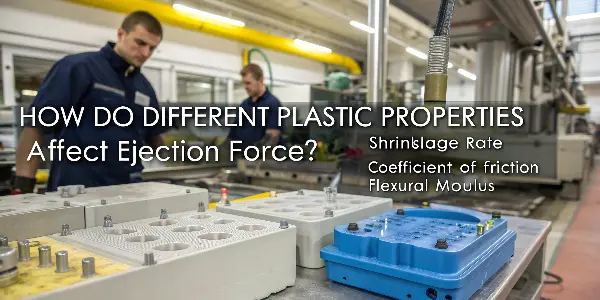
The relationship between a plastic resin and the steel mold is a physical one. When the molten plastic cools and solidifies, it shrinks. This shrinkage causes the part to clamp down tightly onto the mold core. The amount of force needed to break this grip and push the part out is the ejection force.
Friction and Natural Lubricity in Ejector Pin Marks
The coefficient of friction between the plastic and the mold steel is another huge factor. Some plastics are naturally “stickier” than others. For example, Thermoplastic Urethane (TPU) is notorious for its high friction, making it difficult to eject. In contrast, materials like Acetal (POM) or those with added lubricants like PTFE have a very low coefficient of friction. They release so easily that sometimes they fall out before the ejector pins even touch them.
Stiffness vs. Flexibility
The stiffness of the material, or the flexural modulus of the material, is also a factor. For example, for a highly rigid material such as glass-filled polycarbonate, the force of the ejector pin will be easily transmitted, and the part will “pop right out” from the core. For a highly flexible material, such as a soft TPE, the part will merely deform or sag around the ejector pin without becoming detached from the mold core. It could even be pierced through.
The main Processing Parameters that negatively or positively affect ejector pin marks during part ejection
The conditions of processing have a direct impact on the behavior of the plastic at the ejection time. In case the cooling time is not long enough, then the part will not be hard and the ejector pins will push into the surface instead of pushing the part off. This can be enhanced by high mold temperatures which slow down solidification towards the core.
The pressure during packing is also a factor. Over packing causes the plastic material to squeeze against the core of the mold, which enhances friction and adhesion. Although the dimensional stability requires proper packing, excessive packing increases the force of ejection and the risk of defects.
Balanced cooling, regulated pressure during packing and mold temperature creates a part that attains adequate rigidity during ejection enabling the part to disengage with reduced force.
Comparison of the Common Injection Molding Plastics by their Probability of the Ejector Pin Marks.
The various plastics have different behavior under ejection. TPU, TPE, glass-filled nylons and other high-risk materials are either high-friction, highly flexible, or stiff materials that enhance local pin pressure. These are materials that may need special ejection strategies.
Middle risked materials, such as PP, PA and ABS can be readily ejected when the draft, cooling and pin distribution are carefully controlled. Less risky materials, e.g. POM, lubricated grades, or mineral-filled grades, inherently release freely because of low friction and consistent shrinkage. Knowledge of these tendencies would enable the engineers to predict the challenges of ejection even before the mold trials commence.
What Material Are Ejector Pins Usually Made of?
You are worried about the plastic component, but what about the mold component that pushes the plastic out? Ejector pins are the ones doing the heavy lifting in every cycle. If the design material for the ejector pins is not the right one, then the pins can easily bend, shatter, and wear out quickly. This results in downtime, mold failure, and variations in part quality. Selecting the right design material for the pin is just as important to mold designers and engineers.
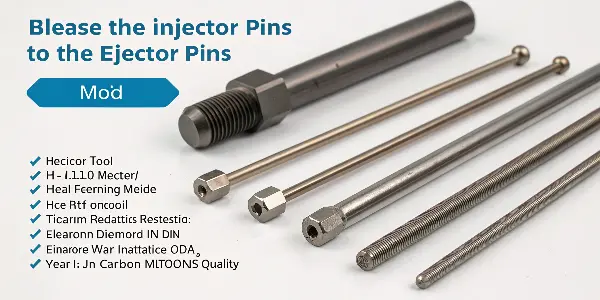
Generally, ejector pins are manufactured using hardened tool steel to withstand the processing conditions of the injection molding process. H-13 tool steel is one of the preferred materials used in the production of ejector pins owing to the remarkable resistance it gives to wear and heat. When wear resistance or lubrication properties are of primary concern, the ejector pin can be treated using coatings of Titanium Nitride or Diamond-Like Carbon or made of specialist alloys to enhance lubrication properties.
Core Material Requirements
The choice of steel for an ejector pin isn’t random. It’s based on a few critical needs of the molding environment.
- Hardness & Strength,: The pin has to possess hardness in order not to deform or mushroom when high ejection forces are involved. The pin also requires sufficient strength not to buckle or bend when it is thin and very long.
- Toughness: This pin must endure the shock of pushing the part out. A material which is too hard and not tough will be brittle enough to break.
o Heat Resistance: The ejector pins work in a hot mold. The material must be resistant to heat in order not to soften. - Wear Resistance: The pin moves through guide bushings in the mold with each cycle. The lack of wear resistance will cause the pin to seize or wear out.
Common Steels and Treatments
To meet these demands, mold makers rely on a few trusted materials.
| Pin Material / Treatment | Key Feature | Best Used For |
|---|---|---|
| H-13 Tool Steel | Good all-around toughness and heat resistance. | General purpose applications. |
| Nitrided Steel | Hardened surface for high wear resistance. | High-volume production, abrasive materials. |
| Titanium Nitride (TiN) Coating | Gold-colored, very hard, low-friction surface. | Running without lubrication, sticky materials. |
| Through-Hardened Steels (e.g., A2, D2) | High hardness throughout the pin. | High-pressure applications, but can be more brittle. |
The material of the pin and the plastic part interact directly. A hard, coated pin will perform much better when ejecting a sticky, abrasive plastic than a standard, untreated pin would. This synergy is key to a robust molding process.
Mold Design and Ejection System Adjustments in cases when the selection of plastic material is not possible.
In most undertakings, the choice of materials is predetermined by either mechanical, regulatory, or customer demands. Mold and ejection system design have to make up in such instances. The more the number of ejector pins, the less force is concentrated on specific pins. Sleeve ejectors or stripper plates distribute the load of the ejection over a greater surface area, and thus the chance of visible marks is reduced.
Transfers to non-cosmetic surfaces and better core surface finish can also be used to minimize adhesion. The modifications enable the hard materials to be modified effectively without losing the appearance of the part or the efficiency of the production process.
Quick Troubleshooting Checklist to Diagnose Material-Rooted Causes of Ejector Pin Marks.
Ejector pin marks are also useful to give clues in their characteristics. The white stress marks are usually a sign of fractured behavior or too much force. Deep pin dents indicate that the part is being ejected when too hot or is made out of a high-shrink material. Random or random walk marks typically indicate uneven cooling or friction coefficients on the mold surface.
In the event that ejection is increasingly becoming more severe with time, abrasives fillers are possible to be abrading pins and core sides. Applying this checklist allows to identify the material-related concerns and the process or tooling errors to take more timely and direct corrective action.
How Does the “Strongest” Plastic Behave During Ejection?
Generally, when I ask a customer what they want in a “strong” plastic, they are usually concerned about high tensile strength or impact resistance of their finished product. However, a finish product that has high strength can, at times, present a problem during its molding process. These high-strength materials tend to have properties that tend to impart a vise-like grip to a mold. How would you remove a piece of this high-strength plastic without damaging it?
The tougher plastics, such as glass-filled nylons, PEEK, or Polycarb, may pose difficulties in ejection when very stiff and contracting little. While the material is stiff, hence difficult to contract, enough force will be required in a feature which might bind the material, such as a lack of draft. The material properties of the glass filling might increase the mold and ejection pin wear rate, making the process of ejection difficult in the long run.
The Double-Edged Sword of Stiffness
High stiffness (flexural modulus) is what makes a plastic “strong”. This stiffness makes a plastic part resistant to deformation when a force is applied. In ejection, this force from pins will be applied efficiently to the part. But at the same time, it makes a plastic unforgiving.
The Impact of Fillers
Many of the “strongest” plastics are composites, containing fillers like glass fibers, carbon fibers or minerals. These fillers dramatically increase strength and stiffness but they also change how the material behaves in the mold.
-
Increased Abrasion: Glass and other mineral fillers are highly abrasive. Over thousands of cycles, they can wear down the polished surfaces of the mold and the ejector pins. This increases friction and makes ejection progressively more difficult over the life of the tool.
We resolved the problem of the glass-filled Nylon with increased draft angles on all vertical walls, and increasing the ejector pins so that the force would distribute more evenly. We also used nitrided pins for better wear resistance. It goes to demonstrate that when you pick a powerful material, you also have to adapt your part and mold design to accommodate its unique ejection behavior.
Shrinkage and Core Grip
Some materials shrink more strongly around a core or develop orientation that increases release force. Gate, cooling, wall and mold temperature affect the direction and magnitude of that grip. Review core taper and draft with the exact resin rather than relying on a generic shrinkage number.
Stiffness at Ejection
A part with low stiffness or a high ejection temperature can flex around a pin and show a raised mark. A high-modulus filled grade may resist local deformation but increase wear or require greater force if the part grips the core.
Fillers and Orientation
Glass, mineral and other fillers alter flow orientation, shrinkage, friction and surface wear. A fiber-oriented region may eject differently from a transverse region, and a pin placed without regard to the load path may create a visible witness or crack.
Moisture and Processing History
Moisture-sensitive resins can change stiffness and surface quality, while excessive thermal history can degrade the material and alter release behavior. Drying, melt, mold temperature, residence and conditioning should be controlled before comparing materials.
Validate the Material Change
When changing grade, filler, color or supplier, compare ejection force, mark severity, dimensions, weight, warpage, cycle and appearance. Recheck draft, pin layout, polish and cooling if the new material changes the release margin.
How Plastic Material Choice Affects Ejector Marks and Ejection Force: Buyer Review Checklist
- Compare shrinkage, crystallinity, stiffness, friction, moisture and ejection temperature.
- Account for filler orientation, wear, local force and core grip.
- Control drying, melt, mold, residence and conditioning history.
- Review draft, polish, cooling and pin load paths for the exact grade.
- Revalidate ejection force, marks, dimensions, weight, warpage and appearance after material changes.
FAQ
Why can glass-filled plastic increase ejection problems?
Filler can change shrinkage, orientation, friction, stiffness and tool wear, increasing local release force or making pin support more critical.
Does higher stiffness generally reduce pin marks?
Not necessarily. It can resist local deformation but may also grip the core more strongly or require higher ejection force.
Conclusion
The selection of the proper plastic is not just about the functionality of the final product. It directly dictates how successfully that product can be manufactured. The innate properties of the material in question-its shrinkage, friction, and stiffness-dictate the ejection force as a primary driver and are found at the very root of the cause of ejector pin marks. Understanding this relationship will enable you to get ahead of the issues and design a much stronger and more efficient molding process right from the start.