
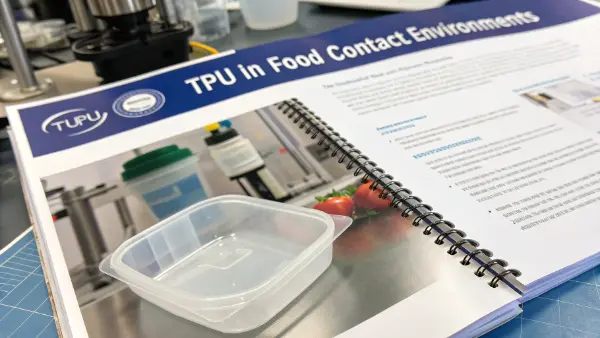
Thermoplastic polyurethane (TPU) is one of the most versatile engineering polymers available today — but when it comes to food contact applications, not all TPU is created equal. The wrong grade can expose your product to regulatory rejection, costly recalls, and consumer safety risks.
TPU can be considered for food-contact seals, grips, flexible interfaces or processing components, but compliance is not established by the word ‘TPU’ alone. The exact polymer grade, colorants, additives, processing aids, supplier, intended food type, temperature, contact time and market determine the evidence required. A responsible selection process connects the formulation declaration to migration, hygiene, traceability and finished-part controls.
Related engineering resources: insert molding and overmolding | production injection molding | mold testing and validation
This guide covers everything engineers, product developers, and procurement specialists need to know about using TPU in food contact environments: the regulations that govern it, how to evaluate material grades, what to watch out for during formulation, and how to make confident material selection decisions.
What Makes TPU a Candidate for Food Contact Use?
TPU’s appeal in food contact applications comes from its unique combination of physical properties:
- Flexibility without plasticizers — Unlike PVC, TPU achieves elasticity through its polymer chemistry, not through phthalate or other potentially leaching additives.
- Chemical resistance — TPU resists oils, greases, weak acids, and many cleaning agents commonly found in food processing environments.
- Mechanical durability — High abrasion resistance and tear strength make it practical for repeated-use components like seals, tubing, and conveyor parts.
- Processability — It can be injection molded, extruded, and thermoformed, making it suitable for complex food contact components.
However, TPU’s chemistry — built on isocyanates, polyols, and chain extenders — introduces migration risks that must be carefully managed before any food contact claim can be made.
Regulatory Frameworks Governing TPU in Food Contact
FDA Regulations (United States)
In the United States, food contact materials are regulated under 21 CFR (Code of Federal Regulations). For TPU, the relevant sections typically include:
- 21 CFR 177.1680 — Covers specified polyurethane resins used as the food-contact surface of articles intended for bulk dry foods of Type VIII, subject to the section’s composition and use conditions. It is not a blanket clearance for repeated contact with every food type.
- 21 CFR 178.3750 — Covers polyethylene glycol with a mean molecular weight of 200–9,500 under stated conditions; it is not a polyurethane-resin authorization.
- Substances in compliance lists — Each component used in the TPU formulation (polyols, chain extenders, pigments, stabilizers) must individually comply with FDA listings or receive a Food Contact Notification (FCN).
The FDA framework is compliance-based, not approval-based. This means manufacturers assert compliance rather than receiving explicit FDA “approval” for each material — which places significant responsibility on the TPU formulator and the end-product manufacturer.
Key practical implication: When requesting a food-grade TPU from a supplier, ask for a letter of compliance that specifies which CFR sections apply, the food types covered (aqueous, fatty, acidic, alcoholic), and the use temperature.
EU Regulations (European Union)
The EU takes a more prescriptive, positive-list approach through:
- Regulation (EC) No 1935/2004 — The framework regulation for all food contact materials, requiring materials not to transfer components in quantities that could harm human health or cause unacceptable changes in food composition.
- Regulation (EU) No 10/2011 — The plastics-specific regulation that includes a Positive List of authorized monomers, additives, and other substances. TPU components must appear on this list to be legally used.
- Overall Migration Limit (OML): 10 mg/dm² of food contact surface area.
- Substance-specific restrictions: The Union list must be checked substance by substance. For 4,4′-MDI, Regulation (EU) No 10/2011 lists a 1 mg/kg restriction in the final material or article, expressed as the isocyanate moiety. This should not be restated as a universal 1 mg/kg migration limit in food simulant.
One critical point for EU compliance: aromatic isocyanates, including MDI and TDI, are heavily scrutinized due to potential formation of aromatic amines. Any TPU destined for EU food contact applications must demonstrate that residual isocyanates do not migrate at detectable levels in food simulant testing.
Other Key Regulations
| Region | Key Standard | Notes |
|---|---|---|
| Germany | BfR Recommendation LVII | National guideline for polyurethanes; often referenced alongside EU regs |
| China | GB 4806.6-2016 | Plastics standard under GB food safety law; positive list approach |
| Japan | JHOSPA / MHLW Notification 370 | Voluntary standards; JHOSPA certification widely recognized |
| Switzerland | Ordinance SR 817.023.21 | Aligns largely with EU 10/2011 |
If your product will be sold internationally, multi-market compliance from the start is far more cost-effective than retrofitting formulations later.
Understanding TPU Chemistry and Migration Risk
The Three Main TPU Chemistries
TPU is formed by reacting a diisocyanate, a polyol (long-chain diol), and a chain extender (short-chain diol or diamine). The polyol component largely determines the TPU’s base chemistry and food contact behavior:
1. Polyester-based TPU
- Good chemical resistance and mechanical properties
- More susceptible to hydrolysis in prolonged contact with water or steam
- Generally avoided in wet food contact unless specifically stabilized
2. Polyether-based TPU
- Superior hydrolytic stability
- Better suited for repeated aqueous food contact
- More commonly used in food processing equipment components
3. Polycarbonate-based TPU
- Excellent hydrolysis and oxidation resistance
- Higher cost but best long-term performance in demanding environments
- Increasingly used in premium food contact applications
Migration: The Central Concern
For food contact compliance, the critical question is: what migrates from the TPU into food, and at what level?
The primary migration concerns for TPU include:
- Residual isocyanates — Most reaction-completed TPU contains very low residual isocyanate, but testing is required to confirm this.
- Aromatic amines — Breakdown products of aromatic isocyanates (TDI, MDI); EU regulation effectively prohibits detectable migration of primary aromatic amines.
- Plasticizers and processing aids — Any additives incorporated during compounding can migrate; each must be individually assessed.
- Colorants and pigments — Must be from approved lists; some organic pigments have associated heavy metal impurities.
- Antioxidants and UV stabilizers — Commonly added to improve shelf life; must comply with applicable positive lists.
How to Select the Right Food-Grade TPU
Step 1: Define Your End-Use Conditions
Before selecting a TPU grade, precisely define the application conditions, because compliance depends heavily on them:
- Type of food contact — Dry foods, fatty foods, aqueous foods, alcoholic beverages? Each has different migration potentials and requires different simulants in testing.
- Contact temperature — Ambient (≤ 20°C), refrigerated, hot-fill (≤ 70°C), or retort (> 100°C)?
- Duration of contact — Single-use, short-term (< 30 min), or prolonged (> 24 hours)?
- Repeated use — Single-use articles have different compliance pathways than repeated-use components.
Example: A TPU seal used in a commercial juicer faces fatty and acidic food types at ambient temperature with repeated daily use — this immediately directs you toward polyether-based TPU with documented SML compliance for fatty food simulants (Tenax or olive oil/sunflower oil, depending on the regulation).
Step 2: Require a Full Compliance Dossier from Your Supplier
A reputable food-grade TPU supplier should provide:
- Declaration of Compliance (DoC) — Signed statement identifying the applicable regulations and confirming compliance.
- Substance list — Full disclosure of intentionally added substances (IAS), ideally with CAS numbers and regulatory references.
- Migration test reports — Third-party test data using appropriate food simulants (e.g., 3% acetic acid for acidic foods, 50% ethanol for alcoholic foods, 95% ethanol or isooctane for fatty foods).
- Formulation stability confirmation — Especially important for polyester TPU, to ensure no hydrolysis-related degradation products arise under use conditions.
Do not accept a generic “food-grade” label without documentation. The term has no universal legal definition — compliance is substance-specific and condition-specific.
Step 3: Evaluate the Exact Chemistry and Evidence Package
The words aromatic and aliphatic do not by themselves establish food-contact compliance, migration performance or price. They describe part of the polymer chemistry. The buyer still needs evidence for the exact commercial grade, color and intended contact conditions.
| Decision question | Evidence to request | Why it matters |
|---|---|---|
| Will light stability or non-yellowing affect function? | Supplier weathering or color-change data for the exact grade and color | Aliphatic systems are often selected for light stability, but appearance depends on the complete formulation and exposure. |
| Could aromatic amines be relevant? | Formulation statement plus current migration report identifying analytes and detection limits | The legal assessment depends on the substances present and the applicable EU restrictions, not the family name alone. |
| Is the grade legally usable for the intended market? | FDA regulatory basis or effective FCN, or EU declaration/supporting documentation for the exact formulation | A generic “food grade” statement does not define food type, time, temperature or repeat-use conditions. |
| Can two offers be compared fairly? | Same hardness, color, performance specification, contact scenario, test basis and annual volume | Unsupported multipliers such as “2–3×” hide scope and market differences. |
For a transparent or light-exposed article, an aliphatic TPU may be a useful candidate. It is not an automatic compliance shortcut: approve the exact grade only after the regulatory and migration evidence matches the intended use.
Step 4: Verify Additive Package Compliance
Even if the base polymer is compliant, a non-compliant additive invalidates the entire material. Common problem areas include:
- Slip agents — Some waxes and amides are not on EU Regulation 10/2011 positive lists.
- Flame retardants — Most halogenated and phosphorus-based flame retardants are not approved for food contact.
- Processing stabilizers — Certain heat stabilizers used to facilitate extrusion can migrate.
Ask specifically: “Is this formulation free of substances not authorized under [applicable regulation] for [intended food type and contact condition]?”
Common Problems and How to Avoid Them
Problem 1: Supplier “Food Grade” Claims Without Supporting Data
Solution: Require a DoC plus third-party migration test reports. The burden of proof is on the supply chain.
Problem 2: Aromatic Amine Migration in EU Testing
Solution: Do not apply one blanket primary-aromatic-amine limit. Ask the laboratory to use the current Annex II rules in Regulation (EU) No 10/2011, identify each amine and state its reporting limit. The consolidated rule distinguishes certain listed or REACH-restricted amines, which must not be detectable at a 0.002 mg/kg limit of detection per amine, from other non-listed PAAs subject to a 0.01 mg/kg sum limit. Changing to an aliphatic system may alter the hazard profile, but the exact formulation and intended use still require assessment.
Problem 3: Hydrolysis Causing Compliance Drift Over Time
Solution: Use polyether or polycarbonate-based TPU for wet contact applications. For polyester-based grades, request hydrolytic stability data under simulated use conditions.
Problem 4: Color Matching Breaks Compliance
Solution: Do not reformulate colorants without reassessing food contact compliance. Use only colorants from approved lists; request a specific DoC for the colored formulation, not just the natural/unfilled grade.
Problem 5: Imported TPU With Incomplete Documentation
Solution: Under EU Regulation 1935/2004, the importer/first EU-market placer bears legal responsibility for compliance. Conduct supplier audits and request full substance disclosure before committing to a supply relationship.
Testing Requirements for Food Contact TPU
Standard Food Simulants (EU 10/2011)
| Food Simulant | Designation | Represents |
|---|---|---|
| 10% ethanol (v/v) | Simulant A | Aqueous, low-alcohol foods |
| 3% acetic acid (w/v) | Simulant B | Acidic aqueous foods |
| 20% ethanol (v/v) | Simulant C | Alcoholic beverages |
| 50% ethanol (v/v) | Simulant D1 | High-alcohol beverages and oil-in-water emulsions |
| Vegetable oil (or isooctane/95% ethanol) | Simulant D2 | Fatty foods |
| Poly(2,6-diphenyl-p-phenylene oxide) — Tenax® | Simulant E | Dry foods |
Testing conditions (time and temperature) are defined by the intended use. For worst-case scenarios, the most severe applicable conditions must be used.
FDA Testing Approach
Regulatory route must match the exact TPU formulation. For every component reasonably expected to migrate, the supplier or article manufacturer should identify an applicable CFR authorization, GRAS basis, prior sanction, effective Food Contact Notification, or a Threshold of Regulation exemption. An FCN is specific to the notified manufacturer or supplier and its stated conditions of use. The 0.5 ppb dietary-concentration level is one basis considered in a formal Threshold of Regulation request; it is not an automatic exemption created by a screening result.
Expert Tips for Food Contact TPU Projects
- Start with the end market in mind. If the product will be sold in both the US and EU, design for EU 10/2011 first — it is generally more stringent.
- Build traceability into your supply chain. Food contact compliance is only as strong as the weakest link. Tier 2 and Tier 3 raw material suppliers must be part of your compliance chain.
- Re-test after any formulation change. A new lot of TPU with a modified stabilizer package is a different material for compliance purposes.
- Document everything. In the event of a product inquiry or recall investigation, your ability to produce complete compliance records is your first line of defense.
- Consult a food contact regulatory specialist early. Regulatory consultants specializing in food contact materials (e.g., FABES Forschungs-GmbH in Germany, or FDNS specialists in the US) can prevent expensive late-stage compliance failures.
FAQs
Is all TPU food-safe?
No. “Food-safe” is not an inherent property of TPU. It depends on the specific formulation, the food type, contact temperature, and duration. Only TPU grades with documented compliance — tested under applicable conditions — should be used in food contact.
Can colored TPU be food contact compliant?
Yes, but the colorant must be individually verified. Generally request a DoC that specifically covers the colored grade.
What is the difference between “food contact” and “food grade”?
“Food contact” is a regulatory term referring to materials that directly contact food. “Food grade” is an informal industry term with no standardized legal definition. Generally ask for “food contact compliance” documentation, not just a “food grade” label.
Does food contact TPU require FDA approval?
No. The FDA uses a compliance system, not a pre-approval system for most food contact materials. Manufacturers self-certify compliance with the relevant CFR sections based on testing and formulation review.
Can I use standard industrial TPU with a food-contact coating instead?
Potentially, if the coating itself is food contact compliant and forms a functional barrier. However, barrier performance must be validated — TPU substrates may cause pinhole defects that compromise the barrier.
What happens if my TPU migrates above the OML in EU testing?
The material is not compliant for use in that application. You must either reformulate, reduce the surface-area-to-volume ratio, or restrict the use conditions until migration testing confirms compliance.
Reference resources: FDA food-contact substance guidance | EU food-contact framework
Define the Intended Contact Use
Record direct or indirect contact, food type, temperature range, contact time, repeated-use conditions, cleaning chemicals, surface area and whether the part is a seal, conveyor component, closure or processing aid. A grade acceptable for one use may not be acceptable for another.
Verify the Exact Formulation and Market Route
Request the exact grade, color, additives, processing aids, supplier identity and change-control status. For the United States, review the applicable FDA authorization route and conditions of use; for Europe, review the applicable framework and required declaration or supporting documentation. Do not treat a generic supplier statement as universal approval.
Evaluate Migration and Organoleptic Risk
Assess extractables or migration under representative food simulants and conditions where required, and consider taste, odor, color transfer, surface damage and cleaning. The material certificate should connect to the formulation actually molded, not only the base polymer family.
Control Molding Hygiene and Process History
Use clean material handling, dedicated or validated equipment where appropriate, controlled regrind rules, approved lubricants and a documented purge and cleaning process. Mold temperature, residence time, degradation, flash and surface defects can affect both function and cleanliness.
Build a Traceable Release Package
Retain resin lot, supplier declaration, color and additive records, molding batch, process window, inspection, test reports and change approvals. Requalify when grade, supplier, formulation, color, mold, process or intended use changes. Regulatory status is a product-and-use claim, not a permanent label on a polymer family.
Evidence to Request Before Release
- Exact grade, color and additive-package identification with lot traceability.
- Intended food types, contact time, maximum temperature, repeated-use status and cleaning cycle.
- US regulatory basis and/or EU declaration plus supporting migration report for the same formulation.
- Test specimen thickness, surface-to-volume ratio, simulants, time/temperature conditions, analytes and reporting limits.
- A change-notification agreement covering resin, colorants, processing aids and manufacturing site.
Submit the contact scenario through the RFQ form. If drawings or a compliance dossier are needed for engineering review, send them separately to jerry@ckmold.com; the form does not require a CAD upload.
TPU for Food Contact Applications: Buyer Review Checklist
- Define food type, temperature, time, reuse, cleaning, surface and contact mode.
- Confirm exact grade, additives, color, supplier, market authorization route and conditions.
- Evaluate migration, extractables, odor, taste, color transfer and cleaning exposure.
- Control hygiene, regrind, lubricants, residence time, degradation and mold cleanliness.
- Maintain lot, declaration, process, test, change-control and release records.
Frequently Asked Questions
Is all TPU suitable for food contact?
No. Food-contact suitability depends on the exact grade, additives, color, supplier, intended conditions and applicable market authorization or declaration.
Does an FDA or EU statement cover every molded part made from the grade?
Not automatically. The statement may be limited by formulation, manufacturer, food type, temperature, contact time and processing conditions. Confirm the applicable conditions with the material supplier and regulatory professional.
Why does processing matter for food-contact TPU?
Degradation, contamination, non-approved lubricants, regrind and poor cleaning can change the finished article even when the starting resin is documented. Manufacturing controls belong in the compliance file.
Conclusion
Selecting TPU for food contact applications is not simply a matter of picking a flexible, durable polymer — it is a regulatory and technical process that demands precision at every step. From choosing between polyether and polyester base chemistries to verifying every additive in the formulation stack, the path to genuine food contact compliance requires documentation, third-party testing, and a thorough understanding of applicable regulations.
The key takeaways:
- Generally demand a full compliance dossier — DoC plus migration test data — from your TPU supplier.
- Understand which regulatory frameworks apply to your target markets (FDA 21 CFR, EU 10/2011, or both).
- For EU markets, pay special attention to aromatic amine migration and the positive list requirements.
- Align your TPU base chemistry with your actual contact conditions — polyether for wet applications, aliphatic isocyanate base for transparency and reduced aromatic amine risk.
- Do not assume that a formulation change leaves your compliance status unchanged.
Done right, TPU delivers outstanding performance in food contact environments. Done carelessly, it creates liability. The difference lies entirely in the rigor of your material selection process.