Are you tired of seeing perfect plastic parts marred by ugly white stress marks? These flaws, known as ejector pin marks, can lead to rejected batches, costly rework, and frustrated clients. It feels like a never-ending battle between getting the part out and keeping it flawless. But what if you could consistently achieve both? At CKMOLD, we’ve learned that smart ejection system design isn’t just a goal; it’s the solution to achieving a perfect finish every time.
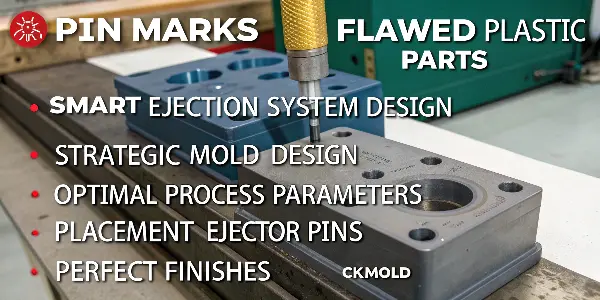
To prevent pin marks, you must combine strategic mold design with optimized process parameters. This starts with placing an adequate number of correctly sized ejector pins on non-cosmetic, sturdy areas of the part, like ribs or bosses. Ensure a smooth mold cavity finish and sufficient draft angles to reduce sticking. Then, fine-tune your process by optimizing cooling time, holding pressure, and injection speed. This holistic approach minimizes the force needed for ejection, preventing stress marks and ensuring part quality.
I’ve seen this issue trip up countless projects. A client once came to us with a beautiful consumer product design, but their previous supplier left noticeable pin marks on the smooth, curved housing. The end customer, of course, rejected it. It’s a common story that highlights how a small detail like ejection can make or break a product’s success. But don’t worry, this is a solvable problem. It just requires thinking about ejection from the very start. Let’s dive deeper into the specific strategies that will help you master this critical aspect of molding.
Where Should Ejector Pins Be Placed for a Flawless Finish?
Have you ever wondered why pin marks appear on the most visible surfaces of your parts? It’s often a sign that pin placement was an afterthought, not a core part of the design strategy. This careless placement can ruin a product’s aesthetic appeal, leading to quality control failures. The solution lies in treating pin placement with the same importance as the part’s primary features, ensuring function and finish go hand-in-hand. This is how you achieve perfection.
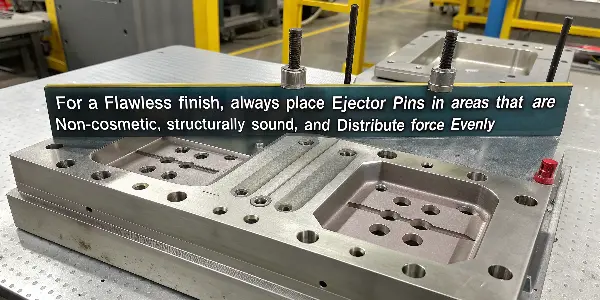
For a flawless finish, always place ejector pins in areas that are non-cosmetic, structurally sound, and distribute force evenly. Prioritize locations like the underside of the part, internal ribs, bosses, or areas that will be covered by other components. The goal is to apply balanced pressure on the strongest, most rigid sections to push the part out smoothly without deforming or marking visible surfaces. Never place a pin on a thin, unsupported wall or a Class-A cosmetic surface.
Thinking about pin placement is like planning the foundation of a house; it has to be done right from the start. You can’t just scatter pins randomly and hope for the best. We need to analyze the part’s geometry to identify the best spots to push.
Key Placement Strategies
The best approach is to target areas that provide maximum support. We always look for ribs and bosses first. These features are naturally stronger and can handle the ejection force without showing stress. Pushing on a flat, thin wall is asking for trouble; it’s like trying to push a car by its window instead of its frame. We also aim for a balanced layout. Imagine a table with only one leg—it falls over. The same principle applies here. If all the pins are on one side, the part can warp or get stuck during ejection. By spreading the force evenly across the part, we ensure a clean, parallel release from the mold.
The Cosmetic Surface Rule
This is a non-negotiable rule in my book: never place an ejector pin on a primary cosmetic surface. These are the surfaces the end-user will see and touch. I always instruct my team to review the part’s final application. If a surface will be hidden after assembly, it becomes a candidate for pin placement. This simple discipline is often the difference between a premium product and a cheap-looking one.
Does the Size and Shape of Ejector Pins Really Matter?
You might think an ejector pin is just a simple steel rod, but are you choosing the right one for the job? Using pins that are too small concentrates force in one spot, creating intense pressure that easily marks the plastic. This is a common mistake that leads directly to whitening and stress marks. The key isn’t just pushing the part out, but pushing it out gently and effectively. Choosing the right pin is the first step to achieving that gentle push.
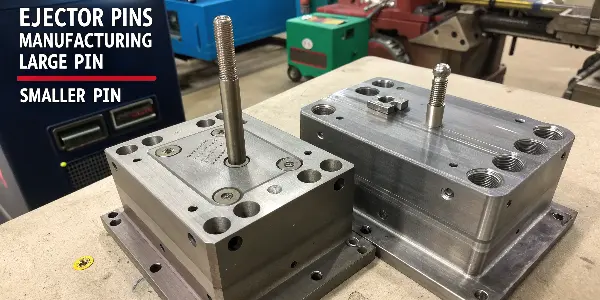
Yes, the size and shape of ejector pins matter immensely. Use the largest diameter pin that the part geometry allows to maximize the contact area and distribute ejection force over a wider surface. This significantly reduces the pressure (PSI) on the plastic, minimizing the risk of marks, punctures, or deformation. For delicate or complex features, consider shaped "blade" ejectors or contouring the pin face to match the part surface, ensuring uniform contact and support during ejection.
I remember a project involving a thin-walled electronics enclosure. The initial design used many small-diameter pins, and the result was a polka-dot pattern of stress marks. The client was panicking. We remade the ejector plate to accommodate fewer, but much larger, pins placed under the internal support ribs. The problem vanished instantly. This experience taught me that maximizing surface area is one of the most powerful tools we have against pin marks.
Calculating Force and Pressure
It all comes down to a simple physics principle: Pressure = Force / Area. The force required to eject the part is determined by factors like material shrinkage, draft angle, and surface finish. While we work to minimize that force, we have direct control over the "Area" part of the equation.
| Pin Diameter | Contact Area (mm²) | Relative Pressure (vs. 8mm pin) |
|---|---|---|
| 2mm | 3.14 | 16x Higher |
| 4mm | 12.56 | 4x Higher |
| 8mm | 50.24 | 1x (Baseline) |
| 12mm | 113.04 | 44% Lower |
As you can see, doubling the pin diameter reduces the pressure on the part by a factor of four. This is why we always push for the largest possible pins.
Beyond Standard Pins
Sometimes, a round pin just won’t fit. On a thin rib, a standard pin would have very little contact area. In these cases, we use an ejector blade. This is essentially a rectangular pin that matches the shape of the rib, maximizing contact area in a tight space. For curved surfaces, we can even contour the face of the pin to perfectly match the part, ensuring the ejection force is applied perpendicular to the surface, preventing slippage and stress.
Can Adjusting Molding Parameters Reduce Ejector Pin Marks?
Your mold design is perfect, with large pins placed in all the right spots. Yet, you’re still getting faint pin marks. What’s going on? Many people forget that the mold is only half the equation; the molding machine’s settings play a huge role. Running the process too aggressively can create a part that grips the core so tightly that even a perfect ejection system will leave marks. The solution is to harmonize your design with a finely tuned process.
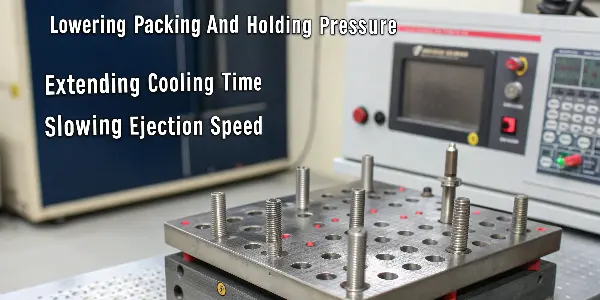
Absolutely. Optimizing molding parameters is critical for reducing pin marks. Lowering the packing and holding pressure reduces the force with which the plastic is pressed against the mold cavity, making it easier to eject. Extending the cooling time ensures the part is fully solidified and rigid enough to withstand ejection forces without deforming. Additionally, a slower ejection speed can provide a gentler push, preventing the sudden impact that causes stress whitening.
The relationship between processing and pin marks is something I learned the hard way. Early in my career, we had a rush job and tried to shorten the cycle time by cutting the cooling phase. We immediately started seeing pin marks on every single part. We had to slow the process back down, letting the part properly cool and harden. It was a clear lesson: a robust process is just as important as a robust mold. You can’t rush physics.
The Big Three Parameters
When we see pin marks, we immediately look at three key settings on the injection molding machine.
- Packing/Holding Pressure: After the mold is filled, holding pressure "packs" more material in to compensate for shrinkage. If this pressure is too high, it’s like gluing the part to the mold core. The part will be over-packed and harder to eject. We methodically reduce this pressure to the lowest point possible that still prevents sink marks.
- Cooling Time: Plastic needs time to go from a molten state to a solid one. If you try to eject it while it’s still too soft (like pushing your finger into warm butter), the ejector pins will easily leave indentations. A sufficient cooling time allows the part to gain the strength and rigidity needed to handle the force of ejection without damage.
- Ejection Speed and Stroke: Sometimes, the problem isn’t the force but the speed at which it’s applied. A fast, jerky ejection motion can shock the part, causing stress. We often program a two-stage ejection: a slow initial movement to gently break the part free from the core, followed by a faster stroke to fully eject it. This "soft touch" approach can make a world of difference.
How Do Surface Finish and Draft Angles Affect Ejection?
You’ve optimized your pin placement and your process, but some parts still stick in the mold, requiring excessive force to eject. Why? The answer often lies in two fundamental design features: the texture of the mold and the angle of the walls. A rough surface acts like Velcro, while perfectly vertical walls create a vacuum effect, making parts incredibly difficult to remove. This is where mastering surface finish and draft angles becomes essential.
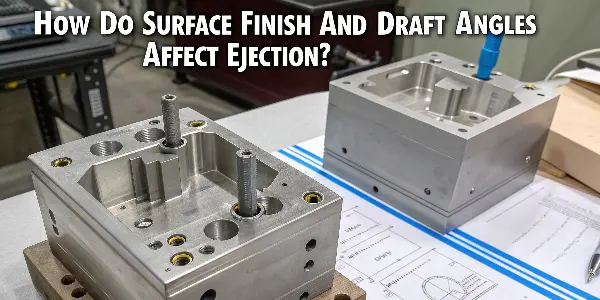
Surface finish and draft angles are critical because they directly determine the amount of friction and adhesion between the part and the mold. A highly polished mold surface (like an A-1 or A-2 finish) creates less friction, allowing the part to release more easily. Similarly, applying an adequate draft angle (typically 1-3 degrees) to all vertical faces ensures that as soon as the part begins to move, it breaks contact with the mold wall, dramatically reducing the required ejection force and preventing pin marks.
Think about trying to pull a wet cup straight out of another identical cup. It’s almost impossible due to suction. But if you tilt it just a little, it comes right out. A draft angle does the same thing for a molded part. I’ve seen projects with zero draft fail spectacularly; the parts would get so stuck that the ejector pins would punch right through them. Adding just one degree of draft solved the problem completely.
The Role of Surface Finish
The texture of the mold steel is a major factor. A rougher texture (like a C-grade SPI finish) has microscopic peaks and valleys that the melted plastic flows into. As it cools and shrinks, the plastic grabs onto this texture, increasing the force needed for ejection.
| SPI Finish | Description | Ejection Force | Recommended Draft |
|---|---|---|---|
| A-1 | Grade #3 Diamond Buff | Very Low | 0.5°+ |
| B-1 | 600 Grit Paper | Low | 1°+ |
| C-1 | 600 Stone | Moderate | 2°+ |
| D-1 | Dry Blast Glass Bead | High | 3°+ |
For deep-draw parts or those with minimal draft, we always specify a highly polished finish on the mold core in the direction of pull. This acts like a lubricant, helping the part slide off cleanly.
Draft Angle: Your Best Friend
Draft is the single most effective way to reduce ejection force. We always recommend adding as much draft as the product design will allow. For every inch of depth, adding one degree of draft creates a significant gap as soon as ejection begins. This immediately breaks any vacuum or friction. When a designer insists on a "zero draft" design for aesthetic reasons, we have to have a serious conversation about the risks, as it dramatically increases the likelihood of scuffing, warping, and, of course, ejector pin marks.
Conclusion
Preventing ejector pin marks is not about a single magic trick; it’s about a holistic and disciplined approach. It requires careful planning from the very beginning, combining smart design choices with a finely tuned manufacturing process. By strategically placing large pins, optimizing draft and surface finish, and controlling your molding parameters, you can eliminate this common defect. This ensures you deliver the high-quality, flawless parts that your customers expect and deserve.