
Are high material costs and heavy, complex metal parts hurting your bottom line? These problems can limit your design freedom and slow down production, making it hard to stay competitive. What if you could produce parts that are lighter, just as strong for the application, and cost significantly less? Metal-to-nylon conversion offers a powerful, modern solution to these age-old manufacturing challenges.
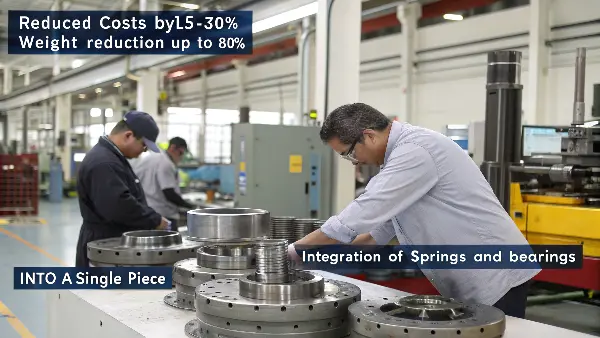
Yes, switching from metal to nylon can dramatically cut costs and improve performance. This conversion leverages injection molding to reduce part costs by 25-50% through lower material prices and faster production cycles. Nylon parts can be up to 80% lighter than their metal counterparts, resist corrosion, and can integrate multiple features like springs and bearings into a single piece, which simplifies assembly. High-performance nylons, often reinforced with glass or carbon fiber, can match or even exceed the strength-to-weight ratio of metals like aluminum or zinc for many applications.
I’ve seen this transformation firsthand with many clients over the years. They were often skeptical at first, just like you might be. They worried about strength, durability, and the potential hassle of changing their entire process. But once they saw the hard numbers and held the high-quality finished parts in their hands, they never looked back. The benefits were just too significant to ignore.
So, let’s break down exactly how this process works. We’ll look at the real benefits, tackle the common concerns, and explore what it takes to make a smart, profitable conversion for your business.
Why Even Consider Replacing Strong Metal with Plastic?
Do you feel locked into using metal for your parts simply because "that’s how it’s always been done"? This mindset can mean you’re missing out on huge opportunities for innovation and cost reduction. Traditional metal fabrication is reliable, but it often comes with significant weight, corrosion issues, and design limitations. Exploring alternatives is key to staying ahead. The answer lies in engineered polymers like nylon, which have evolved to become serious contenders.
Replacing metal with engineered nylon is a strategic move to unlock multiple benefits. The primary advantages are significant cost and weight reduction. Nylon parts are also naturally corrosion-resistant, self-lubricating, and excellent at dampening vibrations, which metals can’t offer without secondary treatments. Furthermore, the injection molding process allows for the consolidation of multiple metal components into a single, complex nylon part. This freedom of design drastically reduces assembly time and costs, creating a more efficient product.

The decision to switch from metal to nylon isn’t just about replacing one material with another; it’s about re-evaluating the entire product lifecycle. I worked with a client in the industrial machinery sector who was using a machined aluminum housing. It was sturdy but expensive and took a long time to produce. We started by looking at more than just strength.
Key Drivers for Conversion
We analyzed the part’s function and environment. It needed to be rigid and protect internal components, but it wasn’t a primary load-bearing part. It was also exposed to machine coolants, which caused some oxidation over time. The biggest win, however, came from a design change that plastic injection molding allowed.
Part Consolidation in Action
The original aluminum part was one of three components that had to be assembled with screws and gaskets. By converting to a glass-filled nylon, we could redesign it as a single piece. We molded in snap-fit features to replace the screws and designed a groove for an O-ring, eliminating the separate gasket.
| Feature Comparison | Original Metal Assembly | Converted Nylon Part |
|---|---|---|
| Component Count | 3 (Housing, Plate, Gasket) | 1 (Integrated Housing) |
| Assembly Steps | 5 (Align, Insert Gasket, 8 Screws) | 1 (Snap-fit & O-ring install) |
| Weight | 450 grams | 95 grams |
| Corrosion Risk | Moderate (Oxidation) | None |
This simple conversion didn’t just save them money on the part itself. It slashed their assembly time, reduced their inventory part numbers, and created a more reliable, leak-proof seal. This is the true power of metal-to-nylon conversion. It forces you to think smarter about your product design.
How Much Can You Really Save by Switching to Nylon?
You see the potential benefits, but the big question is always about the bottom line. How much money can this switch actually put back into your company’s pocket? It’s easy to get lost in technical jargon, but the financial impact is what really matters. You might suspect the savings are minor, not worth the effort of redesign and re-tooling. But the cost reductions are often dramatic and come from several areas, not just the raw material.
You can realistically expect total cost savings of 25% to 50% or more when converting a part from metal to nylon. These savings are achieved in three main areas. First, lower material costs per kilogram. Second, massively reduced production costs due to the speed of injection molding versus slower processes like CNC machining or die casting. Third, the elimination of secondary operations such as deburring, painting, or plating, which are often required for metal parts but not for nylon.
Let’s walk through a real-world case study to put these numbers into perspective. A client of mine was manufacturing a small bracket for an electronics enclosure. The original part was made from die-cast zinc. The annual volume was 100,000 units. The part itself was simple, but the costs were adding up and creating a bottleneck in their supply chain.
Breaking Down the Costs
We conducted a thorough cost analysis to compare the existing zinc part with a proposed part made from 30% glass-filled nylon. We looked at everything from the material purchase to the final, ready-to-ship component.
The Metal Cost Structure
The die-cast zinc process involved the initial casting, followed by a tumbling process to remove flash and sharp edges. Then, each part had to be inspected and was often sent for a powder coating finish to prevent corrosion and improve its appearance. The cycle time for die-casting was slower, and the tooling was complex and required frequent maintenance.
The Nylon Advantage
For the nylon version, the injection molding cycle time was significantly faster. The part came out of the mold with a finished texture and in the desired color, completely eliminating the need for deburring and painting. We also integrated a small locator pin into the design, which was previously a separate pressed-in part.
| Cost Analysis | Die-Cast Zinc Bracket | Injection Molded Nylon Bracket | Savings |
|---|---|---|---|
| Material Cost/Part | $0.45 | $0.25 | 44% |
| Manufacturing Cycle | 45 seconds | 25 seconds | 44% |
| Secondary Ops Cost | $0.30 (Deburr & Paint) | $0.00 | 100% |
| Total Part Cost | $1.15 | $0.48 | 58% |
| Annual Savings | – | $67,000 | – |
The final numbers were undeniable. A 58% reduction in the final part cost translated to $67,000 in direct savings every year. This client reinvested that money into new product development, fueling further growth. These are the kinds of tangible results that make a properly planned metal-to-nylon conversion a game-changer.
Won’t Nylon Parts Just Be Weaker Than Metal Ones?
This is the number one concern I hear from business owners, and it’s a completely valid one. When you hold a metal part in your hand, it feels strong, rigid, and reliable. Plastic can feel less substantial in comparison. You worry that a nylon part will fail under load, snap under pressure, or wear out too quickly, leading to product failures and unhappy customers. The perception is that "plastic" is cheap and weak, but that’s a huge misconception.
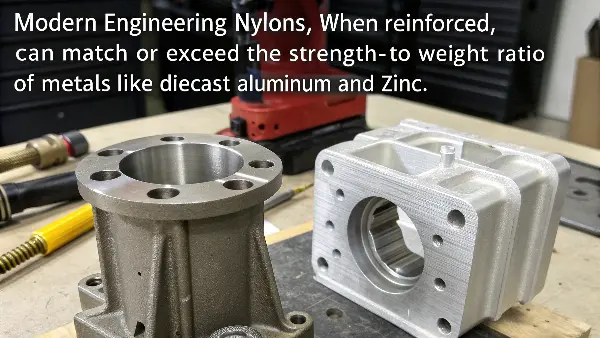
Modern engineering nylons are not comparable to everyday plastics. When reinforced with additives like glass fibers or carbon fibers, their strength-to-weight ratio can surpass that of metals like die-cast aluminum and zinc. The key is not just material selection, but also smart design. By adding ribs, gussets, and radii, and by adjusting wall thicknesses, a nylon part can be engineered to meet or exceed the mechanical performance requirements of the original metal part while offering additional benefits.
Thinking about strength requires a shift in mindset. It’s not about finding a plastic that has the exact same tensile strength on a datasheet as steel. It’s about designing a part that performs its function reliably for the life of the product. Metals are strong, but they are also very rigid and heavy. Sometimes, a little bit of flexibility is actually a good thing.
Strength-to-Weight Ratio is Key
Let’s look at a practical example. An automotive company I consulted for used a steel bracket to hold a small engine component. The steel was overkill for the application, but it was cheap and easy to stamp. However, it was also heavy, which hurt fuel efficiency. We looked at replacing it with a 40% long-glass-fiber-filled nylon.
Designing for Performance
The raw strength numbers for nylon were lower than steel, of course. But the nylon part was 80% lighter. By adding strategically placed ribs to the nylon design, we increased its stiffness only in the directions where force was applied. The final nylon part could withstand the same vibration and load tests as the steel one, but it was far lighter and absorbed vibrations better, reducing noise.
| Property | Stamped Steel | 40% LGF Nylon | Comparison |
|---|---|---|---|
| Tensile Strength | High | Medium | Steel is stronger |
| Part Weight | 800g | 160g | Nylon is 80% lighter |
| Strength-to-Weight Ratio | Good | Excellent | Nylon is superior |
| Vibration Damping | Poor | Excellent | Nylon reduces noise |
The result was a part that was "strong enough" for the job, but superior in almost every other way. It cut weight, reduced noise, and resisted corrosion from engine fluids. Don’t get fixated on a single material property. Instead, focus on the overall performance of the part in its real-world application. That’s where engineered nylons truly shine.
What’s the Process for Converting a Metal Part to Nylon?
Okay, you’re convinced of the benefits and ready to explore this for your own products. What happens next? The process can seem daunting. You might think it involves a huge, complicated engineering project that will disrupt your operations. You worry about an endless cycle of trial and error, costly mold changes, and uncertain outcomes. Where do you even begin? A clear, structured process is essential for success and removes all the guesswork.
The metal-to-nylon conversion process follows four key stages. It starts with a feasibility study and material selection, analyzing the part’s requirements to choose the right nylon grade. Next is the crucial redesign phase, where the part is optimized for injection molding, adding features like ribs and radii. Then, a high-quality injection mold is designed and built. Finally, the process involves prototyping, testing, and validation to ensure the new nylon part meets all performance specifications before full-scale production begins.

I guide my clients through this process step-by-step to ensure a smooth and successful transition. It’s a collaborative effort that relies on clear communication and expertise in both materials science and mold design. Rushing any of these steps is the biggest mistake you can make. It’s better to be thorough upfront than to fix expensive problems down the line.
Phase 1: Feasibility and Material Selection
We start by analyzing your current metal part. What forces does it endure? What is its operating environment (temperature, chemical exposure)? What are the critical functional requirements? Based on this, we select a few candidate nylon materials, from general-purpose grades to highly specialized variants with glass, carbon, or mineral fillers. We present you with the pros and cons of each.
Phase 2: Part Redesign for Injection Molding
This is where the magic happens. A part designed for metal casting is rarely optimal for plastic molding. We use advanced software to redesign the part, taking advantage of nylon’s properties.
| Design Consideration | Metal Design (e.g., Die-Cast) | Plastic Design (Injection Mold) |
|---|---|---|
| Wall Thickness | Often non-uniform, thick sections | Uniform walls are critical |
| Corners | Sharp corners are common | Radiused corners to reduce stress |
| Features | Ribs are less common, simple shapes | Ribs & gussets add strength |
| Draft | Minimal draft needed | Draft angles are essential for release |
We use tools like Mold Flow Analysis (MFA) to simulate how the plastic will fill the mold, predicting potential issues like weak spots or warping before any steel is cut. This simulation phase is critical for getting the design right the first time. The goal is a part that is strong, manufacturable, and cost-effective.
Conclusion
Switching from metal to engineered nylon isn’t just a simple material swap; it’s a strategic business decision. It pushes you to rethink your product design from the ground up, unlocking massive potential for cost savings, weight reduction, and performance improvements that traditional metal fabrication can’t match. As we’ve seen, the benefits are real and impactful, leading to a more competitive and profitable product line.