
You’ve designed a perfect product, but did you choose the right material? A wrong choice can lead to a product that fails under pressure, costing your company millions and damaging its reputation. It’s a constant worry for every designer. What if you could learn from the biggest triumphs and disasters in material selection to avoid these pitfalls and ensure your designs succeed?
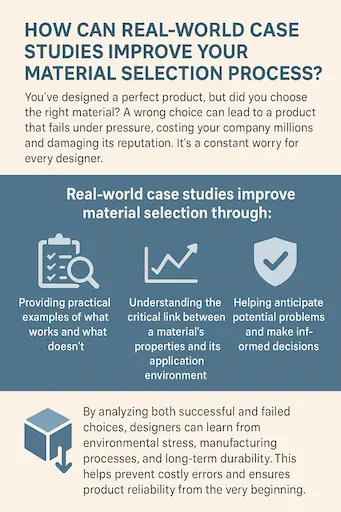
Real-world case studies improve material selection by providing practical examples of what works and what doesn’t. By analyzing both successful and failed choices, designers can understand the critical link between a material’s properties and its application environment. These stories highlight factors like environmental stress, manufacturing processes, and long-term durability. This helps you anticipate potential problems and make informed decisions, preventing costly errors and ensuring product reliability from the very beginning.
Let’s dive into some specific examples. You’ll see how big industries made game-changing choices and how seemingly small mistakes led to disaster. In my years running a mold and CNC business, I’ve seen firsthand how these exact principles play out. These stories are more than just lessons; they are blueprints for success and warnings to heed.
What is the Greatest Challenge in Material Selection?
You’re staring at a spec sheet, overwhelmed by options. Each material has its own set of pros and cons, and the pressure is on to make the right call. Choosing the wrong one could mean project failure, but the "perfect" material often seems elusive. How do you navigate this complex decision-making process without overlooking a critical factor that could doom your design from the start?
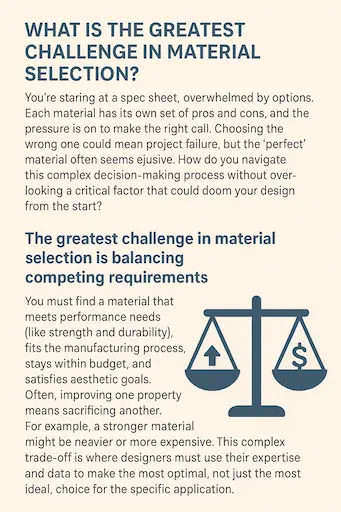
The greatest challenge in material selection is balancing competing requirements. You must find a material that meets performance needs (like strength and durability), fits the manufacturing process, stays within budget, and satisfies aesthetic goals. Often, improving one property means sacrificing another. For example, a stronger material might be heavier or more expensive. This complex trade-off is where designers must use their expertise and data to make the most optimal, not just the most ideal, choice for the specific application.
In my experience, the challenge isn’t just about the material itself; it’s about the entire ecosystem of your product. You have to think like an engineer, a cost analyst, and a production manager all at once. This balancing act is where many projects either succeed or fail. It’s a constant negotiation between what is ideal and what is practical. For instance, a client might want a feather-light part, but the budget only allows for a standard, heavier polymer. Your job is to find the middle ground.
Understanding the Key Trade-Offs
The core of the problem lies in what engineers call "competing constraints." You can’t have it all, so you must prioritize.
- Performance vs. Cost: High-performance materials like PEEK or carbon fiber composites offer amazing properties but come with a hefty price tag. You must ask: is the performance boost truly necessary for the product’s function, or can a cheaper alternative like ABS or polypropylene do the job well enough?
- Manufacturability vs. Design: Some materials are simply difficult to work with. A complex design might be possible with 3D printing but impossible or prohibitively expensive with traditional injection molding. The material choice directly impacts the design freedom and the final production cost.
- Durability vs. Weight: In industries like aerospace and automotive, every gram counts. Lightweight materials like aluminum or magnesium alloys are fantastic, but they may not have the same fatigue resistance or impact strength as steel. Finding that sweet spot is crucial.
I always tell my team to map these factors out. Creating a simple decision matrix can bring a lot of clarity to a complex choice.
| Constraint | Material A (e.g., Steel) | Material B (e.g., Aluminum) | Material C (e.g., CFRP) |
|---|---|---|---|
| Cost | Low | Medium | High |
| Weight | High | Medium | Low |
| Strength | High | Medium | Very High |
| Corrosion Resistance | Low | High | Very High |
Seeing it laid out like this makes it easier to justify your decision to stakeholders and ensure you haven’t overlooked a critical trade-off.
How Do Successful Material Choices Drive Innovation?
You see a product that completely changes the game in its industry. It’s lighter, stronger, and more efficient than anything before it. Have you ever wondered what the secret ingredient is? Often, it’s not a radical new design but a smart material choice that unlocks new possibilities. How can you find a material that doesn’t just meet requirements but pushes the boundaries of what’s possible?
Successful material choices drive innovation by enabling designs that were previously impossible. For example, using Carbon Fiber Reinforced Polymer (CFRP) in airplanes made them lighter and more fuel-efficient. Using specialized plastics for underwater parts prevents degradation. These choices are not accidental. They come from a deep understanding of the application’s environment and a willingness to explore materials that offer a superior balance of properties like strength-to-weight ratio, durability, and cost-effectiveness.

Let’s look deeper into how these strategic choices lead to major breakthroughs. It’s about more than just swapping one material for another; it’s about reimagining the product’s potential based on new material capabilities. This is where experienced designers and engineers really show their value. They see a new material not just as a substitute, but as an opportunity.
Case Study: Aerospace and Carbon Fiber
The aerospace industry is a perfect example. For decades, aluminum was the king. But the push for better fuel efficiency demanded lighter planes.
- The Challenge: Build aircraft that fly farther on less fuel without sacrificing strength or safety.
- The Solution: Engineers turned to Carbon Fiber Reinforced Polymers (CFRPs). These composites have a much higher strength-to-weight ratio than metals.
- The Outcome: Companies like Boeing and Airbus built planes like the 787 Dreamliner and A350 with over 50% composite materials. This dramatically reduced the aircraft’s weight, leading to significant fuel savings and increased range. I remember when my clients in the aerospace supply chain started requesting molds for composite parts. It was a huge shift that required new tooling strategies and a different understanding of material behavior.
Case Study: Medical Implants and Titanium
In the medical field, the material choice can mean the life or death of a patient’s mobility and comfort.
- The Challenge: Create hip and knee implants that are strong, long-lasting, and won’t be rejected by the human body.
- The Solution: High-performance titanium alloys became the standard. Titanium is incredibly biocompatible, corrosion-resistant, and strong. Researchers even found that special surface treatments on Grade 4 titanium could make it a cost-effective and high-performing alternative to even more expensive cobalt-chromium alloys.
- The Outcome: Patients now have implants that last for decades, improving their quality of life. This success is built entirely on choosing a material that works in harmony with the human body’s demanding environment.
These stories show that a breakthrough is often just one smart material decision away.
What Can We Learn From Material Selection Failures?
You’ve followed the design process perfectly, yet the product is failing in the field. The costs are piling up, your company’s reputation is on the line, and everyone is asking why. It’s a designer’s worst nightmare. Could a simple oversight in material selection be the hidden cause? How can you learn from past disasters to prevent them from happening on your watch?
We learn from material selection failures that context is everything. The Challenger space shuttle disaster taught us that materials like rubber O-rings can fail catastrophically at unexpected temperatures. The collapse of the St. Francis Dam showed that you must test all materials, not just assume they are uniform. These failures highlight the critical importance of considering the entire operational environment, manufacturing variables, and chemical compatibility, not just the material’s properties on a spec sheet.

I find that studying failures is often more educational than studying successes. Successes can sometimes happen due to luck, but failures always have a specific, identifiable cause. Understanding these causes is key to becoming a better designer. Let’s break down some infamous cases. They are stark reminders that small details in material choice can have enormous consequences.
Case Study: The Challenger O-Ring Disaster
This is the textbook case for environmental impact on materials.
- The Challenge: The Space Shuttle Challenger was scheduled to launch on a very cold morning, with temperatures below freezing.
- The Mistake: The synthetic rubber O-rings used to seal the joints of the solid rocket boosters were not designed to be flexible at such low temperatures. Data showing this risk existed, but the warnings were not heeded. The material’s properties changed dramatically in the cold.
- The Result: The hardened O-rings failed to create a proper seal. Hot gases escaped, leading to the catastrophic explosion of the external fuel tank, and the tragic loss of the shuttle and its seven astronauts. This disaster taught a painful lesson: a material’s specified performance in a lab means nothing if the real-world operational conditions are different.
Case Study: Metal-to-Plastic Conversion Failure
This is a failure I’ve seen happen in my own industry, and it’s a common trap.
- The Challenge: A company wanted to reduce the cost and weight of a metal gear by switching to plastic.
- The Mistake: They took the exact design of the metal gear and simply molded it in plastic. They failed to account for the fundamental differences between metals and plastics, such as stiffness, thermal expansion, and creep. A direct 1-for-1 swap is almost never a good idea.
- The Result: The plastic gears failed prematurely under load. The project was a costly failure because the team didn’t invest in redesigning the part to suit the new material’s properties. Plastic parts often need reinforcing ribs, thicker walls, or different tooth profiles to match the performance of a metal predecessor. It illustrates you aren’t just swapping materials; you are swapping design philosophies.
Conclusion
Choosing the right material is a mix of science, art, and practical experience. As we’ve seen, a smart choice can lead to groundbreaking innovation, while a poor one can lead to disaster. By studying both successes and failures, you build a mental library of what works and what to avoid. This helps you look beyond the spec sheet and make decisions that ensure your products are safe, reliable, and successful.