
You have an excellent product concept but the prospect of expensive tooling investments and long lead times to injection molding is holding you back. This is the bottleneck in production and it can freeze your project to wait to launch and even bind up large masses of money before you even have a clue as to whether the product is going to be a hit. The positive news is, injection molding is not the only choice. There are a number of great options, and each of them has its advantages in various circumstances.
3D printing, CNC machining, vacuum casting, thermoforming, and extrusion are the most frequently used substitutes of injection molding. All of the methods provide a balanced approach to cost, speed, material choice, and optimal volume of production. As an illustration, 3D printing is ideal to produce fast and intricate prototypes without tooling, or CNC machining to manufacture high-quality components out of solid material blocks. The selection of the appropriate one is based solely on your project need, whether it is a prototype or a low volume production.
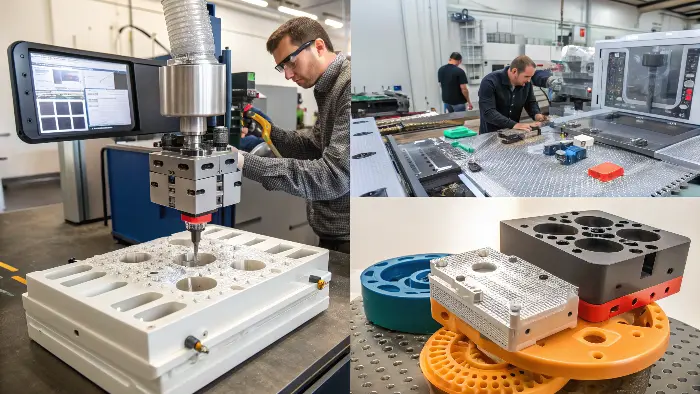
What Is Injection Molding?
Injection molding is a production process that is employed to create parts and products through the injection of molten material into a mold. It ranks among the most generalized processes of producing plastic parts yet it can be used in metals, glass and rubber.
The following is a summary of its functionality:
Material Preparation– The raw material in the form of plastic granules (or other materials) is introduced to a heated barrel, where it is melted into a liquid.
Injection– The melted material is pumped on to a high pressure into a shaped mold of steel or aluminum in the shape of the product wanted.
Cooling – The material is brought to the inside of the mold and it cools down and solidifies, assuming the form of the mold.
Ejection**** – Once the mold cools down, the part is then ejected and the part can then be trimmed or finished further.
Major Facts on Injection Molding:
Mass Production: It is the best to produce considerable quantities of the same components in the shortest time possible.
Precision: A machine that makes complex shapes with high accuracy and consistency.
Material Flexibility: This is usually applicable with plastics, which include polyethene (PE), polypropylene (PP), and ABS, although it can also be used with metals (metal injection molding) and ceramics.
Uses: Automotive parts, packaging, household products, electronics, toys, and medical devices.
Injection molding enables the manufacturer to transform raw plastic into complex, durable and reusable forms- bottle tops and phone cases to car bumpers and medical syringes. Injection molding is an excellent technology. When you’re making volume quantities, it’s difficult to top its speed and comparative cost-per-part. The best manufacturing decision is the one that best fits your budget, timing, and production goal.
Understanding the alternatives is the key to making an informed decision that saves you time and money. Let’s explore these other methods to see which one might be the perfect fit for your next project.
What are the top manufacturing alternatives to injection molding?
You are trying to settle on a manufacturing process and the number of options might seem to be daunting. The temptation is to resort to injection molding but you have some feeling that it can not be applicable to your current requirements. The wrong decision can lead to money, non-fit-spec parts and critical time wastage. The pressure to make it correct at the beginning is very real. We would separate the most widespread options so that it becomes clear what one of them is most likely to suit your project.
The main alternatives to injection molding are 3D Printing (Additive Manufacturing) where high speed and simplicity of design are required, CNC Machining where high-precision and strong materials are needed and Vacuum Casting where prototypes should be high-fidelity. The other two noteworthy processes include Thermoforming of large, low complexity components, and Rotomolding of large, hollow components. The operations are meant to carry out various tasks like the development of the single prototypes to the control of the small or medium scale production batches efficiently and at a low cost.
You are attempting to select a manufacturing process, but there are so many choices that it can be easy to become overwhelmed. It can appear as though the obvious option is injection molding, yet a slightly troubling part of your mind is telling you that it is not necessarily the correct option in your present circumstances. Making the wrong decision may result in the money being spent to no effect, parts that are not to spec, or critical delays. There is a real need to get it firsthand. We will discuss the most popular alternatives in a break down way so that you can clearly understand which alternative matches your project.
The primary substitutes of injection molding are 3D Printing (Additive Manufacturing) in case of speed and complexity in design, CNC Machining in case of high accuracy and material strength and Vacuum Casting in case of high-fidelity prototypes. Other important ones include Thermoforming of large, simple components, and Rotomolding of large, hollow components. Each process has its own purpose, including the production of single prototypes and serving small or medium-sized production batches in a cost-effective and efficient way.
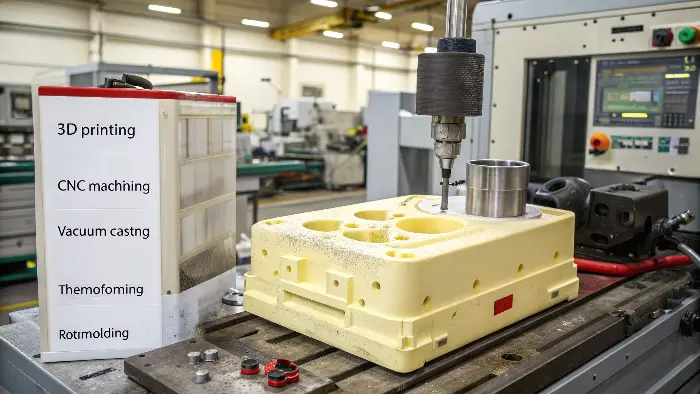
Over the years, I’ve guided many business owners like Michael through this exact decision. They often come to me thinking an injection mold is their only path forward, but we discover a much better fit for their initial stages. For a client who needed a 100-unit test run of a new electronics enclosure, the answer wasn’t a $10,000 mold. It was CNC machining, which gave them strong, accurate parts in two weeks without a huge upfront investment.
To help you navigate these options, let’s look at them more closely.
The Main Contenders
Each manufacturing process has its sweet spot. Understanding where they excel is the first step.
- 3D Printing (Additive Manufacturing): This process builds parts layer by layer from a digital file. It’s like building something with LEGOs, but on a microscopic scale. It’s incredibly fast for one-off parts.
- CNC Machining: This is a subtractive process. It starts with a solid block of plastic or metal and uses computer-controlled tools to cut, drill, and carve away material until the final part is left.
- Vacuum Casting (Urethane Casting): This method uses a 3D-printed or CNC-machined master pattern to create a silicone mold. You can then pour a liquid resin into the silicone mold to produce high-quality copies. It’s great for small batches of parts that look and feel like the final product.
- Thermoforming: Here, a sheet of plastic is heated until it’s pliable, then draped over or pressed into a mold using vacuum or pressure. Think of how yogurt containers are made.
- Rotational Molding (Rotomolding): Perfect for large, hollow objects. Plastic powder is placed inside a large mold, which is then heated and rotated on two axes. The powder melts and coats the inside of the mold, creating a seamless, uniform wall.
Here is a table to help you compare them at a glance:
| Process | Best For | Tooling Cost | Part Cost (Low Vol) | Lead Time |
|---|---|---|---|---|
| 3D Printing | Prototypes, complex geometry | None | Medium | Very Short |
| CNC Machining | High-precision parts, strong materials | None | High | Short |
| Vacuum Casting | High-fidelity prototypes (10-100 units) | Low | Medium | Short |
| Thermoforming | Large, simple parts (e.g., trays, covers) | Low-Medium | Low | Medium |
| Rotomolding | Large, hollow parts (e.g., tanks, kayaks) | Medium | High | Long |
| Injection Molding | High-volume production (10,000+ units) | Very High | Very Low | Long (tooling) |
Choosing the right process isn’t just about cost; it’s a strategic decision that impacts your entire product development cycle.
Is the Die Casting method the closest to plastic injection molding?
Yes – die casting is the closest metal-processing technology to the plastic injection molding. They both have a very similar principle; molten material is pressed into a mold cavity under pressure, allowed to solidify and then ejected.
Here’s how they compare:
Similarities
Principle of process: In both cases, the raw material (plastic pellets in injection molding, metal ingots in die casting) is melted and then pressed into high pressure into a mold and allowed to cool to shape desired form.
Tooling: These two demand an accurately machined mold (also known as a die in die casting) which determines the form of the part.
Mass production: They both can be used in the production of large quantities of standardized parts.
Complex shapes: Each of them can be used to form detailed, complex, and thin-walled geometries.
Differences
Materials:
Injection molding
plastics (thermoplastics, thermosets, occasionally elastomers).
Die casting
metals (aluminum, zinc, magnesium, copper alloys).
Temperature:
plastics melt at a few hundred deg C whereas metals used in die casting need a lot of heat (more than 600 deg C in the case of aluminum).
Durability:
Die-cast components are far stronger and heat resistant when compared to the plastic injection molded components.
Cost:
Die casting is costly as it requires high tooling costs and high energy costs but it is required to make high-strength metal parts.
In brief, therefore die casting is simply a metal version of the plastic injection molding.
Is 3D Printing better than injection molding?
You have heard the hype surrounding 3D printing and its amazing potential. It is quick, nimble and has low start up costs, leaving you wondering whether the traditional injection molding should be abandoned in favor of this new technology. Yet the assertions seem to be too good to be true. You are concerned with lost strength, surface finish and scalability achieved through molding. Do you think that your serious production can be handled using 3D printing? The reality is that one is not a better or worse partner than the other; they are complementary and are good at various life cycle phases of a product.
No, 3D printing does not directly outperform injection molding; it is an effective complement to this technology. 3D printing is unrivaled in terms of the complexity and customization of parts with very low volume and zero tooling cost, which makes the technology ideal in rapid prototyping and testing designs. However, injection molding is the king of mass production, with unbelievable speed, a wide selection of material and a very low unit cost after the injection mold is manufactured. The choice that is superior depends on the volume, complexity and timeline of your project.
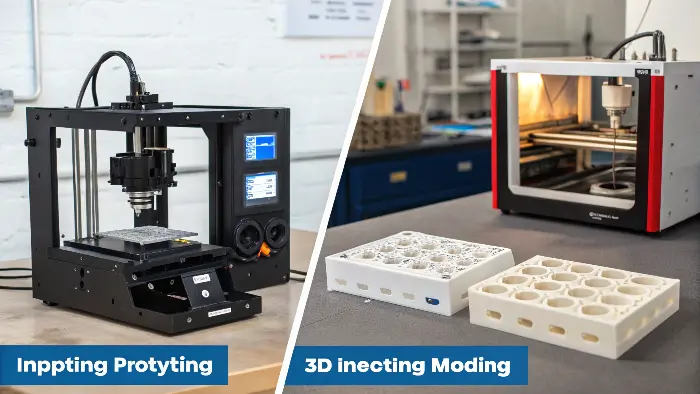
I have encountered this question everywhere. A client will arrive to me with a brilliant new design who is willing to discuss mould making. I always ask the question: Have you 3D printed it yet? One of the most effective strategies in the modern manufacturing is to use the 3D printing as the bridge to injection molding. It gives you the ability to fail at a low cost. It is possible to print a part, check that it fits and works and edit the CAD file and a new version in your hands the following day. The process which is performed many times it conserves thousands of dollars and weeks time which otherwise is used to alter a steel mold.
When to Choose 3D Printing
3D printing is your best friend during the early stages of product development. Use it when you need:
- Rapid Prototyping: To quickly create physical models to test form, fit, and function.
- Complex or Custom Designs: To produce intricate geometries that would be impossible or extremely expensive to mold.
- Very Low Volumes: When you only need a handful of parts for marketing samples, functional testing, or a one-off custom jig.
- No Upfront Investment: You can get started immediately without committing to high tooling costs.
When to Stick with Injection Molding
Once your design is finalized, tested, and ready for the market, it’s time to scale up. Injection molding is the clear winner when you need:
- High-Volume Production: For runs from thousands to millions of parts, the low per-part cost is unbeatable.
- Specific Material Properties: Injection molding offers a massive library of thermoplastics with specific properties for strength, flexibility, chemical resistance, and more.
- Superior Surface Finish: Molded parts can have a beautiful, smooth finish right out of the tool, requiring little to no post-processing.
- Tight Tolerances and Repeatability: The process is incredibly consistent, ensuring every part is virtually identical.
Here’s a direct comparison:
| Feature | 3D Printing | Injection Molding |
|---|---|---|
| Ideal Volume | 1 – 100 units | 10,000+ units |
| Upfront Cost | None | Very High (Mold) |
| Cost Per Part | High and stable | Starts high, drops very low |
| Lead Time | Hours to Days | Weeks to Months (for tool) |
| Design Complexity | Almost unlimited | Limited by moldability |
| Material Choice | Good, but limited | Extremely wide range |
Think of them as a team: 3D printing is the scout that explores the territory, and injection molding is the army that captures it.
Is extrusion better than injection molding?
It requires you to manufacture a continuous piece of plastic such as a pipe, window frame or custom trim. The initial thing that comes into your mind is injection molding, which is the most popular process of plastic. However, you are immediately hit with a problem; injection molding produces discrete, individual objects. Attempting to create a long, straight profile with it would be extremely inefficient, costly and would probably give a low quality output. It is at this point that you must change the way of thinking completely. In such products, extrusion is not only a superior choice – it is the appropriate tool to the task.
It is no good to think of extrusion as being superior to injection molding: the two methods are to be used to make entirely different types of parts. Extrusion is the best method of producing continuous two-dimensional profiles with fixed cross-section, e.g. pipes, tubes and door seals. Complex, three dimensional objects such as enclosures, gears, caps are created through injection molding. You would never apply one process to the work of the other because they are the solution to totally different manufacturing problems.
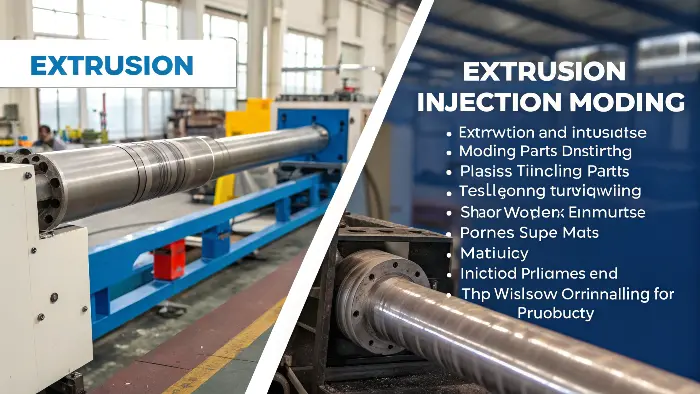
I often use a simple analogy to explain this to clients. Extrusion is like squeezing toothpaste from a tube. The shape of the opening (the die) determines the shape of the long, continuous stream that comes out. Injection molding is more like using an ice cube tray. You inject material into a closed container (the mold) to create a specific, individual shape. You wouldn’t try to make ice cubes with a toothpaste tube, and you wouldn’t fill your toothbrush from an ice cube tray.
The Extrusion Process Explained
The process is quite straightforward. Plastic pellets are fed into a hopper, melted by a long heated screw, and then forced under pressure through a shaped die. The resulting continuous profile is then cooled and cut to the desired length. The tooling, which is just the die, is relatively simple and inexpensive compared to a complex injection mold. This makes it very cost-effective for producing long parts.
Why You Can’t Substitute One for the Other
Geometry is the essence of the difference. Extrusion produces parts, which are characterized by cross-section in 2D, and are theoretically unlimited in length. Injection molding is a 3D process that produces objects that have complicated features on all sides. One client of mine required a sealing strip of machine 2 meters long. He requested quote on injection mold and the mold would have been very huge and ridiculous in cost. I was forced to argue that extrusion was the correct way. We linked him up with an extrusion partner that made the part at a fraction of the price. It is all a matter of the correct manufacturing language to adopt depending on what you want to build.
Let’s look at a clear breakdown:
| Feature | Extrusion | Injection Molding |
|---|---|---|
| Part Geometry | Continuous 2D profile | Discrete 3D object |
| Process | Pushing molten plastic through a die | Injecting molten plastic into a mold |
| Tooling | Low-cost die | High-cost mold |
| Best For | Constant cross-section parts | Complex, detailed parts |
| Typical Products | Pipes, tubes, weather stripping, frames | Housings, gears, caps, connectors |
So, the question isn’t about which is "better." It’s about asking, "Is my part a continuous profile or a discrete object?" The answer will point you to the right process every time.
What is the difference between Rotomolding and injection molding?
You are going to make a large, hollow piece of plastic, maybe a water tank, a kayak or a giant industrial container. You are doing your manufacturing daydreaming. It may appear that injection molding could be an option, but the tooling cost of such a large piece would be astronomical. In addition, injection molding a massive, complex hollow object to give it a completely uniform wall thickness is a grave technical challenge. This is precisely the case in which rotational molding or rotomolding comes to the rescue. It is a special procedure that is only applied to large hollow and especially tough components.
The main distinction is that in injection molding the molten plastic is forced into a closed mold under high pressure to form solid or cored components whereas in rotomolding the plastic powder is thrown into a large hollow part with a slow rotating mold heated. Injection molding is also good at making reduced and accurate components in large quantities. Rotomolding has been the most suitable process to make low-stress, seamless, hollow components such as coolers, tanks, and playground equipment, and the tooling cost is substantially lower with very large parts.
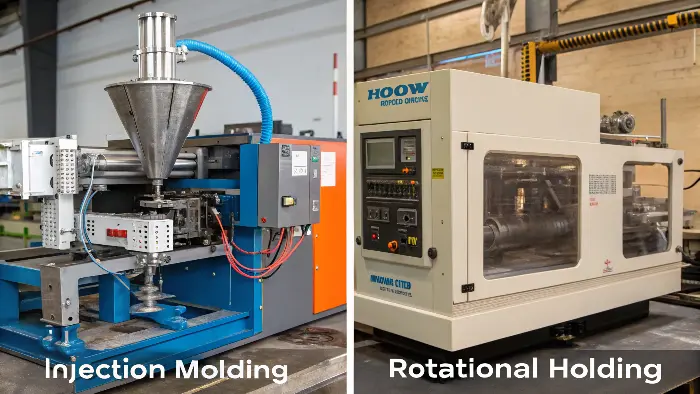
Some years back, one of the entrepreneurs, a man who is very like Michael, approached me with an excellent design of a new kind of heavy-duty cooler. He was equipped with his CAD files and he wanted to talk about injection molding. At the sight of the size and the smooth hollow structure I knew it would sink the project even before it would see the light of day due to the expense of the injection mold. I exposed him to rotomolding. The tooling cost a tenth of the cost and the finished product was unbelievably hard and strain-free. His cooler company is a massive success today.
How Rotomolding Works
The process is unique and elegant. It involves four main stages:
- Loading: A measured amount of plastic powder is loaded into the hollow mold.
- Heating: The mold is closed and moved into a large oven, where it is heated while rotating slowly on two axes (like a rotisserie).
- Cooling: The mold continues to rotate as it is cooled with air or water, allowing the plastic to solidify against the mold wall.
- Unloading: Once cool, the mold is opened, and the finished part is removed.
Because it uses low pressure, the molds can be made from fabricated steel or cast aluminum, making them much cheaper than the high-pressure steel tools required for injection molding.
Key Distinctions in Application and Cost
The processes are built for different worlds. Rotomolding produces parts with very uniform wall thickness and are virtually stress-free, making them exceptionally strong and impact-resistant. Injection molding is faster per part, but the high pressure can introduce molded-in stress if not managed perfectly.
Here is a side-by-side comparison:
| Feature | Rotational Molding | Injection Molding |
|---|---|---|
| Part Type | Large, hollow | Solid, cored, complex |
| Pressure | Low (Atmospheric) | Very High |
| Tooling Cost | Low to Medium | Very High |
| Cycle Time | Long (minutes to hours) | Short (seconds) |
| Wall Thickness | Very uniform | Can be variable |
| Key Advantage | Stress-free parts, low tooling cost | Speed, precision, low part cost |
| Typical Products | Tanks, coolers, kayaks, playground slides | Enclosures, gears, toys, medical parts |
Choosing between them is simple: if you need a large, durable, hollow part, rotomolding is almost certainly your answer. For smaller, solid, high-volume parts, injection molding remains king.
Conclusion
The injection molding is a giant in the mass-production of plastic components; however, it is important to keep in mind that it is not the only tool at your disposal. Smart manufacturing is all about finding the correct process to your particular need. Other methods such as 3D printing, CNC machining, extrusion, and rotomolding offer robust, low cost, solutions to one-off prototyping through large hollow forms. Knowing these options is the initial and most significant step towards making your product come to life in a fruitful and successful way.