
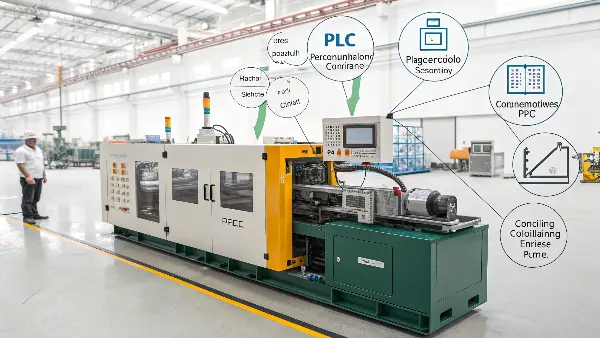
Are you looking to scale your manufacturing but find the world of injection molding machines complex and intimidating? Choosing the wrong equipment or misunderstanding its functions can lead to costly mistakes, production delays, and subpar parts.
The basics of an injection molding machine are easiest to understand by separating the functions it must perform: prepare the polymer, inject it into a closed mold, hold pressure, cool the part, open the mold and eject it safely. Each function has a component, a setting and a failure mode. That framework helps new engineers and buyers ask better questions of a machine or molding supplier.
Related engineering resources: mold design | production injection molding | mold testing and validation
An injection molding machine has three main parts: the injection unit, the clamping unit, and the mold. The injection unit is responsible for melting and injecting the plastic material. The clamping unit holds the mold tightly shut during injection and then opens it to eject the finished part. Finally, the mold is the custom tool that gives the plastic its final shape. Understanding how these three core components work together is the first step to mastering the entire injection molding process.
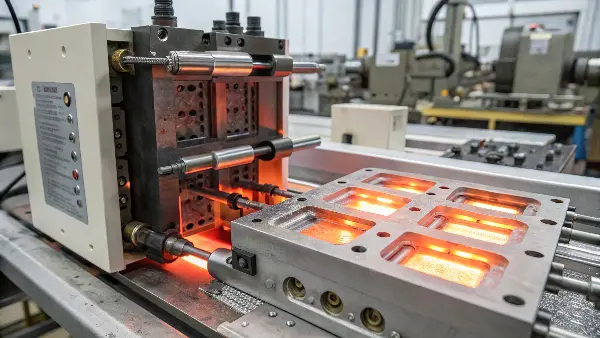
What are the basics of injection molding?
You know what the machine is, but how does it actually create a part? The process itself can often seem like a black box. Misunderstanding these fundamental principles can lead to communication gaps with your suppliers and an inability to troubleshoot quality problems effectively. Let’s demystify the process and walk through the core principles, from raw material to finished component, in simple, easy-to-understand terms.
The basics of injection molding involve melting plastic pellets, injecting this molten material under high pressure into a closed mold, allowing it to cool and solidify into the desired shape, and then ejecting the finished part. It is a highly repeatable, cyclical process that allows for the mass production of identical plastic parts with incredible precision. The key is transforming a solid raw material into a liquid and then back into a specific solid shape using heat, pressure, and a custom tool, which is the mold.
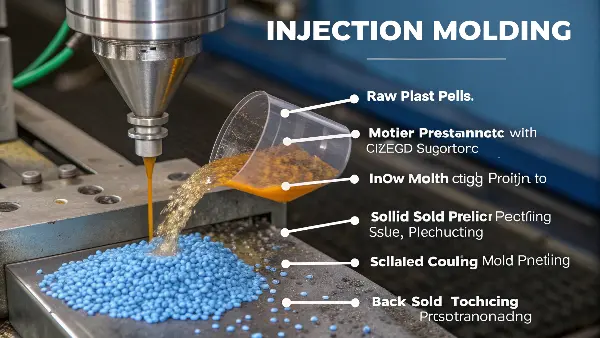
To truly grasp injection molding, you need to think about the three “M’s”: Material, Machine, and Mold. They are the three pillars that support the entire process, and they must work in suitable harmony.
Next is the Machine, which we’ve already touched on. Its job is to take the solid material, melt it down, and inject it into the mold with immense force. The clamping unit’s power, measured in “tonnage,” is crucial. It has to generate enough force to hold the two halves of the mold shut against the injection pressure. Too little tonnage, and you get “flash”—excess plastic leaking out of the mold seams.
Finally, and in my opinion, most importantly, you have the Mold. This is the heart of the operation. It’s a custom-made tool, usually from steel, that contains the cavity shaped like your final part. It’s not just a hollow block; it has intricate cooling channels to control the temperature, and an ejector system with pins to push the finished part out.
| Component | Role in the Process | Key Consideration |
|---|---|---|
| Material | The raw substance that becomes the part. | Correct type and proper drying. |
| Machine | Provides heat, pressure, and clamping force. | Sufficient tonnage and precise control. |
| Mold | Shapes the molten plastic and cools it. | Design, cooling, and ejection system. |
When all three of these elements are reliably aligned, you get a consistent, high-quality part, cycle after cycle.
What are the 5 steps of injection molding?
Knowing the general process is one thing, but understanding the specific sequence of events is crucial for optimizing cycle times and diagnosing problems. If you don’t grasp the distinct stages of the cycle, you can’t identify where production bottlenecks are occurring or why defects are appearing at a certain point. This will give you a much better handle on production efficiency and quality control.
The five main steps of the injection molding cycle are: 1. Clamping, where the two halves of the mold are securely closed. 2. Injection, where molten plastic is forced into the mold cavity. 3. Packing/Holding, where additional pressure is applied to fill the mold completely and compensate for shrinkage. 4. Cooling, where the part solidifies inside the mold. 5. Ejection, where the mold opens and the finished part is pushed out. This entire sequence then repeats for the next part.
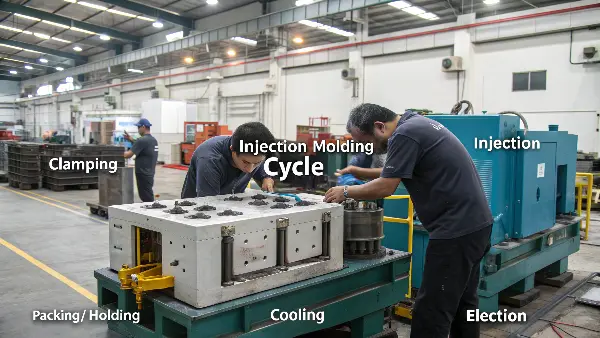
Understanding this sequence is like being able to read the production process like a book.
1. Clamping
Before any plastic is injected, the two halves of the mold—the cavity side and the core side—must be brought together and held shut with immense force. This is done by the clamping unit of the machine. The force, or tonnage, must be high enough to counteract the pressure of the injection phase. If the clamping force is too low, the mold will be pushed apart slightly by the plastic, causing a defect called “flash.”
2. Injection
Once the mold is clamped, the injection process begins. The screw inside the injection unit moves forward like a plunger, forcing the molten plastic from the barrel into the mold’s runner system and then through the gates into the part cavity. This step happens very quickly, often in just a few seconds. The speed and pressure of this injection are critical variables that affect the final part’s appearance and dimensions.
3. Packing and Holding
After the cavity is mostly filled, the machine switches from the fast injection phase to a “packing” or “holding” phase. During this time, it continues to apply pressure to pack more material into the cavity. This is essential to compensate for the material shrinking as it cools. Without this step, you would end up with sink marks or voids in your parts.
4. Cooling
The cooling stage is often the longest part of the entire cycle. The molten plastic inside the mold needs to cool down and solidify enough to hold its shape. The mold has internal channels where a fluid, usually water, circulates to draw heat away from the part. The cooling time depends on the type of plastic, the thickness of the part walls, and the efficiency of the mold’s cooling design.
5. Ejection
Once the part is sufficiently cool, the clamping unit opens the mold. Then, the ejector system—a set of pins or a plate within the mold—pushes forward to pop the finished part out of the cavity. Sometimes a robotic arm is used to grab the part and place it on a conveyor. After ejection, the mold closes again, and the entire cycle starts over for the next part.
What are the 4 variables of injection molding?
You now understand the machine and the process steps, but how do you actually control the outcome? Simply running the machine isn’t enough; you need to manage the key parameters. If you don’t control these core variables, you’re essentially flying blind, which can lead to inconsistent part quality, high scrap rates, and unpredictable production schedules. Let’s focus on the four fundamental variables you must master to achieve reliable and repeatable results.
The four primary variables of injection molding are pressure, temperature, time, and speed. These four elements are interconnected and control the entire process. Pressure (injection and holding) fills and packs the mold. Temperature (melt and mold) ensures the plastic flows correctly and solidifies properly. Time (injection, cooling, cycle) dictates the duration of each stage. Speed (injection) controls how fast the mold is filled. Balancing these four variables is the key to producing high-quality plastic parts consistently.
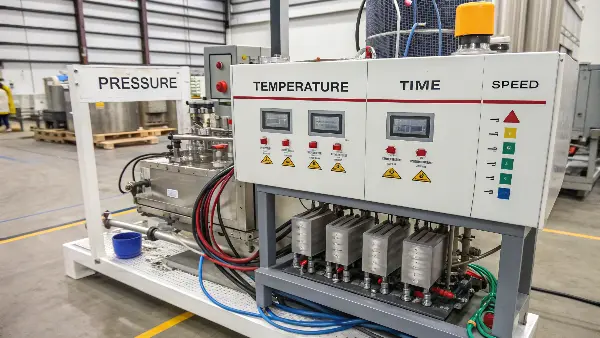
Mastering injection molding is all about finding the suitable recipe, and these four variables are your main ingredients. A small change in one can have a huge impact on the others and, ultimately, on your final product.
1. Temperature
Temperature is a critical factor with two main components:
- Melt Temperature: This is the temperature of the plastic as it leaves the nozzle of the injection unit. If it’s too hot, the material can degrade, becoming brittle or discolored. If it’s too cold, it will be too viscous (thick) to flow properly and fill the entire mold cavity, resulting in a “short shot” or an incomplete part.
- Mold Temperature: The temperature of the mold itself is also crucial. A warmer mold allows the plastic to flow more easily and can improve the surface finish, but it will increase the cooling time. A cooler mold shortens the cycle time but can cause stress in the part if it cools too quickly.
2. Pressure
Like temperature, pressure also has two key phases:
- Injection Pressure: This is the force used to push the molten plastic into the mold. It needs to be high enough to fill the cavity quickly and overcome any resistance to flow.
- Holding Pressure (or Packing Pressure): After the initial injection, this lower, sustained pressure is applied to pack out the part and compensate for material shrinkage as it cools. This is vital for achieving correct part dimensions and preventing defects like sink marks.
3. Speed
This primarily refers to the Injection Speed, which is how fast the screw moves forward to fill the mold. The right speed is a delicate balance. Too fast, and you can create excessive shear heat, degrading the material, or trap air in the mold. Too slow, and the plastic might start to cool and solidify before the mold is completely filled.
4. Time
Time governs the entire process and includes several durations:
- Injection Time: The time it takes to fill the mold.
- Holding Time: The duration for which holding pressure is applied.
- Cooling Time: The time the part spends solidifying in the mold. This is often the largest portion of the cycle.
- Overall Cycle Time: The total time from one part being ejected to the next. Reducing this time, even by a fraction of a second, can lead to significant cost savings in high-volume production.
These four variables are not independent. For example, if you increase the melt temperature, the plastic becomes less viscous, so you might be able to reduce the injection pressure or speed. Finding the optimal processing window where all these variables are in balance is the true art and science of injection molding.
What is PLC in injection molding?
We’ve talked about the machine’s hardware, the process steps, and the variables you need to control. But what actually manages all of this? How does the machine know when to clamp, how fast to inject, and how long to cool? If you don’t understand the machine’s control system, you’re missing the brain behind the brawn. It’s the central hub where your “recipe” of variables is executed with precision, cycle after cycle.
A PLC, or Programmable Logic Controller, is the industrial computer that acts as the brain of an injection molding machine. It controls and automates the entire molding cycle by executing a pre-programmed sequence of instructions. The PLC monitors inputs from sensors (like temperature and pressure sensors) and controls outputs (like valves, motors, and heaters) to ensure every step—from clamping and injection to cooling and ejection—happens at the exact right time and according to the set parameters.
Think of the PLC as the conductor of an orchestra. The machine’s motors, heaters, and hydraulic valves are the musicians. The process variables we just discussed—pressure, temperature, speed, and time—are the sheet music. The PLC reads the music and tells each musician exactly when and how to play their part to create a suitable performance, which in our case is a high-quality plastic part.
Before PLCs became common, older machines were controlled by mechanical relays and timers. Setting up a process was a manual, time-consuming task, and making precise adjustments was difficult. The introduction of PLCs revolutionized the industry.
Here’s a breakdown of what the PLC specifically manages:
1. Sequence Control
The PLC is responsible for the logical order of operations. It ensures the mold is fully clamped before injection starts and that the part is fully cooled before ejection begins. This sequential control is fundamental to the safety and proper functioning of the machine.
2. Parameter Management
This is where the operator interacts with the PLC. Using a Human-Machine Interface (HMI)—which is the screen and buttons on the machine—an operator can input the desired setpoints for all the key variables.
- Temperatures: Setpoints for various heating zones in the barrel and the mold.
- Pressures: Setpoints for injection and holding pressures.
- Speeds & Positions: Setpoints for screw speed, injection speed, and clamp opening/closing positions.
- Timers: Setpoints for injection time, holding time, and cooling time.
3. Real-Time Monitoring and Adjustment
The PLC doesn’t just send out commands; it also receives feedback. It constantly monitors sensors throughout the machine. For instance, if a temperature sensor in the barrel shows the heat is dropping below the setpoint, the PLC will command the heater bands to turn on. This closed-loop control allows the machine to make real-time adjustments to maintain a stable and repeatable process.
For a business owner like the buyer, the PLC is what helps support consistency. Once a process is dialed in and saved, the PLC can replicate it precisely for thousands or even millions of cycles, ensuring that the last part produced is identical to the first. This level of automation and precision is what makes modern injection molding such a powerful manufacturing method.
Injection Unit Basics
The hopper, barrel, screw, heater bands, check ring, nozzle and drive create and deliver the melt. Key variables include shot size, screw speed, back pressure, temperature, injection speed and pressure limit. Material drying, residence time and purge practice belong in this discussion too.
Clamping Unit Basics
The clamp closes and locks the mold, resists cavity pressure, opens after cooling and drives the ejector. Platen size, tie-bar spacing, mold height, clamp force, opening stroke and ejector interface determine whether a mold can run safely and release the part without distortion.
Control and Temperature Basics
The controller coordinates position, speed, pressure, heater zones, mold temperature, cycle timing and alarms. Stable temperature and motion are more useful than a long list of adjustable values. Establish an approved window and define which variables the operator may change.
Mold Interface Basics
The machine must supply the mold with alignment, clamp force, hot-runner power, cooling and ejection. The mold supplies gates, vents, cooling channels, slides, lifters and cavity geometry. Many defects occur at this interface, so machine and mold should be reviewed as one system.
Safety and Maintenance Basics
Guarding, interlocks, hot-surface protection, pressure relief, lockout procedures and trained operation are fundamental. Maintenance includes lubrication, heater checks, leak inspection, screw and valve wear, mold alignment, cooling flow and calibration. Safety and quality both depend on disciplined routines.
Injection Molding Machine Basics for Engineers and Buyers: Buyer Review Checklist
- Identify hopper, barrel, screw, check ring, nozzle and injection controls.
- Check clamp force, platen, tie bars, opening, ejector and mold-height requirements.
- Understand temperature, speed, pressure, position, alarms and allowed adjustments.
- Review mold alignment, hot runner, cooling, ejection and cavity interface.
- Use guarding, lockout, lubrication, leak, wear and calibration routines.
Frequently Asked Questions
Which machine setting affects part quality the most?
It depends on the defect. Material condition, fill speed, transfer, hold, mold temperature, cooling and ejection can each matter. Use defect evidence rather than a universal ranking.
Can a machine operator learn the basics quickly?
The controls can be learned, but safe operation and reliable troubleshooting require training, supervised practice, material knowledge and clear process documentation.
Conclusion
Understanding the basics of an injection molding machine is the first step toward leveraging this powerful technology for your business. We’ve covered the machine’s core components—the injection unit, clamping unit, and mold—and walked through the essential process, key variables, and the PLC that controls it all. This foundational knowledge empowers you to have more effective conversations with suppliers, troubleshoot issues, and make smarter decisions for your production needs.