
You know that One defective part in an injection mold will cause expensive mistakes and delays in production, and endanger your project. You get the best quality and precision you can pay so mastering the role of each part is your business, providing you receive it the first time.
There are a number of critical systems in a plastic injection mold. Its principal elements are the mold base (the foundation), the core and cavity (the form of the part), the system of runners (the route to follow by the plastic), the system of ejector (pushes the part out), the system of cooling (solidifies the plastic) and the system of venting (air can leave). Every component should be flawlessly shaped and produced so that the mold could work properly.
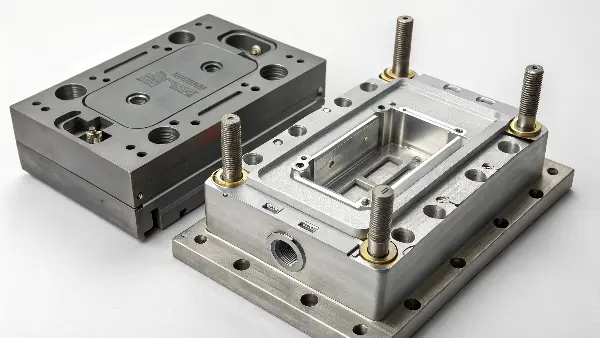
These parts might sound technical, but understanding their roles is simpler than you think. It’s the key to discussing your project confidently with any mold maker. Let’s break down each system so you know exactly what to look for in a high-quality mold. In my years in this business, I’ve found that clients who understand these basics are far more successful. They can spot potential issues early and collaborate more effectively to create a perfect final product.
How Does the Mold Base Form the Foundation of an Injection Mold?
Have you ever wondered what is used to keep a complex injection mold together? When a strong and accurate base is not established, all the other items may get out of place, leading to flash, wear and disastrous failure. It is not merely a matter of holding steel plates this is ensuring that each and every shot is in the proper position and is steady. Precision molding hero is a solid base of molds.
The steel framework, in which all other parts of an injection mold are incorporated, such as the core, cavity, and ejector system, is called the mold base. It is a combination of multiple plates which are connected by bolts. It has the main purposes of securing the mold in the injection molding machine, guiding pins and bushings to ensure the two halves of the mold align with each other, and to furnish the guide pins and bushings with a structure of the cooling system and ejector system. Imagine that it is like the skeleton that makes the rest of the tool a stronger and more accurate tool.
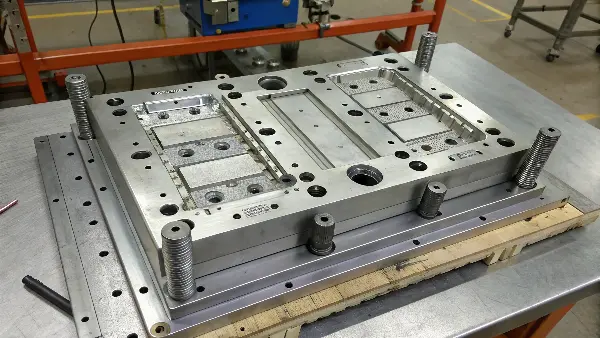
The mold base is the first thing you build, and everything else is built upon it. I’ve seen projects fail because a client tried to save a few hundred dollars on a cheaper, standard mold base. The steel was inferior, and it couldn’t handle the high clamping pressures. This led to constant flash issues and premature wear. It’s a classic case of being penny-wise and pound-foolish. The mold base is divided into two halves: the A-side (stationary half) and the B-side (moving half). Each side has a specific set of plates that serve a distinct purpose.
Key Plates of the Mold Base
The structure is not just a random stack of steel. Each plate is precisely machined and has a name and function.
- A-Side (Cavity Side): This half is attached to the stationary platen of the molding machine. It contains the Top Clamping Plate, which secures the mold, and the Cavity Retainer Plate, which holds the cavity insert.
- B-Side (Core Side): This half is attached to the moving platen. It’s more complex because it houses the ejection system. It includes a Support Plate for rigidity, followed by the Ejector Box which contains the Ejector Plate and Ejector Retainer Plate. These two plates move the ejector pins forward.
Alignment Components
Guide pins and bushings are the components that ensure the two halves of the mold align perfectly every single time. The pins on one half slide into the bushings on the other half as the mold closes. Without this precise alignment, the core and cavity could collide, causing catastrophic damage.
| Component | Side | Function |
|---|---|---|
| Top Clamping Plate | A-Side | Attaches the entire mold to the stationary platen of the machine. |
| Cavity Plate | A-Side | Holds the cavity insert and contains guide bushings. |
| Core Plate | B-Side | Holds the core insert and contains guide pins. |
| Support Plate | B-Side | Prevents the core plate from bending under injection pressure. |
| Ejector Box | B-Side | Houses the entire ejector system. |
| Bottom Clamping Plate | B-Side | Attaches the entire mold to the moving platen of the machine. |
What’s the Real Difference Between the Mold Core and Cavity?
The two terms core and cavity are regularly employed in the process of molding, but what exactly do they do? The confusion or lack of knowledge of what to do with them can cause design mistakes that cost an incredibly high amount of money to undo once the steel is cut. It is essential to know the distinction between them in order to produce a working and attractive plastic component.
The cavity is the part of the mold that is not moving and usually on the A-side and is the external, cosmetic surface of the plastic part. The moving half is the core of the B-side forming the inner features of part. As the mold is closed, a gap between the core and the cavity forms the desired shape of the final product. Basically, the cavity provides the part with its outer look whereas the core gives it its inner look and structure.
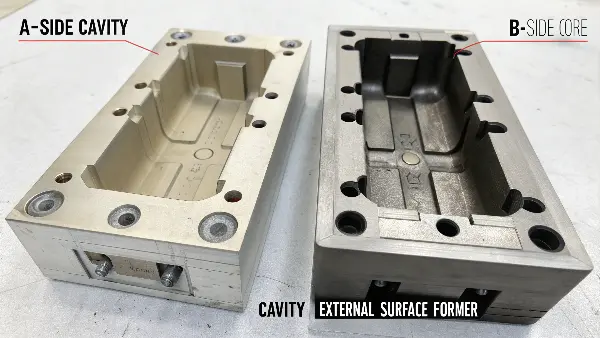
Think of it like making a jelly donut. The cavity is the mold that gives the donut its smooth, rounded outer shape. The core is the part that pokes into the mold to create the hollow space inside where the jelly will go. I once had a client, Michael, who wanted a highly polished, mirror-like finish on the inside of a small electronics case. We had to explain that this requires polishing the core, which is often more complex and time-consuming than polishing the external cavity. This insight helped him adjust his design for better manufacturability and lower cost.
Forming the Part’s Geometry
The core and cavity are the heart and soul of the mold. They are custom-machined inserts, usually from hardened steel, that define the final product’s geometry.
- The Cavity (A-Side): Since it forms the outer surface, this is often called the "cosmetic" side. The surface finish of the cavity directly translates to the surface finish of your part. If you want a glossy part, the cavity needs to be polished to a mirror finish. If you want a textured part, that texture is etched into the cavity.
- The Core (B-Side): This side forms the internal, non-cosmetic features. This includes ribs for strength, bosses for screws, and snaps for assembly. Because the plastic shrinks onto the core as it cools, the part stays on the core side when the mold opens. This is why the ejector system is also on the core side.
Materials and Surface Finishes
The choice of steel and finish is critical for the core and cavity.
| Feature | Core | Cavity |
|---|---|---|
| Function | Forms internal features of the part. | Forms external surfaces of the part. |
| Location | B-Side (moving half) | A-Side (stationary half) |
| Key Features | Ribs, bosses, lifters, holes. | Main cosmetic surfaces, texture. |
| Common Steels | P20, H13, NAK80, S136 | P20, H13, NAK80, S136 |
| Surface Finish | Usually less critical, unless internal is cosmetic. | Critical for aesthetics and part feel. |
The steel choice depends on the production volume and plastic material. For abrasive plastics or very high volume runs, we use harder steels like H13 or stainless S136 to ensure the mold lasts for millions of cycles without wearing down.
What are Three Types Of Injection Molds?
Two-Plate Mold
The most frequent and simple form of plastic injection molding is the two-plate mold. It has two major halves: the cavity side (A-side) and the core side (B-side) which part in case the molded part is ejected. The molten plastic is injected into the cavity trap through a gate and allowed to cool and solidify into the shape that is required.
After the mold has been opened, the part is ejected, and the process is repeated. This is a low cost, easy to make and use mold design that can be applied to a broad variety of plastic components. It particularly fits well with components that have one parting line and that have moderate design complexity.
Three-Plate Mold
The three plate mold is more sophisticated and it is more flexible than the two plate. It has a plate that adds up to a total of 2 plates that ensure that the system of the runners does not touch the molded part and the sprue and the runners can be automatically ejected each time. The design gives higher gating option like putting the gate in the middle of the part to fill both sides equally and give a better look.
The three-plate molds are usually applied to those parts where it demands more than one gate and where the system of runners needs to be cleanly separated so as to increase efficiency in production. They are a bit more expensive and complicated, but more precise and with high-quality finishes on the surface.
Hot Runner Mold
The hot runner mold involves the use of a hot manifold system to maintain the hot molten plastic as it passes into the cavities through the runners. Hot runner molds do not produce waste as the cold runner molds do and enhance material efficiency.
This system provides uniform melt temperature, reduces cycle time and improves the quality of parts by lowering flow lines and weld marks. Hot runner molds are suited to high volume production where accuracy and productivity is of much importance. Nevertheless, they need more start up cost and maintenance since they have heating parts.
Two plate molds are the most cost-effective and very easy to use, three plate molds are more flexible with automatic runner separation, and hot runners are the most efficient molds in terms of large-scale manufacturing. The correct decision will be based on product design, volume of production, type of material, and quality of desired finish.
How Does Melted Plastic Actually Get Into the Mold?
Your core and cavity are perfect, though, how does the molten plastic get to fill that tackle after it comes out of the nozzle of the machine? A delivery system that is not well organized might result in the short shots, sink lot or wasted material, spoiling your parts before they come out in pieces. The community is equally important in the direction of which plastic has to go to.
The plastic subject to melting flows via the composer system into the plastic mold. This is a system that begins at sprue, which receives plastic on the nozzle of the machine. The sprue is attached to runners which are canals cut into the mold that direct the path of the plastic to part. Lastly, there is the gate which is the small opening through which the plastic gets into the actual cavity. The design of this whole set conditions a filling pressure, cycle time as well as the final quality of the part.
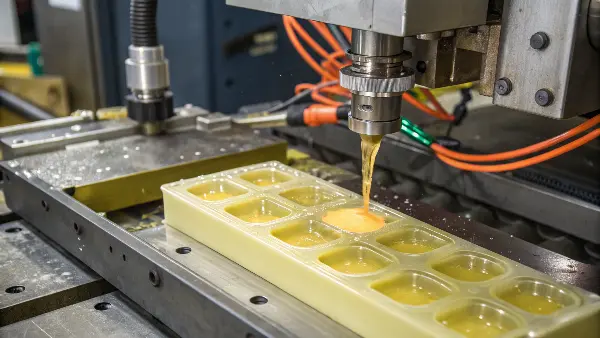
This delivery system is like the plumbing of the mold. A good design ensures that every cavity in a multi-cavity mold fills at the same time and pressure. I’ve seen molds where the runners were not balanced, causing the cavities closest to the sprue to fill first and overpack, while the ones furthest away were left incomplete. It all comes down to understanding fluid dynamics.
The Journey of the Plastic
Let’s trace the path of the molten plastic from the machine to the part.
- The Sprue: This is the first point of contact. The molding machine’s nozzle injects plastic into the sprue bushing. It’s a tapered channel that funnels the plastic into the mold.
- The Runners: From the sprue, the plastic flows into the runners. These are channels machined into the face of the mold plates that guide the plastic toward the cavities. Runner design is a science—they must be large enough to allow easy flow but small enough to minimize waste and cooling time.
- The Gate: The gate is the final, narrow opening through which the plastic enters the cavity itself. The type and location of the gate are critical. It affects how the part fills, where weld lines appear, and how easily the runner can be removed from the part later.
Hot vs. Cold Runner Systems
There are two main types of runner systems, and the choice has a huge impact on cost and efficiency.
| Feature | Cold Runner System | Hot Runner System |
|---|---|---|
| Mechanism | Runners are unheated channels in the mold plate. | Runners are in a heated manifold block. |
| Material Usage | The runner is ejected with the part, creating waste. | No runner is created; plastic stays molten. |
| Cycle Time | Slower, as the runner needs to cool down. | Faster, as there’s no runner to cool or eject. |
| Initial Cost | Lower. | Significantly higher. |
| Best For | Low-volume production, prototyping, materials sensitive to heat. | High-volume production, minimizing waste, fast cycles. |
For a high-volume project with millions of parts, I always recommend a hot runner system to my clients. The initial mold cost is higher, but they often save tens of thousands of dollars in wasted material and reduced cycle time over the project’s life.
Components of an Injection Mold
An injection mold has a number of important elements that work together to create molten plastic into the required part. The main elements of an injection mold are:
Mold Base Structure: The steel plate-based base structure composed of clamp plates, A plate, B plate, spacer block (C plate), rear clamp plate, ejector plate, and ejector retainer plate. This structure carries and supports all other parts of the mold.
Core and Cavity: These are the two main molding surfaces that are shaped by the plastic piece. The core (male side) forms the inside surface and is mounted on the moving side, and the cavity (female side) forms the outside surface and is mounted on the stationary side of the mold.
Runner System: Channels through which molten plastic is transmitted from the injection nozzle to gates of the mold cavity. The runner system includes sprue, runners, and gates for the flow of material.
Ejection System: Includes ejector pins, plates, sleeves, and rods that push the molded product out of the mold upon solidification.
Cooling System: Channels installed within the mold through which coolant (usually water) is circulated to regulate the mold temperature for consistent cycle times and quality of the product.
Guide Pins and Bushings: These ensure proper alignment and smooth open/close of mold halves.
Using the Venting System: Tiny vents or openings to allow for air and gas release during injection, preventing defects like burns or voids.
Other Auxiliary Components: These might include sliders or lifters for undercuts, inserts for fine details, and insulation plates.
These components collectively form the entire assembly that makes the injection molding process efficient, accurate, and repeatable
How Is the Finished Part Safely Removed from the Mold?
Your place is all shaped and concrete, yet once more it is trapped in the mould. Where are you going to take it out to leave it without any marks or damage? The poorly developed ejection system may result in pin marks, part distortion, even breakage and a completed part that proves to be but a tracking moment in failure at the finish line.
The ejector system is a system, which involves forcing the solidified portion of plastic out of the mold core occurring once the mold has opened. It is synthesized on the other face (moving half) of the mold. The process is made up of an ejector plate, which creates a movable propulsion mechanism, and collides ejector pins (or sleeves/blades) into the part. This forced action separates the part with the core and the part can be removed by either a robot or an operator. The correct insertion of such pins is important so as not to break the part.
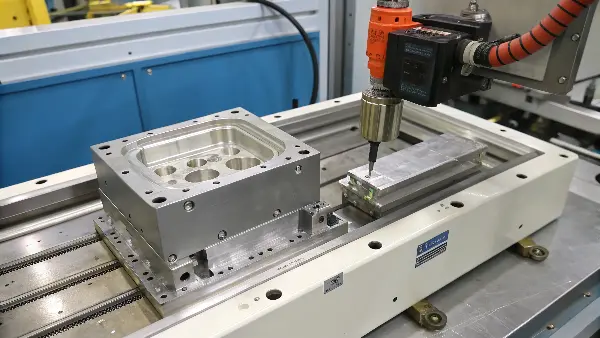
I remember a project for a client making a flat electronic housing. The initial design had ejector pins in the middle of the flat, cosmetic surface. We worked with them to move the pins to push on internal ribs and the inside edge of the part’s wall. This made the ejector marks completely invisible on the final product. It’s these small details that separate a good mold from a great one. The goal is always to eject the part cleanly and without a trace.
The Mechanics of Ejection
The entire system is housed within the ejector box on the B-side of the mold.
- Mold Opens: The molding machine pulls the B-side of the mold away from the A-side. The plastic part, having shrunk onto the core, stays on the B-side.
- Ejector Plate Activation: A hydraulic or mechanical rod from the molding machine pushes the ejector plate assembly forward.
- Pins Engage: The ejector pins, which are attached to the plate, travel through holes in the core plate and push against the solidified plastic part.
- Part Release: The force from the pins overcomes the vacuum and friction holding the part to the core, and the part is released.
- System Reset: Return pins ensure that the ejector plate assembly moves back to its original position as the mold closes for the next cycle.
Types of Ejectors
You don’t always have to use a simple round pin. Different part geometries call for different types of ejectors.
| Ejector Type | Description | Best Use Case |
|---|---|---|
| Ejector Pin | A simple, round steel pin. The most common type. | Pushing on ribs, bosses, or non-cosmetic surfaces. |
| Ejector Blade | A rectangular pin. | Ejecting on thin, straight ribs where a round pin won’t fit. |
| Ejector Sleeve | A hollow pin that ejects around a core pin. | Ejecting round bosses or posts to distribute force evenly. |
| Lifter | An angled ejector that moves forward and sideways. | Ejecting parts with undercuts without needing a side-action. |
The key is to use enough ejectors, and in the right places, to push the part out evenly without warping or damaging it.
If you want to get more info read our article What are the 7 components of injection mold?
Why Are Cooling and Venting the Secret to High-Quality Parts?
It is possible to have the top steel and design, but that will only make you go down the wrong road when you cannot regulate temperature and pressure of air in the mold. Uneven cooling will result in warping, whereas trapped air will result in burn marks and unfinished parts. These unseen forces are the Hugo cause of the most exasperating moulding failures.
Two very important systems that are not cosmetic, are cooling and venting. The cooling system is made of channels cut inside the plates of the mold with fluid (typically water) left to circulate through the channels to take away heat of the molten plastic that solidifies quickly and evenly. The process of venting consists of small holes milled into the parting line of the mold that open the air in the cavity to escape as the plastic forces into the mold, and venting size helps in preventing defects such as short shots and burning the mold.
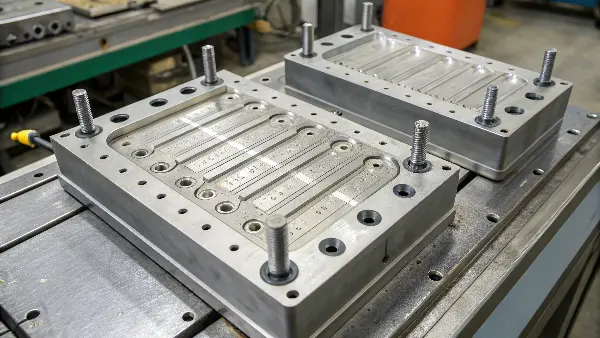
We had a case where a part was consistently showing burn marks at the very last point to fill. The vents were there, but they were just a little too small and were clogging up. We deepened them by just a few thousandths of an inch—too small for plastic to enter, but big enough for air to escape easily. The problem vanished immediately. Sometimes, the smallest adjustments to these "invisible" systems make the biggest difference.
The Importance of Temperature Control
The cooling system is arguably the most important factor for cycle time. A majority of the molding cycle is just waiting for the part to cool enough to be ejected.
- Cooling Channels: These are drilled through the core and cavity plates, as close to the part surface as possible. Water is constantly circulated through them to carry heat away.
- Uniform Cooling: The goal is to cool the part evenly. If one side cools faster than another, the part will warp as it shrinks unevenly. For deep features on a core, we use special components like baffles or bubblers to get cooling fluid deep inside.
Letting the Air Out
When molten plastic is injected into the cavity at high speed, the air that was originally in that space needs somewhere to go. If it gets trapped, it gets compressed and superheated, causing defects.
- Vents: These are very shallow channels (typically 0.01-0.03mm deep) ground into the parting line of the mold. They are big enough for air to escape but too small for the viscous plastic to flow into.
- Venting Locations: Vents are placed at the end of the fill path and in any areas where air could be trapped. Sometimes, ejector pins are also designed to act as vents.
| Defect | Potential Cause: Poor Cooling | Potential Cause: Poor Venting |
|---|---|---|
| Warping | Uneven temperature across the mold surface. | Not applicable. |
| Sink Marks | Part is too thick or not cooled enough before ejection. | Not applicable. |
| Burn Marks | Not applicable. | Trapped, compressed air ignites the plastic front. |
| Short Shot | Plastic freezes off before filling completely. | Trapped air pressure prevents the cavity from filling. |
Conclusion
To summarize, a plastic injection mold would be a system of numerous parts in harmony. Considering the base of the mold, the actual part-forming center, and molding cavity, as well as the injection, ejection, cooling and venting systems, all are important. Learning these factors will enable you to make the correct questions and make sure your manufacturing partner such as CKMOLD will produce a tool that can withstand quality and its service.