
Are you trying to scale up your product manufacturing but worried about quality control and rising costs? You know that producing thousands, or even millions, of a part can lead to inconsistencies and budget overruns. This challenge can slow your growth and put your company’s reputation at risk. Injection molding is the proven solution that delivers high-quality, identical parts at a low cost per unit, making it the gold standard for mass production.
Injection molding is ideal for mass production because it combines high speed, incredible precision, and low per-unit costs. Once the initial mold is created, it can produce millions of identical parts with minimal variation. The process is highly automated, which reduces labor costs and production time. Plus, it works with a vast range of plastic materials, allowing you to choose the perfect one for your product’s specific needs. This blend of efficiency, consistency, and versatility makes it unmatched for high-volume manufacturing.

When I first started in this industry, I worked on the factory floor. I saw firsthand how a well-designed mold could churn out perfect parts, one after another, like clockwork. This experience taught me a crucial lesson: the right manufacturing process is the foundation of a successful product. Many business owners I meet, like you, are looking for that solid foundation to build their growth on. They need a method that won’t let them down when the orders start flooding in. Let’s dig deeper into the specific benefits that make injection molding that reliable choice.
Why Is Injection Molding So Cost-Effective at High Volumes?
Thinking about the high upfront cost of a steel mold can be intimidating. Business owners often worry that this initial investment is too big of a risk. This hesitation might push them toward methods that seem cheaper at first, but these alternatives can end up costing much more per part. This can slowly eat away at profits, especially when production numbers climb. The secret is to look at the total cost over the entire production run, not just the initial setup.
Injection molding is cost-effective at high volumes because the significant initial investment in the mold is spread out over thousands or millions of parts. This process, known as amortization, drastically lowers the cost attributed to each individual unit. As you produce more parts, the per-part cost continues to drop. Automation and minimal material waste in the process further reduce labor and material expenses, making it the most economical choice for mass-producing plastic components.

To really understand the financial advantage, you have to look at the whole picture. I once had a client, let’s call him Michael, who was developing a new casing for an electronic device. He initially considered 3D printing for his first 10,000 units because the startup cost was low. I sat down with him and mapped out the costs. While the injection mold required a significant upfront investment, the cost for each plastic casing was just cents. For 3D printing, each part cost several dollars to make. The math was clear.
The Power of Economies of Scale
The core principle here is economies of scale. The mold is a one-time capital expense. A high-quality steel mold can last for hundreds of thousands, or even millions, of cycles without degrading. The more parts you make, the less the mold costs you per part.
Let’s compare the costs for a simple plastic part across different manufacturing methods and volumes.
| Production Volume | 3D Printing (per part) | CNC Machining (per part) | Injection Molding (per part) |
|---|---|---|---|
| 100 Units | $10 | $35 | $250 (incl. mold cost) |
| 10,000 Units | $10 | $25 | $2.75 |
| 1,000,000 Units | $10 | $20 | $0.28 |
Note: These are illustrative figures and can vary greatly based on part complexity and material.
As you can see, for prototyping or very small batches, other methods can make sense. But as soon as your volume increases, injection molding quickly becomes the most affordable option by a huge margin. Michael made the investment, and his product became a huge success, partly because he could price it competitively.
How Does Injection Molding Guarantee Part Consistency?
You’ve designed the perfect part, but now you have to make a million of them. You start to worry if the last part off the line will be as good as the first. Inconsistencies can lead to product failures, customer complaints, and costly recalls. This is a common fear for any business owner scaling up production. You need a process that you can trust to deliver the same result every single time. It’s not just about quality; it’s about your brand’s reputation.
Injection molding ensures exceptional consistency by using a single, highly durable steel mold as the master template for every part. The process parameters—such as temperature, pressure, and cooling time—are precisely controlled by computers. This high level of automation removes human error and guarantees that each part is a near-perfect replica of the last. This repeatability, with tolerances as tight as ±0.001 inches, is the key to its reliability in mass production.

I remember working with a medical device company that needed a small, intricate component for a diagnostic tool. The part’s dimensions were absolutely critical; even a tiny variation could affect the device’s accuracy. They were trying to produce these parts using another method, and their rejection rate was almost 20%. That’s a huge waste of time and money. When we switched them to a precision injection mold, their rejection rate dropped to less than 0.1%. This is the power of consistency.
The Pillars of Repeatability
What makes this process so reliable? It comes down to a few key factors that work together to eliminate variables.
1. The Master Mold
A mold made from hardened steel is incredibly tough. It doesn’t warp or wear down easily, even after hundreds of thousands of cycles. It acts as a permanent, unchanging template. Every single shot of molten plastic is forced into the exact same cavity, taking on its precise shape, dimensions, and texture.
2. Process Automation
Modern injection molding machines are computer-controlled. An operator sets the parameters at the beginning of the run, and the machine takes over. It controls:
- Injection Pressure: Pushing the exact same amount of plastic in every time.
- Temperature: Keeping the plastic at its optimal flow temperature.
- Cooling Time: Ensuring each part solidifies uniformly before ejection.
This automation removes the element of human error, which is often the biggest source of inconsistency in manufacturing. Day or night, the first part and the 500,000th part are made under virtually identical conditions.
How Fast Can Injection Molding Produce Parts?
Your product is a hit, and demand is surging. Now, the pressure is on to get units out the door as fast as possible. Production speed becomes your biggest challenge. A slow manufacturing process creates bottlenecks, leading to long lead times, missed deadlines, and unhappy customers. If you can’t keep up with demand, you risk losing market share to competitors who can. You need a process built for speed and high output.
Injection molding is exceptionally fast, with typical cycle times ranging from just 15 to 60 seconds. This means a single mold can produce thousands of parts per day. For even higher output, multi-cavity molds can be used to create multiple parts in a single cycle. This incredible speed allows manufacturers to scale production rapidly to meet market demand, making it one of the most efficient processes available for high-volume manufacturing.

Speed is not just about a single cycle. It’s about the entire production flow. I was once approached by a toy company right before the holiday season. Their previous supplier couldn’t keep up, and they were facing a massive stock shortage. They needed a million units of a popular plastic toy part, and they needed them fast. We designed a multi-cavity mold for them. Instead of making one part every 30 seconds, we were making eight parts every 30 seconds from a single machine. We were able to run the machines 24/7.
Breaking Down the Speed Advantage
The efficiency of injection molding comes from its continuous, cyclical nature. Let’s look at the factors that contribute to its high output.
1. Rapid Cycle Times
The entire process is incredibly quick. A typical cycle includes:
- Clamping: The mold closes (a few seconds).
- Injection: Molten plastic is injected into the mold (a few seconds).
- Cooling: The part solidifies (the longest part of the cycle, often 10-30 seconds).
- Ejection: The mold opens, and the part is pushed out (a few seconds).
A simple part might have a total cycle time of only 20 seconds. That translates to 180 parts per hour, or over 4,300 parts per day from just one molding machine.
2. Multi-Cavity and Family Molds
To multiply this output, we use advanced mold designs:
- Multi-Cavity Molds: These molds have multiple identical cavities, allowing you to produce 2, 4, 8, or even up to 64 identical parts in one single shot.
- Family Molds: These have different cavities to produce all the parts needed for a single assembly in one shot. For example, the front and back casing of a TV remote.
This is how we helped that toy company. By using an 8-cavity mold, we increased their production output by 800% without needing eight machines. This drastically reduced their lead time and saved their holiday season.
What Design and Material Options Are Available?
You have a great idea for a product, but you’re not sure if it’s possible to manufacture. You might need a complex shape, a specific color, or a material with special properties like heat resistance or flexibility. Being limited by your manufacturing process can force you to compromise on your design. These compromises can affect your product’s performance, appearance, and ultimately, its success in the market. You need a process that gives you freedom, not limits.
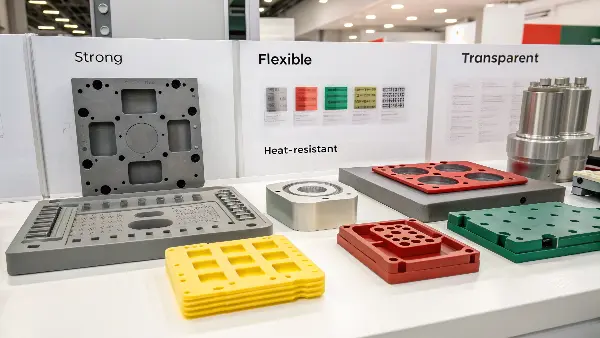
Injection molding offers tremendous design freedom and an almost limitless selection of materials. It can produce highly complex and intricate parts with features like thin walls, living hinges, and threaded inserts. Additionally, there are thousands of thermoplastic polymers and elastomers available, each with unique properties. You can choose materials that are strong, flexible, transparent, heat-resistant, or chemical-resistant, and they can be mixed with additives for custom colors and performance enhancements.

I’ve always loved the creative side of mold making. It’s like solving a puzzle. A client in the consumer goods space came to me with a design for a new kitchen utensil. It had a rigid handle, a flexible spatula tip, and a soft-grip overlay. They thought they would need to make three separate parts and assemble them, which would be expensive. I showed them how we could use a process called overmolding. We could inject the rigid handle first, then inject the flexible tip and soft-grip material directly onto it in the same molding cycle.
Unleashing Creative Potential
This ability to work with different materials and create complex geometries is what sets injection molding apart. Let’s explore these two areas.
1. Freedom in Part Design
Because plastic is injected as a liquid under high pressure, it can fill very small and complex features within the mold. This allows for:
- Intricate Geometry: You can create complex shapes, ribs for strength, and integrated mounting bosses that would be difficult or impossible with other methods.
- Surface Finishes: The mold surface can be polished, textured, or even engraved to apply finishes directly to the part. This means you can get a high-gloss, matte, or patterned finish right out of the mold, eliminating secondary finishing steps.
- Consolidation: You can combine multiple parts into a single molded component. This reduces assembly time, lowers costs, and creates a stronger final product.
2. A World of Materials
The choice of plastic resin is one of the most powerful aspects of injection molding. You aren’t stuck with just one or two options.
| Material | Key Properties | Common Uses |
|---|---|---|
| ABS | Strong, impact-resistant, good surface finish | LEGO bricks, electronic housings, car trim |
| Polycarbonate (PC) | Extremely tough, transparent, heat-resistant | Eyeglass lenses, safety goggles, CDs |
| Nylon (PA) | Strong, high wear resistance, low friction | Gears, bearings, zip ties, engine covers |
| Polypropylene (PP) | Flexible, chemical-resistant, inexpensive | Food containers, car bumpers, living hinges |
| TPE/TPU | Rubbery, flexible, soft to the touch | Phone cases, grips, seals, flexible tubes |
This is just a small sample. We can also add fillers like glass fibers for strength or pigments for any color imaginable. This versatility means you can select the perfect material to meet the functional and aesthetic needs of your product without compromise.
Conclusion
As you can see, injection molding is more than just a manufacturing process. It’s a comprehensive solution for bringing products to market at scale. It offers an unmatched combination of low per-unit cost, perfect consistency, high speed, and incredible design freedom. For any business owner looking to grow, this process provides the reliable and efficient foundation needed to succeed in a competitive marketplace.