
Are you trying to figure out the best way to manufacture your plastic parts? The options can feel overwhelming, and choosing the wrong process can lead to costly mistakes and delays that hurt your business. You need a method that is reliable, scalable, and cost-effective, but it’s hard to know which one truly fits your project’s needs. This uncertainty can be a major roadblock to getting your product to market efficiently.
Injection molding offers a compelling combination of repeatability, material flexibility, integrated geometry, automation and low unit cost at suitable volumes. It also has real tradeoffs: upfront tooling, design constraints, minimum economic volume, process development and maintenance. A professional comparison states both sides so the chosen process fits the product rather than treating molding as the answer to every plastic-part problem.
Related engineering resources: injection molding services | DFM analysis | production injection molding
The primary advantages of injection molding are high efficiency for mass production, excellent part-to-part consistency, and low per-unit costs at high volumes. This process allows for complex and intricate part geometries with high precision. It also offers a vast selection of materials and color options, providing incredible design flexibility. For businesses looking to scale production, injection molding is often the most reliable and cost-effective method for creating high-quality plastic components in large quantities, ensuring a great return on the initial investment.
What are the primary advantages of injection molding?
You’re looking to produce thousands, maybe millions, of identical parts. You need every single one to be suitable, and you need the cost per part to be as low as possible. Trying to achieve this with slower, more labor-intensive methods can quickly drain your budget and lead to quality control nightmares. It feels like you’re forced to choose between quality, speed, and cost, with no way to get all three.
The biggest advantage of injection molding is its incredible efficiency and precision at scale. Once the initial mold is made, you can produce a massive number of high-quality parts very quickly. This speed leads to a very low cost per part. The process allows for complex designs with fine details that are reliably repeatable from the first part to the millionth. You also have a huge choice of materials, from rigid plastics to flexible elastomers, giving you total control over your product’s final properties.
High Efficiency and Speed
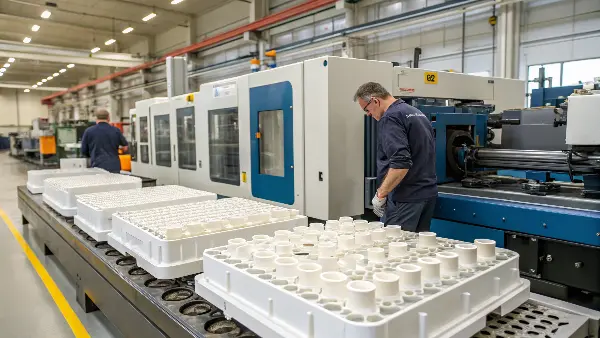
Once the mold is created and the machine is set up, the injection molding process is incredibly fast. Cycle times can range from a few seconds to a couple of minutes, depending on the part’s size and complexity. For the buyer’s enclosures, we were able to produce thousands of units per day from a single mold. This rapid production means you can meet market demand quickly and reduce your inventory holding costs.
Design Complexity and Precision
Injection molding excels at producing intricate and complex parts. The high pressures used in the process force the molten plastic into every tiny detail of the mold cavity. This means you can incorporate features like ribs, bosses, and complex textures directly into the part, reducing the need for secondary assembly operations. Every part that comes out of the mold is virtually identical, ensuring high repeatability and quality control.
Material Versatility and Cost-Effectiveness
There is a massive library of thermoplastic polymers available for injection molding. This allows you to select a material with the exact properties you need, whether it’s strength, flexibility, color, or heat resistance. Furthermore, while the initial mold is a significant investment, the cost per part becomes extremely low as production volume increases. The table below shows how the cost-per-part drops dramatically with scale.
| Production Volume | Initial Mold Cost | Per-Part Cost | Total Cost per Part |
|---|---|---|---|
| 1,000 units | $5,000 | $1.00 | $6.00 |
| 10,000 units | $5,000 | $1.00 | $1.50 |
| 100,000 units | $5,000 | $1.00 | $1.05 |
| 1,000,000 units | $5,000 | $1.00 | $1.005 |
This scalability is what makes injection molding a go-to choice for so many industries.
What are the main disadvantages of injection molding?
You’ve heard about the great benefits of injection molding, but you’re a careful business owner. You know there’s generally another side to the story. The fear is that you’ll invest heavily in this process only to discover hidden costs or limitations that cripple your project’s timeline and budget. You’re worried about the large upfront investment and what happens if your design needs to change after the fact.
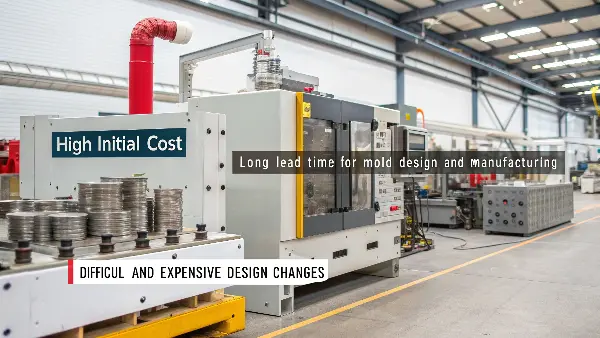
The most significant disadvantage of injection molding is the high initial cost and long lead time required to design and manufacture the mold (tooling). This upfront investment can be thousands or even tens of thousands of dollars. Additionally, making design changes after the mold is created is difficult and expensive. The process is best suited for high-volume production, as the costs are hard to justify for small batches or prototypes. Certain part geometries, like those with undercuts or inconsistent wall thickness, can also pose challenges.
It’s crucial to be realistic about these challenges. A useful principle is that injection molding is like building a highway. The initial construction is expensive and takes time, but once it’s built, you can move a massive amount of traffic quickly and cheaply. If you only need to move a few cars, building a simple dirt road is better.
High Initial Tooling Costs
The mold is the heart of the process, and it’s a highly engineered piece of equipment. It needs to be precisely machined from durable materials like steel or aluminum to withstand high pressure and temperature over hundreds of thousands of cycles. This engineering and manufacturing process is what drives the high upfront cost. For startups or projects with unproven market demand, this initial barrier can be a deal-breaker. It’s why we often recommend other methods, like 3D printing, for initial prototyping before committing to expensive tooling.
Long Lead Times for Molds
Creating a production-ready mold is not a quick process. From finalizing the design to machining the steel and testing the final tool, it can take anywhere from a few weeks to several months. This lead time needs to be factored into your overall product development schedule. If you’re in a race to get to market, this waiting period can be a significant disadvantage. Proper planning is absolutely essential to avoid delays.
Design Restrictions and Considerations
While injection molding allows for complexity, it also comes with its own set of design rules, often called Design for Manufacturability (DFM). For example, parts must be designed with a draft angle to allow them to be ejected from the mold easily. Wall thickness should be as uniform as possible to prevent defects like sink marks or warping. Complex features like undercuts require more complicated and expensive mold actions, such as side-cores or lifters. Ignoring these rules can lead to a part that is impossible to manufacture or has serious quality issues.
How do the pros and cons of the mold itself impact a project?
You understand the process, but now you’re wondering about the tool—the mold. It’s the single most expensive part of the setup, and you’re concerned about its lifespan and material. Choosing the wrong type of mold could mean it wears out too soon, forcing another huge investment, or you might overspend on a tool built to last longer than your product’s entire life cycle. This decision feels critical to your project’s long-term financial health.
The mold itself presents a trade-off between cost and longevity. A “soft” mold made from aluminum is cheaper and faster to produce but has a shorter lifespan, suitable for 1,000 to 10,000 parts. A “hard” mold made from hardened tool steel is very expensive and takes longer to make, but it can last for over a million cycles. The choice directly impacts your project’s upfront cost versus its long-term cost per part. A well-made hard mold is an asset that ensures consistent quality over massive production runs.
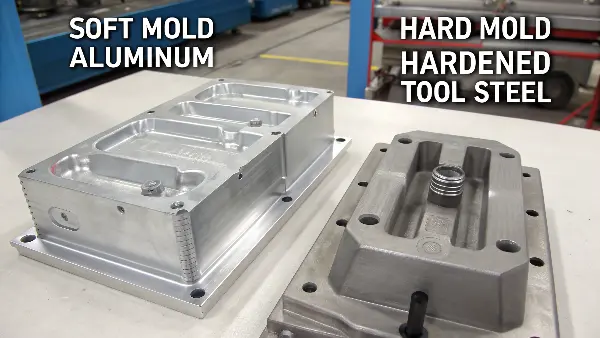
Mold Material vs. Project Volume
The core decision comes down to your expected production volume.
- Aluminum Molds: These are suitable for prototyping and low-volume production. They are easier to machine, meaning lower costs and faster lead times. However, aluminum is softer and will wear out much faster than steel. It’s a great way to test a market without a huge upfront risk.
- Pre-Hardened Steel Molds (e.g., P20): This is the workhorse of the industry. It offers a good balance of cost, durability, and machinability. It’s suitable for production volumes in the tens to hundreds of thousands of parts. Most consumer products use molds made from this type of steel.
- Hardened Steel Molds (e.g., H13, S7): This is the top tier. These molds are heat-treated after machining to achieve maximum hardness and durability. They are the most expensive and time-consuming to create, but they can produce millions of parts with minimal wear. This is reserved for high-volume, long-term projects where consistency is paramount.
The Impact of Mold Complexity
Beyond the material, the complexity of the mold is a major factor. Features that prevent the part from ejecting straight out of the mold, known as undercuts, require special mechanisms.
- Side-Actions (Slides): These are moving parts within the mold that slide in to form a feature and then retract before the part is ejected. They add significant cost and complexity to the mold but are necessary for many designs.
- Lifters: These are components on the ejector side of the mold that move at an angle to disengage an undercut as the part is pushed out.
Each additional mechanism increases the cost of building and maintaining the mold, so a key part of DFM is to minimize or eliminate these features if possible.
How does injection molding compare to other manufacturing methods?
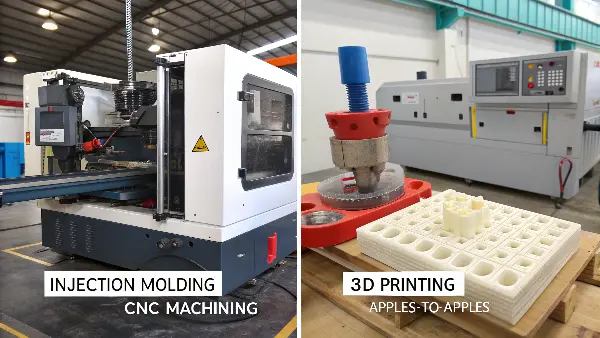
You’re trying to make a final decision, but injection molding isn’t the only option. You’ve heard about 3D printing for its speed in prototyping and CNC machining for its precision with different materials. This creates confusion. You’re struggling to compare these methods on an “apples-to-apples” basis for your specific needs of cost, speed, and volume. Without a clear comparison, you risk choosing a method that isn’t optimized for your business goals.
Injection molding is superior for high-volume production due to its extremely low per-part cost and high speed, but it has high startup costs. 3D printing is ideal for low-volume prototypes because it has no tooling costs and is very fast for single parts, but it’s slow and expensive for mass production. CNC machining offers high precision and material variety without tooling costs, making it great for low-to-mid volume production, but it’s generally slower and more expensive per part than injection molding at scale.
Thinking about the best method reminds me of choosing a vehicle. Do you need a race car, a cargo truck, or an all-terrain vehicle? Each is excellent for its specific purpose. In manufacturing, the “purpose” is usually defined by your required production volume and design complexity. A business owner like the buyer needs to understand these trade-offs to make the right call. Let’s put these three popular methods side-by-side to make the choice clearer.
Injection Molding vs. 3D Printing
This is the classic “mass production vs. prototyping” comparison.
- Speed: 3D printing is faster for one part. Injection molding is exponentially faster for 1,000+ parts.
- Cost: 3D printing has a high cost per part that stays constant. Injection molding has a high initial cost but a very low cost per part that drops with volume. The break-even point is often around 500-1000 units.
- Materials: Both offer a good variety, but injection molding provides access to a wider range of engineering-grade polymers with more consistent material properties.
- Best Use: Use 3D printing for design validation and functional prototypes. Use injection molding for mass production.
Injection Molding vs. CNC Machining
This comparison is about “forming vs. removing” material.
- Complexity: CNC machining can often create more complex geometries without the draft angle and undercut limitations of molding. However, injection molding is better at creating thin-walled parts.
- Cost: CNC machining has no tooling cost, but the per-part cost is high due to machine time and material waste (it’s a subtractive process). Injection molding is the opposite.
- Materials: CNC is not limited to plastics; it excels with metals like aluminum and steel. For plastics, injection molding is usually more cost-effective at scale.
- Best Use: Use CNC for high-precision parts in low-to-mid volumes or for parts made from metal. Use injection molding for high-volume plastic parts.
Here is a summary table to help you decide:
| Feature | Injection Molding | 3D Printing (FDM/SLA) | CNC Machining |
|---|---|---|---|
| Best Volume | 1,000 – 1,000,000+ | 1 – 100 | 1 – 1,000 |
| Upfront Cost | Very High | None | Low (programming) |
| Cost per Part | Very Low | High | Medium to High |
| Speed | Very Fast (per part) | Slow (per part) | Medium |
| Complexity | High (with DFM) | Very High | Very High |
| Waste | Low | Very Low | High |
Ultimately, the right choice depends entirely on your project’s unique requirements.
Advantage: Repeatable Geometry at Scale
A mature mold can reproduce interfaces, ribs, clips, textures and dimensions across many cycles. Repeatability depends on cavity balance, material condition, cooling, machine control, tool wear and measurement; it is created by the complete process, not supported by the mold alone.
Advantage: Broad Material and Feature Options
Thermoplastics, engineering grades, elastomers, reinforced resins, inserts and overmolded assemblies can address different product needs. Each option changes drying, flow, shrinkage, wear, surface, tooling and validation requirements, so material breadth also increases engineering responsibility.
Advantage: Low Direct Labor and Integrated Parts
Automation can remove, inspect, package and trace parts while the mold forms several functional features in one cycle. Integration may reduce assembly but can increase tool mechanisms or make a defect more expensive, so compare the complete value stream.
Tradeoff: Tooling and Design Commitment
Mold investment, parting, draft, gates, slides, cooling and ejection must be considered before production. Late changes can be costly. Use DFM, prototypes or rapid tooling to reduce uncertainty before committing to a complex production tool.
Tradeoff: Process and Quality Development
A quote or first sample does not establish a stable production window. Material conditioning, machine settings, cavity balance, inspection, maintenance and control plans require development. Compare these requirements honestly with printing, machining or casting for the specific volume.
Injection Molding Advantages—and the Tradeoffs Buyers Should Know: Buyer Review Checklist
- Measure repeatability against the actual CTQs, material, tool and quality system.
- Select material and integrated features with processing and validation consequences visible.
- Compare labor, automation, assembly, scrap and defect costs across the value stream.
- Use DFM and prototypes before committing to complex tooling.
- Include mold development, maintenance, inspection and change risk in the process comparison.
Frequently Asked Questions
What is the biggest advantage of injection molding?
For suitable volumes, it can produce repeatable, feature-rich parts at low direct labor and competitive accepted-part cost.
What is the biggest tradeoff?
Upfront tooling and design commitment. The product and process need enough maturity and volume to recover that investment.
Conclusion
In summary, injection molding is a fantastic choice for mass production. Its main strengths are incredible speed, high precision, and a very low cost per part when you’re making thousands of units. While the initial investment in the mold is high, the long-term savings and quality consistency are unmatched for scaling a product. It offers a huge range of materials and the ability to create complex designs, making it a powerful tool for any business.