
Are you struggling to scale up your product manufacturing without costs spiraling out of control? Many businesses find that as production volume increases, methods that worked for prototypes become slow, expensive, and inconsistent. This bottleneck can stall growth and hurt your bottom line. Injection molding provides a robust solution, designed specifically to handle the demands of high-volume production with incredible efficiency and precision.
Injection molding works well for mass production because the high one-time tooling effort can be spread across a large number of accepted parts. The process also supports automation, multi-cavity output, integrated features and a wide range of thermoplastics. Its success depends on stable demand, mature design, controlled material, balanced cavities, reliable maintenance and a quality system that detects drift early.
Related engineering resources: production injection molding | multi-cavity molds | mold testing and validation
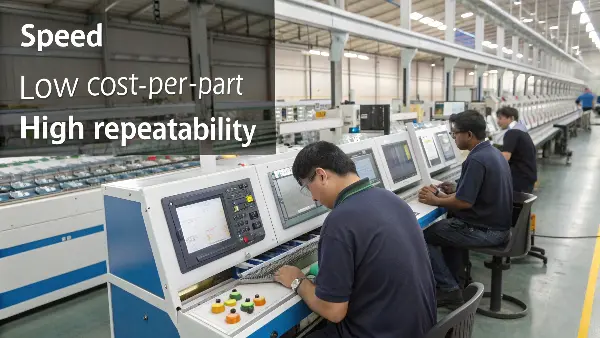
Injection molding is ideal for mass production because it offers an unparalleled combination of speed, low cost-per-part, and high repeatability. Once the initial mold is created, the automated process can produce thousands or even millions of identical parts very quickly. This high-volume output spreads the significant upfront tooling cost, making the price of each individual component extremely low. The process also ensures consistent quality and dimensional accuracy across the entire production run, which is crucial for large-scale manufacturing.
The benefits of using injection molding for mass production are clear, but how do these advantages actually work in practice? It’s more than just a fast machine; it’s a complete system where every element is optimized for efficiency and scale. To truly understand its power, we need to look closer at the factors that make it the go-to choice for businesses aiming for large-scale output.
How does injection molding achieve such low costs per part?
Finding a manufacturing method that keeps unit costs low is a constant battle for business owners. You’ve developed a great product, but high production expenses eat into your profit margins, making it difficult to price competitively. This forces you into a tough choice: raise prices and risk losing customers, or accept thin margins that limit your company’s growth. Injection molding directly addresses this by leveraging economies of scale to drastically reduce your cost per part.
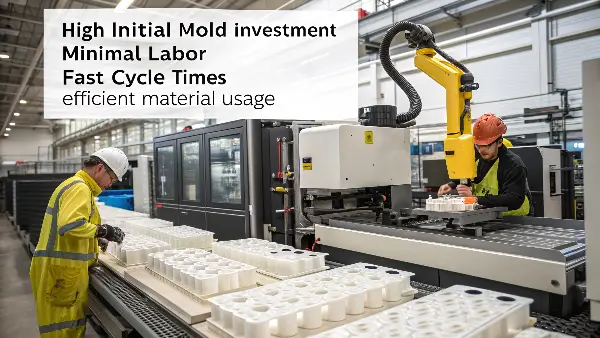
The low cost per part in injection molding is achieved by amortizing the high initial mold investment over a very large number of units. The process is highly automated, requiring minimal labor per part, and has fast cycle times, maximizing output per hour. Furthermore, it’s incredibly efficient with materials, generating very little waste, and any scrap can often be reground and reused. This combination of factors drives the unit price down significantly as production volume increases.
Key Factors in Cost Reduction
- Tooling Amortization: This is the most significant factor. That high upfront cost is divided by the total number of parts the mold will produce. A mold that costs $50,000 and produces one million parts has a tooling cost of just 5 cents per part.
- Automated Labor: Modern injection molding is a highly automated process. After the initial setup, machines can run 24/7 with minimal human supervision. One technician can often oversee several machines, making the labor cost per individual part almost negligible.
- Material Efficiency: The process is designed for minimal waste. Runners and sprues, which are the channels the plastic flows through, can often be reground and mixed back into the raw material. This high material utilization keeps input costs low.
The effect of volume is dramatic, as you can see in this simplified comparison:
| Cost Factor | 10,000 Unit Run | 1,000,000 Unit Run |
|---|---|---|
| Mold Cost ($50,000) | $5.00 / part | $0.05 / part |
| Material & Machine Cost | $0.50 / part | $0.50 / part |
| Total Estimated Cost | $5.50 / part | $0.55 / part |
As the table shows, the cost impact of the mold diminishes rapidly with higher volumes, making injection molding the undisputed economic choice for mass production.
What makes the speed and efficiency of injection molding so high?
Your product is ready for market, but your current manufacturing process is too slow to meet demand. These delays mean missed sales opportunities and give competitors a chance to catch up. A slow production line is a major roadblock to scaling your business and capitalizing on market momentum. You need a method that can keep pace with your growth, and this is where the incredible speed of injection molding truly shines.
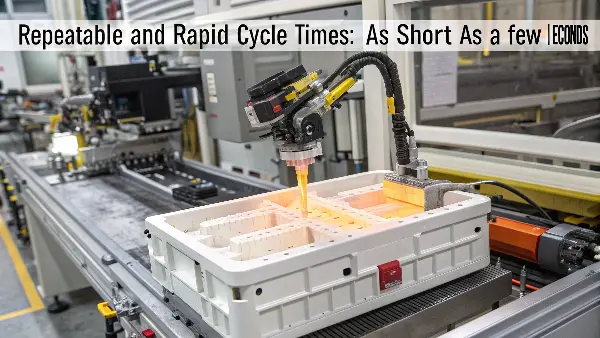
The high speed of injection molding comes from its repeatable and rapid cycle times, which can be as short as a few seconds for simple parts. Once the mold is set up, the automated process of injecting, cooling, and ejecting parts runs continuously with minimal downtime. For multi-cavity molds, each cycle produces multiple parts simultaneously, multiplying the output and making it one of the fastest manufacturing methods available for plastics.
The Anatomy of a Fast Production Cycle
The injection molding cycle is a finely tuned, four-stage process that repeats seamlessly:
- Clamping: The two halves of the mold are securely closed by a powerful clamping unit. This step must be fast but precise to prepare the mold for the high-pressure injection.
- Injection: Molten plastic is injected into the mold cavity at high speed and pressure. The speed of this “shot” is critical and is carefully controlled to ensure the cavity fills completely and uniformly without defects. This phase is often just a matter of seconds.
- Cooling: This is typically the longest part of the cycle. The plastic must cool and solidify into its final shape inside the mold. The efficiency of the mold’s cooling channels is a major factor in determining the overall cycle time. A well-designed mold optimizes cooling to shorten this phase as much as possible.
- Ejection: Once the part is solid, the mold opens, and an ejector system pushes the part out, often into a collection bin or onto a conveyor belt. The machine is then ready to immediately begin the next cycle.
Improving efficiency even further is possible through advanced mold design. Multi-cavity molds, as mentioned in my story, are a material change. Instead of one part per cycle, you get 2, 4, 8, or even 64. For small, high-volume parts, this is the standard. Another technique is using hot runner systems, which keep the plastic in the feed channels molten. This eliminates the runner that needs to cool and be ejected, shortening the cycle time and reducing material waste.
Can injection molding maintain quality and consistency across millions of parts?
Your brand’s reputation depends on the quality of your products. If the first part off the line is suitable but the thousandth is flawed, you have a serious problem. In mass production, inconsistencies can lead to product failures, customer complaints, and costly recalls. You need a process that helps support every single part meets the exact same specifications, from the first to the last. This level of reliability is a non-negotiable requirement for scaling successfully.
Yes, injection molding excels at maintaining exceptional quality and consistency across millions of parts. The process uses a solid steel mold as a master template, ensuring every part is an exact replica. Paired with precise control over process parameters like temperature, pressure, and injection speed, and robust quality control systems, injection molding delivers a level of repeatability that is virtually unmatched by other manufacturing methods. This makes it a highly reliable choice for mass production.
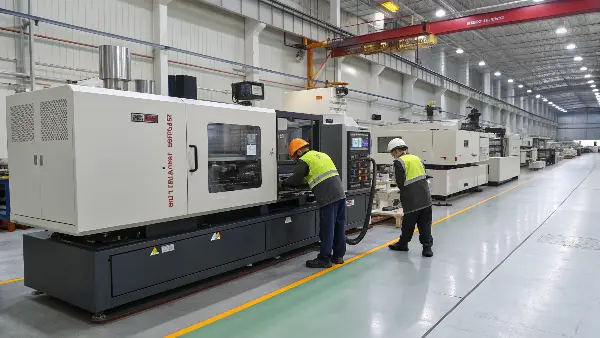
This consistency isn’t accidental; it’s engineered into the core of the process.
Pillars of Injection Molding Repeatability
Three main pillars ensure that every part is a suitable copy of the one before it:
- The Steel Mold: The mold itself is the foundation of consistency. Machined from durable tool steel to extremely high tolerances, it acts as a permanent, unchanging template. Unlike softer molds used in other processes, a steel injection mold can withstand millions of cycles without wearing down or losing its dimensional accuracy. Every part produced is forced to take the exact shape of the mold cavity.
- Process Parameter Control: Modern injection molding machines offer precise digital control over every variable.
- Temperature: Both the molten plastic and the mold are kept at exact temperatures.
- Pressure: Injection and holding pressures are finely tuned to pack the mold reliably.
- Speed: The rate at which plastic is injected is controlled to prevent defects.
- Time: Every phase—injection, cooling, ejection—is timed to the hundredth of a second.
This data-driven approach removes human error and environmental variation, ensuring the process is identical for every single cycle.
- Robust Quality Control (QC): Quality isn’t just assumed; it’s actively monitored. Automated optical inspection systems can check parts as they come off the line. Regular manual checks with precise measuring tools (like calipers and CMMs) are standard procedure. Statistical Process Control (SPC) is used to track key dimensions and ensure they remain well within the specified tolerance range. This means potential deviations are caught and corrected long before they become a problem.
How does material and design flexibility benefit mass production?
Your product idea is unique, but can it be manufactured effectively at scale? You might be worried that the demands of mass production will force you to compromise on your design or use a material that isn’t ideal. This lack of flexibility can limit your product’s performance, appearance, and innovation, preventing it from standing out in a crowded market. You need a process that supports your vision, rather than restricting it.
Injection molding offers enormous material and design flexibility, which is a major asset for mass production. It supports a vast range of thermoplastic polymers, each with unique properties, allowing you to select the suitable material for your product’s function. The process also accommodates highly complex geometries, intricate details, and features like living hinges or overmolding. This allows for innovative and highly integrated part designs that can be produced consistently at scale.
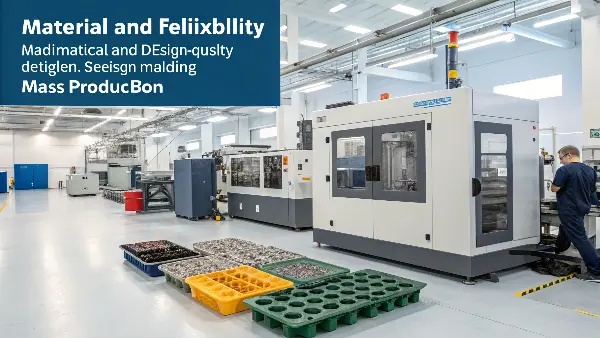
The ability to choose the right material and execute a complex design is what turns a good product into a great one.
Unlocking Potential with Material and Design Freedom
1. Vast Material Selection
The range of materials available for injection molding is immense. You aren’t locked into just one or two options. You can choose a polymer based on the specific needs of your product.
| Property Needed | Common Material Choices | Example Application |
|---|---|---|
| Strength & Durability | Polycarbonate (PC), ABS, Nylon (PA) | Power tool housings |
| Flexibility | Polypropylene (PP), TPE | Living hinges, seals |
| Clarity / Transparency | Acrylic (PMMA), Polycarbonate (PC) | Light pipes, lenses |
| Chemical Resistance | Polypropylene (PP), HDPE | Medical containers |
| Cost-Effectiveness | Polystyrene (PS), Polypropylene (PP) | Disposable consumer goods |
This allows you to optimize for performance, cost, and appearance without compromise. You can also add fillers like glass fibers for extra strength or UV stabilizers for outdoor products.
2. Complex Design Capabilities
Injection molding empowers designers to think beyond simple shapes. The process can handle features that would be difficult or impossible to achieve with other high-volume methods:
- Intricate Details: Fine ribs, bosses for screws, and delicate snap-fit features can be molded directly into the part.
- Part Consolidation: You can combine multiple components into a single molded part. This reduces assembly time, lowers costs, and creates a stronger final product.
- Advanced Techniques: Processes like overmolding (molding a soft material like rubber over a hard plastic substrate) and insert molding (molding plastic around a metal component like a screw or contact) are easily integrated, adding functionality directly on the production line.
This design freedom means you can create more efficient, innovative, and cost-effective products specifically for mass production.
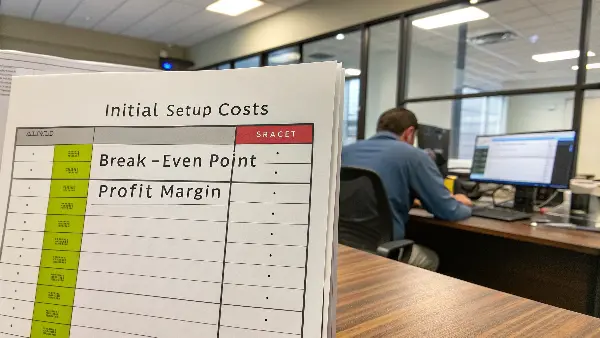
What are the initial setup costs and how do they impact the break-even point?
You’re convinced that injection molding is the right path for scaling your product, but the high upfront cost of the mold is a major concern. How can you be sure this large investment will pay off? If you miscalculate the break-even point, you could tie up significant capital in tooling without seeing a return, putting your business’s financial health at risk. Understanding the true cost and when you’ll start profiting is essential before you commit.
The primary initial setup cost in injection molding is the design and fabrication of the steel mold, which can range from a few thousand to over one hundred thousand dollars depending on its complexity. This high upfront investment means the process has a high break-even point. It is only profitable for production volumes large enough to spread that initial cost effectively, typically starting in the thousands or tens of thousands of units. For small-batch production, the cost per part is prohibitively high.
This is the most critical conversation I have with new clients. It’s the “go or no-go” decision point. A startup founder once came to me with a brilliant product idea. He wanted a quote for a mold but only planned to produce 500 units for his initial launch. The mold was going to cost $15,000. That would make his tooling cost $30 for every single part, on top of the material and production cost. It just didn’t make financial sense. We discussed other options like urethane casting or 3D printing for his initial run. He came back a year later when he had secured pre-orders for 20,000 units. At that volume, the $15,000 mold was a smart investment, and we moved forward.
Understanding your numbers is key. It’s not that injection molding is expensive; it’s that it’s an investment in scale.
Calculating Your Break-Even Point
The decision to invest in an injection mold is a strategic one that hinges on your projected sales volume. You need to do the math to see where the lines cross.
Factors Influencing Mold Cost:
- Part Complexity: More intricate shapes, undercuts, and tight tolerances require a more complex and expensive mold.
- Mold Material: Hardened tool steel for a mold designed to last millions of cycles costs more than softer aluminum used for shorter runs.
- Number of Cavities: A multi-cavity mold costs more to build but produces parts faster and lowers the per-part production cost.
- Surface Finish: A high-polish, mirror-like finish requires significant manual labor and increases the cost of the mold.
The Break-Even Calculation
To determine if injection molding is right for you, you need to compare it to an alternative method (like CNC machining or 3D printing).
Formula:
Break-Even Volume = (Total Mold Cost) / (Cost per Part [Alternative Method] – Cost per Part [Injection Molding])
Let’s use an example:
- Mold Cost: $20,000
- CNC Machining Cost per Part: $12.00
- Injection Molding Cost per Part (Material + Machine Time): $2.00
Break-Even Volume = $20,000 / ($12.00 – $2.00) = $20,000 / $10.00 = 2,000 units
In this scenario, once you produce more than 2,000 units, injection molding becomes the cheaper option. At 100,000 units, you’d save a massive amount of money. This calculation is crucial for justifying the investment and planning your production strategy.
Spread Tooling Cost Across a Stable Demand
A production mold is an asset whose economics improve as accepted output rises. Confirm demand, variants, engineering-change risk and tool-life expectations before choosing cavity count or complex mechanisms. A low unit price is meaningful only if the tool stays productive.
Use a Controlled Cycle as the Basic Unit
Filling, packing, cooling, recovery, opening and ejection repeat in a measurable sequence. Stabilize each stage and track the loss that limits output. A cycle that is nominally short but produces rework or frequent stops is not a good mass-production cycle.
Scale Quality With Cavity and Process Data
Identify cavities, trend critical dimensions and weight, monitor material and mold temperatures, and retain process records. Cavity-level evidence helps separate a tool issue from a machine or material issue before a large quantity is affected.
Protect the Line With Maintenance and Spares
Clean vents, inspect shutoffs, service hot runners, lubricate mechanisms and replace wear inserts before quality drifts. Keep critical spare parts, gauges and recovery instructions available. Maintenance is part of capacity planning, not an activity outside production economics.
Plan Supply and Change Control
Material, packaging, labels, logistics and backup capacity should match the run rate. Any resin, color, tool, machine or process change needs an approval path and revalidation decision. High volume amplifies both a benefit and a small unrecognized defect.
Injection Molding Works Well for Mass Production: Buyer Review Checklist
- Confirm stable demand, variants, tool life, cavity count and engineering-change risk.
- Define filling, packing, cooling, recovery, ejection and output losses.
- Trend CTQs, weight, temperatures and cavity-level behavior.
- Plan maintenance, wear parts, gauges, spares and recovery instructions.
- Align material, packaging, logistics, backup capacity and change-control approvals.
Frequently Asked Questions
Why does high volume make small defects more serious?
A defect that seems minor in a trial can multiply across thousands of parts. Early detection, cavity traceability and reaction plans are therefore essential.
Does mass production require a multi-cavity mold?
Not necessarily. Cavity count depends on demand, machine, tool cost, balance, maintenance and quality risk. A well-controlled single-cavity tool can be appropriate for a smaller high-volume program.
Conclusion
In summary, injection molding is the champion of mass production for a clear set of reasons. It delivers incredibly low costs per part by spreading the initial mold investment over huge volumes. Its speed and efficiency are unmatched, thanks to rapid, automated cycles. Crucially, it maintains strict quality and consistency from the first part to the millionth, protecting your brand’s reputation. This blend of economy, speed, and reliability makes it the definitive choice for scaling your plastic product manufacturing.