Which Plastic Prototyping Method is Right for Your Product Development?

You have a brilliant product idea, but choosing the wrong prototyping method can waste time and money. This leads to design flaws, production delays, and a final product that doesn’t meet expectations. Understanding the key methods helps you make the right choice, ensuring your journey from concept to reality is smooth and efficient.

Choosing the right plastic prototyping method depends on your needs for speed, cost, material properties, and fidelity. For early concepts, 3D printing is fast and cheap. For functional testing, CNC machining offers precision with real materials. When you need a small batch of near-production parts, consider vacuum casting or rapid tooling (injection molding). Each method has unique strengths, so matching them to your development stage is key to success.

A collection of different plastic prototypes on a workbench

It sounds complex, but it doesn’t have to be. I’ve spent years guiding clients through this process, helping them avoid costly mistakes. Let’s break down these options step-by-step so you can make an informed decision for your next project. It all starts with a simple question.

So, What Exactly is Plastic Prototyping?

Everyone talks about building a prototype, but what does that really mean for your plastic part? Without a clear definition, you might invest in a model that looks right but fails under real-world testing. This misunderstanding can set your project back weeks or even months. Having a solid grasp of the "why" behind prototyping is your first step toward a successful product launch.

Plastic prototyping is the process of creating a model or sample of a plastic product before starting mass production. Its main purpose is to test and validate the design’s form, fit, and function. This step allows you to identify potential flaws, gather user feedback, and make necessary improvements early on. A good prototype saves you from costly mistakes and ensures the final product meets your exact specifications and quality standards.

A designer holding a 3D-printed plastic prototype

Plastic prototyping is about turning a digital design into something you can hold in your hand. It’s a reality check for your idea. In my early days, a client wanted to rush a product to market. We skipped a thorough prototyping phase, and the final parts had a critical snap-fit failure that we would have easily caught with a functional prototype. It was a costly lesson for both of us. Now, I always tell people that prototyping isn’t a cost; it’s an investment that pays for itself by preventing expensive problems down the line.

The Core Goals of Prototyping

At its heart, prototyping aims to answer specific questions about your design. It’s not just about having a model; it’s about learning from it.

  • Design Validation: Does the part look and feel like you imagined? Does it fit with other components in an assembly?
  • Functional Testing: Can the part withstand the stresses it will face in real-world use? Does the mechanism work as intended?
  • User Feedback: How do potential customers interact with the product? Is it intuitive and easy to use?

By thinking of prototyping as a series of questions, you can choose the right method to get the answers you need at each stage. A simple visual model can answer the first question, but you’ll need something more robust for the second.

What is the Difference Between Prototype and Product Development?

It’s easy to mix up the terms "prototype" and "product development," but they are very different things. Thinking they are the same can lead you to expect a finished product’s quality from a simple model. This can cause frustration and miscommunication with your manufacturing partners. Understanding where one ends and the other begins is crucial for managing expectations and your project timeline.

A prototype is a single step within the larger product development process. Prototyping focuses on creating testable models to validate specific aspects of a design, like its shape or function. Product development is the entire journey from the initial idea to a market-ready product. It includes research, design, engineering, prototyping, manufacturing, marketing, and sales. A prototype is a tool used to reduce risk during product development.

A flowchart showing the stages of product development

Think of it this way: building a prototype is like making a test batch of cookies to perfect a recipe. Product development is the whole process of creating the recipe, buying the ingredients, baking, packaging the cookies, and selling them at a bakery. The test batch is essential to make sure the final product is delicious, but it’s just one part of the overall business. I once worked with a startup founder, a lot like Michael, who was brilliant but new to manufacturing. He thought his first functional prototype was the final product. We had to sit down and map out the entire development journey—including mold design, material selection for mass production, and quality control planning. It helped him see the bigger picture and budget correctly for the path ahead.

Key Stages in the Journey

To see the difference clearly, let’s look at the distinct phases. Each phase has its own goals and challenges.

Phase Key Activities Primary Goal
Prototyping 3D Printing, CNC, Casting Learn and validate design choices
Tooling (Mold Making) DFM Analysis, Mold Flow, Steel Cutting Prepare for mass production
Production Injection Molding, Assembly, QA Manufacture final products at scale
Product Development All of the above, plus market research, branding, etc. Bring a successful product to market

As you can see, the prototype is a critical learning tool used early in the process. It informs the later, more expensive stages like tooling and production. Getting the prototype right makes every subsequent step in product development smoother, faster, and more cost-effective. It’s about spending a little money upfront to save a lot of money later.

What are the Four Types of Prototyping?

You know you need a prototype, but which kind? Choosing a high-fidelity, functional prototype when you just need to check the shape is a waste of money. On the other hand, using a simple visual model for stress testing is a recipe for failure. This mismatch can drain your budget and lead to incorrect conclusions about your design’s viability. Knowing the different types helps you pick the right tool for the job.

The four main types of prototypes are categorized by their purpose: looks-like, works-like, pre-production, and feasibility. A "looks-like" prototype focuses on visual appearance and ergonomics. A "works-like" prototype tests the product’s function, often with a rough appearance. A pre-production prototype is a near-final version used to validate the manufacturing process. A feasibility prototype is a very early, rough model used to test a single core idea or technology.

Four different prototypes showing increasing levels of fidelity

Thinking about these categories helps you focus your efforts. At the beginning of a project, I always ask my clients, "What question are you trying to answer with this prototype?" Their answer tells me exactly which type they need. If they say, "I need to show this to investors to get funding," they likely need a "looks-like" prototype that is visually stunning. If they say, "I need to know if this hinge mechanism can survive 10,000 cycles," they definitely need a "works-like" prototype made from durable materials. It’s all about matching the prototype to the purpose.

Choosing the Right Prototype for Your Stage

Each prototype type serves a distinct purpose at a specific stage of the development cycle. Using them in the right order creates an efficient path from idea to reality.

1. Feasibility and Proof-of-Concept Prototypes

This is where you start. It’s often crude and built from off-the-shelf parts. You might even build it yourself. The goal isn’t to create a product; it’s to answer a single, critical question: "Is this core idea even possible?" It’s about testing the riskiest assumption in your design before you invest any significant time or money. For a plastic part, this could be testing a novel living hinge design with a piece of cut-and-bent plastic sheet.

2. "Looks-Like" Prototypes (Visual Prototypes)

Once you’ve confirmed your concept is feasible, you need to define its physical form. A looks-like prototype focuses on the aesthetics, ergonomics, and visual appeal. It’s what you use for marketing photos, focus groups, and investor pitches. The internal workings don’t have to function. Methods like SLA 3D printing are perfect for this because they produce beautiful, high-resolution models that accurately represent the final product’s appearance.

3. "Works-Like" Prototypes (Functional Prototypes)

This is the workhorse of the engineering world. A works-like prototype is all about function. It might look rough on the outside, but it must perform exactly like the final product. This is where you test durability, mechanical movements, and system integrations. CNC machining is a popular choice here because it allows you to use production-grade plastics, giving you data that accurately predicts how the final part will behave.

4. Pre-Production Prototypes

This is the final dress rehearsal before mass production. This prototype is made using the actual manufacturing process (or a very close equivalent, like rapid injection molding). It looks and works exactly like the final product. The goal is to confirm that your design is ready for manufacturing (DFM) and to iron out any final kinks in the production line. It’s the last checkpoint before you press the big green button on a production run of thousands of units.

What are the 8 Common Methods and Best Practices in Prototyping?

With so many prototyping technologies available, it’s easy to feel overwhelmed. Do you need the speed of 3D printing or the precision of CNC machining? Choosing a method that isn’t suited for your material or design complexity can lead to parts that don’t work, wasting both time and money. Understanding the strengths and weaknesses of each common method is the key to making a smart, cost-effective decision.

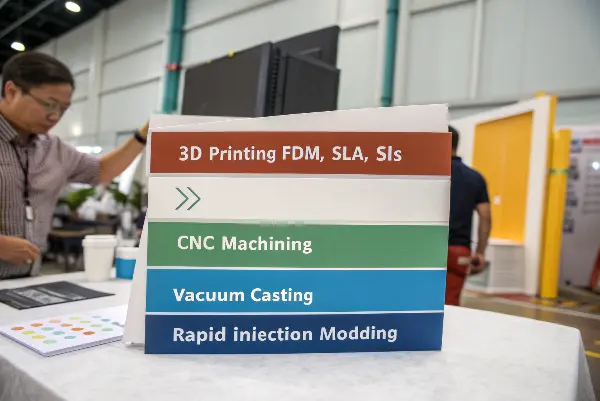
The 8 common plastic prototyping methods are 3D Printing (FDM, SLA, SLS), CNC Machining, Vacuum Casting, and Rapid Injection Molding. The best method depends on your priorities. For speed and low cost in early stages, use FDM 3D printing. For high-resolution visual models, use SLA. For functional prototypes with good mechanical properties, choose SLS or CNC Machining. For small batches of production-quality parts, Vacuum Casting and Rapid Injection Molding are ideal.

A comparison chart showing different prototyping methods

I see this choice as a balance between three things: speed, cost, and quality. You can usually pick two. When a client needs a part by tomorrow just to check how it fits, I’ll recommend FDM 3D printing. It’s fast and cheap, perfect for that job. But when another client needs to test a gear mechanism that will be under constant stress, I’ll steer them toward CNC machining or SLS. The part will cost more and take longer to make, but the data from their tests will be reliable because the prototype behaves like a real production part. The best practice is to not have a favorite method, but to choose the best method for the specific question you need to answer at that moment.

A Detailed Look at Prototyping Methods

Let’s break down the most common methods, looking at how they work and where they shine. This will help you build a decision-making framework for your own projects.

3D Printing (Additive Manufacturing)

This category covers several technologies that build parts layer by layer from a digital file.

  • Fused Deposition Modeling (FDM): The most common and affordable type. A plastic filament is melted and extruded layer by layer.
    • Best for: Very early concepts, fit checks, simple shapes.
    • Pros: Very fast, very low cost, wide range of simple materials.
    • Cons: Low resolution, visible layer lines, weaker than other methods.
  • Stereolithography (SLA): A laser cures liquid photopolymer resin layer by layer.
    • Best for: High-detail visual prototypes ("looks-like" models), patterns for casting.
    • Pros: Excellent surface finish, high accuracy, complex details.
    • Cons: Parts can be brittle, requires post-processing, material properties can change over time.
  • Selective Laser Sintering (SLS): A laser fuses powdered plastic (like nylon) together.
    • Best for: Functional prototypes with complex geometries, parts needing good strength and durability.
    • Pros: Strong, durable parts; no support structures needed.
    • Cons: Rougher surface finish, more expensive than FDM/SLA.

Subtractive and Molding Methods

These methods offer higher fidelity and are often used in later prototyping stages.

Method Description Best For Pros Cons
CNC Machining A solid block of production plastic is cut away by a computer-controlled tool. High-precision functional prototypes; testing with real production materials. Excellent accuracy, great surface finish, uses actual production plastics (ABS, PC, etc.). Can be expensive for complex geometries; some design limitations (undercuts).
Vacuum Casting A silicone mold is created from a master pattern (often 3D printed). Liquid urethane is then poured into the mold. Small batches (10-50 units) of high-quality parts for marketing or initial product testing. High-quality surface finish, excellent for overmolding, lower cost per part in small runs. Silicone molds have a limited life; material options are urethane-based, not true thermoplastics.
Rapid Injection Molding Uses simplified aluminum molds instead of hardened steel. Otherwise, it’s the same as standard injection molding. Pre-production prototypes (50-10,000 units); bridge tooling before mass production. Uses real thermoplastic materials, parts are identical to production parts, fast turnaround for tooling. Higher upfront cost than other methods; not cost-effective for just a few parts.

Choosing the right method is about aligning the technology’s strengths with your project’s specific needs at its current stage.

Conclusion

Choosing the right plastic prototyping method isn’t about finding the single "best" one; it’s about selecting the smartest tool for your specific goal. By understanding the core types and common methods, you can move from concept to product with confidence. This saves you time, reduces costs, and ultimately leads to a better final product for your customers.

Facebook
Twitter
LinkedIn

Request A Quote for Your Projects!

Hi there! I’m Jerry, a proud dad and passionate at CKMOLD. With years of hands-on experience in the injection mold and CNC industry, I’ve grown from managing the smallest details on the shop floor to leading international projects with clients across Europe and the U.S.

At CKMOLD, we specialize in precision molds, plastic parts, and CNC solutions that help bring bold product ideas to life. I love solving complex challenges, building long-term partnerships, and pushing the limits of what great manufacturing can do.

Let’s connect, exchange ideas, and grow together—whether you’re looking for a reliable manufacturing partner or just want to talk shop!

Request a Quick Quote

Send your drawings and detailed requirements via:
Email: jerry@ckmold.com

Or fill out the contact form below:

We will contact you within one working day. Please pay attention to the email with the suffix “@ckmold.com”

Wait, We Have Something Special for You!

Join our mailing list and receive a 10% discount on your next mold or CNC project.