
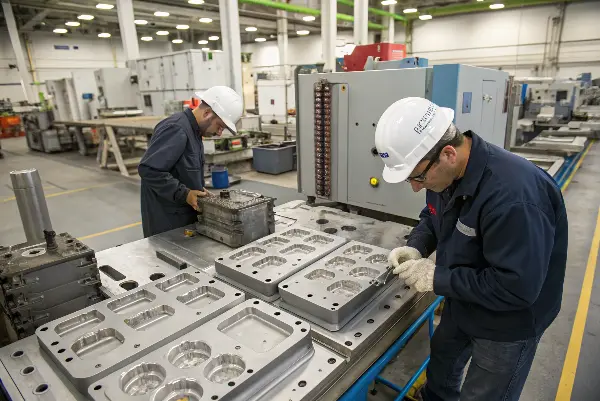
Are you struggling to keep up with the fast pace of material science? Choosing the right PVC formulation can feel like navigating a maze, where outdated information leads to costly mistakes in product performance, compliance, and even your brand’s reputation. Using the wrong material can mean product failures, regulatory headaches, and falling behind competitors who are already leveraging the latest innovations.
PVC innovation can involve stabilizers, impact modifiers, plasticizers, recycled content, bio-based inputs, lower-emission formulations, color systems or compounds designed for better processing. The manufacturing impact is not just a new datasheet value. Formulation changes can alter thermal stability, flow, shrinkage, odor, migration, surface, tool wear, supply and end-of-life decisions.
Related engineering resources: production injection molding | DFM analysis | mold testing and validation
Recent PVC innovations focus heavily on improving sustainability, performance, and safety. Key advancements include bio-based plasticizers replacing traditional phthalates, the adoption of lead-free stabilizers for environmental safety, and enhanced recycling processes. These breakthroughs lead to PVC compounds with superior durability, weather resistance, and biocompatibility. As a result, new formulations are unlocking opportunities for PVC in demanding applications across medical, construction, and consumer goods, making it a more versatile and responsible choice for modern manufacturing.
How Are Eco-Friendly PVC Formulations Changing the Industry?
The environmental reputation of PVC has long been a challenge for manufacturers. Today, both customers and regulators are demanding greener materials, putting immense pressure on your entire supply chain. Ignoring this powerful trend could mean losing market share to more sustainable alternatives, facing stricter regulations, and ultimately damaging your brand’s reputation. Fortunately, new eco-friendly PVC formulations offer a clear path forward, allowing you to meet sustainability goals without sacrificing performance.
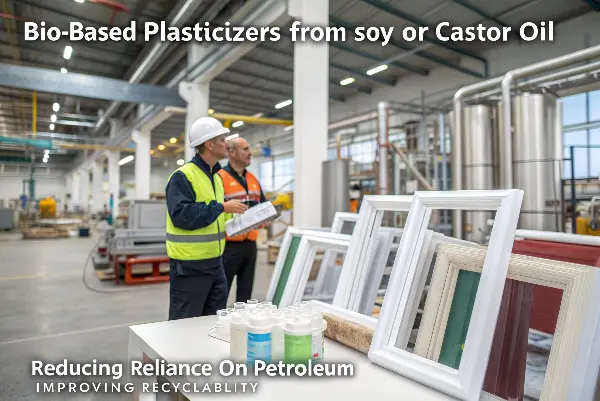
Eco-friendly PVC formulations are transforming the industry by replacing historically problematic components and radically improving recyclability. Key innovations include the use of bio-based plasticizers derived from renewable resources like soy or castor oil, which significantly reduces reliance on petroleum. At the same time, harmful lead and cadmium-based stabilizers are being phased out in favor of safer, organic-based systems. Furthermore, advancements in chemical recycling now allow for the recovery of pure PVC from complex waste streams, supporting a more circular economy.
The Impact of Bio-Plasticizers
Bio-plasticizers are game-changers. Unlike traditional phthalates, which are derived from crude oil, these are made from renewable sources like plants. This switch dramatically lowers the product’s carbon footprint. For my flooring client, this change was pivotal. Not only did it help them secure LEED-certified projects, but they also found that the new formulation offered better flexibility at low temperatures, reducing the risk of cracking during installation in colder climates. It was a win for sustainability and performance.
Advancements in PVC Recycling
The other side of the eco-friendly coin is recycling. PVC used to be notoriously difficult to recycle, especially when mixed with other materials. Today, solvent-based and chemical recycling technologies like Vinyloop™ and Texyloop® can dissolve the PVC, filter out contaminants like fibers and adhesives, and precipitate pure, reusable PVC resin. This means a construction company can now recycle old vinyl banners or roofing membranes, turning waste directly back into high-quality raw material. This closes the loop and redefines what’s possible for PVC in a circular economy.
What’s New in High-Performance PVC for Demanding Applications?
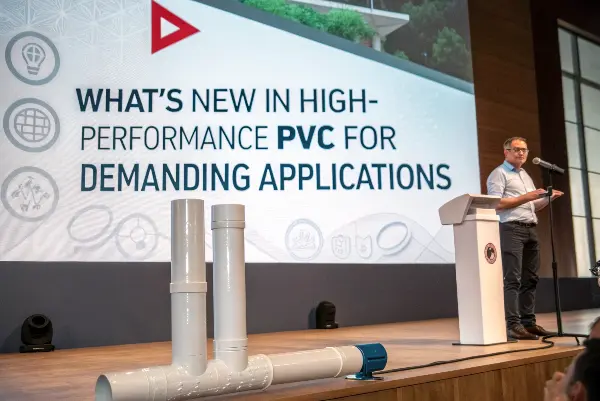
Is your product expected to withstand extreme weather, constant use, or harsh chemicals? Simply using a standard PVC grade won’t cut it when performance is on the line. Relying on outdated material specifications can lead to premature product failure, costly warranty claims, and a damaged reputation for quality. The good news is that specialized, high-performance PVC formulations are engineered specifically to overcome these challenges, ensuring your product lasts.
New high-performance PVC formulations deliver exceptional durability through advanced additives and polymer chemistry. Innovations in impact modifiers, such as acrylic or MBS (methacrylate-butadiene-styrene), significantly improve toughness and resistance to cracking. Enhanced UV stabilizer packages, often using HALS (Hindered Amine Light Stabilizers), prevent discoloration and material degradation from sun exposure. These developments make modern PVC ideal for demanding applications like outdoor construction materials, automotive components, and industrial piping where reliability is absolutely critical.
Engineering for Extreme Weather Resistance
The solution lay in a specialized PVC compound designed for exterior applications. This wasn’t just a minor tweak; it was a complete reformulation. The key was a sophisticated UV stabilization package. Instead of just a basic stabilizer, this formula used a synergistic blend of absorbers and HALS. The absorbers act like a sunscreen for the plastic, while the HALS actively trap the free radicals generated by any UV rays that get through. This dual-action approach dramatically slows down the degradation process. The table below shows the difference in key components:
| Component | Standard PVC Profile | High-Performance PVC Profile |
|---|---|---|
| Impact Modifier | Basic Acrylic | High-Efficiency MBS |
| UV Stabilizer | Titanium Dioxide | Synergistic HALS/Absorber |
| Heat Stabilizer | Tin-Based | Calcium-Zinc |
| Expected Lifespan | 5-7 Years | 20+ Years |
By switching to this advanced formulation, my client could offer a 20-year warranty against discoloration and brittleness, completely turning their market reputation around.
Can PVC Be Made Safer for Medical and Consumer Products?
When your products come into direct contact with people, especially in medical or childcare settings, safety is non-negotiable. The historical use of certain plasticizers like DEHP and lead-based stabilizers in PVC has created significant regulatory hurdles and consumer concern. Using the wrong material can expose you to liability, product recalls, and a complete loss of trust. Thankfully, material science has provided clear, safe, and reliable alternatives.
Yes, modern PVC can be made exceptionally safe for sensitive applications by eliminating components of concern. The industry has shifted to using non-phthalate plasticizers like DOTP (dioctyl terephthalate) and bio-based alternatives, which have excellent toxicological profiles. Furthermore, heavy metal stabilizers have been replaced with organic-based or calcium-zinc systems. These medical-grade and food-contact-safe PVC compounds meet stringent global regulations, including FDA and USP Class VI requirements, ensuring they are biocompatible and non-toxic for consumers.
The Shift to Non-Phthalate Plasticizers
The core of the issue was the plasticizer used to make the PVC soft and flexible. Traditional phthalates, particularly DEHP, were flagged for potential health risks. The solution was to move to a non-phthalate plasticizer like DOTP. DOTP has been extensively tested and approved by regulatory bodies worldwide for use in sensitive applications, including medical devices and food contact materials. For the toy company, making this switch was a straightforward way to eliminate the primary concern. They could confidently market their products as “phthalate-free,” which became a major selling point.
Meeting Strict Biocompatibility Standards
How Do These PVC Advancements Impact Mold Design and Manufacturing?
So you’ve chosen an advanced PVC formulation. That’s a great first step, but it’s not the end of the story. Many business owners assume that a new material can be dropped into an existing process without any changes. This is a costly mistake. Different PVC compounds have unique processing characteristics, and ignoring them can lead to production defects, damaged molds, and wasted material. How do you adapt your process to get the most out of these innovations?
PVC advancements directly impact mold design and manufacturing by altering the material’s processing behavior. For example, bio-plasticizers can affect flow characteristics and require adjustments to gate size and location. High-performance formulations filled with glass fibers demand hardened steel molds to prevent abrasion. Similarly, switching from lead to calcium-zinc stabilizers can change the material’s thermal stability window, requiring precise temperature control during injection molding to prevent degradation. Successful manufacturing depends on adapting the process to the specific material.
Adapting Mold Design and Process Parameters
We had to take a step back and analyze the entire system. The new material’s higher viscosity meant it needed more help to flow. First, we modified the mold. We enlarged the gates and added more vents to allow trapped air to escape easily. We also applied a specialized low-friction coating to the mold cavity to improve material flow.
Next, we adjusted the injection molding machine’s process parameters. Here’s a look at the changes we made:
| Parameter | Original Setting (Standard PVC) | New Setting (Advanced PVC) | Reason for Change |
|---|---|---|---|
| Melt Temperature | 185°C | 195°C | To decrease material viscosity for better flow. |
| Injection Speed | Medium | High | To fill the mold quickly before the material cools. |
| Mold Temperature | 40°C | 60°C | To keep material flowing and improve surface finish. |
| Cooling Time | 25 seconds | 30 seconds | To ensure the thicker part fully solidifies. |
In an illustrative troubleshooting scenario, matching gate, cooling and process settings to the exact PVC formulation can isolate whether defects arise from material behavior or tooling. Any flame-retardant requirement must be verified for the final grade, thickness, color and applicable test—not inferred from appearance.
Substantiate a PVC Innovation Claim Before Tooling
Terms such as bio-based, non-phthalate, recycled, medical-grade, weatherable and recyclable describe different questions. None proves that an exact PVC compound is safer, lower impact or suitable for a product without a defined formulation, application, market and test boundary.
| Claim | Evidence to request | Manufacturing check |
|---|---|---|
| Bio-based input | Which ingredient, percentage, accounting method and chain of custody? | Flow, thermal stability, migration, odor, color and lot consistency |
| Non-phthalate / restricted-substance | Exact plasticizer/additives, current declaration and market/use limits | Formulation lock, contamination control and supplier change notice |
| Recycled content / recyclability | Feedstock definition, percentage, calculation boundary and actual recovery route | Variation, contamination, color, degradation and property retention |
| Medical or food-contact use | Exact grade, conditions of use and device/article-specific regulatory basis | Finished-state residues, sterilization/cleaning and traceability |
| Weatherability or long life | Test method, specimen, exposure, failure criterion and field correlation | Production color, thickness, stress, joining and aging state |
ECHA’s investigation of PVC additives and microparticle releases evaluated risks across plasticizers, heat stabilizers and flame retardants. That finding supports formulation-specific scrutiny; it does not justify calling every current additive harmful or every replacement safe.
Before changing an existing mold or ordering a new one, submit the old and new compound specifications, claim boundary, CTQs, target markets and comparative trial plan through the CKMOLD RFQ. Treat supplier change control as part of product qualification.
Define the Problem the Innovation Solves
Identify whether the goal is lower mass, better impact, weathering, flexibility, heat stability, processing window, recycled content, bio-content, odor, durability or end-of-life performance. Without a measured objective, an innovation can add cost and qualification work without improving the product.
Understand Formulation Interactions
Stabilizers, lubricants, plasticizers, pigments, modifiers and fillers interact with hardness, flow, shrinkage, surface, migration and thermal history. Request exact formulation and supplier change-control information. Similar product names do not support identical processing or service behavior.
Requalify the Mold and Process
Check drying or conditioning requirements, barrel and mold temperature, speed, pressure, residence time, venting, cooling, ejection, color, odor and surface. Review corrosion or wear risk. Use the same tool and representative production conditions to compare the new compound.
Measure Durability and Compliance Evidence
Run impact, flex, compression, chemical, UV, thermal, aging, migration or other tests tied to the application. Keep certificates, declarations, lot records and test conditions. A sustainability or performance claim should match the exact grade and use case.
Plan Supply and Change Management
Confirm source capacity, color and additive availability, minimum orders, recycled or bio-content consistency and change notification. A material innovation is production-ready when the commercial and technical evidence can be maintained over the product life.
PVC Material Innovations: Buyer Review Checklist
- State the measurable performance, processing or sustainability objective.
- Review exact additives, interactions, formulation limits and supplier change control.
- Requalify mold, process, surface, color, odor, wear and dimensional behavior.
- Test durability and application-specific compliance or claim evidence.
- Confirm supply continuity, lot consistency, documentation and substitution rules.
Frequently Asked Questions
Does a new PVC additive automatically improve the product?
No. It may solve one problem while changing flow, thermal stability, odor, surface, migration, wear or cost. The complete formulation and use case must be evaluated.
Can an innovative PVC formulation use the old process window?
Use the old window only as a starting hypothesis. Comparative trials should confirm filling, thermal history, dimensions, appearance and durability.
Conclusion
The world of PVC is evolving rapidly. From eco-friendly formulations that support a circular economy to high-performance compounds that withstand the harshest conditions, these materials are more capable than ever. Understanding these innovations is the first step. The next is adapting your design and manufacturing processes to unlock their full potential. By embracing these advancements, you can create better, safer, and more sustainable products that will define the future of your industry.