
Are you trying to manufacture plastic parts at scale but struggling with high costs and inconsistent quality? It can be frustrating when production methods fail to deliver the precision you need, driving up expenses and causing delays. You need a reliable, efficient process that can handle complex designs and large volumes without compromising on the final product. Plastic injection molding is the solution that industry leaders trust to solve these exact problems.
Plastic injection molds are valuable when a part needs repeatable geometry, integrated features and competitive accepted-part cost over a suitable quantity. They are not automatically the right answer for a one-off part, an unstable design or a product requiring frequent geometry changes. The decision should compare tooling investment, volume, material, finish, tolerance, schedule, inventory and alternative processes.
Related engineering resources: injection molding services | DFM analysis | rapid tooling
You should use plastic injection molds for high-volume manufacturing where precision, repeatability, and a low cost-per-part are critical. It is the ideal method for creating complex and durable plastic components with excellent surface finishes. This technology is used everywhere, from the automotive industry for dashboards and bumpers, to consumer electronics for device casings, medical for syringes and instruments, and household goods like containers and toys. It’s the go-to process for mass-producing identical plastic parts efficiently.
That gives you the big picture, but the real value is in the details. As a business owner, you need to know more than just the basics to make a smart investment. To truly understand if this process fits your specific project, we need to explore how it works, its core benefits, and where it shines the brightest.
What exactly is plastic injection molding?
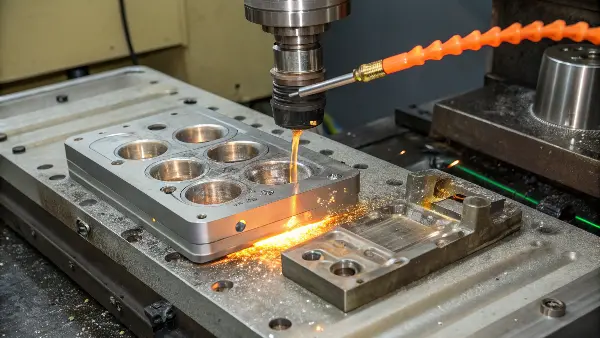
Plastic injection molding is a manufacturing process where molten plastic is injected under high pressure into a metal mold, or “cavity.” The plastic cools and solidifies, taking the shape of the mold. The mold then opens, and the finished part is ejected. This cycle repeats rapidly, allowing for the production of thousands or even millions of identical parts from a single mold. It is the most common method for mass-producing plastic components with high precision.
The Four Main Stages
The entire process can be simplified into four key stages that happen in a continuous loop.
This cycle, from clamping to ejection, can take anywhere from a few seconds to a couple of minutes, depending on the part’s size and complexity.
What are the biggest advantages of using injection molding?
You need to produce a large volume of parts, but you can’t afford for quality to drop or for the cost of each part to spiral out of control. Many manufacturing methods are either too slow for mass production or too inaccurate for complex designs. This puts you in a tough spot, forcing you to choose between speed, quality, and cost. It’s a common challenge I help my clients solve every day.
The biggest advantages are incredible efficiency and a very low cost-per-part at high volumes. Once the mold is made, you can produce thousands of parts quickly and with extreme consistency. This process also allows for highly complex and intricate part designs that would be impossible or too expensive with other methods. Furthermore, it offers a wide choice of materials and colors, giving you immense design freedom while ensuring high-quality surface finishes straight from the mold.
Why It’s a Go-To for Manufacturing
| Advantage | Business Impact |
|---|---|
| High Efficiency & Speed | Once the machine is set up, production is extremely fast. The automated process means you can produce a massive number of parts in a short amount of time, allowing you to meet tight deadlines and high demand. |
| Low Cost-Per-Part | While the initial investment in the mold can be high, the cost of each individual part becomes incredibly low as you increase production volume. This economy of scale is unmatched for mass production. |
| Design Complexity | Injection molding can handle extremely complex geometries, intricate details, and tight tolerances. You can create features like thin walls, ribs, and bosses directly into the part, reducing the need for secondary assembly operations. |
| Material & Color Flexibility | There is a massive library of thermoplastic polymers available, each with unique properties. You can choose materials based on strength, flexibility, temperature resistance, or cost. Pigments can also be added for a wide range of color options. |
| High Repeatability | The process produces parts that are virtually identical from the first to the millionth. This consistency is critical for quality control and for parts that need to fit together reliably in an assembly. |
When you combine these factors, you get a manufacturing process that is not only efficient but also incredibly versatile and reliable for businesses that need to scale.
What types of plastics can be used in injection molding?
You’ve designed a great product, but you’re not sure which plastic material will give it the right feel, strength, or durability. Choosing the wrong material can lead to product failure, customer complaints, and costly recalls. It’s a paralyzing decision when you’re faced with hundreds of options, each with technical specifications that are hard to decipher. You need clear guidance to match the right material to your application.
A vast range of thermoplastic polymers can be used in injection molding, making it incredibly versatile. Common materials include Polypropylene (PP) for its flexibility and chemical resistance, ABS for its toughness and impact strength, Polycarbonate (PC) for its high strength and transparency, and Nylon (PA) for its durability and heat resistance. The choice depends entirely on the part’s requirements, such as strength, flexibility, temperature exposure, and cost. This allows for precise material selection for any application.
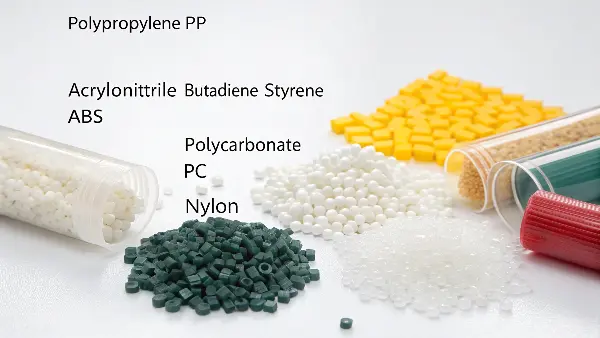
Choosing the right plastic is one of the most critical decisions you’ll make. It affects everything from the part’s performance to its final cost. I’ve worked on projects where a simple material switch completely transformed the product’s success. This isn’t an exhaustive list, but it covers the materials A common observation is used most often in my clients’ projects.
Common Materials and Their Applications
Understanding the trade-offs between different plastics is key. There’s no single “best” material; there’s only the best material for your specific needs.
| Material | Key Characteristics | Common Uses |
|---|---|---|
| Polypropylene (PP) | Flexible, excellent chemical resistance, lightweight, low cost. | Food containers, automotive parts, living hinges, packaging. |
| Acrylonitrile Butadiene Styrene (ABS) | Strong, rigid, good impact resistance, great surface finish. | LEGO bricks, keyboard caps, electronics housings, car interiors. |
| Polycarbonate (PC) | Very strong, high impact resistance, transparent (like glass). | Eyeglass lenses, safety goggles, CDs/DVDs, electronic device screens. |
| Nylon (Polyamide, PA) | High strength, excellent wear and chemical resistance, good temperature resistance. | Gears, bearings, zip ties, engine components, outdoor equipment. |
| Polyethylene (PE) | Lightweight, durable, excellent moisture resistance. High-density (HDPE) is rigid, while low-density (LDPE) is flexible. | Milk jugs (HDPE), plastic bags (LDPE), bottles, toys. |
| Polystyrene (PS) | Can be rigid and brittle (General Purpose PS) or tough (High Impact PS). Clear, low cost. | Disposable cups, cutlery, CD jewel cases, foam packaging (as EPS). |
When we work with a new client, we generally start by asking about the part’s function. Will it be exposed to sunlight? Does it need to bend? Will it hold heavy loads? The answers to these questions guide us to the suitable material choice.
Which industries rely most on plastic injection molding?
You may be wondering if injection molding is just for simple consumer goods or if it’s robust enough for your industry’s demanding standards. It’s hard to invest in a technology without seeing clear proof that it works for applications similar to yours. You need to be confident that the process can deliver the quality, durability, and precision your specific field requires, whether it’s medical, automotive, or something else.
Virtually every major manufacturing industry relies heavily on plastic injection molding. The automotive sector uses it for everything from interior panels and dashboards to bumpers and engine components. The medical industry depends on it for high-precision, sterile items like syringes, surgical tools, and implants. Consumer electronics wouldn’t exist without it, as it creates the housings for phones, laptops, and remote controls. It is also fundamental in packaging, aerospace, and consumer goods.
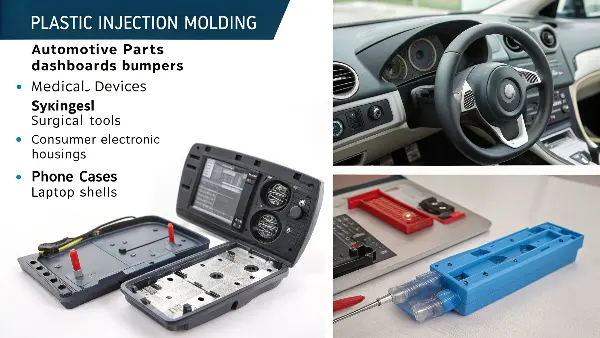
Key Industrial Applications
The requirements for a part in the medical field are vastly different from those for a toy, but injection molding serves them both reliably.
Automotive
The automotive industry is one of the largest users of injection molding. Cars are filled with plastic parts that need to be durable, lightweight, and precisely made.
- Interior: Dashboards, door panels, buttons, air vents, console components.
- Exterior: Bumpers, grilles, fender flares, light housings.
- Under the Hood: Engine covers, fluid reservoirs, wire housings.
The goal here is often weight reduction to improve fuel efficiency, as well as durability and aesthetics.
Medical
Precision and cleanliness are non-negotiable in the medical field. Injection molding can produce sterile, biocompatible parts with extremely tight tolerances.
- Devices: Syringe barrels, IV components, surgical instruments, inhalers.
- Equipment: Housings for diagnostic machines, lab test equipment.
- Implants: Some bio-compatible plastics are used for implants and prosthetics.
Consumer Electronics
This industry moves fast and requires high-volume production of parts with a suitable cosmetic finish.
- Housings: Casings for smartphones, laptops, TVs, game consoles, and remote controls.
- Components: Buttons, connectors, internal brackets, and light pipes.
The material needs to be strong enough to protect the delicate electronics inside while also looking and feeling good to the consumer.
Each of these industries leverages the core strengths of injection molding to meet its unique challenges, proving just how adaptable the process is.
How do you decide if injection molding is right for your project?
You have a product idea, but you’re at a crossroads. Should you use injection molding, 3D printing, or another method? Choosing the wrong path can lead to a budget blowout or a product that can’t be scaled effectively. You need a clear framework to analyze your project and make an informed, confident decision that aligns with your business goals, especially when it comes to volume and cost.
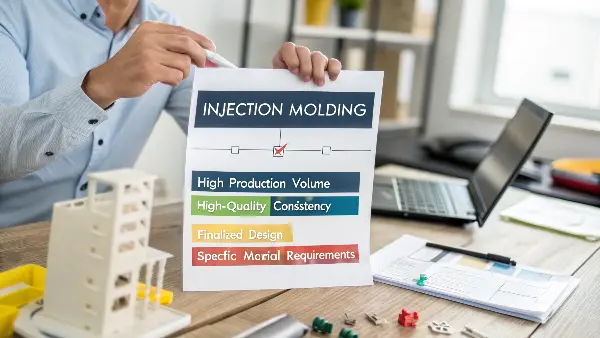
Decide on injection molding if your project requires high production volume (typically over 1,000 units) and you need high-quality, consistent parts. It is the right choice when your design is finalized, as mold changes are expensive. Consider your part’s complexity and material requirements; if you need specific performance plastics and intricate details at scale, injection molding is ideal. For low-volume prototyping or simple parts, other methods like 3D printing or machining might be more cost-effective initially.
I walk clients through this decision process all the time. It’s about weighing the trade-offs between upfront cost and long-term value. A high initial mold cost can be intimidating, but when you look at the total cost over a large production run, the story changes completely. To make it simple, I’ve created a checklist of questions you should ask yourself. Answering these honestly will point you in the right direction.
Key Questions to Ask Yourself
Think of this as a quick consultation. Your answers will help clarify whether the upfront investment in a mold makes financial and practical sense for you.
-
What is your total production volume?
- Low (1-500 parts): Injection molding is likely too expensive. Consider 3D printing or urethane casting.
- Medium (500-10,000 parts): This is a gray area. A simple, single-cavity aluminum mold might be cost-effective.
- High (10,000+ parts): Injection molding is almost certainly the most cost-effective method. The low price per part will quickly offset the mold cost.
-
Is your design finalized?
- The high cost of creating and modifying steel molds means you should be very confident in your design before committing. If you are still in the prototyping phase and expect changes, use 3D printing to iterate first.
-
How complex is your part?
- Injection molding excels at producing complex geometries. If your part has intricate features, undercuts, or thin walls, molding is a great option. For very simple, blocky shapes, CNC machining might be a viable alternative, even at higher volumes.
-
What are your material requirements?
- Do you need a specific engineering-grade plastic for strength, heat resistance, or chemical inertness? Injection molding offers the widest selection of thermoplastic materials, far more than most 3D printing technologies.
-
What is your timeline?
- Creating the mold (tooling) can take several weeks or even months. However, once the mold is ready, production is extremely fast. If you need parts tomorrow, 3D printing is faster. If you need 100,000 parts in two months, injection molding is your only realistic choice.
By evaluating your project against these five points, you can make a much more strategic decision.
Use Molds When the Design Is Mature
A production mold is an asset built around a specific parting line, gate, ejection and shrinkage plan. If the design, material or interfaces are still changing, prototypes or rapid tooling may reduce risk before durable steel is committed. Design maturity is as important as part count.
Match Volume to Tooling Economics
Injection molding can become economical as tooling cost is spread over accepted parts, but break-even depends on cavity count, material, cycle, labor, scrap and maintenance. Low-volume tools can still make sense when the part needs production resin, repeatability or a bridge to a larger program.
Use the Process for Feature-Rich Geometry
Ribs, bosses, clips, textures, thin walls, inserts and overmolded surfaces can be formed in one cycle when the mold supports them. Draft, undercuts, gates, vents, cooling and ejection should be reviewed before assuming a feature is free to add.
Know When Another Process Is Better
Machining, additive manufacturing, urethane casting, thermoforming or compression molding may fit a very low quantity, very large part, frequently changing design or unusual material better. Compare finished function, lead time, surface, tolerance and total cost—not only the process name.
Plan the Ownership and Change Path
A mold requires storage, preventive maintenance, spare inserts, inspection and change control. Clarify who owns it, who can modify it and how a material or design change is qualified. A process is a better fit when its future obligations are manageable as well as its launch price.
Where Plastic Injection Molds Make Sense—and Where They Do Not: Buyer Review Checklist
- Confirm design maturity, material, volume, variants, finish and tolerance.
- Model tooling, cycle, cavities, labor, scrap, maintenance and accepted-part economics.
- Use DFM to assess ribs, bosses, undercuts, gates, cooling and ejection.
- Compare machining, printing, casting or other processes for the actual requirement.
- Define tool ownership, maintenance, storage, modification and change qualification.
Frequently Asked Questions
Are injection molds only for high-volume parts?
No. Rapid, modular, aluminum or single-cavity tooling can support lower volumes when the part needs molded material, repeatability or a bridge to production.
What is the biggest reason not to cut a mold yet?
Unstable design or requirements. Late changes to geometry, material, appearance or interfaces can cost more than the initial tooling decision saved.
Conclusion
In the end, plastic injection molding is the undisputed champion for mass-producing high-quality plastic parts. It offers the suitable blend of speed, precision, and cost-effectiveness at scale. From the phone in your pocket to the car you drive, its impact is everywhere. Understanding why and where to use it is the first step toward leveraging this powerful technology to grow your business and bring your products to life successfully.