
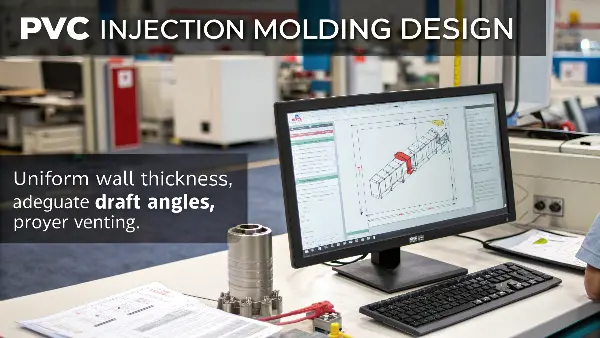
Designing parts for PVC injection molding can be a real headache. You might face issues like material degradation, inconsistent part quality, or even damage to your expensive molds if you don’t follow the specific rules for this material. These problems lead to costly rework and missed deadlines, making you feel like every step is a gamble. But what if you had a clear roadmap? Understanding PVC’s unique properties is the key to designing durable, high-quality parts every time.
PVC part design should protect the material’s thermal sensitivity while delivering the geometry, connection and appearance the product needs. Uniform walls, generous transitions, correct draft, accessible vents, safe shutoffs and a controlled gate plan reduce stress and variation. The right guideline is generally tied to the exact PVC compound, wall thickness, flow length and service requirement.
Related engineering resources: DFM analysis | mold design | production injection molding
Designing for PVC injection molding requires special attention to its thermal sensitivity and corrosive nature. Key guidelines include using corrosion-resistant mold materials like stainless steel, incorporating generous radii and draft angles to prevent stress, and ensuring proper venting to release corrosive gases. It’s also vital to maintain precise temperature control throughout the molding process. Adhering to these material-specific rules is absolutely crucial for achieving successful, repeatable production and extending the life of your tooling.
Getting the details right for PVC is just one piece of the puzzle. Before you even get to material-specific design, you have to ask a more fundamental question about the manufacturing process itself. Many projects run into trouble because this critical first step is overlooked. This initial decision-making process is where many projects either set themselves up for success or lock themselves into a path of costly revisions.
Is Injection Molding the Right Choice for Your Part?
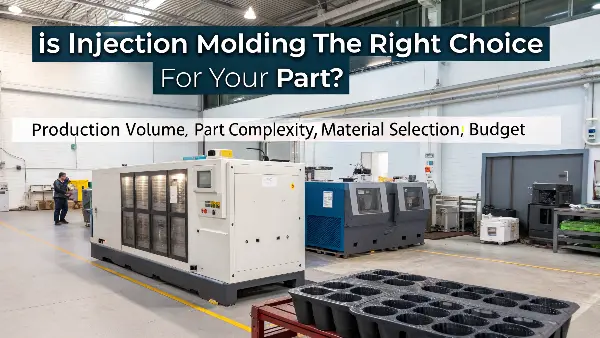
You have a new part to produce, but you’re not sure if injection molding is the best manufacturing method. Choosing the wrong process can lead to sky-high costs for low-volume runs or design limitations you didn’t anticipate, wasting both time and money. Evaluating factors like production volume, part complexity, and material requirements upfront will help you confidently decide if injection molding truly meets your project’s needs and budget.
To decide if injection molding is right for your part, consider four key factors: production volume, part complexity, material selection, and budget. Injection molding is ideal for high-volume production, typically in the thousands to millions of parts, where the high initial cost of the mold is offset by a very low per-part cost. It excels at producing complex, detailed geometries that are difficult or impossible with other methods. If your part requires a specific thermoplastic, like PVC, and you have the upfront capital, injection molding is likely your best choice.
Evaluating Your Production Volume
This is the most critical question. Injection molds are complex tools that can cost anywhere from a few thousand to over a hundred thousand dollars. If you only need 100 parts, that cost is prohibitive. But if you need 100,000 parts, the cost of the mold, when spread across all those units, becomes negligible. As a rule of thumb, if your production run is over 10,000 units, injection molding becomes highly cost-effective. For smaller runs or prototypes, other methods like 3D printing or CNC machining might be a better fit.
Assessing Part Complexity
Injection molding shines when it comes to creating complex shapes. Features like intricate ribs, bosses, and snaps can be integrated directly into the mold, producing consistent parts with tight tolerances cycle after cycle. Other processes struggle to replicate this complexity and consistency at scale. However, features like undercuts or threads add complexity and cost to the mold itself, requiring side-actions or lifters. You must balance the design complexity with your tooling budget.
Comparing Manufacturing Method Costs
| Feature | Injection Molding | CNC Machining | 3D Printing |
|---|---|---|---|
| Initial Cost | High (mold tooling) | Low (no tooling) | Very Low (no tooling) |
| Per-Part Cost | Very Low | High | Medium to High |
| Best Volume | 10,000+ Units | 1 – 1,000 Units | 1 – 100 Units |
| Complexity | Excellent | Good | Good |
| Lead Time | Long (tooling) | Short | Very Short |
How Do You Choose the Right Material for Injection Molding?
You’ve decided on injection molding, but now you face a sea of plastic options. Choosing the wrong material can lead to part failure, whether it’s cracking under stress, warping from heat, or degrading when exposed to chemicals. This uncertainty can be paralyzing and lead to costly testing or, worse, a product recall. The key is to systematically match the material’s properties to the specific demands of your part’s application and environment.
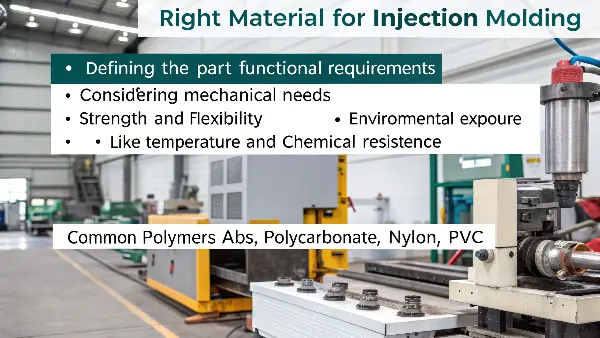
To choose the right injection molding material, start by defining the part’s functional requirements. Consider its mechanical needs (strength, flexibility), environmental exposure (temperature, UV light, chemicals), and regulatory requirements (e.g., food-grade, medical-grade). Then, compare these needs against the properties of common polymers like ABS, Polycarbonate, Nylon, or specialized materials like PVC. Consulting a material datasheet and working with an experienced molder can help you select the most cost-effective material that meets all performance criteria.
Defining Your Application’s Needs
Before you even look at a material datasheet, write down everything your part needs to do and endure. This is your checklist.
- Mechanical Properties: Does it need to be strong and rigid like Polycarbonate, or flexible like TPE? Will it face impact or constant stress?
- Thermal Properties: What is the maximum and minimum temperature it will operate in? Materials like PVC have a relatively low heat resistance compared to something like PEEK.
- Chemical Resistance: Will the part come into contact with oils, acids, or cleaning solvents? PVC is known for its excellent resistance to many chemicals, which is why it’s used so often in pipes and containers.
- Aesthetics and Finish: Do you need a high-gloss finish, a specific color, or transparency? These requirements can narrow down your choices significantly.
Focusing on PVC’s Strengths and Weaknesses
PVC is a fantastic choice for many applications due to its unique blend of properties.
Strengths of PVC:
- Low Cost: It’s one of the most affordable polymers.
- Excellent Chemical Resistance: Stands up well to acids, salts, bases, and fats.
- Durability and Abrasion Resistance: It’s tough and holds up well to wear and tear.
- Electrical Insulation: It does not conduct electricity, making it great for wire coatings and electrical boxes.
Weaknesses of PVC:
- Thermal Sensitivity: It can begin to degrade at relatively low molding temperatures if not controlled precisely. This process releases hydrochloric acid, which is corrosive to molds.
- Poor UV Resistance (unstabilized): Standard PVC can become brittle and change color with prolonged sun exposure unless UV stabilizers are added.
- Lower Temperature Limit: It is not suitable for high-temperature applications.
Choosing the right material is a balancing act between performance and cost. By clearly defining your needs first, you can navigate the options and make a smart, informed decision.
What are the Key Parameters for a Successful Mold Design?
Your part design is finalized, and you’ve chosen your material. Now, you need a mold. But a poorly designed mold can cause a host of problems, from cosmetic defects like sink marks to critical failures like weak weld lines. These issues force you into a frustrating cycle of mold adjustments and part testing, delaying your launch and driving up costs. A successful project depends on getting the fundamental mold design parameters right from the very beginning.
The key parameters for successful injection mold design are draft, wall thickness, gate location, and venting. A proper draft angle (typically 1-2 degrees) is essential for easy part ejection. Uniform wall thickness prevents sink marks and warping. Strategic gate location controls how plastic fills the cavity, affecting part strength and appearance. Finally, adequate venting allows trapped air and gases to escape, preventing short shots and burn marks. Mastering these four elements is foundational to creating a reliable and efficient mold.
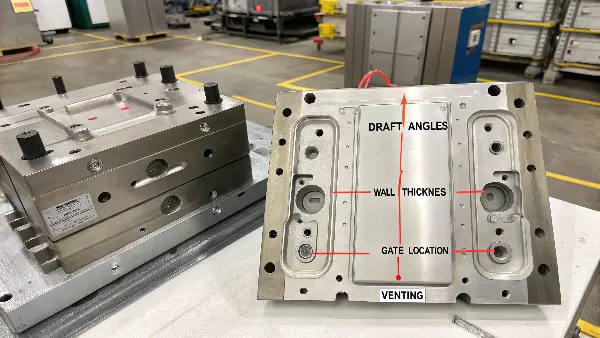
The Importance of Draft and Wall Thickness
These two parameters are closely related and are critical for part quality.
- Draft Angle: This is a slight taper applied to the vertical walls of the part. Without it, the part would scrape against the mold surface during ejection, causing drag marks and potentially damaging both the part and the mold. Even a small draft of 1 degree can make a world of difference. For textured surfaces, you’ll need even more.
- Uniform Wall Thickness: Plastic shrinks as it cools. If one section of your part is much thicker than another, the thick section will cool slower and shrink more, pulling on the thinner section and causing warping or ugly depressions called sink marks. The goal is to design walls that are as uniform in thickness as possible. If you must have variations, make the transition gradual.
Strategic Gate and Venting Design
How the plastic enters and how the air leaves are just as important.
- Gate Location: The gate is the opening where molten plastic enters the mold cavity. Its location determines the flow path of the plastic, which affects the strength and look of the final part. Placing a gate in a highly visible area can leave a blemish. Placing it in a way that creates weak weld lines can compromise the part’s structural integrity. For a material like PVC, you want a gate that allows for a smooth, unrestricted flow to prevent overheating.
- Venting: As plastic fills the mold, it displaces the air inside. That air needs a place to escape. Vents are tiny channels (usually only 0.01-0.03 mm deep) cut into the mold’s parting line that are big enough for air to get out but too small for the plastic to flash into. For PVC, venting is even more critical because the material itself can release gases during processing. Insufficient venting traps these gases, causing incomplete parts and burn marks.
What Are the Golden Rules for PVC Injection Molding Design?
You’re specifically working with PVC and want to avoid the common pitfalls associated with this tricky material. General design rules are helpful, but PVC has its own unique personality. If you treat it like any other plastic, you risk degrading the material, corroding your mold, and producing brittle, unreliable parts. Following a few “golden rules” specific to PVC can save you from these costly and frustrating outcomes.
The golden rules for PVC injection molding design center on managing its heat sensitivity and corrosive nature. First, use corrosion-resistant steel for your mold, like stainless steel. Second, design parts with generous radii and smooth transitions to avoid sharp corners that trap material and cause burning. Third, ensure uniform wall thickness to promote even cooling. Finally, incorporate adequate draft and proper venting to facilitate part ejection and allow corrosive gases to escape safely.
Rule 1: Use Corrosion-Resistant Mold Materials
This is the number one rule. When PVC is heated to its melting point, it can start to thermally degrade, releasing hydrochloric acid gas. This gas is highly corrosive to most standard tool steels like P20. Over time, it will etch and pit the surface of your mold, ruining the part finish and eventually the mold itself.
- Recommended Materials: For molds running PVC, you should generally opt for stainless steel grades like S136 or similar corrosion-resistant alloys.
- Plating as an Alternative: In some cases, applying a protective coating like nickel or chrome plating to a standard steel mold can work, but it’s a less durable solution than using a solid-stainless tool. A single scratch in the plating can expose the steel underneath to corrosion.
Rule 2: Design for Smooth Material Flow
PVC does not like to be restricted or forced through sharp corners when it’s molten. Abrupt changes in flow direction can cause excessive shear heat, leading to material degradation right inside the mold.
- Generous Radii: Avoid sharp internal corners. Generally design with the largest possible radius where walls meet. A good rule of thumb is to have an internal radius of at least 0.5 times the wall thickness.
- Gradual Transitions: When changing wall thickness, use smooth, gradual transitions or tapers instead of abrupt steps. This keeps the flow front even and reduces stress in the final part.
Rule 3: Prioritize Venting and Temperature Control
Managing gas and heat is paramount for PVC.
- Aggressive Venting: As mentioned earlier, you need robust venting to let both air and the off-gasses from the PVC escape. Place vents at the end of the flow path and anywhere air could be trapped.
- Precise Temperature Control: The processing window for PVC is narrow. The mold temperature needs to be controlled precisely and uniformly. Use dedicated heating/cooling channels in the mold and monitor temperatures closely to prevent overheating, which accelerates degradation, or under-heating, which results in poor flow.
Use Uniform Walls and Generous Radii
Avoid abrupt thickness changes, heavy bosses and sharp internal corners that concentrate stress or create uneven cooling. Core out thick sections and blend transitions. A more uniform section generally gives the process a wider window and reduces sink, distortion and thermal history variation.
Set Draft for the Surface and Ejection Method
Texture, long cores, holes and flexible features can increase release force. Provide draft that works with the chosen finish, draw direction and ejection layout. Do not hide a difficult undercut in the design without considering slides, lifters, wear and PVC residue.
Place Gates and Vents Around Function
Gate the part so weld lines, vestige and flow stress stay away from seals, threads and highly loaded regions. Vent end-of-fill areas and shutoff boundaries. If a flow front must cross a critical feature, analyze the risk instead of hoping pack pressure will remove it.
Design Threads, Inserts and Fasteners for PVC
Molded threads and bosses need adequate root radius, wall support and installation torque limits. Metal inserts can create thermal mismatch and local stress. Keep insert locations stable, protect shutoffs and validate installation after thermal or chemical conditioning.
Make the Tool Maintainable
Provide replaceable wear areas, accessible vents, cleanable gates and a clear texture or polish standard. PVC residue and degradation products make dead spots and difficult cleaning more costly. A maintainable tool protects both quality and operator safety over its service life.
PVC Injection-Molded Part Design Guidelines: Buyer Review Checklist
- Maintain wall uniformity, core heavy sections and blend stress transitions.
- Set draft from texture, draw direction, undercuts and ejection force.
- Keep gates and weld lines away from seals, threads and loaded features.
- Vent end-of-fill areas and design inserts or fasteners with thermal mismatch in mind.
- Provide cleanable, replaceable and inspectable mold features.
Frequently Asked Questions
Can PVC parts use the same wall rules as other thermoplastics?
Use general DFM principles as a starting point, but validate wall, flow, thermal exposure and stress for the exact PVC compound and tool.
Why should PVC mold design include cleaning access?
PVC can leave residue or degradation products in gates, vents and dead zones. Access and replaceable features reduce quality drift and maintenance risk.
Conclusion
From deciding if injection molding is the right process to mastering the specific design rules for a material like PVC, every step matters. A successful part comes from a holistic approach—considering production volume, part complexity, and material properties together. By following these guidelines, you can avoid common pitfalls, create efficient and reliable molds, and manufacture high-quality parts that meet your exact specifications and budget.