

Injection molding is among the most used techniques for the manufacturing of plastic parts with great precision, durability, and at a low cost. In achieving consistent quality and efficiency in this process, a number of critical factors have to be carefully observed. Every parameter in material selection to mold design, from temperature control to injection pressure, has an important role in the success of the final product.
The injection molding process is governed by the interaction of material, machine, mold, method and measurement. A stable result does not come from one suitable pressure or temperature setting; it comes from controlling the complete chain from resin preparation and product design through filling, packing, cooling, ejection and inspection. Prioritizing the right variables helps engineers solve defects at the source rather than compensate for them at the machine.
Related CKMOLD resources: DFM analysis, mold design, production injection molding.
Understanding what is important to the injection molding process helps manufacturers optimize production cycles, reduce defects, and improve overall product performance. By focusing on key elements such as machine settings, tooling accuracy, cooling systems, and raw material properties, companies can ensure that every molded part meets exact specifications while maintaining cost efficiency and reliability.
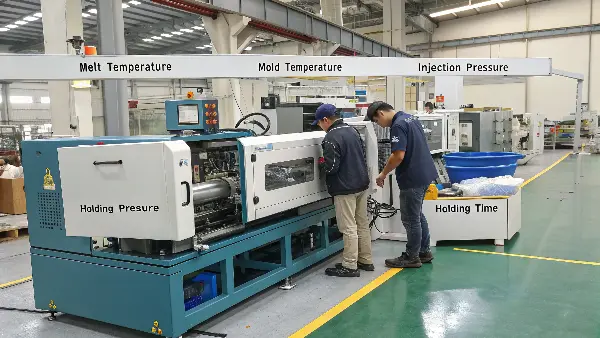
The most critical parameters that are considered during injection molding include melt temperature, mold temperature, injection pressure, holding pressure, and holding time. These parameters directly affect the quality, strength, and appearance of the molded parts. By controlling these variables, you can reduce defects, improve efficiency, and ensure that every product meets your standards.
When I talk to other designers and engineers, I often hear the same questions: What makes injection molding so useful? What are the key parameters? How do you control them? In this article, I’ll break down the essentials, share my own experiences, and help you understand how to master the injection molding process.
What is Injection Moulding process?
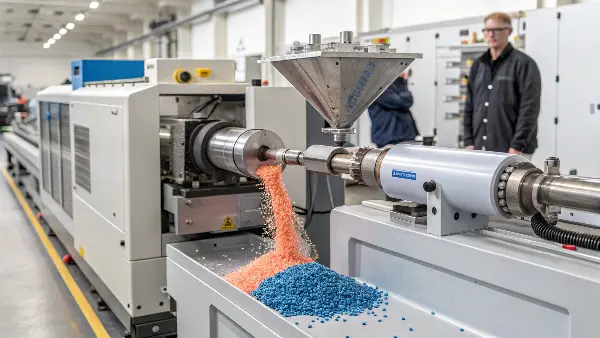
Injection moulding process is a very effective production process that is utilized in creating parts through injecting molten material into a moulding cavity. It is applied most often in manufacturing plastic components, although it can also be utilized in metals, glass and elastomers. It is done by melting plastic balls and pushing the molten substance under pressure into a specially shaped mould, which subsequently cools and hardens to achieve the finished shape.
The technique is common in automotive, medical, packaging, and consumer electronics industries since it provides a means to manufacture complex and high-quality components in large volumes with very high repeatability and low material wasteage. These will consist of among others, thermoplastics such as polypropylene (PP), polyethylene (PE), acrylonitrile butadiene styrene (ABS) and nylon (PA).
The benefits of injection moulding are as follows:
- Large volume production is highly efficient.
- Regular quality of products and size.
- Ability to generate complicated and intricate geometries.
- Small unit cost after the mould is formed.
History of Injection Moulding.
Injection moulding can be traced to the late 19th century. In 1872, John Wesley Hyatt and his brother Isaiah Hyatt, American inventors, came up with the first injection moulding machine to cut celluloid, one of the earliest plastics. It was pretty straightforward in their invention; a plunger system was used to inject a heated material into a mould.
In the 1930s and 1940s, it came to the next level with the introduction of new synthetic polymers like polystyrene and nylon. In 1946, James Watson Hendry introduced the screw-type injection machine which made the industry revolutionized, with better control of the material flow, mixing, and consistency, and the design is the basic structure of the modern injection moulding machine.
Furthermore, the advancement of technology in the second half of the 20th century, in the form of computerized process control, multi-cavity moulds, and the use of automation systems, increased the speed and precision of production. In the modern times, with the introduction of CNC machining, robotics, and software simulation, injection moulding is currently one of the best developing and necessary manufacturing procedures in the world.
Sustainable materials, efficient energy usage machines and fast prototyping systems such as 3D printing of moulds design make modern injection moulding keep on improving and remain one of the main sources of industrial manufacturing in contemporary manufacturing.
What makes injection molding such a useful process?
I is unlikely to forget the first time I witnessed an injection molding machine in action. The speed, precision, and repeatability were impressive, but what most caught my attention was how this process could take raw plastic and transform it into complex, quality parts in just seconds. That’s where the real power of injection molding lies.
Injection molding is a viable process because it allows high-volume production of complex parts with consistent quality and tight tolerances. It is cost-effective for large runs, supports a wide range of materials, and enables the creation of detailed shapes that would be difficult or impossible with other methods.
Why is injection molding so widely used?
Injection molding stands out because it combines speed, precision, and flexibility. Here’s a breakdown of why it’s so valuable:
| Feature | Benefit |
|---|---|
| High Production Speed | Makes thousands of parts quickly, reducing lead times |
| Consistent Quality | Produces identical parts, batch after batch |
| Complex Geometry | Allows for intricate designs and fine details |
| Material Variety | Supports many plastics, including reinforced and colored |
| Low Waste | Efficient use of material, with minimal scrap |
| Cost Efficiency | Lowers per-part cost for large production runs |
The common types of mold tooling
In injection moulding, the tooling can be described as the special equipment used to inject the molten materials into the final products. The kind of mould to be used is determined by the quantity of production, complexity in part design, type of material, and budget. All the mould tooling are of different structure, functionality, and benefits. The most widespread ones are listed below:
Single-Cavity Mold
A single-cavity mold makes one part at a time of injection. It is suitable in the low volume production, prototyping, or when accuracy is high. These are less complicated molds, easy to maintain and cheaper to make. They serve to design medical parts and custom parts, as well as to test prior to full scale manufacturing.
Advantages:
Lower tooling cost
Less difficult to maintain and clean.
Great accuracy and uniformity.
Limitations:
Slower production rate
Unsuitable for large scale production.
Multi-Cavity Mold
Multi-cavity mold It is a mold that manufactures several parts at once. As an example, a 4-cavity mold can produce four parts at a time, every time it gets injected. This design is more productive and the unit cost is lower compared to that of the high volume production and thus this design is suitable.
Advantages:
Higher output per cycle
Lower price of production per component.
Effective utilization of machine time.
Limitations:
Higher initial tooling cost
Sophisticated design and servicing.
Family Mold
The shape of the cavities in a family mold is varied, and it is possible to cast several various parts in a single injection. This is useful in making product assemblies in which different parts are required to be made in the same color and material.
Advantages:
Manufactures various elements at the same time.
Inexpensive assemblies of small products.
Saves production time
Limitations:
Demands equal flow in order to achieve even filling.
Ideally not when the parts are not similar in size or geometry.
Two-Plate Mold
The most commonly used and the simplest injection moulding design is the two plate mold. It comprises a fixed half (those fixed to the machine) and a moving half (which opens to throw off the part). The parting line is the point of location of the gate and when the mold is opened the part and the runner are ejected simultaneously.
Advantages:
Very simple and simple to maintain.
Inexpensive to a wide range of designs.
Applicable in single and multiple cavity molds.
Limitations:
Noticed connected door marks on the part.
Little control over location of gating.
Three-Plate Mold
This kind has an extra plate that enables them to have more flexibility in the gating like putting the gate at the center of the part. As the mold is opened the runner and the part automatically separate, minimizing the amount of manual work.
Advantages:
More suitable positioning of gates.
Finished parts whose marks of the gate are hidden.
Auto-separation of components and parts.
Limitations:
More difficult and costly to construct.
Requires more maintenance
Hot Runner Mold
In a hot runner mold, the molten plastic remains hot in the system of runners with the help of the heated manifolds and nozzles, therefore, there is no solidified runner to dispose of. Such a design reduces wastes and enhances cycle time.
Advantages:
No scrap of material waste by runners.
Quickened cycle times and enhanced efficiency.
Stable part quality and color.
Limitations:
Increased cost of tooling and maintenance.
Complicated temperature regulation was necessary.
Cold Runner Mold
A cold runner mold incorporates a channel that is cut into the plates of the mold intended to transfer molten plastic to the cavities. Following every shot, the part is solidified with the help of the runner, which has to be removed or recycled.
Advantages:
Easier construction and reduced construction cost.
Appropriate in materials of thermoset.
Easy to maintain and operate
Limitations:
Material waste from runners
Longer cycle time
Insert Mold
The first one is insert molding, whereby a metal or pre-made insert (such as a threaded part) is inserted in the mold, and the plastic is injected around it. It is usually applied on the components that require mechanical strength or electrical conductivity.
Advantages:
Fuses metal and plastic in a single piece.
Enhances the strength and toughness of products.
Reduces assembly time
Limitations:
More setup time per cycle
Needs to be careful of the placement of the inserts.
Overmold
An overmold can be used where one material is molded on top of another, e.g. soft rubber on hard plastic. The method adds beauty, comfort and functionality-typically in grips, handles and electronic cases.
Advantages
Enhances handling, touch and operation.
Offers a two-tone or a multi-material finish.
Increases shock absorption and sealing.
Limitations
Complex process and tooling
Increased cost and longer cycle time.
All these types of mold tooling have a purpose and the selection of the appropriate one will depend on the design of the part, material to be used, volume of production and the expectations of the performance. In the contemporary injection moulding, engineers tend to apply the CAD simulation and the mold flow analysis to identify the ideal tooling that would give the most efficient and quality output.
What are the key parameters of injection molding?
The key injection molding parameters include melt temperature, mold temperature, injection pressure, holding pressure, and holding time. Each must be carefully controlled to ensure the plastic flows, fills the mold, and cools properly to produce strong, accurate parts.

How do these parameters affect the final product?
| Parameter | Description | Effect on Product Quality |
|---|---|---|
| Melt Temperature | Temperature of the plastic as it enters the mold | Too high: burns, flash; too low: short shots, poor flow |
| Mold Temperature | Temperature of the mold itself | Too high: long cooling, warping; too low: poor surface finish, incomplete fill |
| Injection Pressure | Force pushing plastic into the mold | Too high: flash, mold damage; too low: incomplete fill |
| Holding Pressure | Pressure maintained after filling to pack the part | Too high: stress, flash; too low: sink marks, voids |
| Holding Time | Duration of holding pressure | Too long: cycle time increases; too short: incomplete packing |
I learned that even small changes in these settings can have a big impact. For example, increasing the mold temperature helped us eliminate weld lines on a transparent part. Adjusting holding pressure reduced sink marks on a thick section. It’s all about finding the right balance for each part and material.
What are the four primary elements that influence the injection molding process?
When I troubleshoot molding problems, I generally look at the four main elements that influence the process. These are the foundation of good molding practice.
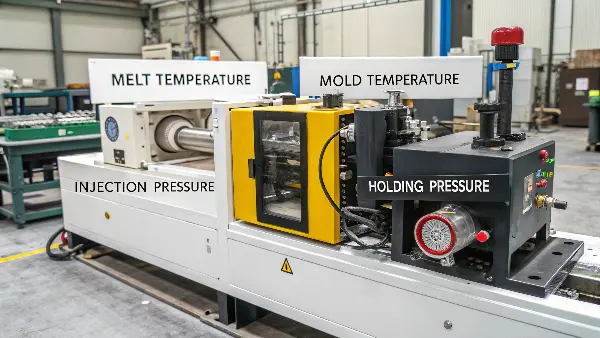
The basic variables involved with injection molding include temperature of melt, mold temperature, injection pressure, and holding pressure. It is these factors that will determine how the plastic will flow, fill the mold, and then solidify, thus determining directly the quality and consistency of the final product.
How do these four elements interact?
These elements don’t work in isolation. They interact in complex ways:
| Element | Role in Process | Interaction with Other Elements |
|---|---|---|
| Melt Temperature | Controls flow and fill | Affects pressure needed, cooling rate |
| Mold Temperature | Influences cooling and surface finish | Impacts holding pressure and time |
| Injection Pressure | Drives material into mold | Depends on melt temp and mold temp |
| Holding Pressure | Packs material, prevents shrinkage | Linked to holding time and mold temp |
For example, if the melt temperature is too low, you might need to increase injection pressure to fill the mold. But that can cause flash or stress in the part. If the mold temperature is too high, the part may warp or take longer to cool. Balancing these elements is key to getting the best results.
What are the requirements for injection molding?
My approach to the design of a new mold is by first considering what that mold needs to meet the requirements for successful injection molding, since accomplishing that will help ensure high-quality parts and an efficient operation.
Precise control of process parameters, proper mold design, suitable material selection, and regular maintenance of equipment are the major requirements for injection molding. This will pave the way for a smooth process, and the parts will meet specifications while defects are at a minimum.

What do you need for a successful injection molding process?
Here’s what I focus on:
| Requirement | Why It Matters | How to Achieve It |
|---|---|---|
| Process Control | Ensures consistency and quality | Use reliable machines, monitor parameters |
| Mold Design | Affects part quality and cycle time | Design for manufacturability, good cooling |
| Material Selection | Impacts strength, appearance, and cost | Choose based on part needs, test samples |
| Equipment Maintenance | Prevents downtime and defects | Regular cleaning, inspection, calibration |
Material Condition and Grade
Resin grade, moisture, lot, color, filler, regrind and residence time affect viscosity, shrinkage, appearance and strength. Drying and storage should be controlled with the grade’s requirements. A process window built on the wrong material condition is not a real process window.
Part and Mold Design
Wall thickness, flow length, draft, ribs, bosses, gates, runners, vents, cooling, ejection, slides and steel condition determine what the machine can achieve. DFM should identify risks before steel is finished, because a machine adjustment cannot fully correct an impractical flow or release design.
Machine and Process Capability
Shot size, pressure reserve, injection response, check-ring behavior, clamp force, temperature control and screw recovery must match the mold and resin. A stable process uses a validated speed, pressure, transfer, hold, cooling and cushion range rather than a single nominal setting.
Cooling, Ejection and Handling
Cooling controls shrinkage and dimensional stability, while ejection and handling can distort a warm part. Mold temperature, channel balance, draft, support, robot timing and inspection conditioning should be treated as quality variables.
Measurement and Corrective Action
Measure part weight, critical dimensions, appearance, fill time, pressure, cushion, temperature, cycle and cavity variation. Use controlled changes and a root-cause record. Without measurement, operators may chase normal variation and create a less stable process.
What Matters Most in the Injection Molding Process? A Quality Framework: Buyer Review Checklist
- Control resin grade, drying, lot, color, filler, regrind and residence time.
- Review wall, flow, gate, runner, vent, cooling, draft and ejection before tooling.
- Match machine shot, pressure, clamp, temperature and response capability to the tool.
- Validate cooling, ejection, warm-part handling and inspection conditioning.
- Trend weight, dimensions, appearance and process signals with defined corrective actions.
FAQ
What is the single most important setting in injection molding?
There is no universal single setting. Quality depends on the complete material, mold, machine and process window, supported by measurement.
Why do defects return after a process adjustment?
If the root cause is geometry, material condition, venting, cooling or wear, a temporary setting change may only move the defect or reduce process margin.
Conclusion
Successful injection molding can be obtained by understanding and controlling a few key parameters: melt temperature, mold temperature, injection pressure, holding pressure, and holding time. With these elements, added to good mold design and good process control, you can produce consistent and quality parts while being able to solve most common molding issues.