

Weld line is not a mere cosmetic issue, but it may be a fatal fault and jeopardize the integrity of the entire product. To the business owners, such as you, this one flaw can cause part failures, customer complains, and expensive recalls which make what seemed like an excellent production cycle a huge financial burden.
A weld line forms when two polymer flow fronts meet after traveling around an opening, insert, core feature or split gate path. The local interface can have different orientation, temperature, gas condition and molecular contact from the surrounding material. A visible weld line may be acceptable on a noncritical surface, but in a loaded, sealed, transparent or cosmetic area it can affect appearance, strength, fatigue or leakage.
Related CKMOLD resources: mold design, DFM analysis, mold testing and validation.
Knit lines or weld lines are formed when two or more streams of molten plastic are present in the mold cavity. These separate melt fronts may fail to fuse together as they cool and solidify each other at their intersection. Such an incomplete fusion results in a visible line which tends to be weaker than the rest of the material. The predominant reasons are the design characteristics of the mold such as holes or inserts which divide the flow, the wrong processing parameters, and the wrong choice of the materials.
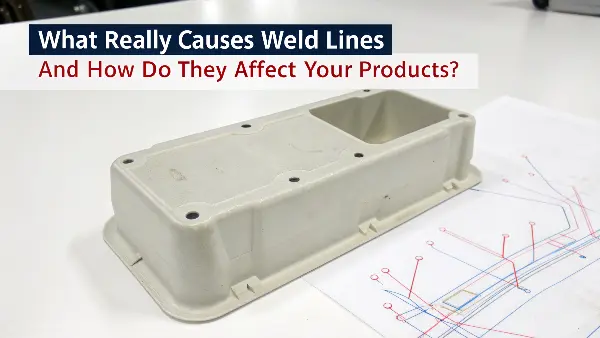
What Exactly is a Weld Line in Injection Molding?
It is irritating to look at a fault on your product and not even know its name or cause. The visible line is an ordinary injection molding flaw known as a weld line. You may fear that it is an indicator of a much greater issue in your tooling or process. This insecurity may render trouble shooting with your supplier a hard task and you will be left with parts that are not up to your quality standard.
A line, notch or color change on the surface of a molded part is a weld line, which indicates that two distinct melt fronts have come together and they have not successfully merged completely. It occurs in the case when the plastic flow is divided by an obstacle, such as a core pin in a hole, and recombines on the opposite side. Another similar defect is a meld line, where two fronts collide and flow sideways to each other, which is typically more powerful than a weld line.
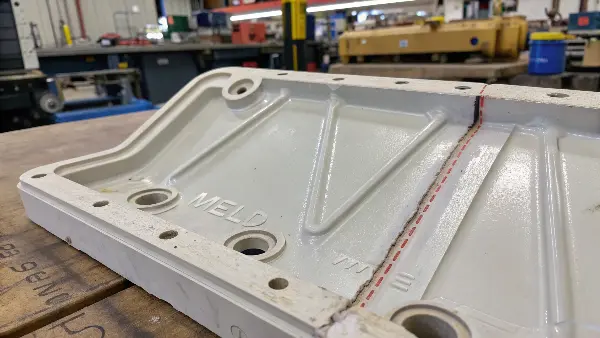
Weld Lines vs. Meld Lines
The one confusion that is likely to occur is between a weld line and a meld line. There is a significant difference between them yet they are connected. When two melting fronts come into direct collusion with each other a weld line is formed. Suppose that two waves crashed together. Their meeting angle is very sharp less than 135 degrees. This direct confrontation does not allow the chains of the polymer to entangle and this is a major weak point.
A meld line on the other hand is created by the meeting of two melt fronts and moving side by side in the same direction. The angle of meeting is considerably softer and is usually more than 135 degrees. Due to the joining and flowing together of the fronts over a distance, the polymer chains stand a higher probability of mixing and bonding. This leaves a stronger joint to a weld line, although it can still be seen.
| Feature | Weld Line | Meld Line |
|---|---|---|
| Meeting Angle | < 135 degrees (Head-on) | > 135 degrees (Parallel) |
| Material Bonding | Poor molecular entanglement | Better molecular entanglement |
| Structural Strength | Significantly weaker | Relatively stronger |
| Common Cause | Flow splitting around a hole | Flowing around a long feature |
Understanding this difference is critical for troubleshooting. If you see a line, identifying how the melt fronts are meeting tells you if you’re dealing with a major structural risk (weld line) or a less severe one (meld line).
Effects of Injection Molding Weld Line on Product’s Quality and Performance
Weld lines may appear to be little more than cosmetic surface blemishes, but they can have a major impact on how a plastic part will function when used in the real world. This is one of the reasons when molten plastic flows around a core, hole or insert and then meets with itself again, it doesn’t fully fuse together.
This forms a weak point in the part, and can cause reduced mechanical strength and impact resistance with greater likelihood of cracking under stress. Weld lines also can generate visible defects on the surfaces of consumer parts, detracting from perceived quality and requiring post finishing operations.
How Do Different Factors Cause Weld Lines to Form?
You know that weld lines come from splitting melt fronts, but why are they so prominent on some parts and almost invisible on others? You might tweak your machine settings, yet the problem persists, leading to wasted time and materials. This trial-and-error approach is inefficient and costly. The root cause is often a combination of factors, and without understanding them, you’re just guessing in the dark, which is no way to run a manufacturing operation.
Weld lines are primarily caused by three interconnected factors: mold design, processing parameters, and material properties. Part geometry with holes or obstructions forces the melt front to split. Low melt temperature, slow injection speed, or low packing pressure prevent the fronts from fusing properly upon meeting. Finally, the viscosity of the plastic and the presence of fillers can hinder the polymer chains from entangling effectively at the seam, weakening the bond.
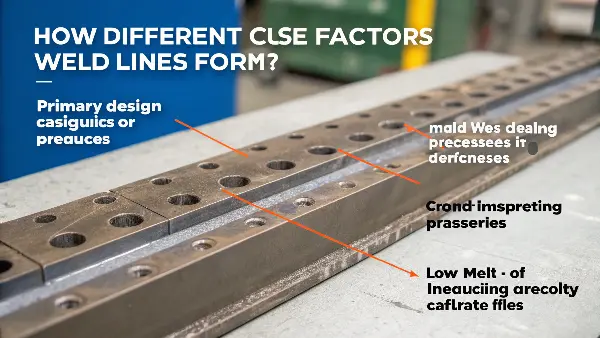
Isolating the exact cause requires a systematic look at your entire process, from the CAD file to the material you’re using. I’ve found that it’s rarely just one thing. More often, it’s a mix of design and process that needs fine-tuning.
Breaking Down the Core Causes
To effectively combat weld lines, you need to understand the interplay between design, processing, and materials. Each one plays a critical role in how those melt fronts behave inside the mold.
Mold and Part Design
The journey to a consistent part begins with design. This is where most weld lines are born.
- Gate Location: The position of the gate determines the entire flow path of the plastic. Placing a gate where the flow will immediately hit an obstacle is a sure way to create a prominent weld line. I generally advise placing gates to ensure a single, uninterrupted flow path for as long as possible.
- Obstructions: Features like holes, pins, ribs, and bosses are necessary but are natural obstacles. The melt must split to go around them. The further the melt has to travel after splitting, the cooler it gets, and the weaker the resulting weld line will be.
- Wall Thickness: Inconsistent wall thickness creates variations in flow speed and cooling rates. Thicker sections fill slower and cool slower, while thinner sections do the opposite. When fronts from these different sections meet, their temperature mismatch can lead to a very poor weld. Uniform wall thickness is one of the pillars of good part design.
Processing Parameters
Even a suitable mold design can produce weld lines if the machine settings aren’t right.
- Melt & Mold Temperature: This is the most critical parameter. Higher temperatures keep the plastic molten for longer, giving the melt fronts more time to fuse and entangle. If the temperature is too low, the fronts will be semi-solid by the time they meet.
- Injection Speed & Pressure: Faster injection speeds generate more frictional heat, helping to keep the melt hot. Higher packing pressure helps push the melt fronts together more forcefully, improving the bond. However, going too fast can also cause other issues like jetting or gas traps.
Material Properties
The plastic resin itself has a say in weld line formation.
- Viscosity: Low-viscosity (runny) materials flow more easily and retain heat better, leading to stronger welds. High-viscosity materials are sluggish and cool faster.
- Fillers and Reinforcements: Adding fibers like glass or carbon can dramatically reduce weld line strength. The fibers tend to align with the flow direction. When two fronts meet, the fibers don’t cross the seam, creating a resin-rich area with very little reinforcement. This is a major reason why weld lines are so dangerous in reinforced plastics.
Why Should You Be Concerned About a Weld Line’s Structural Impact?
One can easily put the weld line aside as a cosmetic problem, a fine line that will not be perceived by majority users of the products. However, what happens when that component is a load bearing one or a housing that is safety critical? Disregarding the effect of a weld line on its structure is a gamble. A component that appears good may fail in the process of stressing and you will have to take the part back, your brand name may suffer and as well as liability.
This is something to be concerned about since a weld line is the most vulnerable part of a plastic part. It has tensile and impact strengths that are up to 20-60 percent of the base material. The reason is that the polymer chains through the weld are not completely entangled or bonded. In components that are stressed, vibrating, or impacted, the weld line serves as an inherent crack in a component. This form of structural tradeoff may result in early and disastrous breakdown of the product in operation.

I’ve personally seen projects where a simple bracket failed in the field because a weld line was located in a high-stress area that nobody accounted for. The failure wasn’t due to bad material or a poor design concept, but simply because the impact of a weld line was underestimated. This is not just a theoretical problem; it has real-world consequences for your business and your customers.
Quantifying the Weakness
The structural impact of a weld line is not uniform; it varies greatly depending on the material, processing conditions, and the type of stress applied to the part. Understanding these specifics is vital for any business owner who needs to support product reliability.
Reduction in Mechanical Properties
A weld line acts as a divider, disrupting the internal structure of the plastic.
- Tensile Strength: This is the ability of a material to resist being pulled apart. Studies and field tests consistently show that the tensile strength across a weld line can be 40-80% lower than the virgin material. For glass-filled materials, this drop is even more severe because the reinforcing fibers do not bridge the gap, leaving a weak, resin-rich boundary.
- Impact Strength: This measures a part’s ability to withstand sudden force or shock. Weld lines create a notch effect, concentrating stress and making the part brittle. The impact strength at a weld line can be reduced by over 50%, making the part susceptible to cracking or shattering if dropped or struck.
- Fatigue Resistance: For parts that undergo repeated cycles of loading and unloading, a weld line is a point where fatigue cracks initiate and grow. The part’s lifespan under cyclic stress can be drastically shortened.
Here’s a simplified table showing the typical reduction in properties for a common material like Polycarbonate (PC), with and without glass fiber reinforcement.
| Property | Unfilled PC | 30% Glass-Filled PC |
|---|---|---|
| Tensile Strength | 20-40% Reduction | 50-80% Reduction |
| Impact Strength | 30-50% Reduction | 60-90% Reduction |
| Appearance | Visible line | More pronounced, often with surface fiber alignment |
The data is clear. If your part relies on the full strength of the chosen plastic, you cannot afford to have a weld line in a critical area. It fundamentally changes the performance characteristics you designed for.
What is a Weld Line, and Why Should Designers Care?
Weld lines, also referred to as knit lines or meld lines, occur when two or more flow fronts come together during the filling phase in injection molding. They often occur at design features such as through-holes, bosses, and ribs. They also can occur between gates, or any place that the molten plastic flow path splits and rejoins.
The weld lines, to a designer, aren’t just some computer-generated lines on a Moldflow plot that may appear somewhat askew in the molded parts; they are inherently weaker areas that raise the potential for failure. These are places where the polymer chains may not adequately fuse, leading to reduced mechanical strength associated with poor molecular entanglement. In fiber-reinforced materials, the problem is compounded by disrupted fiber orientation, where normally aligned fibers with the flow become misaligned or cross-oriented at the weld, weakening the interface further.
Cosmetically, weld lines can manifest as visible seams, streaks, or gloss variation; on cosmetic parts and highly visible surfaces, this is most problematic. Functionally, weld lines often translate to unreliable performance in features that bear loads, such as snap-fits, clips, through-holes, screw bosses, and other mounting features. Understanding where they form, why they form there, and how strong they are is key to delivering a part that performs consistently, molds efficiently, and avoids costly rework after tool steel is cut.
Can You Predict and Analyze Weld Lines Before Production?
Trying to create a steel mold in thousands of dollars and finding that there is a vital weld line in the initial trial run is a nightmare. This post-facto fix-it strategy contributes to costly alterations of molds, project delays and poor working relationships with clients. You are left wishing that you have known the problem was coming. Having no means of prioritizing these problems, you are throwing the money into tooling with your eyes closed and praying that you will have a good time but you are afraid that you will be smacking your head.
Yes, it is quite possible to predict and analyze weld lines in advance and cut any steel with the help of Mold Flow Analysis (MFA) software. This is a modeling Simulation software that builds a virtual model of the injection molding process. It determines the flow of molten plastic in the mold, its cooling and hardening. MFA can not only determine the precise position in which weld lines are going to occur, but also display the temperature of the melt fronts as they come together and even provide a rough idea of the quality and weakness of the weld line.

In my business, we don’t build a mold without running a mold flow analysis first. It’s our insurance policy against costly surprises. It transforms the conversation from “We have a problem” to “Here’s how we’re preventing a problem.” This proactive approach saves money, time, and a lot of headaches down the line. It’s a tool that empowers you to make informed decisions early in the design stage, where changes are cheap and easy.
Leveraging Simulation for Better Outcomes
Mold Flow Analysis isn’t just a predictive tool; it’s a powerful problem-solving and optimization platform. By simulating the molding process, we can test different variables digitally without wasting a single plastic pellet.
How Mold Flow Analysis Works
The process is straightforward but incredibly insightful.
- Create a Digital Model: We start with the 3D CAD file of your part. This model is converted into a mesh, which is a network of small elements that the software uses for its calculations.
- Input the Parameters: We then input all the relevant data: the specific type of plastic, the proposed gate locations, and the processing parameters like melt temperature, injection time, and packing pressure.
- Run the Simulation: The software calculates the flow of the plastic second by second, simulating how it fills every corner of the mold.
- Analyze the Results: The output provides a wealth of information. The most crucial for our topic is the “Weld Lines” plot. It shows exactly where melt fronts meet. But it gives us more than just the location.
Key Insights from the Analysis
- Location of Weld Lines: The software visually maps out every weld and meld line on the part model. This allows us to see if they fall in cosmetically sensitive or structurally critical areas.
- Melt Front Temperature: It also shows the temperature of the plastic at the point where the fronts meet. A higher meeting temperature (closer to the initial melt temp) indicates a better, stronger weld. A low temperature indicates a cold weld, which will be weak and brittle.
- Air Traps: Where melt fronts meet, they can trap small pockets of air or gas. These air traps prevent the fronts from making good contact, further weakening the weld and causing surface blemishes like burn marks or voids. The analysis predicts these locations so we can add proper venting to the mold design.
Using this data, we can iterate on the design digitally. We can move the gate, adjust wall thicknesses, or change the material, and then re-run the simulation in a matter of hours to see the impact. This process ensures the final mold design is optimized to minimize or relocate weld lines before any manufacturing begins.
What Are the Best Strategies to Minimize or Eliminate Weld Lines?
You have discovered one of the weld lines, and you recognize that it puts your product at risk of its quality and strength. So, what’s next? It is not sufficient to know that the problem exists. You require action plans that can correct it. Having no plan, you may be forced to make some random changes that fail to address the root problem, and you will keep producing poor parts. This is the area where experience and being systematic are all that can be used to bring about high quality and reliable product.
The most effective plans of reducing weld lines can be made in three-pronged approach such as streamlining part and mold design, perfecting the processing parameters, and using appropriate material. Weld lines may be redirected or concealed by design modifications such as moving gates or finding overflow wells. The process modifications, which include a higher fusion are provided through process adjustments, which include high melt temperature, injection speed, and packing pressure. Finally, it is important to select a lower-viscosity material or a material that does not contain fillers since it may lead to a much better weld line and look.
A Practical Guide to Better Welds
Here are some of the most effective techniques I use with my clients to control and improve weld lines. We can categorize them into design solutions and process solutions.
Design-Level Solutions
These changes are made before the mold is built and have the most significant impact.
- Strategic Gate Location: This is your number one tool. The goal is to place the gate(s) to create a single, progressive flow path that pushes all weld lines to a non-critical or non-visible area of the part. For a long, rectangular part with a hole in the middle, gating from one end will create a weld line behind the hole. Gating from both sides might create a weld line in the middle. Mold flow analysis is essential to finding the optimal spot.
- Use an Overflow Well: A small pocket, or “well,” can be added to the mold cavity just past the point where a weld line forms. This feature encourages the initial, cooler plastic at the front of the flow to be pushed out of the main part area, allowing hotter material behind it to form the weld. This results in a much stronger bond.
- Sequential Valve Gating: For parts with multiple gates, a sequential valve gate system allows you to control a series of gates that open and close in a specific order. This can be used to direct the flow path intentionally, ensuring one melt front flows over the other and effectively eliminates the weld line altogether.
Process-Level Solutions
If the mold is already made, these adjustments on the molding machine can still make a big difference.
| Parameter | Adjustment | Why it Works | Potential Trade-off |
|---|---|---|---|
| Melt Temperature | Increase | Keeps the melt fronts hotter and more fluid when they meet, promoting better molecular entanglement. | Can increase cycle time, risk material degradation if too high. |
| Mold Temperature | Increase | Slows down the cooling of the melt fronts as they travel, giving them more time to bond properly. | Significantly increases cycle time. |
| Injection Speed | Increase | Generates shear heat, which helps maintain the melt’s temperature. It also fills the cavity faster, reducing heat loss. | Can cause flash, jetting, or burn marks if too fast. |
| Packing Pressure | Increase | Physically forces the two melt fronts together with greater pressure, improving the density and fusion at the weld line. | Can cause flash or overpacking, leading to part sticking or warpage. |
By systematically applying these strategies, starting with design and fine-tuning with process, you can gain control over weld lines, ensuring your parts are both beautiful and strong.
How Flow Fronts Meet
Holes, ribs, bosses, inserts, multiple gates and complex contours divide the melt. When the fronts reunite, the angle, temperature and speed of the meeting determine whether the line is strong, visible or contaminated by trapped gas.
Why Weld Lines Can Be Weak
A cold or oxidized flow front, poor venting, fiber orientation, moisture, degradation or insufficient packing can reduce molecular interdiffusion and cross-section continuity. The line may be more sensitive to impact, tension, fatigue or chemical aging than the bulk material.
Why They Affect Appearance
Gloss, texture, color, flow marks, fiber orientation and local cooling change the way the interface reflects light. A line that is barely visible on a matte surface may be obvious on a high-gloss or transparent part.
Design and Process Drivers
Gate placement, flow length, wall transition, insert position, mold temperature, injection speed, pressure, venting, packing and cooling all influence the line. Moving the gate may relocate the line but can create a new one or change fiber orientation elsewhere.
Evaluate Risk by Function
Map weld lines against fasteners, clips, pressure, sealing, impact, fatigue, cosmetic zones and regulatory surfaces. Use flow analysis and molded trials to decide whether to accept, strengthen, relocate or eliminate the line.
What Causes Weld Lines in Injection Molded Parts and Why They Matter: Buyer Review Checklist
- Map flow fronts around openings, inserts, ribs, bosses and multiple gates.
- Assess weld-line temperature, gas, orientation, packing and local cross-section.
- Separate visual acceptance from structural, sealing, fatigue and impact requirements.
- Review gate, wall, mold temperature, speed, pressure, venting and cooling together.
- Validate the weld-line location and function with production-like parts and tests.
Weld-Line Diagnosis and Correction
Use these focused guides when the project reaches a narrower engineering decision:
- Knit Lines in Injection Molding: Diagnosis and Control
- How to Prevent Visible Weld Lines in Plastic Parts
- Can Advanced Mold-Temperature Control Reduce Weld Lines?
- How to Eliminate or Reduce Weld Lines in Injection Molding
FAQ
Are weld lines generally a defect?
No. A weld line may be acceptable if it is outside critical surfaces and retains the required strength, sealing and appearance.
What is the main cause of a weak weld line?
Cold or poorly vented flow fronts, orientation, moisture, degradation, geometry and insufficient packing can all reduce weld-line integrity.
Conclusion
Weld lines are not merely superficial defects, but serious signs of how your mold is behaving as well as potentially grossly invalidating the structural stability of your product. The first thing is to know how they are made, what they are made with, how they are designed. You can easily control and reduce their adverse effect by estimating their position with the help of such tools as the mold flow analysis and applying strategic design and process modifications to make sure that your end result is not only robust but attractive.