
Plastic waste is piling up in our warehouses and landfills, threatening both our profit margins and the planet. If you are a business owner dealing with plastic components, ignoring the shift toward sustainability is a risk you cannot afford. How can we turn this waste back into valuable raw material without sacrificing quality?
The most useful polyethylene recycling advances are not a single miracle process. Progress is coming from better feedstock identification, washing and odor removal, melt filtration, formulation, dissolution-based purification and several chemical or thermal conversion routes. Their commercial value depends on the waste stream, product specification, recovery yield, energy and emissions, not merely on whether a technology can transform plastic in a laboratory.
Related engineering resources: production injection molding | DFM analysis | mold testing and validation
Advanced polyethylene (PE) recycling technologies refer to a suite of innovative chemical and mechanical processes designed to break down hard-to-recycle plastics into their original monomers or high-quality resins. Unlike traditional recycling, which often results in downcycling, these breakthroughs—such as pyrolysis, gasification, and solvent-based purification—allow polyethylene to be recycled repeatedly without losing its structural integrity1. This ensures that manufacturers can use recycled content for high-performance applications.
Traditional mechanical recycling has served us well, but it has limits. Every time you melt plastic down, the polymer chains get shorter, making the material weaker.2We need better solutions. These aren’t just science experiments; they are viable industrial solutions that could change how we source materials for our molds.
Can Chemical Recycling Solve the Quality Drop-Off Issue?
We all know the frustration of using recycled plastic pellets only to find they are brittle or discolored. It kills production efficiency. You want to be green, but you can’t ship bad products. So, is there a way to recycle polyethylene so it acts exactly like virgin material?
Chemical recycling, specifically depolymerization and pyrolysis, solves the quality drop-off issue by breaking polyethylene down at the molecular level. Instead of just melting the plastic, these processes use heat and chemical reactions to turn waste plastic back into oil or gas feedstocks. These feedstocks are then used to create “virgin-quality” polyethylene that has zero performance difference from brand-new plastic derived from fossil fuels.
There are two main types you need to know about:
Pyrolysis (Thermal Cracking)
This is the heavy lifter. You take mixed polyethylene waste—even the dirty stuff that usually goes to the landfill—and heat it in an oxygen-free environment. It doesn’t burn; it breaks down. The long polymer chains snap back into smaller hydrocarbon molecules. The output is a pyrolysis oil. This oil can be fed right back into a petrochemical cracker to make ethylene, the building block of PE.
Solvent-Based Purification
This is a bit different. It doesn’t break the chemical bonds. Instead, it uses specific solvents to dissolve the polyethylene. This allows the process to filter out additives, dyes, and contaminants at a microscopic level. Once the solvent is evaporated, you are left with pure polymer resin.
Here is a quick comparison of why this matters for a business like yours:
| Feature | Mechanical Recycling | Chemical Recycling |
|---|---|---|
| Input Tolerance | Low (needs clean, sorted waste) | High (can handle mixed/dirty plastics) |
| Output Quality | Lower (degrades with each cycle) | Virgin-quality (indistinguishable) |
| Application | Low-stress parts (crates, park benches) | High-precision parts (electronics, medical) |
| Cost | Generally Lower | Higher (but dropping as scale increases) |
For us in the mold industry, this means we can finally specify “recycled material” for high-tolerance parts without fearing rejection from the QC department.
Is Enzymatic Recycling the Future of Polyethylene Processing?
Chemical recycling uses a lot of heat and energy, which costs money. You might be wondering if there is a way to break down plastic that is more gentle and perhaps more energy-efficient. Could nature itself provide a tool to take apart what we have built?
Enzymatic recycling uses bio-engineered enzymes to act as biological catalysts that specifically target and break the chemical bonds in polyethylene. This process operates at much lower temperatures than chemical recycling, significantly reducing energy consumption and carbon footprint. It offers a pathway to infinite recyclability where the plastic can be broken down into monomers and rebuilt again and again.
Chemical recycling is like using a sledgehammer to crack a nut—effective, but intense. Enzymatic recycling is like using a key to open a lock. The enzymes are programmed to find specific links in the polymer chain and snip them.
Why is this efficient?
- Low Temperature: Most chemical processes need 400°C or more. Enzymatic processes often work around 60°C to 70°C. That is a massive energy saving.
- Specificity: Enzymes don’t get distracted by contaminants. If you have a multi-layer material (like a food pouch with aluminum and plastic), the enzyme only eats the plastic layer and leaves the metal clean and ready to be recycled separately.
However, we need to be realistic about the timeline. Currently, this technology works best on PET (like water bottles). Research on Polyethylene (PE) is harder because PE has a very stable carbon-carbon backbone. It is tough to break. But breakthroughs are happening. Scientists are discovering enzymes in the saliva of wax worms that degrade PE.
The Impact on Manufacturing
Imagine a future where you can have a bio-reactor on-site. You throw your scrap runners and rejected parts into a tank, enzymes break them down into liquid monomers, and you re-polymerize that liquid back into pellets. We aren’t there yet, but for a business owner like the buyer, keeping an eye on this sector is crucial. The companies that adopt these bio-based supply chains first will have a massive marketing advantage in the consumer electronics space.
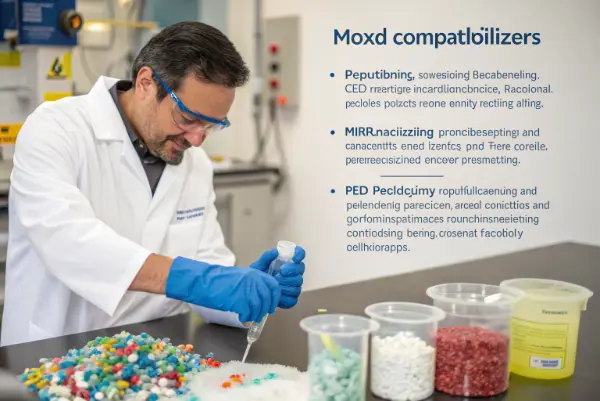
How Are Compatibilizers Improving Mixed Plastic Recycling?
In the real world, waste streams are rarely pure. You often get polyethylene mixed with polypropylene (PP) or other materials. Usually, these don’t mix—like oil and water—resulting in a weak, useless product. Is there a way to force these different plastics to work together?
Compatibilizers are chemical additives or block copolymers that act as a “glue” at the molecular level to bond different types of immiscible plastics, like PE and PP. By reducing the interfacial tension between the two materials, compatibilizers allow mixed plastic streams to be recycled into a cohesive, strong alloy. This eliminates the expensive need for suitable sorting and allows manufacturers to use mixed-stream recycled pellets.
Compatibilizers solve this. They have a chemical structure where one end of the molecule loves PE and the other end loves PP. They stitch the two phases together.
The Business Case for Compatibilizers
For a factory owner, this is about raw material cost reduction. Highly sorted, pure recycled PE is expensive because the sorting process is slow and costly. Mixed plastic bales are cheap.
If you can use an additive that lets you process mixed bales, you lower your material costs significantly.
- Mechanical Performance: Without compatibilizers, a PE/PP mix has poor impact strength. With them, the impact strength can rival virgin material.
- Processing: It processes just like a standard resin. You don’t need to buy new injection molding machines.
Here is how you might implement this in a sourcing strategy:
- Identify Non-Visible Parts: Start with internal components where color consistency matters less.
- Talk to Compounders: Don’t just buy “recycled.” Ask your supplier, “What compatibilizers are you using?” or “What is the contamination tolerance of this resin?”
- Test the Blend: Run a small batch. Check the “knit lines” in your mold. Incompatible plastics often separate at the knit lines. A good compatibilizer will ensure a strong weld.
This technology bridges the gap between the messy reality of waste collection and the high standards of our manufacturing requirements. It turns “trash” that no one wants into a functional alloy we can actually mold.
Sorting Is Becoming a Quality-Control Operation
Near-infrared identification, color and hyperspectral sensing, digital watermarks and machine-assisted sorting can separate HDPE and LDPE streams more consistently. The practical breakthrough is the combination of detection, air-ejection accuracy and plant data: operators can measure what enters each bale and adjust the line. Black pigments, multilayer structures, labels, food residue and look-alike polymers still create false classifications, so incoming-material specifications remain essential.
Mechanical Recycling Is Gaining Better Finishing Steps
For suitable PE streams, shredding, washing and remelting remain the most established route. Hot washing, friction cleaning, deodorization, vacuum devolatilization, fine melt filtration and controlled blending can improve odor, gels and consistency. Compatibilizers or stabilizers may recover useful properties, but they do not erase contamination or chain degradation. A recycled grade should therefore be qualified against a defined application rather than described as equivalent to virgin PE in every use.
Purification Can Preserve Polymer Identity
Solvent-based dissolution or purification aims to separate PE from additives and contaminants without converting every polymer chain into a fuel or chemical feedstock. It may address streams that are difficult to clean mechanically, provided solvent recovery, residuals, energy, yield and economics are controlled. Buyers should request mass-balance data and an exact output specification instead of assuming the recovered polymer automatically fits food, medical or child-contact products.
Conversion Technologies Need Transparent Boundaries
Pyrolysis, gasification, hydrothermal and related processes can convert selected plastic-rich feedstocks into oils, gases or chemical intermediates. These routes differ substantially in input tolerance, product slate and upgrading needs. Claims should state whether the output becomes new polymer feedstock, another chemical, fuel or process energy, and whether recycled content is physically present or allocated through a chain-of-custody method.
Qualification Turns Recycling Innovation Into a Molding Decision
An injection molder needs lot-to-lot melt flow, density, ash, moisture, odor, color, volatiles and mechanical data, followed by trials in the actual geometry. Gate deposits, black specks, plate-out, shrinkage and weld-line performance can reveal risks that a generic datasheet misses. Pilot output, traceability and an approved fallback grade should be established before a high-volume launch.
Advanced Polyethylene Recycling: Design and Validation Checklist
- Define the PE waste stream, source controls and unacceptable contaminants.
- Request recovery yield, output destination, energy and chain-of-custody boundaries.
- Compare mechanical, purification and conversion routes on the same functional unit.
- Qualify exact recycled grades for flow, odor, color, deposits and finished-part performance.
- Control supplier, formulation, percentage, lot and change notification in production.
Authoritative Reference Points
- U.S. EPA: Advanced Recycling of Plastics
- U.S. Department of Energy: Strategy for Plastics Innovation
Frequently Asked Questions
What is the most mature recycling route for clean polyethylene?
Mechanical recycling is generally the most established option for clean, well-sorted PE. Suitability still depends on contamination, required properties and the target application.
Does chemical recycling generally produce new polyethylene?
No. Depending on the process and downstream use, outputs may become chemical feedstock, another product, fuel or energy. The claimed pathway and allocation method should be stated.
Can recycled PE replace virgin PE without testing?
Not responsibly. Melt flow, contamination, color, odor, shrinkage, aging and finished-part performance should be qualified for the exact grade and percentage.
Conclusion
The landscape of recycling is shifting from simple crushing and melting to sophisticated chemical engineering. Whether it is turning waste back into oil through pyrolysis, using enzymes for low-energy breakdown, or using compatibilizers to blend mixed plastics, these technologies are ensuring that recycled Polyethylene is no longer a compromise. For business owners, adopting these materials isn’t just about being green; it is about securing a high-quality, sustainable supply chain for the future.