
You are under pressure to make your manufacturing process greener, but you worry about rising costs and losing product quality. Every business owner today faces the dilemma of balancing sustainability with profitability. If you ignore the shift toward eco-friendly materials, you risk falling behind competitors and losing environmentally conscious customers.
The future of eco-friendly Polyethylene (PE) plastics lies in advanced recycling technologies, bio-based feedstocks, and biodegradable additives that maintain material performance. Innovations like chemical recycling allow waste plastic to be reborn as virgin-quality PE, while sugarcane-derived bio-PE offers a carbon-neutral alternative without changing your existing molds. These solutions help manufacturers reduce their carbon footprint while keeping production lines running efficiently.
It is easy to get overwhelmed by all the scientific jargon surrounding green plastics. However, the transition does not have to be complicated or expensive. In the following sections, I will break down the most practical technologies available right now. We will look at how they work, where they fit in your supply chain, and why they matter for the future of your business.
Is Chemical Recycling the Key to infinite PE Plastic Lifecycles?
We all know mechanical recycling has limits because the plastic gets weaker every time it is processed. You end up with a lower-quality material that cannot be used for high-precision parts. This degradation is a major headache for manufacturers who need consistent strength and appearance in their products.
Chemical recycling is a game-changer because it breaks plastic waste down to its molecular level, effectively resetting it to its original state. This process turns mixed, dirty, or low-grade PE waste back into oil or gas, which is then used to create "virgin-quality" plastic again. This means you can use recycled material for high-end applications without sacrificing any mechanical properties.
Let’s dive deeper into why this technology is so critical for the industry. In my early days at the mold factory, we had heaps of scrap plastic that we simply could not reuse because it was contaminated or mixed with other polymers. We had to throw it away, which always felt like a waste of money. Chemical recycling solves this old problem.
Unlike mechanical recycling, which just chops and melts, chemical recycling uses heat and catalysts to depolymerize the plastic. This removes colors, additives, and impurities that ruin the quality of recycled PE.
Here is a breakdown of how it compares to traditional methods:
| Feature | Mechanical Recycling | Chemical Recycling |
|---|---|---|
| Input Material | Clean, sorted single-type plastic | Mixed, contaminated, multi-layer plastics |
| Output Quality | Lower grade (downcycling) | Virgin-quality (upcycling) |
| Cycles | Limited (degrades over time) | Theoretically infinite |
| Cost | Generally lower | Higher initial investment |
For a business owner like you, Michael, this means you can source recycled PE pellets that behave exactly like the new material you are used to. You do not need to change your mold designs or injection parameters. You get the sustainability badge for your brand without the production headaches of dealing with inconsistent recycled regrind. It opens the door to a true "circular economy" where the plastic you sell today becomes the raw material for what you sell tomorrow.
Can Bio-Based PE Replace Traditional Fossil-Fuel Plastics?
Many manufacturers believe that "green" plastic means completely new, unproven materials that might warp or break. You might hesitate to switch because you fear these new materials won’t work with your expensive steel molds. This fear of the unknown often stops companies from making the switch to sustainable options.
Bio-based PE, often made from sugarcane or corn ethanol, is chemically identical to traditional petroleum-based PE, meaning it is a "drop-in" solution. It offers the same durability, flexibility, and chemical resistance as standard PE, but it captures CO2 from the atmosphere during its production. You can use bio-PE in your current injection molding machines immediately without any modifications.
When I first started my trading company, a client asked if they could make their shampoo bottles "green" without buying new molds. I introduced them to Bio-PE. They were shocked to learn that the molecule is exactly the same—it just comes from a plant instead of an oil well.
This is crucial for risk management. You are not betting your production line on a weird experimental polymer. You are using the same Polyethylene you know and trust. The primary difference is the origin of the carbon.
Here are the key benefits of switching to Bio-Based PE:
1. Carbon Footprint Reduction
Traditional plastic releases carbon that was trapped underground for millions of years. Bio-PE uses carbon that plants pulled from the air last year. This can create a negative carbon footprint for the material itself.
2. No Retooling Costs
This is the biggest win for mold owners.
- Shrinkage Rate: Same as standard PE.
- Melting Point: Same as standard PE.
- Cycle Time: Same as standard PE.
3. Marketability
You can label your products as "Made from Renewable Resources." This is a powerful selling point for modern consumers. However, you must be clear: Bio-PE is usually recyclable (like normal milk jugs), but not necessarily biodegradable (it won’t just rot in a forest). Understanding this distinction helps you avoid "greenwashing" accusations. You are offering a product that helps fight climate change at the source, which is a solid business strategy.
Are Biodegradable Additives a Viable Solution for PE Waste?
Sometimes, despite our best efforts to recycle, plastic products end up in landfills or the natural environment. You might worry about your products contributing to ocean pollution, which can severely damage your brand’s reputation. Clients are increasingly asking, "What happens to this product if it gets thrown away?"
Biodegradable additives are chemical compounds mixed into standard PE during manufacturing that allow microbes to digest the plastic much faster than normal. These additives attract bacteria in landfill environments, accelerating the breakdown process from centuries to just a few years. This technology provides an insurance policy for plastics that accidentally escape the recycling stream.
I have seen a lot of debate about this technology. Some purists say we should only focus on recycling. But as a pragmatic business owner, I know that 100% recycling rates are a dream, not reality yet. We need a safety net.
These additives work by changing the chemical structure of the polymer chain when it is exposed to specific environments (like a microbe-rich landfill). It turns the plastic from a material that bacteria ignore into a food source.
Let’s look at the pros and cons to see if this fits your strategy:
How it Works in Production
- Dosing: You typically add 1% to 3% of the additive to the hopper.
- Processing: It processes just like a masterbatch colorant.
- Shelf Life: The plastic remains stable on the shelf. The breakdown only starts in active microbial environments (like deep inside a landfill).
Critical Considerations
You need to be careful with marketing claims here.
- Not "Compostable": Most additive-treated PE is not suitable for backyard compost bins. It needs an industrial environment or a landfill.
- Recycling Contamination: There is a concern that if too much of this additive gets into the recycling stream, it might weaken the next batch of recycled plastic.
- The "Littering License": We must not encourage people to litter just because the plastic degrades.
However, for single-use items or products likely to be discarded (like agricultural films or certain packaging), this is a powerful solution. It shows you are thinking about the "end of life" of your product, not just the sale. It adds a small cost to your raw material but adds significant value to your brand story.
How Can Smart Design and Lightweighting Reduce PE Consumption?
Buying eco-friendly materials is great, but the most sustainable plastic is the plastic you never use in the first place. You are likely constantly fighting against rising raw material costs, and heavy parts mean higher shipping fees and more material usage. Focusing only on material types ignores the massive savings found in better design.
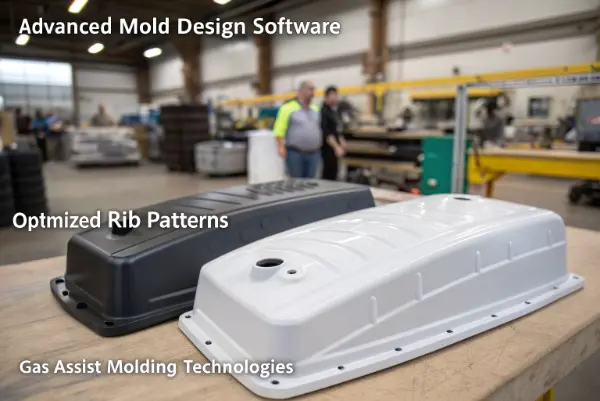
Lightweighting involves using advanced mold design software and engineering principles to reduce the wall thickness of a part without sacrificing structural integrity. By optimizing rib patterns and using gas-assist molding technologies, manufacturers can use significantly less PE material per part. This strategy immediately lowers material costs and reduces the environmental impact of every single unit produced.
In my experience running a mold factory, I have seen clients insist on thick walls because they think "heavy means strong." That is often a misconception. A well-designed part with thin walls and smart ribbing is often stronger and cools faster, which speeds up your production cycle.
Let’s break down how we achieve this through engineering and technology:
1. Structural Optimization
We use Computer-Aided Engineering (CAE) software to simulate stress. We can see exactly where the part needs material and where it doesn’t.
- Ribbing: Adding ribs allows us to make the main wall thinner while keeping stiffness.
- Coring out: Removing thick sections that create sink marks and waste plastic.
2. Manufacturing Technologies
- Gas-Assist Injection Molding: We inject nitrogen gas into the mold cavity. This pushes the plastic against the walls, creating a hollow center. This is perfect for handles or thick structural parts. It saves a huge amount of resin.
- Microcellular Foaming (MuCell): This process injects gas into the melted plastic, creating millions of tiny bubbles. The part looks solid on the outside but has a honeycomb structure inside. It uses less plastic and weighs less.
The Business Impact
If you produce 1 million parts a year, and we can shave off just 2 grams per part through better design, that is 2,000 kilograms of PE saved.
- Less Resin Cost: You buy less raw material.
- Faster Cycles: Thinner parts cool faster. If we save 2 seconds per cycle, your daily output goes up significantly.
- Lower Shipping: Lighter products cost less to ship to your customers.
This is the most direct way to be "eco-friendly." It aligns your profit motive perfectly with sustainability. You do not need new suppliers or certification bodies; you just need better design and mold engineering.
Conclusion
The future of eco-friendly PE plastics is not about waiting for a magic miracle material; it is about combining smart technologies available today. Whether you choose chemical recycling to maintain quality, bio-based feedstocks to reduce carbon, biodegradable additives for safety, or simply design lighter parts to save resources, every step counts. As a manufacturer, these choices do not just help the planet; they streamline your efficiency and future-proof your business against changing regulations. Start small, test one solution, and build from there.