
Plastic waste is choking our planet, and as manufacturers, we often feel like part of the problem rather than the solution. You see piles of scrap polyethylene (PE) and wonder if there is a better way than just dumping it. The pressure to be sustainable is rising, but the path forward isn’t generally clear.
A circular economy strategy for polyethylene begins before a product becomes waste. The strongest programs reduce unnecessary material, extend product life, enable reuse, simplify collection and design the remaining PE for a realistic recycling system. Recycling is one loop in the model—not permission to ignore product utility, leakage, quality loss or the market demand required to keep recovered material circulating.
Related engineering resources: DFM analysis | production injection molding | injection mold services
Circular economy solutions for PE plastic waste involve a closed-loop system where polyethylene materials are recovered, recycled, and reintegrated into the production cycle rather than being discarded. This includes mechanical recycling to create post-consumer recycled (PCR) resin1, chemical recycling to break plastics down to their molecular level2, and redesigning products for easier recyclability. For business owners, this means reducing raw material costs, meeting regulatory demands, and creating a more resilient supply chain.
What Is Mechanical Recycling and Is It Enough?
Mechanical recycling is often the first solution people think of, but does it solve the whole problem? Many businesses struggle with the quality of recycled material and wonder if it can truly replace virgin plastic. You might worry that using mechanically recycled PE will compromise the strength or appearance of your final product.
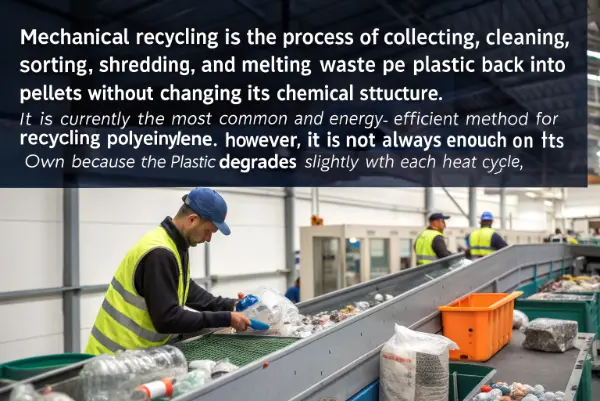
Mechanical recycling is the process of collecting, cleaning, sorting, shredding, and melting waste PE plastic back into pellets without changing its chemical structure. It is currently the most common and energy-efficient method for recycling polyethylene. However, it is not necessarily enough on its own because the plastic degrades slightly with each heat cycle, potentially limiting its use in high-performance applications.
To really understand this, we have to look at the pros and cons.
The Breakdown of Mechanical Recycling
When we talk about mechanical recycling, we are talking about a physical transformation. The polymer chains remain largely intact, but they get shorter every time they are melted. This affects the “Melt Flow Index” (MFI), which is crucial for injection molding.
Here is a simple way to look at the limitations and where it fits best:
| Feature | Virgin PE | Mechanically Recycled PE |
|---|---|---|
| Purity | 100% | Can contain trace contaminants |
| Color Consistency | Excellent | Difficult to color match reliably |
| Physical Strength | High | Slightly reduced (5-10% drop usually) |
| Cost | Market price | Generally lower, but processing adds cost |
| Best Use | Food contact, medical parts | Crates, pallets, non-critical housings |
If you are manufacturing consumer electronics casings, you might use a blend. For example, using 30% recycled PE mixed with 70% virgin material often maintains the necessary physical properties while boosting your sustainability score. Project teams should test their molds with these blends first. Sometimes, we need to adjust the gate size or cooling channels in the mold design to accommodate the slightly different flow characteristics of recycled material. It is not just about the material; it is about how the tool handles it.
Can Chemical Recycling Solve the Quality Issue?
If mechanical recycling degrades the plastic, is there a way to make it “new” again? You might have heard about advanced recycling technologies that promise virgin-quality resin from waste. This sounds like the holy grail for manufacturers who need high purity but still want to be sustainable.
Chemical recycling turns plastic waste back into its original building blocks (monomers) or raw hydrocarbons through chemical reactions or high heat. Unlike mechanical recycling, this process removes contaminants and restores the plastic to virgin-quality PE. This allows manufacturers to use recycled content in sensitive applications like food packaging or medical devices where safety is paramount.
Understanding the Process and Viability
Chemical recycling is often broken down into technologies like pyrolysis or gasification. It sounds complex, but think of it as unzipping a zipper. You are unzipping the long plastic molecule back into the small pieces it was made from.
However, we have to look at this critically. It is not a magic wand.
- Energy Consumption: This process uses a lot of heat and energy. While it saves the plastic material, the carbon footprint of the process itself can be high.
- Cost: Currently, chemically recycled PE is more expensive than mechanically recycled PE and sometimes even more than virgin PE.
- Availability: There are not enough chemical recycling plants yet. The supply chain is tight.
Let’s compare the “End of Life” scenarios for PE waste:
| Method | Outcome Quality | Scalability (Current) | Energy Input |
|---|---|---|---|
| Landfill | N/A (Waste) | High | Low (Transport only) |
| Mechanical | Lower (Downgraded) | High | Medium |
| Chemical | Equal to Virgin | Low (Emerging) | High |
For a business owner like the buyer, the decision comes down to the application. If you need suitable clarity and high strength, you might have to pay the premium for chemically recycled resin. It allows you to market your product as “circular” without sacrificing a single drop of quality. As we design molds for these materials, the good news is that chemically recycled PE behaves exactly like virgin PE. There is no need for tooling modifications, which saves you money on the manufacturing side.
How Can Product Redesign Facilitate the Circular Economy?
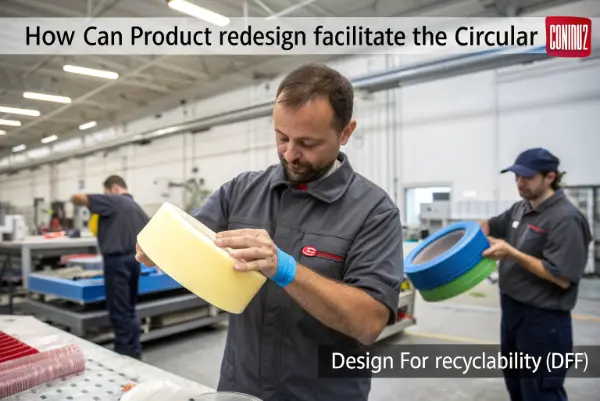
Is the problem just how we recycle, or is it also how we design? Often, we blame the recycling process, but the fault lies in the product itself. If a product is made of three different types of plastic glued together, it is a nightmare to recycle. You might be making recycling impossible before the product even leaves your factory.
Design for Recyclability (DfR) involves engineering products specifically so they can be easily disassembled and processed at the end of their life. For PE products, this means using mono-materials (only PE) instead of mixed plastics, avoiding permanent glues, and using labels that wash off easily. This strategy ensures that your products actually get recycled instead of rejected by sorting centers.
The Role of Mold Design in DfR
A mold maker have a unique perspective here. We can actually influence recyclability through the mold itself. It is not just about the plastic pellets; it is about the geometry and assembly.
Here are specific strategies we can use:
- Snap-Fits over Glues: Instead of designing a part that needs to be glued or screwed with metal inserts, we can design clever snap-fits into the mold. This allows the product to be assembled securely but pulled apart easily for recycling.
- Mono-material Hinges: We can design “living hinges” using PE. This allows a container and its lid to be one single piece of material. It simplifies the mold (one shot instead of two) and makes recycling 100% easier because the whole thing is just one material.
- In-Mold Labeling (IML) with Compatible Material: If you need a label, use a PE label and fuse it to the product during molding. This way, the label and the bottle are the same material and don’t need separation.
- Old Way: Design for function -> Select material -> Figure out disposal later.
- Circular Way: Select sustainable material -> Design for function AND disassembly -> Ensure compatibility with recycling streams.
When you bring me a design, I will look for these traps. If we can eliminate a metal screw by designing a better plastic clip, we save you assembly time, part cost, and make the product circular. It is a win-win-win. This is where “Master Molding Right” really applies—doing it right means thinking about the end from the beginning.
Prioritize Prevention and Useful Life
Remove avoidable components, right-size walls and packaging, and design durable products that can be repaired or reused when the business model supports it. Lightweighting must not create premature breakage or increase total system losses. The correct metric is service delivered over the product lifetime, not grams removed from a single unit.
Design for the Collection System That Exists
A theoretically recyclable PE part may still be discarded if its size, color, labels, adhesives, fillers or attached materials prevent identification and separation. Map the intended sales market to actual collection and sorting routes. Where take-back is necessary, define who collects, consolidates, cleans and pays for reverse logistics before making a circularity claim.
Keep Material Streams Simple and Identifiable
Mono-material PE designs, detachable non-PE components, compatible closures and documented additives can improve recovery. Permanent metal inserts, dark pigments, bonded multilayers and unknown flame retardants may reduce output quality. A bill of materials and disassembly map help recyclers understand what the part contains and where contamination enters.
Create Demand for Verified Recycled PE
Circular supply requires buyers as well as recyclers. Procurement teams can specify a qualified recycled-content range, performance limits, evidence method and change process. The molder then adjusts gate, venting, filtration expectations and process controls around the approved grade. Blanket percentage targets can be counterproductive when they ignore lifetime, scrap or failure risk.
Measure Loops Without Hiding Losses
Track virgin material avoided, collection rate, sorting yield, recycling yield, actual output use, manufacturing scrap, product life and final disposition. Separate pre-consumer regrind from post-consumer material and physical content from mass-balance allocation. These distinctions make progress comparable and keep circularity reporting useful for engineering decisions.
Circular Economy Solutions for Polyethylene Waste: Design and Validation Checklist
- Define product function and lifetime before setting material-reduction targets.
- Map each market to a real collection, sorting and recycling pathway.
- Document resin, pigments, labels, adhesives, inserts and disassembly steps.
- Qualify recycled content with measurable part and process requirements.
- Report collection, yield, output use and allocation method as separate metrics.
Authoritative Reference Points
Frequently Asked Questions
Is polyethylene recyclable everywhere?
No. Technical recyclability does not support local collection, sorting or an end market. The claim must be checked against the geography and format.
Is higher recycled content generally more sustainable?
Not automatically. Product life, rejects, added mass, transport, cleaning and the displaced virgin material all affect the outcome.
What should a PE circularity specification include?
Define the source and percentage, evidence method, property limits, color, odor, contamination, testing, approved supplier and change notification.
Conclusion
The circular economy for PE plastic is not just a trend; it is the future of manufacturing. By utilizing mechanical recycling for standard parts, adopting chemical recycling for high-performance needs, and rethinking our product designs for easier disassembly, we can turn waste into value. We need to stop seeing plastic as a single-use item and start seeing it as a cycle. At CKMOLD, we are ready to help you design the tools that make this transition possible.