
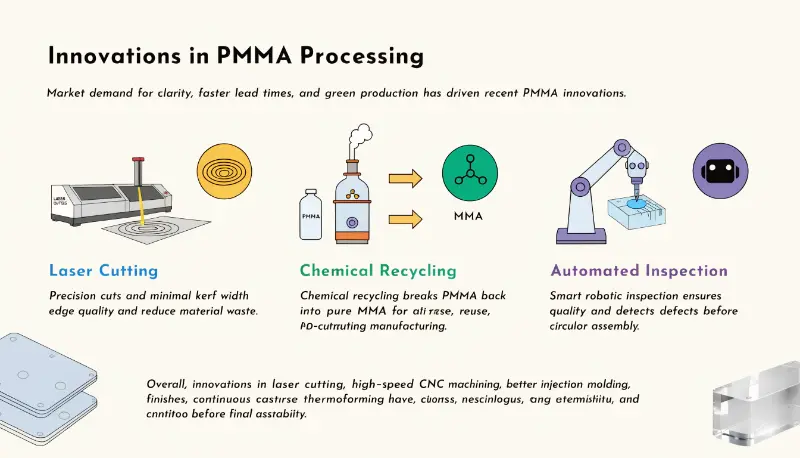
Making acrylic parts used to feel simple. But today, buyers want clearer parts, faster lead times, and greener production all at once1. That pressure is real, and old methods can’t generally keep up. The good news? PMMA processing is changing fast. New tools like laser cutting, smart robots, and chemical recycling are helping makers hit quality, cost, and speed targets that seemed hard just a few years ago.
Acrylic and Plexiglas-type PMMA products are being changed less by one new machine than by the integration of digital design, precision tooling, controlled thermal history and optical inspection. The relevant technology depends on whether the product is machined from sheet, thermoformed, cast, extruded or injection molded. Each route produces a different stress state, thickness distribution, surface and economic profile.
Related engineering resources: prototype injection molding | mold design | mold testing and validation
Recent PMMA innovations include laser cutting, high-speed CNC machining, better injection molding, UV-curing finishes, continuous casting, automated thermoforming, and smart robotic inspection. On top of that, the biggest shift is toward greener, circular manufacturing — especially chemical recycling that breaks PMMA back into pure MMA for reuse2. Together, these tools raise accuracy, cut waste, and keep acrylic clear and strong for signage, optics, lighting, and medical parts.
I’ve spent years around molds, CNC, and plastics, so I’ve watched these changes up close. Below, This article explains the tools that matter most and how they help business owners like you make smarter buying calls.
The PMMA Injection Molding for Clear Plastic Parts is the broad molding reference for clear parts; the present article examines newer acrylic and PMMA manufacturing technologies.
Which Cutting and Machining Technologies Improve PMMA Precision?
Getting a clean edge on acrylic is harder than it looks. A bad cut leaves chips, haze, or cracks. That means scrap, rework, and lost time. For anyone selling clear parts, that hurts both cost and reputation. So better cutting and machining tools are a big deal.
Laser cutting and high-speed CNC machining are the two top tools for PMMA precision. Laser cutting gives smooth, polished edges with no tool contact, which reduces cracks. High-speed CNC handles complex shapes with tight tolerances and repeatable accuracy. Both cut waste and speed up production, so they work well for detailed acrylic and plexiglass parts.
Why laser cutting works so well
Laser cutting melts and vaporizes the acrylic along a thin line. Because nothing physically touches the sheet, there’s no pressure that can crack it. The edge often comes out clear and shiny, so you may skip polishing. That saves a step. It’s great for signs, logos, and detailed shapes.
Where high-speed CNC shines
CNC machining is better when you need depth, holes, pockets, or 3D features. High-speed spindles let the tool move fast without grabbing the material. This keeps the surface clean and the tolerance tight.
| Method | Best For | Main Benefit |
|---|---|---|
| Laser cutting | Flat sheets, fine detail | Clean edges, no contact |
| High-speed CNC | 3D shapes, holes, thick parts | Tight tolerance, complex designs |
How Are Molding and Forming Methods Advancing for Acrylic?
Scaling up acrylic production is tricky. Defects like bubbles, warping, or uneven thickness show up fast when volume rises. That means rejected parts and angry customers. So the way we mold and form PMMA really affects your bottom line.
Injection molding, continuous casting, and automated thermoforming are the leading forming methods for PMMA. Injection molding now produces large volumes with fewer defects. Continuous casting makes thick, uniform acrylic panels at scale. Automated thermoforming shapes sheets quickly with less labor. Together, these methods improve consistency, lower costs, and give more design freedom.
Injection molding gets smarter
Modern injection molding uses better control over temperature, pressure, and cooling. This cuts common flaws like sink marks and internal stress. Good process control also means better clarity, which matters a lot for optical parts. When I inspect molded acrylic, clarity and low haze tell me the process was dialed in right.
Continuous casting for thick panels
Casting pours the acrylic into a controlled setup and cures it slowly. This gives very even thickness and great optical quality. It’s the go-to method for thick glazing and large panels because it avoids the stress marks you sometimes see in extruded sheets.
Automated thermoforming
Thermoforming heats a sheet and shapes it over a mold. Automation makes this fast and repeatable. It cuts labor cost and opens up curved and complex shapes. For products like display covers or machine guards, this is a cheap, flexible option.
For the buyer-type buyers, the key is matching the method to the part. High-volume small parts favor injection molding. Thick clear panels favor casting. Large curved shapes favor thermoforming. A good supplier will guide you here instead of forcing one method for everything.
What Finishing and Bonding Innovations Boost PMMA Quality?
A clear part that scratches easily or yellows in the sun is a problem. Poor bonding that cracks or looks messy is worse. These issues kill product life and customer trust. So finishing and bonding upgrades are just as important as shaping.
UV-curing finishes, solvent-free bonding, and barrier coatings are the top finishing innovations for PMMA. UV-curing quickly hardens surfaces for better scratch resistance and clarity. Solvent-free bonding improves safety and creates stronger, cleaner joints. Barrier coatings add weather and UV protection. These upgrades extend part life and keep acrylic looking clear longer.
UV-curing for tough, clear surfaces
UV-curing uses light to harden a coating in seconds. This is fast, so it fits high-volume lines. The result is a surface that resists scratches and stays clear. For lighting and optical parts, that clarity is everything.
Solvent-free bonding
Old bonding methods used strong solvents that were bad for workers and the air. New solvent-free methods create strong joints without those risks. They’re safer and often more durable. For me, this is a big win because it helps shops meet stricter environmental rules.
Barrier coatings for the outdoors
Acrylic used outside faces sun, rain, and dirt. Barrier coatings add a shield against UV rays and weather. This keeps signs and glazing from fading or clouding. If your product lives outdoors, ask about coating options up front.
These finishing steps might seem small, but they decide how long a part lasts. In many cases, the coating and bonding quality separates a premium supplier from a cheap one. It’s worth asking hard questions here.
How Is Sustainability Reshaping PMMA Manufacturing?
Waste is expensive, and buyers now ask about green practices. Throwing away acrylic scrap or making virgin material with high emissions is getting harder to justify. So the industry is moving toward a circular model, and it’s changing how acrylic gets made.
The biggest sustainability shift is chemical recycling that breaks PMMA back into pure MMA for reuse. New depolymerization systems recover near-virgin quality material with lower emissions. Low-temperature recovery methods protect material quality. Combined with automated inspection and additive manufacturing, these tools reduce waste and keep acrylic in a closed loop.
Chemical recycling to MMA
This is the headline change. Instead of throwing away old acrylic, companies now break it down into methyl methacrylate — the building block of PMMA. That MMA gets turned back into new acrylic. The key is purity. If the recovered material stays clean, you can make premium clear parts again. That’s the goal.
Smart robots and inspection
Automated robotic inspection checks parts for defects in real time. This catches flaws early and cuts scrap. It also keeps quality steady across big runs, which is exactly what a growing business needs.
Additive manufacturing and new foams
3D printing is being explored for custom, complex acrylic parts with little waste. And microwave-assisted foaming is creating lightweight PMMA foams for advanced uses. These are newer, but they show where things are heading.
For a business owner, the smart move is picking suppliers who combine recycling access with strong optical quality. Recovering more material only helps if the material stays clear and consistent. That balance is where the real value sits, and it’s the kind of focus a mold and plastics partner should bring to the table.
Digital Fabrication Is Shortening the Design Loop
Five-axis CNC machining, calibrated laser cutting and automated polishing can create display, lighting and enclosure features directly from sheet or block. Toolpath simulation and optical CAD help teams predict edge quality and distortion. Laser parameters must be validated because a visually smooth edge can retain heat-affected stress that later appears during cleaning, bonding or outdoor service.
Optical Injection Molding Depends on the Entire Tool
High-polish cavity steel, controlled venting, balanced filling, uniform cooling and stable mold temperature are central to molded PMMA optics and covers. Conformal cooling and cavity-pressure monitoring can reduce drift, but they cannot compensate for poor gate placement or abrupt thickness changes. Dust control, resin drying and careful handling are equally important because small contamination becomes highly visible.
Forming and Joining Are Becoming More Repeatable
Digitally controlled ovens, zone heating and measured sheet temperature improve thermoforming consistency. Vision-guided trimming and fixtures control final geometry. For assembly, solvent bonding, reactive adhesives, ultrasonic methods and laser transmission joining each create different stress and appearance risks; compatibility must be tested with the exact PMMA, coating and service chemicals.
Inline Inspection Can Quantify Visual Quality
Machine vision, transmitted-light inspection, laser profilometry and color or haze measurement can move acceptance beyond subjective visual checks. The inspection setup should define light source, background, viewing angle, defect size and surface zone. Optical parts also need dimensional and birefringence or stress evaluation when their function is sensitive to distortion.
Recycling Technology Is Expanding Material Options
Clean PMMA production scrap can be mechanically recovered for suitable uses, while depolymerization routes aim to recover methyl methacrylate feedstock from more controlled streams. The engineering question is not only recycled percentage: residual contamination, optical clarity, color, odor and molecular properties must meet the intended product specification and remain traceable by lot.
New Technologies in Acrylic and PMMA Manufacturing: Design and Validation Checklist
- Choose sheet machining, forming, casting, extrusion or molding from the real geometry and volume.
- Define optical zones, edge quality, haze, color, gloss and allowable defects.
- Control thermal history, residual stress, cleaning chemicals and joining method.
- Validate process monitoring against dimensions and optical performance.
- Qualify recycled PMMA by exact source, grade, clarity and finished-product tests.
Frequently Asked Questions
Are acrylic and PMMA the same material?
Acrylic is the common material name; PMMA is the polymer abbreviation. Plexiglas and similar names may be trademarks or commercial grade families.
Is laser cutting generally best for a clear acrylic edge?
No. Thickness, grade, edge geometry, stress and later bonding or cleaning determine whether laser, CNC and polishing are appropriate.
Can recycled PMMA be used for optical parts?
Potentially, but optical clarity, contamination, color, stress behavior and long-term performance must be validated for the exact recovered grade.
Conclusion
PMMA processing is getting faster, cleaner, and more precise. Laser cutting and CNC boost accuracy. Better molding, casting, and thermoforming raise consistency. UV-curing, solvent-free bonding, and coatings protect quality. And chemical recycling is pushing the whole industry toward a circular model. For buyers, the winning suppliers mix all three: cost control, high clarity, and greener production. Choose partners who master that balance.