
Are your water management products failing sooner than expected? The constant leaks, cracks, and pressure failures lead to costly repairs, service interruptions, and a damaged reputation. It feels like a never-ending cycle of replacing parts that should have lasted decades. A smarter approach, focusing on material selection and design from the very beginning, can build products that stand the test of time, ensuring reliability and customer trust.
To optimize HDPE product design for water management, you must focus on three key areas. First, select the correct HDPE grade, such as PE100, for its high density, stress crack resistance, and UV stability. Second, implement crucial design features like uniform wall thickness, generous radii at corners to reduce stress, and properly designed ribs for strength. Finally, ensure the injection mold is engineered with optimal gate locations and efficient cooling channels to prevent defects and ensure part integrity.
I’ve spent years in the molding industry, and I’ve seen firsthand how a small design choice can make or break a product meant to last 50 years. It’s not just about picking a tough material like HDPE; it’s about understanding how that material behaves in the mold and in the field. The journey from a plastic pellet to a reliable pipe fitting is filled with details that determine its ultimate strength and longevity. Let’s dive into those details, because getting them right is what separates a product that works from a product that endures.
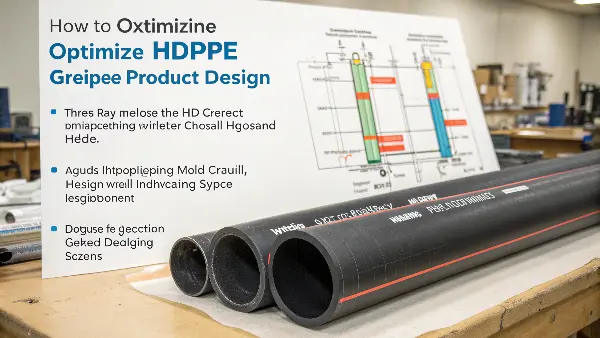
Why is selecting the right HDPE grade so crucial for water management?
Have you ever chosen a general-purpose material for a critical application, only to see it fail under stress? This mistake can be incredibly expensive, leading to product recalls and warranty claims that erode your profits and customer confidence. The problem is that not all plastics labeled "HDPE" are the same. Choosing the wrong grade for a high-pressure water pipe is a recipe for disaster, and the consequences can be severe.
Selecting the right HDPE grade is crucial because water management applications demand specific performance characteristics. Grades like PE80 and PE100 are chosen for their high density, which provides excellent stiffness and chemical resistance. They also offer a low Melt Flow Index (MFI) for better long-term pressure handling and superior Environmental Stress Cracking Resistance (ESCR). Additives like carbon black are also critical for UV protection in components exposed to sunlight, ensuring a service life of 50 years or more.
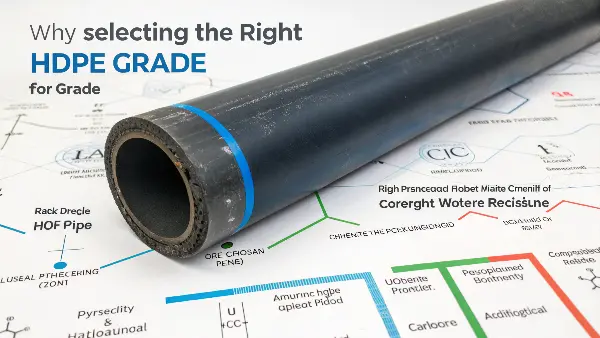
When we talk about water management, we’re talking about systems that need to perform reliably for decades, often buried underground or exposed to harsh weather. This is where the specifics of the HDPE grade become non-negotiable. It’s not just a matter of choice; it’s a matter of engineering for safety and longevity.
Understanding Key HDPE Properties
The performance of an HDPE product is directly tied to the polymer’s molecular structure and any additives mixed in. Here are the most critical factors:
- Density: Higher density HDPE offers greater stiffness, hardness, and chemical resistance. This is vital for pipes and fittings that must maintain their shape under soil load and resist degradation from chemicals in the water or ground.
- Melt Flow Index (MFI): This measures how easily the plastic flows when melted. For high-pressure pipes, you want a lower MFI. A low MFI indicates a higher molecular weight, which translates to better long-term strength and resistance to stress cracking. It might be harder to process, but the trade-off for durability is worth it.
- Environmental Stress Cracking Resistance (ESCR): This is a critical property for fittings and pipes that will be under constant internal pressure and external mechanical stress. A high ESCR value means the material can resist the formation of slow-growing cracks over many years.
PE80 vs. PE100: What’s the Difference?
| Feature | PE80 (MRS 8.0 MPa) | PE100 (MRS 10.0 MPa) | Application Implication |
|---|---|---|---|
| Minimum Required Strength (MRS) | Lower | 25% Higher | PE100 allows for thinner pipe walls for the same pressure rating, saving material and weight. |
| Density | High | Very High | PE100 offers slightly better stiffness and long-term stability. |
| Stress Crack Resistance | Good | Excellent | PE100 is superior for demanding installations with high stress or potential ground movement. |
| Rapid Crack Propagation | Good | Excellent | PE100 provides a higher safety margin against catastrophic failure in large-diameter gas and water pipes. |
As you can see, while both are great materials, PE100 is the modern standard for high-pressure water and gas applications due to its superior mechanical properties. I remember a client who was using a generic HDPE for irrigation fittings. They were seeing field failures after just a couple of seasons. We switched them to a proper PE100-RC (Resistant to Crack) grade, and their warranty claims vanished. The material cost was slightly higher, but it saved them a fortune in the long run.
How does mold design directly influence the durability of HDPE fittings?
You’ve designed a perfect part on your computer and selected the best possible HDPE grade. Yet, when the parts come out of the machine, you find they warp, have weak spots, or fail quality tests. This frustrating gap between design and reality often points to a single culprit: the injection mold. An improperly designed mold can introduce stresses and defects that completely undermine the strength of the final product, turning a robust design into a liability.
Mold design directly impacts HDPE fitting durability by controlling the plastic flow, cooling rate, and internal stress formation. Key elements like gate location determine weld line strength, while a well-designed cooling system with optimized channels prevents warpage and ensures uniform density. Proper venting is also critical to avoid trapped air, which causes voids and weak spots. A precisely engineered mold is essential to transform high-grade HDPE resin into a flawless, long-lasting part.
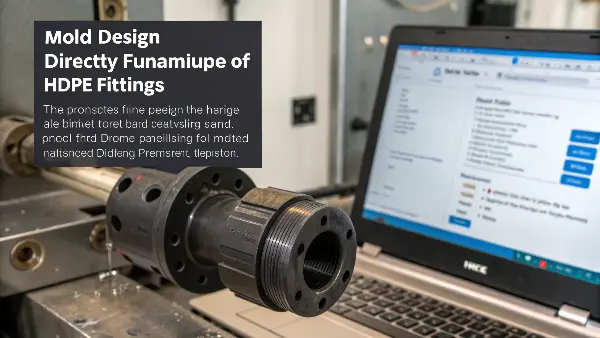
Think of the mold as the birthplace of your product. Any flaws in that birthplace will be carried by the product for its entire life. In my experience building molds for clients worldwide, I’ve learned that you can’t cut corners here. Investing in a high-quality mold built with precision and a deep understanding of polymer physics is the only way to guarantee the performance you designed for. It’s not just about making a shape; it’s about making a shape that is strong from the inside out.
Critical Mold Design Elements for HDPE
Let’s break down the most important aspects of mold design for high-performance HDPE components:
- Gating Strategy: The gate is where molten plastic enters the mold cavity. Its size and location are critical. For a symmetrical part like a pipe elbow, a diaphragm or ring gate can ensure the plastic fills the cavity evenly from the center out. This minimizes weld lines, which are potential weak points where two flow fronts meet. A poorly placed gate can create a weak weld line right where the part experiences the most stress.
- Cooling System Design: HDPE has a high rate of shrinkage as it cools. If one part of the mold is hotter than another, the part will shrink unevenly, causing it to warp or develop internal stresses. A good mold has cooling channels that follow the contour of the part, ensuring a uniform temperature across the entire surface. We use Moldflow analysis software to simulate the cooling process and optimize channel placement before cutting any steel.
- Venting: As molten plastic rushes into the mold, it displaces the air that’s already there. If that air can’t escape quickly through tiny vents, it gets trapped and compressed, causing burns, incomplete filling (short shots), or bubbles (voids) within the part wall. These voids are major stress concentrators and can lead to premature failure under pressure.
- Mold Steel Selection: For long production runs with HDPE, especially if it contains reinforcing fillers, choosing the right mold steel is important. Hardened steels like S136 or H13 are often used for their durability and resistance to wear, ensuring the mold can produce millions of consistent, high-quality parts without degrading.
I once worked on a project for a large T-fitting. The initial mold from another supplier had major warpage issues. By redesigning the cooling system to add extra circuits around the thick flange sections, we were able to balance the cooling rate and produce parts that were dimensionally stable and free of internal stress. This small change in mold design saved the entire project.
What specific design features maximize the lifespan of HDPE components?
Your team designed a robust HDPE part, but field reports show cracks originating from sharp corners or thick sections. The problem isn’t the material or the manufacturing, but the geometry of the part itself. Sharp corners create stress points where failures begin, while abrupt changes in thickness cause uneven cooling and built-in weaknesses. Without adhering to fundamental design principles for plastics, even the best material will underperform, shortening the product’s lifespan significantly.
To maximize the lifespan of HDPE components, focus on design features that minimize stress concentration and ensure structural integrity. The most critical rules are maintaining a uniform wall thickness to prevent warping and sink marks, using generous radii on all inside and outside corners to distribute stress, and designing ribs that are no more than 50-60% of the wall thickness they are attached to. These simple geometric considerations are fundamental to preventing premature failure under load.
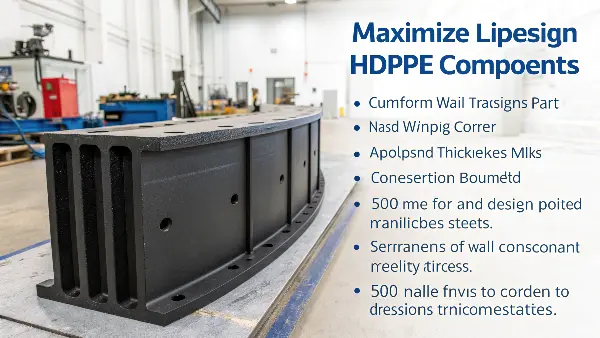
Designing for plastic is different than designing for metal. With plastics, you have to think about how the material flows, cools, and shrinks. Every curve, every wall, and every supporting feature plays a role in the final strength of the part. I’ve spent countless hours with engineers, refining their designs before a mold is even made. It’s in this digital stage that we can add years to a product’s life by simply following a few key rules that respect the nature of the material.
Design Rules for Durable HDPE Parts
Let’s explore these foundational principles in more detail. Getting these right at the CAD stage is the most cost-effective way to ensure durability.
-
Uniform Wall Thickness: This is the golden rule of plastic part design. A consistent wall thickness allows the part to fill, pack, and cool evenly. When you have a thick section connected to a thin section, the thin section cools and solidifies first. As the thick section continues to cool and shrink, it pulls on the already-solid thin section, creating internal stress and potential warpage. If thickness variations are unavoidable, make the transition gradual and smooth.
-
Generous Radii: Sharp internal corners are the number one enemy of a durable plastic part. They act as stress concentrators, multiplying the force applied to that small area. A crack will almost always start at the sharpest corner. As a rule of thumb, the inside radius should be at least 0.5 times the wall thickness. An outside radius should then be the inside radius plus the wall thickness. This simple change distributes stress over a wider area, dramatically increasing the part’s fatigue life.
-
Proper Rib Design: Ribs are a fantastic way to add strength and stiffness to a part without adding thick, problematic walls. However, a poorly designed rib can cause more harm than good. If a rib is too thick at its base, it will create a thick section that leads to sink marks (depressions on the opposite surface) and voids.
| Good Design Practice | Bad Design Practice | Why it Matters |
|---|---|---|
| Uniform Wall Thickness | Abrupt changes in thickness | Prevents internal stress, warpage, and sink marks. Ensures even cooling. |
| Inside Radius > 0.5x Wall | Sharp internal corners | Distributes stress and prevents cracks from forming under load. |
| Rib Thickness = 50-60% of Wall | Ribs as thick as the main wall | Prevents sink marks, voids, and cosmetic defects on the part surface. |
| Draft Angle (1-2 degrees) | Vertical walls (0 degrees) | Allows the part to be easily ejected from the mold without drag marks or stress. |
By following these guidelines, you move from simply creating a shape to engineering a high-performance component. It’s a shift in mindset that pays huge dividends in product reliability and customer satisfaction.
How do you design HDPE parts to withstand harsh environmental conditions?
You’ve specified a high-grade HDPE and perfected the part geometry, but your product is still degrading in the field. The surfaces are becoming brittle and chalky, or the material is failing when exposed to common chemicals. This happens because standard HDPE, while tough, is not invincible. Without specific considerations for environmental challenges like sunlight, chemicals, and temperature swings, the material’s polymer chains can be broken down, leading to a catastrophic loss of strength and a drastically shortened service life.
Designing HDPE parts to withstand harsh environments requires a two-pronged approach: material enhancement and smart geometry. First, the HDPE resin must be compounded with specific additives, like carbon black or other UV stabilizers, to protect against sunlight degradation. Second, the design must account for thermal expansion and contraction by incorporating features like expansion loops in pipe systems. Finally, ensuring the chosen HDPE grade has high chemical resistance is vital for applications involving treated water or contaminated soil.
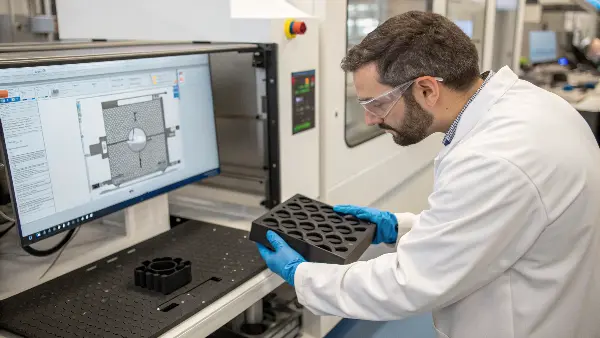
When a product leaves the factory, its battle has just begun. For water management systems, the enemy can be the sun overhead, the soil below, or the very water flowing through it. I always tell my clients that we need to design for the worst-case scenario. We must anticipate every environmental stressor the part will face over its 50-year design life. This foresight is built directly into the material selection and physical design, creating a product that is truly resilient and dependable in the real world.
Key Environmental Factors and Design Solutions
Let’s examine the primary environmental threats and how to counter them through effective design and material science.
-
UV Radiation: Sunlight, specifically its ultraviolet (UV) component, is highly effective at breaking the long polymer chains that give HDPE its strength. This process, called photodegradation, makes the plastic brittle. The most effective countermeasure is adding a UV stabilizer to the resin. For HDPE, the undisputed champion is carbon black. A 2-2.5% dispersion of finely ground carbon black makes the material almost completely opaque to UV light, protecting the polymer structure. This is why you see so many outdoor HDPE products, like pipes and tanks, colored black. For other colors, more complex and expensive UV stabilizer packages are used.
-
Chemical Exposure: HDPE is known for its excellent chemical resistance, but it’s not immune to everything. Water management systems may be exposed to chlorine and other disinfectants in potable water, as well as various chemicals present in soil and wastewater. It’s crucial to select an HDPE grade specifically certified for the application (e.g., NSF/ANSI 61 for drinking water) to ensure it can resist chemical attack over decades of exposure.
-
Temperature Extremes: HDPE has a relatively high coefficient of thermal expansion. This means it expands significantly when it gets hot and shrinks when it gets cold. A long, straight pipeline installed on a cool morning could buckle on a hot afternoon if this isn’t managed. The design must accommodate this movement. This is often done by snaking the pipe in the trench (creating slack) or designing engineered expansion loops. For cold climates, it’s also important to ensure the HDPE grade has good low-temperature impact strength to resist becoming brittle and cracking during freeze-thaw cycles.
By anticipating these environmental attacks during the design phase, we can arm the product with the defenses it needs to survive and perform reliably for its entire intended lifespan.
Conclusion
In summary, creating durable and high-performing HDPE water management products requires a holistic approach. It all starts with selecting the right PE100 grade, continues with intelligent part and mold design that minimizes stress, and finishes with forethought for the harsh environmental conditions the product will face. By mastering these elements, you can ensure your products deliver the 50-year lifespan your customers expect, building a reputation for unwavering quality and reliability.