Select automotive nylon from the specific duty cycle, moisture state, fluids, loads and acceptance plan. Family and reinforcement labels help shortlist candidates, but do not establish the reliability of a finished vehicle component.
The right nylon for an automotive part depends on where the part lives, how it is loaded and how its environment changes over time. An interior clip, an under-hood bracket, an electrical connector and an air-management component should not be selected from the same generic material rule. Grade family, reinforcement, moisture condition, heat history, chemicals, weld lines and assembly loads all belong in the decision.
Use DFM analysis to review the selected grade with the geometry, define acceptance through mold testing and validation, and retain the approved material and conditioning controls in production injection molding.
Shortlist exact commercial grades against the requirements of each vehicle location. Record heat stabilization, reinforcement, fluid exposure, conditioning and aging evidence; labels such as PA66-GF30 or PA12 are not complete specifications.
Why Is Nylon So Crucial for Powertrain and Under-the-Hood Components?
Reinforced polyamides may be candidates for under-hood components, but heat, creep, hydrolysis, fluid exposure and dimensional requirements must be verified for the selected grade and molded geometry. Metal replacement requires validation of the complete load path and duty cycle.
Heat Resistance is Non-Negotiable
Do not use one “under-hood temperature” for every automotive location. Define continuous and peak temperature at the part, exposure time, coolant or fluid contact, stress and aging requirement. Heat-stabilized glass-filled PA66 or PPA may be candidates, but a PA66-GF30 label alone does not prove long-term creep, hydrolysis or coolant resistance for a radiator end tank; use the exact grade data and validate the molded part against the OEM duty cycle.
The Role of Glass Fibers
Glass reinforcement can increase stiffness, but the result depends on fiber content, length, orientation and the molded geometry. Compare relevant conditioned properties and weld-line behavior instead of choosing a fiber percentage from a generic range. More reinforcement does not automatically improve every failure mode.
Chemical and Fluid Resistance
Assess each service fluid separately at its concentration, temperature, exposure time and applied stress. Do not group battery acid with oils or fuels or infer resistance from the PA6/PA66 family; request the exact supplier’s compatibility and aging evidence.
When Is Nylon Appropriate for Interior and Exterior Parts?
For a visible or touched part, qualify appearance and function separately. A PA6 or PA66 label does not establish scratch resistance, gloss, tactile feel or weathering life. Compare candidate grades against the actual color, texture, load, environment and inspection criteria; consider another material family when those requirements cannot be met.
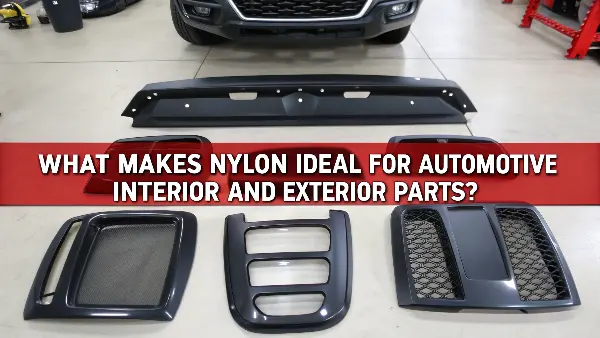
Illustrative component display; the image does not identify the material grade or establish its suitability. Select materials from the stated requirements and supplier evidence.
Aesthetics and Haptics for Interiors
Treat the finished surface as an acceptance requirement. Agree the surface reference, scratch or abrasion method, cleaners, temperature and humidity conditions, emissions requirements where applicable, and allowable appearance change before selecting a grade. Test the proposed color and finish on representative molded samples.
Durability and Weathering for Exteriors
Weathering can affect appearance and mechanical properties differently. Specify color or gloss change and retained function after the required exposure. Qualify the actual grade, pigment, texture and thickness; UV stabilization or impact modification alone does not prove that the complete part will resist every crack or appearance defect.
| Application decision | Define before shortlisting | Evidence before approval |
|---|---|---|
| Visible interior surface | Color, texture, gloss, contact and cleaning conditions | Molded appearance samples and the agreed scratch, cleaner and aging assessments. |
| Handle or moving interior component | Load path, friction pair, actuation cycles and conditioning | Assembly force, wear, dimensional and retention checks on representative parts. |
| Visible exterior component | Weathering exposure, allowable appearance change and functional load | Appearance and mechanical acceptance after the specified exposure. |
| Impact-loaded exterior attachment | Impact direction, temperature, mounting and permissible damage | Finished-assembly impact and retention tests at the agreed condition. |
Qualify the Exact Grade and Fluid-Contact Construction
Define the fuel or fluid composition, temperature, pressure, permeation limit, assembly stress and aging requirement. PA11, PA12, PA612 or other grades may enter the shortlist only with supporting supplier data for that exposure.
For multilayer tubing or molded connectors, qualify the complete construction and joints. A material-family label, general chemical-resistance statement or current fuel result does not establish compatibility with every future blend.
Treat Structural and Safety Uses as Part-Level Validation Decisions
Specify load cases, crash or impact requirements where applicable, fatigue, creep, temperature, conditioning and assembly interfaces. Reinforcement and impact modification are material design options, not evidence that a finished component satisfies a safety requirement.
Require traceable grade and process records and validation on representative molded parts. Supplier experience claims cannot replace the project’s acceptance evidence.
What Are the Key Molding Considerations for Automotive Nylon Parts?
Define moisture, melt temperature, mold temperature and residence-time controls for the exact grade. Use directional shrinkage data and the gate layout to assess dimensional risk. Process qualification must connect those settings to the required part dimensions and performance.
The Challenge of Moisture
Control incoming material moisture, drying, conveying and storage using the exact grade supplier’s guidance. Verify moisture at the defined sampling point and record the method. Excess moisture during processing can cause defects and hydrolytic degradation; a universal 0.2% limit does not cover all grades.
Temperature and Shrinkage Control
BASF’s Ultramid product brochure explains grade-dependent processing ranges, directional properties and shrinkage. Use the selected grade’s processing sheet, then confirm the actual melt and mold temperatures. Compare flow and transverse shrinkage with geometry, packing and conditioning; a generic shrinkage value cannot establish a finished-part tolerance.
Mold and Gating Design
Select tool material and wear protection for the intended life, reinforcement, corrosion exposure and surface requirement. Review gates for fill, pressure, shear, fiber orientation and weld-line location. Size and locate vents for the grade and geometry, then confirm the fill pattern, visible defects and dimensions during trial. High processing temperature alone is not a complete tooling specification.
Automotive Nylon Evidence Matrix
| Requirement | Grade-level evidence | Part-level confirmation |
|---|---|---|
| Heat and load | Tensile/creep/aging data at relevant temperature and conditioning | Assembly load and dimensional test after thermal aging |
| Coolant, fuel, oil or cleaner | Chemical-resistance data for concentration, temperature and time | Leak, pressure or retention test after exposure |
| Moisture and dimensions | Conditioned-property and moisture-absorption data | Measurement at agreed conditioning state |
| Glass-fiber orientation | Shrinkage and anisotropy data | Warpage/capability by cavity and gate layout |
Compare grade data on the same temperature, moisture, specimen and test basis. The prototype performance validation guide explains how to separate material data from finished-part evidence. Submit the duty cycle and material shortlist through the RFQ page; send drawings separately to jerry@ckmold.com.
Map the Vehicle Location and Duty Cycle
Separate interior, under-hood, exterior, fuel or fluid-adjacent and electrical applications. Record continuous and peak temperature, humidity, fluids, vibration, impact, UV, noise and service life. A short hot event and a long-term load at elevated temperature create different risks for nylon.
Choose the Nylon Family and Reinforcement
Compare the exact PA grade, chain structure, glass or mineral reinforcement, impact modification, heat stabilization and hydrolysis resistance where relevant. Reinforcement can improve stiffness and reduce creep while increasing anisotropic shrinkage, surface read-through and weld-line sensitivity.
Design Around Moisture and Fiber Direction
Nylon absorbs moisture and can change stiffness, dimensions and impact behavior. Gate and rib orientation also influence shrinkage and strength. Place ribs, clips, bosses and weld lines with the actual load path in mind, and define the conditioning state used for fit and performance decisions.
Check Assembly and Interface Loads
Fasteners, snap fits, clips, inserts, seals and neighboring metals can concentrate stress. Review installation force, torque, pullout, thermal expansion mismatch and long-term relaxation. A grade that is strong in a tensile coupon may still fail at a thin boss or a molded-in interface.
Validate the Part in Its Automotive Environment
Use production-like parts and test temperature cycling, humidity, fluids, vibration, impact, fatigue, assembly and dimensional retention as required. Include weld-line and fiber-direction specimens when they are representative of the design. Record grade, lot, drying, process and conditioning so future substitutions can be assessed.
Selecting Nylon for Automotive Systems: Buyer Review Checklist
- Identify vehicle zone, temperature-time profile, fluids, vibration, impact and life.
- Select exact nylon grade, reinforcement and stabilization from the failure mode.
- Account for moisture, fiber orientation, weld lines, shrinkage and conditioning.
- Check clips, bosses, fasteners, inserts, seals and metal interfaces.
- Validate finished parts under representative automotive environment and assembly loads.
Frequently Asked Questions
Is glass-filled nylon the best choice for every automotive part?
No. It can improve stiffness and creep resistance, but it may increase anisotropy, surface variation, wear and weld-line risk. The application and load direction must decide.
Why must nylon automotive parts be tested after conditioning?
Moisture changes nylon’s stiffness, dimensions and impact response. The conditioning state should reflect the vehicle requirement, not only the as-molded sample.
Conclusion
Release the grade only after its data and the molded-part evidence address the required service conditions. Preserve conditioning, lot and process records so changes can be assessed against the same acceptance basis.