
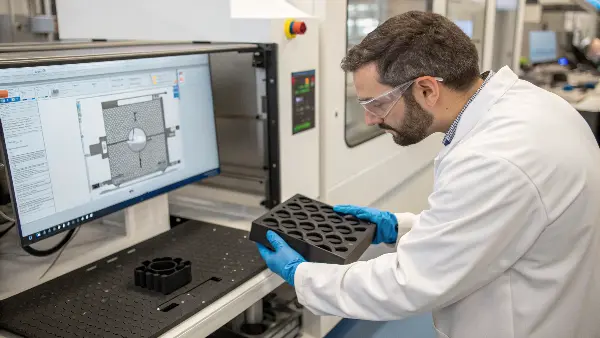
Are your water management products failing sooner than expected? The constant leaks, cracks, and pressure failures lead to costly repairs, service interruptions, and a damaged reputation. It feels like a rarely-ending cycle of replacing parts that should have lasted decades. A smarter approach, focusing on material selection and design from the very beginning, can build products that stand the test of time, ensuring reliability and customer trust.
HDPE is attractive for many water-management components because of its chemical resistance, toughness and low moisture uptake, but a reliable part still depends on geometry and service conditions. Tanks, fittings, channels, covers and valve bodies see pressure, temperature swings, threads, seals, UV, impact and long-term creep. Design should begin with the water path and failure consequence, not only the resin name.
Related engineering resources: DFM analysis | mold design | production injection molding
To optimize HDPE product design for water management, you must focus on three key areas. First, select the correct HDPE grade, such as PE100, for its high density, stress crack resistance, and UV stability. Second, implement crucial design features like uniform wall thickness, generous radii at corners to reduce stress, and properly designed ribs for strength. Finally, ensure the injection mold is engineered with optimal gate locations and efficient cooling channels to prevent defects and ensure part integrity.
Why is selecting the right HDPE grade so crucial for water management?
Have you ever chosen a general-purpose material for a critical application, only to see it fail under stress? This mistake can be incredibly expensive, leading to product recalls and warranty claims that erode your profits and customer confidence. The problem is that not all plastics labeled “HDPE” are the same. Choosing the wrong grade for a high-pressure water pipe is a recipe for disaster, and the consequences can be severe.
Select the polyethylene grade from the component’s pressure, temperature, chemical, UV, joining and molding requirements. PE80 and PE100 are pressure-pipe material designations based on minimum required strength; they are not generic injection-molding grades and do not by themselves guarantee density, melt flow, ESCR, UV life or a 50-year service life for every molded component.
When we talk about water management, we’re talking about systems that need to perform reliably for decades, often buried underground or exposed to harsh weather. This is where the specifics of the HDPE grade become non-negotiable. It’s not just a matter of choice; it’s a matter of engineering for safety and longevity.
Understanding Key HDPE Properties
The performance of an HDPE product is directly tied to the polymer’s molecular structure and any additives mixed in. Here are the most critical factors:
- Density: Higher density HDPE offers greater stiffness, hardness, and chemical resistance. This is vital for pipes and fittings that must maintain their shape under soil load and resist degradation from chemicals in the water or ground.
- Melt Flow Index (MFI): This measures how easily the plastic flows when melted. For high-pressure pipes, you want a lower MFI. A low MFI indicates a higher molecular weight, which translates to better long-term strength and resistance to stress cracking. It might be harder to process, but the trade-off for durability is worth it.
- Environmental Stress Cracking Resistance (ESCR): This is a critical property for fittings and pipes that will be under constant internal pressure and external mechanical stress. A high ESCR value means the material can resist the formation of slow-growing cracks over many years.
PE80 vs. PE100: What’s the Difference?
| Feature | PE80 (MRS 8.0 MPa) | PE100 (MRS 10.0 MPa) | Application Implication |
|---|---|---|---|
| Minimum Required Strength (MRS) | Lower | 25% Higher | PE100 allows for thinner pipe walls for the same pressure rating, saving material and weight. |
| Density | High | Very High | PE100 offers slightly better stiffness and long-term stability. |
| Stress Crack Resistance | Good | Excellent | PE100 is superior for demanding installations with high stress or potential ground movement. |
| Rapid Crack Propagation | Good | Excellent | PE100 provides a higher safety margin against catastrophic failure in large-diameter gas and water pipes. |
Separate Pipe Classification From Injection-Grade Selection
| Input | What to verify |
|---|---|
| Pressure-pipe system requirement | Applicable product standard, design coefficient, temperature derating and compatibility with the connected pipe. |
| Injection molding | Commercial molding grade, MFR/rheology, shrinkage, impact, ESCR and processing sheet. A pipe-extrusion grade may not fill the part or preserve required properties. |
| Outdoor exposure | Exact stabilization package, pigment/carbon-black specification and weathering evidence for the molded thickness. |
| Finished product | Burst, sustained-pressure, leak, joint, chemical and dimensional tests under the specified conditioning. |
A polyethylene supplier’s injection-grade guide shows that MFR, stiffness, impact and ESCR vary by commercial grade and application. Use those grade-level data alongside the system standard. Share the duty cycle and drawing during product design review.
How does mold design directly influence the durability of HDPE fittings?
You’ve designed a suitable part on your computer and selected the best possible HDPE grade. Yet, when the parts come out of the machine, you find they warp, have weak spots, or fail quality tests. This frustrating gap between design and reality often points to a single culprit: the injection mold. An improperly designed mold can introduce stresses and defects that completely undermine the strength of the final product, turning a robust design into a liability.
Mold design directly impacts HDPE fitting durability by controlling the plastic flow, cooling rate, and internal stress formation. Key elements like gate location determine weld line strength, while a well-designed cooling system with optimized channels prevents warpage and ensures uniform density. Proper venting is also critical to avoid trapped air, which causes voids and weak spots. A precisely engineered mold is essential to transform high-grade HDPE resin into a consistent, long-lasting part.
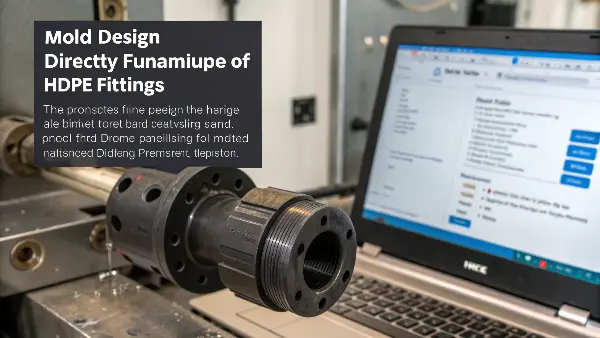
Critical Mold Design Elements for HDPE
- Gating Strategy: The gate is where molten plastic enters the mold cavity. Its size and location are critical. For a symmetrical part like a pipe elbow, a diaphragm or ring gate can ensure the plastic fills the cavity evenly from the center out. This minimizes weld lines, which are potential weak points where two flow fronts meet. A poorly placed gate can create a weak weld line right where the part experiences the most stress.
- Cooling System Design: HDPE has a high rate of shrinkage as it cools. If one part of the mold is hotter than another, the part will shrink unevenly, causing it to warp or develop internal stresses. A good mold has cooling channels that follow the contour of the part, ensuring a uniform temperature across the entire surface. We use Moldflow analysis software to simulate the cooling process and optimize channel placement before cutting any steel.
- Venting: As molten plastic rushes into the mold, it displaces the air that’s already there. If that air can’t escape quickly through tiny vents, it gets trapped and compressed, causing burns, incomplete filling (short shots), or bubbles (voids) within the part wall. These voids are major stress concentrators and can lead to premature failure under pressure.
- Mold Steel Selection: For long production runs with HDPE, especially if it contains reinforcing fillers, choosing the right mold steel is important. Hardened steels like S136 or H13 are often used for their durability and resistance to wear, ensuring the mold can produce millions of consistent, high-quality parts without degrading.
What specific design features maximize the lifespan of HDPE components?
Your team designed a robust HDPE part, but field reports show cracks originating from sharp corners or thick sections. The problem isn’t the material or the manufacturing, but the geometry of the part itself. Sharp corners create stress points where failures begin, while abrupt changes in thickness cause uneven cooling and built-in weaknesses. Without adhering to fundamental design principles for plastics, even the best material will underperform, shortening the product’s lifespan significantly.
To maximize the lifespan of HDPE components, focus on design features that minimize stress concentration and ensure structural integrity. The most critical rules are maintaining a uniform wall thickness to prevent warping and sink marks, using generous radii on all inside and outside corners to distribute stress, and designing ribs that are no more than 50-60% of the wall thickness they are attached to. These simple geometric considerations are fundamental to preventing premature failure under load.
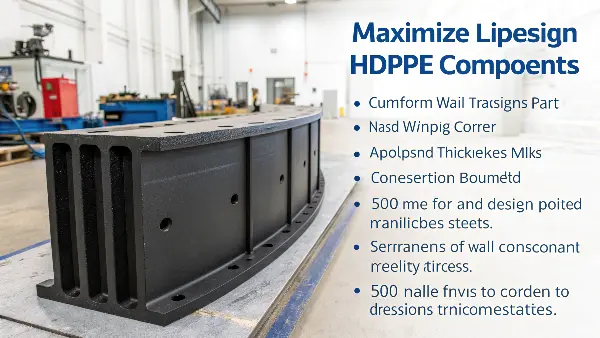
Designing for plastic is different than designing for metal. With plastics, you have to think about how the material flows, cools, and shrinks. Every curve, every wall, and every supporting feature plays a role in the final strength of the part. I’ve spent countless hours with engineers, refining their designs before a mold is even made. It’s in this digital stage that we can add years to a product’s life by simply following a few key rules that respect the nature of the material.
Design Rules for Durable HDPE Parts
Getting these right at the CAD stage is the most cost-effective way to ensure durability.
| Good Design Practice | Bad Design Practice | Why it Matters |
|---|---|---|
| Uniform Wall Thickness | Abrupt changes in thickness | Prevents internal stress, warpage, and sink marks. Ensures even cooling. |
| Inside Radius > 0.5x Wall | Sharp internal corners | Distributes stress and prevents cracks from forming under load. |
| Rib Thickness = 50-60% of Wall | Ribs as thick as the main wall | Prevents sink marks, voids, and cosmetic defects on the part surface. |
| Draft Angle (1-2 degrees) | Vertical walls (0 degrees) | Allows the part to be easily ejected from the mold without drag marks or stress. |
By following these guidelines, you move from simply creating a shape to engineering a high-performance component. It’s a shift in mindset that pays huge dividends in product reliability and customer satisfaction.
How do you design HDPE parts to withstand harsh environmental conditions?
You’ve specified a high-grade HDPE and perfected the part geometry, but your product is still degrading in the field. The surfaces are becoming brittle and chalky, or the material is failing when exposed to common chemicals. This happens because standard HDPE, while tough, is not invincible. Without specific considerations for environmental challenges like sunlight, chemicals, and temperature swings, the material’s polymer chains can be broken down, leading to a catastrophic loss of strength and a drastically shortened service life.
Designing HDPE parts to withstand harsh environments requires a two-pronged approach: material enhancement and smart geometry. First, the HDPE resin must be compounded with specific additives, like carbon black or other UV stabilizers, to protect against sunlight degradation. Second, the design must account for thermal expansion and contraction by incorporating features like expansion loops in pipe systems. Finally, ensuring the chosen HDPE grade has high chemical resistance is vital for applications involving treated water or contaminated soil.
After release, the part may face sunlight, soil loads, disinfectants, temperature cycles, installation damage and sustained pressure. Define the required design life for the actual system and validate those exposures. The 50-year convention used to establish pipe-material MRS at 20°C is an extrapolation basis for qualified pressure-pipe materials, not an automatic promise for an injection-molded fitting or enclosure.
Key Environmental Factors and Design Solutions
By anticipating these environmental attacks during the design phase, we can arm the product with the defenses it needs to survive and perform reliably for its entire intended lifespan.
Define Pressure, Temperature and Life
State internal pressure, pressure cycling, vacuum, water temperature, installation loads and design life. HDPE can creep under sustained stress, so a short burst test cannot replace long-duration pressure or deformation evaluation. Include the worst support and constraint condition.
Design Uniform Walls and Durable Transitions
Avoid heavy intersections, sharp corners and abrupt thickness changes that create sink, voids, warpage or stress concentrations. Use generous radii, controlled ribs and local support around ports, threads and sealing lands. Keep the flow path and the load path visible in the CAD review.
Protect Sealing and Connection Features
Threads, O-ring grooves, weld faces, barbs and clamp interfaces need stable dimensions and clean surfaces. Gate and ejector locations should not distort sealing lands. Review shrinkage, ovality, flash and assembly force using the actual material grade and conditioning.
Account for Chemicals, UV and Environmental Stress Cracking
Water chemistry, cleaning agents, oils, surfactants and outdoor exposure can change risk. Confirm the grade’s resistance and use stabilizers or shielding where needed. Avoid assuming that general chemical resistance helps support long-term performance under stress and exposure.
Validate Flow, Pressure and Leak Performance
Use flow analysis or prototype trials to check weld lines, air traps and gate location, then test leakage, pressure cycling, burst or deformation as the application requires. Measure critical interfaces after thermal conditioning and document the acceptance standard for every connection.
HDPE Product Design for Water-Management Systems: Buyer Review Checklist
- Define pressure, temperature, cycling, support, installation loads and service life.
- Use uniform walls, radii, controlled ribs and supported ports or threads.
- Protect seals, weld faces, grooves and connections from gates and ejection distortion.
- Review water chemistry, cleaners, UV, stress cracking and stabilizer needs.
- Validate leak, pressure, deformation and dimensional performance on finished parts.
Frequently Asked Questions
Can HDPE be used for every pressurized water component?
Not automatically. Pressure, temperature, duration, geometry, connection type, regulation and installation support must be checked for the exact grade and design.
Why are weld lines important in HDPE fittings?
A weld line can reduce local strength or leak resistance depending on flow and geometry. Gate strategy, venting and representative pressure testing should address the actual weld-line locations.
Conclusion
In summary, durable water-management parts require the correct injection grade, a load-aware design, controlled molding and product-specific validation. Use PE100 only where the selected material and system specification actually require it. Confirm pressure, temperature, joints, chemicals, UV exposure and design life rather than promising a universal 50-year result.