
Have you ever designed a plastic part that looked perfect on screen, only to have it warp, crack, or fail under real-world temperature changes? This mismatch can lead to costly rework, project delays, and unhappy clients. It’s frustrating when a well-designed component fails simply because its material properties weren’t fully considered for its thermal environment. Let’s dive into how you can prevent this from happening.
Temperature directly impacts a plastic’s mechanical properties, dimensions, and long-term stability. For short-term exposure, high temperatures can cause plastics to soften and deform, while low temperatures can make them rigid and brittle. Over the long term, elevated temperatures can accelerate material degradation, leading to a permanent loss of strength and integrity. The specific effect depends heavily on whether the plastic is amorphous or semi-crystalline, as each type responds differently to heat.
Understanding the general impact of temperature is the first step. But to design reliable parts, we need to move beyond generalities and into specific, measurable indicators. This is where concepts like HDT and RTI come in. These metrics give us the hard data needed to select the right material for the job. Let’s break down these critical concepts so you can apply them with confidence in your next project.
How Does Temperature Affect Plastics in Detail?
You know that heat and cold impact plastics, but do you know exactly how? This lack of specific knowledge can lead to over-engineering parts, which adds unnecessary cost, or under-engineering them, which risks catastrophic failure. It can feel like you’re guessing instead of making informed design decisions. Your professional reputation relies on getting it right.
Temperature changes a plastic’s molecular structure and behavior. High temperatures increase molecular movement, causing the material to soften, lose stiffness, and expand (thermal expansion). This is especially true for amorphous plastics above their glass transition temperature. Low temperatures do the opposite, restricting molecular movement and making the material more brittle and prone to impact fracture. These changes affect tensile strength, flexibility, and dimensional stability, all critical for part performance.
To truly master this, we need to look closer at the two main families of thermoplastics: amorphous and semi-crystalline. Their internal structures dictate how they handle heat. I learned this the hard way on a project involving an outdoor electronics enclosure. We chose a material that looked great on the spec sheet, but we didn’t fully account for its structure. The parts started warping under the summer sun, and we had to do an expensive re-tool.
Amorphous vs. Semi-Crystalline Polymers
The response of a plastic to temperature is fundamentally tied to its molecular structure.
- Amorphous Plastics (e.g., PC, PS, PVC): These polymers have a random, tangled molecular structure, much like a plate of spaghetti. They don’t have a sharp melting point. Instead, they have a Glass Transition Temperature (Tg). Below Tg, they are hard and brittle. Above Tg, they become soft, rubbery, and deformable. This transition is gradual, not sudden.
- Semi-Crystalline Plastics (e.g., PP, PE, Nylon): These materials have both amorphous regions and highly ordered, crystalline regions. This structure gives them two critical temperature points: a Glass Transition Temperature (Tg) where the amorphous parts soften, and a true Melting Temperature (Tm) where the crystalline structures break down and the material becomes liquid. They generally maintain their structural integrity better between Tg and Tm compared to amorphous plastics.
| Feature | Amorphous Plastics | Semi-Crystalline Plastics |
|---|---|---|
| Structure | Random, tangled chains | Ordered crystalline and random amorphous regions |
| Key Temp | Glass Transition (Tg) | Glass Transition (Tg) & Melting Temp (Tm) |
| Behavior at Tg | Becomes soft and rubbery | Amorphous regions soften, but still holds shape |
| Clarity | Often transparent (e.g., PC) | Often opaque (e.g., Nylon) |
| Examples | PC, PS, ABS, PVC | PP, PE, PA (Nylon), POM |
Understanding this difference is not just academic; it’s a practical tool for material selection.
What is the HDT Temperature?
Have you ever selected a plastic based on its melting point, only to find it deforms at temperatures far below that? This happens because a material’s ability to resist deformation under load is very different from its melting point. Relying on the wrong metric can lead to parts that sag, warp, and fail in service, causing major headaches for you and your client.
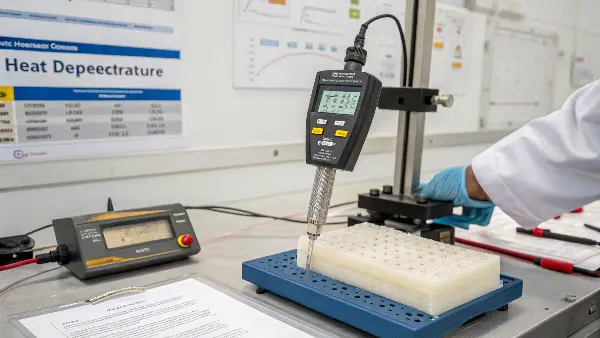
Heat Deflection Temperature (HDT), sometimes called Deflection Temperature Under Load (DTUL), is the temperature at which a plastic sample deforms a specified amount under a specific load. It’s a measure of a material’s short-term stiffness at elevated temperatures. Essentially, HDT tells you the maximum temperature a material can handle for a short period without significant deformation while bearing a load. It is not a measure of a material’s continuous service temperature.
HDT is one of the most common values you’ll find on a material datasheet, but it’s also one of the most misunderstood. It’s a quality control and material comparison metric, not a direct design input for long-term performance. I often see designers treat HDT as the absolute maximum operating temperature, which is a dangerous mistake. It gives you an indication of a material’s stiffness, but it doesn’t tell you how the material will behave after weeks, months, or years at that temperature.
How is HDT Measured and Used?
The test, standardized under ASTM D648 or ISO 75, is quite straightforward. A standard-sized bar of the plastic is placed under a three-point bending setup. It’s submerged in an oil bath, and a constant load is applied to its center. The two standard loads are:
- 0.455 MPa (66 psi)
- 1.82 MPa (264 psi)
The temperature of the oil bath is then increased at a steady rate of 2°C per minute. The HDT is the temperature at which the bar deflects by a specific amount (0.25 mm for ASTM).
HDT’s Role in Design
So, how should a designer like you use HDT?
- Material Screening: HDT is excellent for quickly comparing the relative short-term heat resistance of different materials. If you are choosing between two grades of Nylon, the one with the higher HDT will generally be stiffer at elevated temperatures.
- Evaluating the Effect of Reinforcements: You will notice that the HDT of a base resin increases dramatically when it’s filled with glass or carbon fibers. For example, a standard Polypropylene (PP) might have an HDT of 60°C, but a 30% glass-filled PP could have an HDT over 140°C. This shows how additives can dramatically improve high-temperature stiffness.
- Red Flag Indicator: If your part’s expected operating temperature is close to or above the material’s HDT, it’s a major red flag. The part will likely deform under even minimal load. You either need to redesign the part to reduce stress or choose a material with a higher HDT.
Remember, HDT is a test of deflection, not degradation. For long-term performance, you need a different metric.
What is the RTI Temperature?
Imagine designing a product with a 10-year lifespan, like an appliance motor housing or an electrical insulator. You used a material with a high HDT, and it passed all short-term tests. But after two years in service, the parts start cracking and failing. The problem is that HDT only predicts short-term performance. For long-term reliability, you need a different measure.
Relative Thermal Index (RTI) is the maximum service temperature at which a material will retain at least 50% of its original properties after 100,000 hours (about 11.4 years) of continuous use. Established by Underwriters Laboratories (UL), RTI is a critical measure of a material’s long-term thermal aging resistance. It’s the most reliable indicator for predicting the lifetime of a plastic part that will be exposed to elevated temperatures for extended periods.
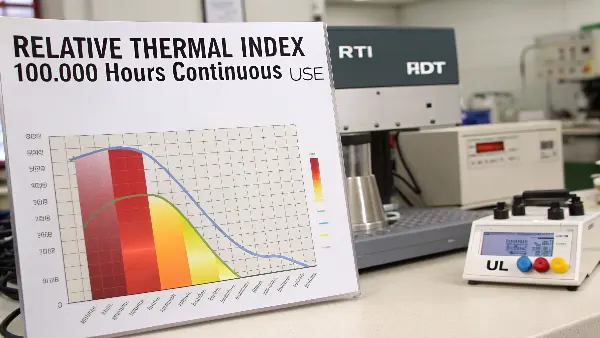
RTI is the gold standard for long-term thermal endurance. The testing process is long and expensive, which is why it’s such a trusted value. It involves aging samples of the plastic at several different high temperatures for thousands of hours (often over a year). Technicians periodically test the material’s properties, like tensile strength, impact strength, and electrical insulation. By plotting the degradation over time, they can extrapolate to predict the temperature that will cause a 50% property loss at 100,000 hours.
Understanding the Three Types of RTI
When you look at a UL Yellow Card (the official scorecard for a plastic’s safety and performance ratings), you’ll often see three different RTI values.
- RTI Electrical: This value is critical for electrical applications. It indicates the temperature at which the material’s insulating properties will degrade by 50%. If you’re designing insulators, connectors, or housings for electronics, this is the number you need to pay close attention to.
- RTI Mechanical Impact: This refers to the temperature at which the material loses 50% of its ability to withstand sudden force or impact (e.g., its Izod or Charpy impact strength). This is crucial for parts that might be dropped, bumped, or subjected to mechanical shock.
- RTI Mechanical Strength: This refers to the temperature at which the material loses 50% of its tensile strength or stiffness. It’s key for any structural part that needs to bear a continuous load over its lifetime.
It’s common for these three values to be different. A material might maintain its electrical properties well at a high temperature but become very brittle (low RTI Impact).
| Metric | What it Measures | Best for Designing… | Typical Timescale |
|---|---|---|---|
| HDT | Short-term stiffness under load. | Parts needing to resist brief temperature spikes without sagging. | Minutes to Hours |
| RTI | Long-term property retention at a constant temperature. | Parts needing to survive and function for years at a steady operating temp. | Years to Decades |
As a rule, for any part that needs to last, the continuous use temperature should always be below the material’s lowest RTI value.
What is the Recommended Temperature Range for Performing Plastic Repairs?
You have a cracked plastic bumper or a broken housing. You know you can repair it, but doing it wrong can make the problem worse. Applying too much heat can melt and distort the part, while not using enough heat results in a weak bond that will fail again. This uncertainty can turn a simple repair into a frustrating and costly do-over.
The recommended temperature for plastic repair, particularly for thermal welding, depends on the specific type of plastic. As a general rule, the ideal welding temperature is slightly above the material’s melting temperature (Tm) for semi-crystalline plastics or well into the rubbery state for amorphous plastics. This ensures the material flows and fuses properly without being overheated, which would cause degradation. Using a temperature-controlled welder is crucial for a strong, reliable repair.
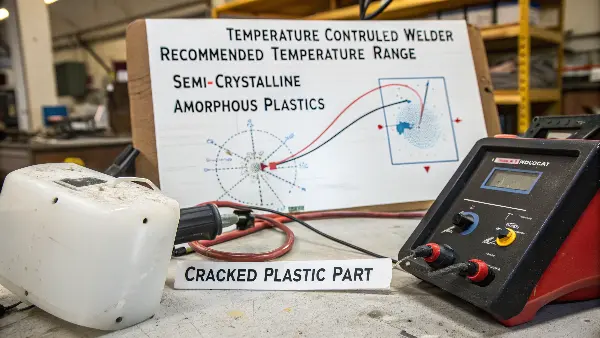
From my experience in manufacturing, I can tell you that successful repairs are all about temperature control. Just like in injection molding, a few degrees can make the difference between a perfect bond and a useless mess. You need to know both the material and your tools. The goal is to melt the welding rod and the surfaces of the base material just enough so they mix and fuse together as they cool. If you see smoke or discoloration, you’re using too much heat and burning the plastic, which creates a very weak and brittle joint.
Finding the Right Temperature
So how do you find the right temperature for the job?
- Identify the Plastic: This is the most critical step. Most automotive and consumer product parts have a recycling code or material abbreviation (e.g., >PP<, >ABS<, >PC<) stamped on them. This tells you exactly what you’re working with. If you can’t find a code, you can perform a burn test, but that requires experience.
- Consult a Welding Chart: Experienced technicians and tool manufacturers provide charts that recommend starting temperatures for common plastics. These are invaluable resources.
- Start Low and Go Slow: Always begin with a temperature at the lower end of the recommended range. Test on a hidden area of the part or a scrap piece of the same material. You’re looking for a smooth, consistent bead that fuses well with the parent material. If the rod isn’t melting properly or the bond is weak, increase the temperature in small increments (5-10°C) until you get a good result.
Here is a general guide for some common plastics. Always use it as a starting point and fine-tune based on your specific equipment and material.
| Plastic Material | Abbreviation | Typical Welding Temp. Range (°C) | Notes |
|---|---|---|---|
| Polypropylene | PP | 230 – 280°C | Very common in car bumpers, tanks. |
| Acrylonitrile Butadiene Styrene | ABS | 275 – 325°C | Common in enclosures, interior trim. Can get sticky. |
| Polycarbonate | PC | 300 – 350°C | Used for headlight lenses, strong parts. Needs higher heat. |
| Polyethylene | PE | 260 – 300°C | Varies greatly by density (HDPE, LDPE). Used in containers, kayaks. |
| Polyvinyl Chloride | PVC | 275 – 325°C | Used in pipes, window frames. Can release harmful fumes if burned. |
Remember to work in a well-ventilated area, especially when working with materials like PVC. Proper preparation, including cleaning the surface and "V"-grooving the crack, is just as important as getting the temperature right.
Conclusion
Understanding how temperature affects plastics is not optional; it’s essential for designing durable and reliable products. We’ve covered short-term effects measured by HDT and the critical long-term performance predicted by RTI. Mastering these concepts moves you from guessing to making data-driven decisions. This knowledge empowers you to select the right material and design parts that will stand the test of time and temperature, solidifying your reputation as an expert designer.