
Choosing the wrong plastic for your project can be a costly mistake, leading to part failure, budget overruns, and production delays. You might be facing a choice between several materials that all seem qualified on paper. This indecision can stall progress and create risk. Understanding the specific strengths and weaknesses of each option is the only way to select the perfect thermoplastic for your application, ensuring product success and saving you valuable time and money.
The best way to choose between Nylon and other engineering thermoplastics is to match the material’s core strengths to your application’s most critical requirements. Nylon (Polyamide) is a top choice for its excellent toughness, wear resistance, and chemical resilience, making it ideal for moving parts. However, if your part needs superior impact strength and optical clarity, Polycarbonate (PC) is better. For low-friction and precise, dimensionally stable parts, Acetal (POM) is superior. For excellent electrical insulation and stability in hot, wet conditions, choose PBT.
I’ve been in the mold and manufacturing industry for a long time, and I’ve seen firsthand how material selection can make or break a project. A simple datasheet doesn’t tell the whole story. The real world brings challenges like moisture, chemical exposure, and constant mechanical stress. A decision that seems right in theory can fall apart in practice. That’s why we need to dig deeper than just surface-level specs. Let’s break down the common comparisons to give you the clarity you need to choose with confidence.
When Should You Use Nylon Instead of Polycarbonate (PC)?
You need a tough material for your parts, but you’re stuck between Nylon’s flexibility and PC’s incredible impact strength. Picking the wrong one could mean your parts either crack under sudden force or wear out far too quickly in a high-friction environment. Imagine launching a product only to have it fail because the material couldn’t handle the specific stresses of its job. Let’s clearly define the strengths of both Nylon and PC so you can match the material to your part’s mechanical demands.
You should use Nylon instead of Polycarbonate (PC) when your application requires superior wear resistance, a low coefficient of friction, and strong chemical resistance, especially against oils, fuels, and solvents. This makes Nylon the perfect choice for gears, bearings, bushings, and other sliding components. In contrast, PC is the better option when you need exceptional impact strength, optical clarity, and stable dimensions. PC is excellent for protective housings, lenses, and safety equipment where toughness and transparency are key.
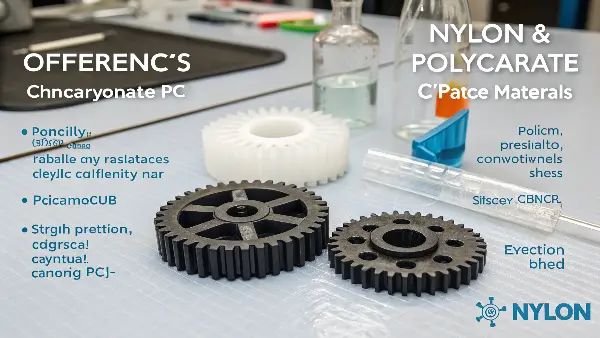
Let’s dive deeper into this choice. The main difference comes down to how these materials handle stress. Polycarbonate is famous for its almost unbreakable nature. It has outstanding impact strength, which is why it’s used for things like bulletproof glass and safety goggles. It’s also dimensionally stable and doesn’t change shape much with temperature or humidity shifts. However, it scratches easily and has poor resistance to a lot of common chemicals. I once worked with a client making a housing for a handheld industrial scanner. They picked PC because it was so tough. But the workers often cleaned the scanners with harsh solvents, and the PC housings started to develop cracks. It was a classic case of not considering the chemical environment.
Nylon, on the other hand, is all about durability in motion. It’s not as impact-resistant as PC, but it is incredibly tough and has great abrasion resistance. Its low-friction surface makes it a self-lubricating material in many cases. The key weakness of Nylon is its tendency to absorb moisture from the air. This absorption can cause the material to swell and can change its mechanical properties and dimensions. This makes it less suitable for parts that need to hold very tight tolerances in a humid environment.
Nylon vs. PC: Key Property Showdown
| Property | Nylon (PA66, Unfilled) | Polycarbonate (PC, General Purpose) | Best For… |
|---|---|---|---|
| Wear Resistance | Excellent | Poor | Nylon: Gears, bearings, sliding parts. |
| Impact Strength | Good | Excellent | PC: Protective covers, safety visors, lenses. |
| Chemical Resistance | Excellent (oils, fuels) | Poor (solvents, cleaners) | Nylon: Automotive, industrial machine parts. |
| Moisture Absorption | High | Low | PC: Parts needing dimensional stability. |
| Optical Clarity | Opaque | Excellent (Transparent) | PC: Windows, light pipes, clear housings. |
Is Nylon a Better Choice Than Acetal (POM)?
You’re designing a part that needs to be precise and move smoothly, again and again, without wearing out. Both Nylon and Acetal (POM) seem like great options, but their subtle differences are critical. Choosing incorrectly could result in a part that either swells and jams up your assembly or doesn’t have the long-term fatigue resistance to last. This choice directly impacts the reliability and lifespan of your product. Let’s look closely at where each material truly shines to prevent these issues.
Nylon is a better choice than Acetal (POM) when you need higher toughness, better impact resistance, and a higher operating temperature. It excels in applications that experience shock loads or operate in warmer environments. However, Acetal (POM) is the superior material for applications demanding the highest dimensional stability, extremely low friction, and excellent performance in wet or humid conditions. POM’s low moisture absorption makes it perfect for precision gears, rollers, and fuel system components that cannot tolerate dimensional changes.
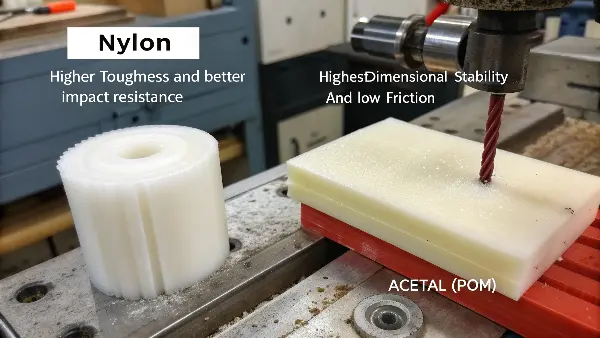
When we get into the details, the decision between Nylon and POM often comes down to one key factor: water. As I mentioned, Nylon is hygroscopic, meaning it loves to absorb moisture. Acetal, or Polyoxymethylene, is the exact opposite. It absorbs almost no water, which is why its mechanical properties and dimensions remain incredibly stable, even when submerged. I remember a project for a client who was developing a small water pump. They initially specified Nylon for the internal impeller because it was tough. However, during testing, the impeller would swell slightly after being in water, causing it to rub against the housing and fail. We switched to POM, and the problem disappeared completely.
Beyond water, there are other important trade-offs. Nylon generally has better toughness and can handle higher temperatures than POM. It’s also more resistant to abrasion. POM, however, has a natural lubricity that is even better than Nylon’s, giving it one of the lowest coefficients of friction of any engineering thermoplastic. This makes it fantastic for high-precision sliding or rotating parts that don’t see a lot of shock impact. It also has better creep resistance, meaning it resists deforming over time when under a constant load.
Nylon vs. POM: A Practical Comparison
| Feature | Nylon (PA66, Unfilled) | Acetal (POM, Copolymer) | Best For… |
|---|---|---|---|
| Dimensional Stability | Poor (due to moisture) | Excellent | POM: Precision parts, components in water. |
| Friction & Wear | Very Good | Excellent (lower friction) | POM: High-speed, low-load bearings. |
| Toughness & Impact | Excellent | Good | Nylon: Parts subject to shock and impact. |
| Fatigue Resistance | Very Good | Excellent | POM: Components with repetitive stress cycles. |
| Operating Temperature | Higher | Lower | Nylon: Applications near engines or motors. |
When Is Polybutylene Terephthalate (PBT) a Smarter Pick Than Nylon?
Your next product is an electronic component, maybe a connector or a sensor housing. It needs to be strong, stable, and a great electrical insulator. Both Nylon and PBT are on your list. But one critical weakness could cause total failure. If you choose a material that absorbs moisture, its electrical properties could degrade, leading to short circuits and a product that’s unreliable or even dangerous. Let’s make sure your choice protects your product’s performance and your company’s reputation.
Polybutylene Terephthalate (PBT) is a smarter pick than Nylon for applications where electrical insulation and dimensional stability in hot and humid environments are critical. PBT absorbs very little moisture, so its excellent electrical properties and precise shape remain consistent. This makes it ideal for electrical connectors, switches, sensor housings, and automotive ignition components. Nylon, while tough, absorbs moisture, which can compromise its insulating ability and cause it to swell, making it unsuitable for many high-precision electronic applications.
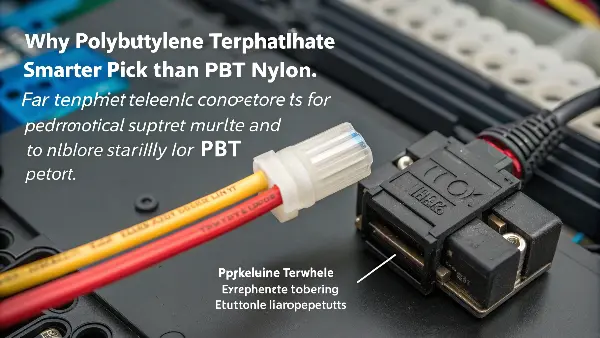
Diving into this comparison, it’s clear that PBT was engineered to solve some of Nylon’s inherent problems, especially for the electronics industry. The defining characteristic of PBT is its electrical performance combined with its resistance to the environment. It has a high dielectric strength, meaning it’s a fantastic insulator. Crucially, that strength doesn’t change when the humidity goes up, because PBT, much like POM, barely absorbs any water. This is a massive advantage over Nylon. We once had a customer developing an outdoor electrical sensor. Their first prototype used a glass-filled Nylon for strength. It worked perfectly in our dry workshop, but when they field-tested it in a rainy climate, they started getting ghost readings and failures. The absorbed moisture was wrecking the material’s insulating properties. A quick switch to a glass-filled PBT solved the issue instantly.
PBT also has better resistance to staining and is more resistant to chlorine, which is found in cleaning solutions and tap water. While Nylon is generally tougher and has better wear resistance, PBT offers a balanced profile that is often more suitable for housings and structural components rather than moving parts. When you add glass fibers to PBT, it becomes very strong and stiff, with excellent dimensional stability and a high heat deflection temperature, often rivaling or exceeding that of glass-filled Nylons.
Nylon vs. PBT: Electronics and Stability Focus
| Characteristic | Nylon (PA66, Unfilled) | Polybutylene Terephthalate (PBT, Unfilled) | Best For… |
|---|---|---|---|
| Electrical Properties | Good (degrades when wet) | Excellent (stable) | PBT: Connectors, insulators, bobbins. |
| Moisture Absorption | High | Very Low | PBT: Stable performance in any humidity. |
| Chemical Resistance | Excellent (oils) | Very Good (cleaners) | PBT: Housings for consumer electronics. |
| Dimensional Stability | Poor | Excellent | PBT: Precision electronic components. |
| Toughness | Excellent | Good | Nylon: Mechanical parts needing impact strength. |
Conclusion
Choosing the right engineering thermoplastic is not about finding the "best" material, but the right one for your specific job. Nylon is a fantastic, tough, and wear-resistant workhorse. However, its performance can be compromised by moisture. For unmatched impact strength and clarity, turn to PC. For precision and stability in wet environments, POM is the clear winner. And for reliable electrical applications, PBT offers the stable performance you need.