
Are you tired of receiving nylon parts that vary from batch to batch? Inconsistent quality can halt your assembly line, increase costs, and damage your reputation. The frustration of dealing with parts that don’t fit, deform easily, or fail under stress is a major headache. Implementing a systematic quality control process with specific measurements and standards is the key to ensuring every part you receive meets your exact specifications and performs reliably every time.
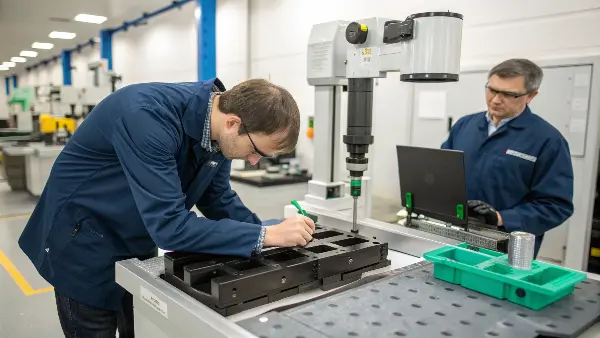
To ensure quality in nylon injection molded parts, a multi-step quality control process is essential. This includes rigorous dimensional analysis using CMM machines and calipers, visual inspections to identify defects like flash or sink marks, and material property testing to verify tensile strength, impact resistance, and moisture content. Critically, all tests must be performed against established industry standards, such as ISO 294 for plastics injection molding and DIN 16742 for plastic molded part tolerances, to guarantee objective and repeatable results.
These initial checks provide a solid foundation for quality, but they are just the starting point. True mastery over nylon part production comes from understanding the specific standards and process parameters that dictate the final outcome. The details are what separate a good part from a great one, and knowing what to look for can save you significant time and money. Let’s explore the specific checks, standards, and parameters you need to know to ensure your nylon components are always up to spec.
What Are the Fundamental Quality Control Checks for Any Injection Molded Part?
You’ve spent weeks, maybe even months, perfecting your product design. But how can you be sure that the ten-thousandth part produced is identical to the first one you approved? Without a clear, documented quality control plan, you’re essentially gambling with your production. This uncertainty can lead to downstream assembly issues, unexpected field failures, and angry customers, creating problems that could have been easily avoided with a little foresight.
The fundamental quality control checks for injection molding are built on a three-stage process. First is the First Article Inspection (FAI), where the initial parts from a new mold are meticulously measured against all design drawings. Next is In-Process Inspection, involving regular checks on the production line to monitor critical dimensions and look for visual defects. Finally, a Final Inspection is conducted on a random sample of the completed batch to verify overall quality before shipment, ensuring the entire lot meets your standards.
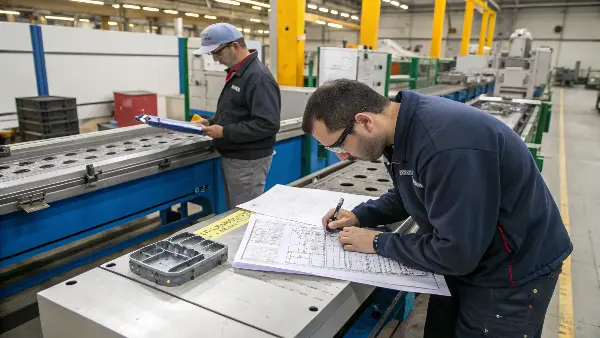
These stages—FAI, in-process, and final—form the backbone of any reliable quality assurance program. Each serves a distinct purpose, and together they create a powerful system for catching errors before they become major problems. I remember a project for a client in the automotive sector where a tiny dimensional drift on a clip went unnoticed for half a production run. It wasn’t caught because the in-process checks were too infrequent. That experience taught me a valuable lesson: consistency in monitoring is just as important as the initial approval. Let’s break down why each of these stages is non-negotiable for achieving consistent quality.
Deeper Look: The Three Pillars of Injection Molding QC
To truly understand quality control, we need to go beyond the stages and look at what’s being checked. The process is built on three core pillars: verifying the part’s dimensions, confirming its visual integrity, and testing its functional performance.
1. Dimensional Accuracy
This is the most objective part of quality control. Does the part match the CAD file and the 2D drawing? We use a range of tools for this, from simple digital calipers for quick checks on the factory floor to advanced Coordinate Measuring Machines (CMM) for highly precise, automated measurements of complex geometries. The CMM report from an FAI serves as the "birth certificate" for the part, providing a baseline for all future production. Go/no-go gauges are also critical for quick, repeatable checks of key features like hole diameters or slot widths during in-process inspections.
2. Visual Inspection
A part can be dimensionally perfect but still be a reject. Visual inspection is crucial for catching cosmetic and structural defects that can affect appearance or performance. An experienced inspector knows exactly what to look for.
| Common Visual Defect | Likely Cause | How to Fix It |
|---|---|---|
| Flash | Mold clamp pressure too low; worn-out mold | Increase clamp force; repair or re-tool the mold |
| Sink Marks | Insufficient packing pressure; thick walls | Increase packing pressure/time; redesign part geometry |
| Weld Lines | Melt fronts meeting at low temperature | Increase melt temperature; adjust gate locations |
| Short Shot | Not enough material injected | Increase shot size; check for blocked gates |
3. Material and Functional Testing
Finally, does the part do its job? For nylon, this often involves confirming its mechanical properties. We might perform tensile tests to check its strength, Izod impact tests to ensure it’s not too brittle, or moisture analysis to confirm it was dried properly before molding. If the part is a snap-fit clip, a functional test might involve repeatedly engaging and disengaging it to ensure it doesn’t break or permanently deform. This pillar ensures the part doesn’t just look right—it works right.
What are the key process parameters for nylon injection molding?
You’ve found a supplier with a great mold and a solid QC plan, but you’re still getting inconsistent nylon parts. Why? Often, the problem lies not in the mold or the final inspection, but in the molding process itself. If the machine parameters aren’t precisely controlled, even the best mold will produce bad parts. This can be incredibly frustrating, as you’re left with components that warp, show splay marks, or are too brittle, all because of invisible process variations.
The critical parameters for nylon injection molding are melt temperature, mold temperature, injection pressure and speed, and material drying. Nylon is highly sensitive to moisture, so it must be thoroughly dried to a specific moisture content (typically below 0.2%) before processing. Melt temperature (around 260-320°C for PA66) and mold temperature (often 80-120°C) are crucial for ensuring proper flow and achieving the desired crystalline structure, which directly impacts the part’s final strength and dimensional stability.
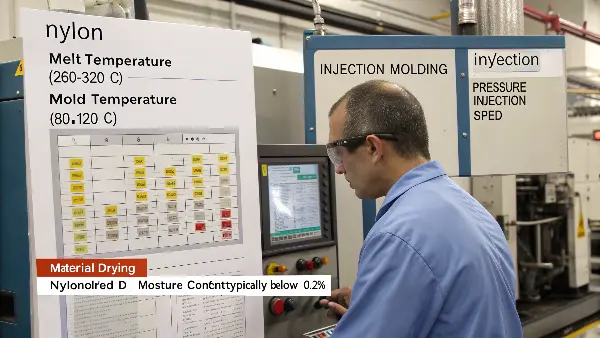
Getting these parameters right is an art as much as a science, and it’s where an experienced technician truly shines. I’ve seen situations where a new operator, trying to speed up cycle times, lowered the mold temperature slightly. The parts looked fine coming out of the machine, but a day later they had warped beyond tolerance. That’s because the internal stresses weren’t properly relieved. Understanding these four key parameters is essential for anyone sourcing nylon parts, as they are the levers that control the final quality of your product.
Deeper Look: Dialing in the Nylon Molding Process
Achieving a stable, repeatable process for nylon is all about managing heat, pressure, and moisture. Each parameter is linked, and a change in one will almost certainly require adjustments to the others. Let’s look at them more closely.
1. Material Drying: The First and Most Critical Step
Nylon is hygroscopic, meaning it acts like a sponge and absorbs moisture from the air. If you try to mold undried nylon, the water in the pellets will turn to steam at processing temperatures. This steam causes cosmetic issues like splay or silver streaks on the part surface and, more importantly, it breaks down the polymer chains—a process called hydrolysis. This severely weakens the material, making the final part brittle and useless.
- Best Practice: Always use a desiccant dryer. For a standard PA66, we typically dry it for 4 hours at 80°C (175°F) until the moisture content is below 0.2%. We verify this with a moisture analyzer before loading the material into the machine.
2. Melt Temperature: Finding the Sweet Spot
This is the temperature of the plastic as it’s injected into the mold.
- Too Low: The nylon will be too viscous (thick), leading to short shots, poor surface finish, and weld lines.
- Too High: The material can degrade, becoming brittle and discolored. It can also flash more easily.
The right temperature, which varies for different grades like PA6 and PA66, ensures the material flows easily to fill every detail of the mold cavity without degrading.
3. Mold Temperature: Controlling Crystallinity and Shrinkage
This is arguably the most overlooked parameter for semi-crystalline materials like nylon. The temperature of the steel mold controls how quickly the plastic cools.
- Cool Mold (e.g., <60°C): The part cools quickly, preventing crystal structures from forming properly. This can lead to lower shrinkage but also results in a weaker, less stable part with higher internal stress, which may warp over time.
- Hot Mold (e.g., >80°C): The slower cooling allows for a higher degree of crystallinity. This results in a part that is stronger, stiffer, and more dimensionally stable, though it will shrink more. For most engineering applications with nylon, a hot mold is required to achieve the material’s full potential.
4. Injection Pressure & Speed: Filling the Mold Correctly
Injection speed controls how fast the mold is filled, while injection pressure (and the subsequent packing pressure) ensures the cavity is completely filled and compensates for shrinkage as the part cools. A carefully profiled injection speed—starting slow, then speeding up, then slowing again at the end—can help prevent defects and control the final part properties. It’s a delicate balance to fill the mold quickly without causing issues like jetting or burning the material.
How do DIN 16742 and DIN 16901 standards differ?
You’ve specified a tolerance for your part, but your supplier mentions "DIN 16742." You might wonder if it’s just another piece of industry jargon. Ignoring these standards can lead to a major disconnect between your expectations and the final product. You might receive parts that are technically "in spec" according to the supplier’s standard, but they don’t work in your assembly because you were assuming a different level of precision. This misunderstanding can cause disputes and costly delays.
The key difference is that DIN 16901 is an older, superseded standard for general plastic molding tolerances, while DIN 16742 is the modern, more comprehensive replacement. DIN 16742 is material-specific, considering the unique shrinkage behavior of different polymers, and it ties tolerances directly to manufacturing process stability. It defines tolerance groups (TG) based on part complexity and material type, providing a much more realistic and accurate framework for what is achievable in production than the outdated DIN 16901.
Switching from the old standard to the new one was a huge step forward for the industry. I remember the days of arguing with customers about tolerances based on DIN 16901; it was too general and didn’t account for the fact that nylon shrinks very differently from, say, ABS. DIN 16742 gives us, as molders, and you, as the customer, a common language. It forces a conversation about material choice and part design upfront, leading to better, more manufacturable products. Let’s dig into what this standard actually means for your nylon parts.
Deeper Look: Applying DIN 16742 to Your Nylon Parts
The core concept of DIN 16742 is that tolerance is not a single number you can just pick; it’s the result of the material, the part design, and the molding process. The standard organizes this into a structured system.
Understanding Tolerance Groups (TG)
DIN 16742 defines nine tolerance groups, from TG1 (finest precision) to TG9 (coarsest). However, not all groups are achievable for all materials or feature types. For a standard glass-filled nylon part produced in a well-controlled process, you would typically be working in the TG5 to TG7 range. Achieving TG4 or better would require an extremely stable process and might not be possible for larger dimensions.
How It Works in Practice
When you design a nylon part, DIN 16742 provides a table that helps you determine a realistic tolerance. The process looks like this:
- Identify the Material Group: Nylon (PA66, PA6) falls into a specific material group within the standard, which has a defined shrinkage range and processing difficulty.
- Determine the Nominal Dimension: Find the dimension you want to tolerance on your drawing (e.g., 50 mm).
- Select a Tolerance Group: Based on the part’s functional requirements and an understanding of the molding process, you and your supplier agree on a Tolerance Group (e.g., TG6).
- Find the Tolerance: You then reference the DIN 16742 table. For a 50 mm dimension in TG6, the table will give you a specific tolerance value, for example, ±0.25 mm.
Here’s a simplified example of what part of the table might look for a specific material:
| Nominal Size Range (mm) | TG5 (High Precision) | TG6 (Normal Precision) | TG7 (Reduced Precision) |
|---|---|---|---|
| 10 to 18 | ±0.12 mm | ±0.18 mm | ±0.28 mm |
| 18 to 30 | ±0.14 mm | ±0.21 mm | ±0.33 mm |
| 30 to 50 | ±0.17 mm | ±0.25 mm | ±0.40 mm |
| 50 to 80 | ±0.20 mm | ±0.30 mm | ±0.48 mm |
This systematic approach removes guesswork. It forces a realistic discussion about what is commercially and technically feasible, preventing the common mistake of over-tolerancing a part, which dramatically increases mold cost and part price.
What Are the Most Important ISO Standards for Injection Molding?
You need to ensure your parts are made to a globally recognized standard, but the world of ISO standards can feel like an alphabet soup of numbers. Which ones actually matter for your injection molded parts? Not specifying the right standards is like building a house without a blueprint. You leave too much open to interpretation, which can result in inconsistent quality, failed audits, and difficulties if you ever need to switch suppliers, as there is no common baseline for comparison.
For injection molding, the most critical ISO standards are ISO 9001, which governs the overall Quality Management System of the manufacturer, and the ISO 294 series, which details the specific procedures for molding test specimens for material property testing. Additionally, ISO 20457 (based on DIN 16742) provides a framework for geometrical product specifications and tolerances. Adherence to these standards ensures that a supplier has a documented, repeatable process for both manufacturing and quality control.

When I first started my company, getting ISO 9001 certified was one of the most challenging but rewarding things we ever did. It forced us to document every single process, from how we handle incoming raw materials to our final inspection checklist. It seemed like a lot of paperwork at the time, but it built the foundation for the consistency we deliver today. For my clients, seeing that certification isn’t just a logo; it’s peace of mind that we have a robust system in place to manage quality from start to finish.
Deeper Look: The ISO Standards You Need to Know
While there are hundreds of ISO standards, a few are foundational for ensuring quality and consistency in injection molding. Let’s break down the role of the most important ones.
1. ISO 9001: The Foundation of Quality Management
This is the big one. ISO 9001 isn’t a standard for products; it’s a standard for systems. It certifies that a company has a well-documented and consistently followed Quality Management System (QMS). For an injection molder, this means they have defined procedures for:
- Customer Requirements: How they receive, review, and confirm your specifications.
- Design & Development: Control over mold design and validation.
- Purchasing: How they select and verify raw material suppliers.
- Process Control: Documented parameters for every molding job.
- Inspection & Testing: Clear methods and records for all QC checks.
- Corrective Actions: A system for investigating and fixing any quality issues.
Working with an ISO 9001 certified molder means they are committed to a systematic approach to quality, which significantly reduces your risk.
2. ISO 294: Standardizing Material Testing
How do you know the nylon you specified is what you’re getting? The material supplier provides a datasheet with properties like tensile strength and impact resistance. The ISO 294 family of standards specifies exactly how to mold the test bars (or "dog bones") used to get that data.
- ISO 294-1: General principles for injection molding of test specimens.
- ISO 294-3: Focuses on plates for testing properties that vary with direction (anisotropy), which is very important for fiber-filled nylons.
This ensures that when you compare the datasheet properties of two different nylon grades, you are comparing apples to apples, as the data was gathered using a standardized method.
3. ISO 20457: The Modern Standard for Tolerances
As mentioned earlier, this standard is the ISO equivalent of DIN 16742. It provides the international framework for defining and communicating tolerances for plastic molded parts. Using this standard on your drawings ensures that any molder, anywhere in the world, will understand your requirements for precision in the exact same way. It links achievable tolerances directly to the material being used, making it an essential tool for designing manufacturable and cost-effective plastic parts.
Conclusion
Ensuring the quality of nylon injection molded parts is not about a single check or standard, but a comprehensive system. It begins with fundamental QC checks, is guided by precise process parameters, and is validated against globally recognized standards like DIN 16742 and ISO 9001. By understanding these elements, you can turn the frustrating process of sourcing plastic parts into a predictable, reliable partnership that delivers consistent, high-quality components every single time.