
Are you struggling to choose the right PVC grade for your injection molding project? You know that getting the material wrong can lead to failed parts, wasted money, and production delays. The sheer number of formulations, from rigid to flexible, can feel overwhelming. You need clear, straightforward information to make a confident decision that ensures product quality and protects your bottom line.
The key to selecting the right PVC for injection molding is understanding its two main forms: rigid (uPVC) and flexible (PVC-P). Rigid PVC is strong and cost-effective, ideal for pipes and window frames. Flexible PVC, made by adding plasticizers, is soft and adaptable, perfect for cables, flooring, and medical tubing. Your choice depends entirely on your product’s required hardness, flexibility, chemical resistance, and operating temperature. Start by defining these requirements, and the right grade will become clear.
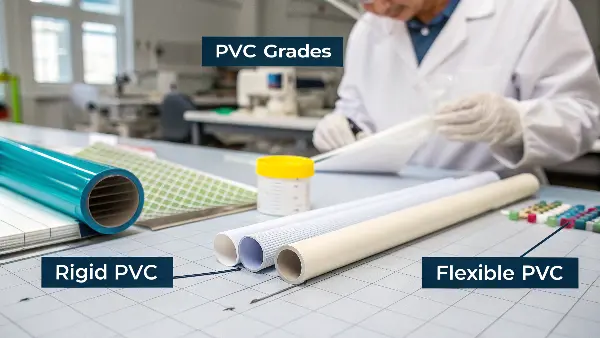
Choosing the right material is one of the most critical decisions you’ll make in any manufacturing project. I’ve seen firsthand how a simple material choice can make or break a product’s success. It’s not just about the plastic itself; it’s about how that plastic performs in the real world, how it holds up over time, and whether it delivers the value your customers expect. Let’s break down PVC in a way that makes sense, so you can pick the perfect grade for your next project.
What Exactly is PVC Material for Injection Molding?
You’ve probably heard of PVC, but do you know what makes it so versatile for manufacturing? It’s easy to see it as just another plastic, but this assumption can lead to costly design flaws. Without understanding its basic makeup, you might choose a formulation that cracks under pressure or deforms in its working environment, forcing expensive redesigns and tooling adjustments.
Polyvinyl Chloride (PVC) is a synthetic polymer made from vinyl chloride. For injection molding, it’s rarely used in its pure form. Instead, it’s a compound mixed with various additives to achieve specific properties. The most important additive is a plasticizer, which determines if the PVC is rigid (uPVC, with no plasticizer) or flexible (PVC-P). Other additives include stabilizers for heat resistance, lubricants for mold flow, and fillers for strength and cost reduction. This customizability is what makes PVC so useful.
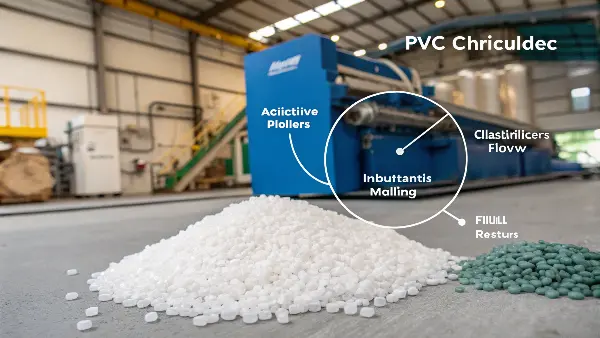
To really understand PVC, you have to think of it not as a single material, but as a base for a custom recipe. The magic happens with the additives. Early in my career, I worked with a client, Michael, who was developing a new line of outdoor electrical enclosures. He initially specified "PVC" because he knew it was durable and weather-resistant. But he didn’t specify the grade. The first prototypes we made used a standard, indoor-grade rigid PVC. They looked great, but failed miserably in UV exposure tests—they became brittle and yellowed within weeks.
We had to go back to the drawing board. I explained that for his application, he needed a uPVC formulation with special additives. We needed UV stabilizers to protect against sunlight and impact modifiers to handle temperature swings without cracking. By adjusting the "recipe," we created a compound perfect for his needs. This experience taught me a valuable lesson: the term ‘PVC’ is just the starting point. The real work is in defining the additives that will make it perform.
Here’s a simple breakdown of the common ingredients in a PVC compound:
| Additive | Primary Function | Impact on Injection Molding |
|---|---|---|
| Plasticizers | Increases flexibility and softness | Makes the material flow easier, but can affect cycle |
| Heat Stabilizers | Prevents degradation during high-heat processing | Crucial for preventing burns and defects in the part |
| Lubricants | Improves melt flow and release from the mold | Reduces friction and helps prevent short shots |
| Fillers | Adds bulk, increases strength, reduces cost | Can affect surface finish and increase melt viscosity |
| Impact Modifiers | Improves toughness and resistance to cracking | Essential for parts that will endure physical stress |
| Pigments | Provides color | Must be heat-stable to avoid discoloration |
Understanding this table is key. When you send a quote request, don’t just ask for PVC. Think about whether your part needs to be flexible, if it will be used outdoors, or if it needs to withstand impact. Giving your molder this information helps us select or create the perfect PVC recipe for your product.
What Are the Main Types of PVC Used in Manufacturing?
You need a PVC part, but which kind? Choosing between rigid and flexible seems simple, but getting it wrong can be disastrous. Imagine designing a sturdy housing with flexible PVC—it would bend and offer no protection. Or making a soft, pliable grip from rigid PVC—it would be hard and uncomfortable. This confusion can easily lead to a product that doesn’t function as intended, resulting in customer complaints and a damaged reputation.
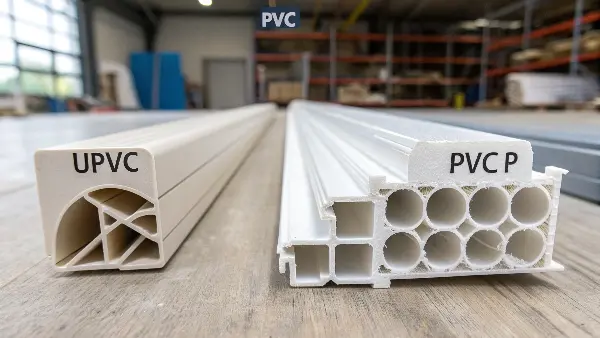
The two primary types of PVC are Unplasticized Polyvinyl Chloride (uPVC), also known as rigid PVC, and Plasticized Polyvinyl Chloride (PVC-P), known as flexible PVC. uPVC is hard, durable, and has excellent chemical resistance, making it ideal for construction materials like pipes and window profiles. PVC-P contains plasticizers that make it soft and flexible, suitable for products like electrical cable insulation, flooring, and inflatable structures. The amount of plasticizer directly controls the material’s final hardness and flexibility.
Beyond these two main categories, there are other specialized types you might encounter. It’s helpful to know about them because they solve specific engineering challenges. For instance, I once had a project for a medical device company. They needed tubing that could handle higher temperatures than standard flexible PVC during sterilization. We couldn’t use regular PVC-P. Instead, we used a specialty grade that could withstand the heat without leaching chemicals or degrading.
This highlights the importance of matching the PVC type to the application’s demands. Here’s a deeper look at the main types and some important variations:
Rigid PVC (uPVC)
This is PVC in its most basic, strong form. Without plasticizers, the polymer chains are packed tightly together, creating a rigid and durable material. It’s known for its excellent resistance to chemicals, water, and weathering. You see it everywhere in construction.
- Pros: High stiffness, strong, low cost, great chemical resistance.
- Cons: More brittle than other plastics, can be sensitive to UV light without stabilizers.
Flexible PVC (PVC-P)
This is what most people think of when they hear "vinyl." By adding plasticizers, we push the polymer chains apart, which allows them to move and slide against each other. This creates a soft, flexible material. The more plasticizer you add, the softer the PVC becomes.
- Pros: Very flexible, good electrical insulation, can be made crystal clear.
- Cons: Can become stiff in cold temperatures, some plasticizers have environmental concerns.
Specialized PVC Types
For more demanding jobs, engineers have developed other versions:
- CPVC (Chlorinated Polyvinyl Chloride): We add more chlorine to the PVC polymer. This makes it able to withstand much higher temperatures and pressures, so it’s often used for hot water pipes.
- PVC-O (Molecularly Oriented PVC): During manufacturing, the PVC-O pipe is stretched. This aligns the polymer chains, making the pipe incredibly strong and tough, even with thinner walls. It’s a great choice for high-pressure water mains.
Here is a quick comparison to help you see the differences:
| Property | uPVC (Rigid) | PVC-P (Flexible) | CPVC (Chlorinated) |
|---|---|---|---|
| Feel | Hard and stiff | Soft and rubbery | Hard and stiff (like uPVC) |
| Primary Use | Pipes, window frames, siding | Cables, flooring, medical tubes | Hot water pipes, industrial piping |
| Temp. Resistance | Up to 60°C (140°F) | Similar to uPVC, but gets brittle when cold | Up to 90°C (194°F) or more |
| Key Advantage | Low cost and high strength | High flexibility and versatility | Excellent heat and chemical resistance |
When you’re thinking about your project, start here. Does the part need to be stiff like a rock, or flexible like a hose? Answering that one question will immediately narrow down your material choice and put you on the right path.
How Are PVC Grades Classified for Injection Molding?
You know you need rigid or flexible PVC, but how do you specify the exact grade? Suppliers list codes like "K-value" or "Shore hardness," which can be confusing. If you pick a grade with the wrong melt flow, your parts could have defects. If you choose the wrong hardness, your product won’t feel right to the end-user. This lack of specific knowledge can lead to inconsistent quality and production headaches.
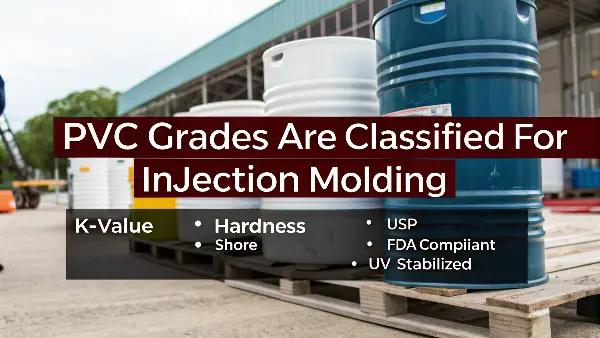
PVC grades for injection molding are classified primarily by K-value, hardness, and application-specific standards. The K-value indicates the polymer’s molecular weight, which affects its strength and processing temperature. Hardness is measured on the Shore scale (A for flexible, D for rigid) and defines the material’s feel and stiffness. Finally, grades can be certified for specific uses, such as medical-grade (USP Class VI), food-grade (FDA compliant), or UV-stabilized for outdoor applications. Providing these specifications ensures you get the exact performance you need.
Drilling down into these specifics is where professional molders add real value. I remember a customer, an entrepreneur developing a new type of ergonomic handle for garden tools. He wanted a "soft, grippy feel" but didn’t know how to specify it technically. He just knew what he wanted the final product to be like. We worked together, creating several prototypes using flexible PVC grades with different Shore A hardness values.
We started with a Shore A 70, which felt a bit too firm. Then we tried a Shore A 50, which was too squishy and felt cheap. Finally, we settled on a Shore A 60. It had the perfect balance of softness for comfort and firmness for control. This process of testing and feeling the material was essential. Technical data sheets are important, but sometimes you have to physically hold the part to know if it’s right. It showed him that "soft" isn’t a technical spec—Shore A 60 is.
Here’s a practical guide to the key classification metrics for PVC:
1. K-Value (Molecular Weight)
The K-value is a number that tells us about the length of the PVC polymer chains.
- Low K-Value (e.g., K57-K60): Shorter chains. This means the PVC melts at a lower temperature and flows more easily into the mold. It’s good for complex parts with thin walls but might be slightly weaker.
- High K-Value (e.g., K65-K70): Longer chains. This PVC is tougher and stronger but requires higher processing temperatures and pressures. It’s used for parts that need high durability, like pressure pipes.
2. Shore Hardness
This is how we measure the "softness" or "hardness" of the material.
- Shore A Scale: Used for flexible PVC. The numbers range from very soft (Shore A 40) to semi-rigid (Shore A 95). A rubber band might be around Shore A 25, while a car tire is around Shore A 70.
- Shore D Scale: Used for rigid PVC (uPVC) and other hard plastics. A hard hat is typically around Shore D 75.
3. Application-Specific Grades
Many industries have standards that materials must meet.
- Medical Grade: Must be biocompatible and often needs to meet standards like USP Class VI. This ensures it’s safe for contact with the human body.
- Food Grade: Must comply with FDA regulations, ensuring no harmful substances will leach into food.
- UV-Stabilized Grade: Contains additives to prevent sunlight from making the PVC brittle or discolored. Essential for any product used outdoors.
When you’re writing your product specifications, think in these terms. Instead of saying "a strong plastic," say "uPVC with a K-value of 67." Instead of "a soft handle," specify "Flexible PVC with a Shore A hardness of 60." This clear communication eliminates guesswork and ensures you get consistent, high-quality parts every time.
Is PVC Always the Best Choice for Injection Molding?
With its low cost and versatility, it’s tempting to default to PVC for every project. But is it always the right tool for the job? Using PVC in an application where another plastic would perform better can lead to premature product failure. For example, using it in a high-temperature environment could cause warping, while using it for a snap-fit enclosure might lead to cracking. Choosing the wrong material can be a costly mistake.
No, PVC is not always the best choice. While it is excellent for its chemical resistance, durability, and low cost, it has limitations. Other plastics like Polypropylene (PP), ABS, and Polycarbonate (PC) offer distinct advantages in certain areas. For example, PP has better fatigue resistance for living hinges, ABS offers a better surface finish and impact strength for consumer electronics, and PC provides superior toughness and heat resistance for demanding applications like safety glasses. The best plastic depends on balancing cost, strength, temperature resistance, and appearance.
Making the right material selection is a strategic decision. As a business owner myself, I’m always thinking about the total cost of ownership, not just the price per kilogram of resin. I once consulted for a company making children’s toys. They were using rigid PVC for some click-together building blocks. The cost was low, but they were getting customer complaints about the blocks cracking at the connection points after repeated use.
I suggested they switch to ABS (Acrylonitrile Butadiene Styrene). Yes, the material cost was slightly higher, but ABS has much better impact strength and a bit more flexibility, making it perfect for snap-fit features. The change almost eliminated the breakage problem. Their customer satisfaction went up, and returns went down. The small increase in material cost was easily offset by the savings from fewer returns and a stronger brand reputation. This is a perfect example of why looking beyond PVC is sometimes the smartest business move.
To help you make an informed choice, here’s a comparison of PVC with other common injection molding plastics:
| Feature | PVC (Rigid/Flexible) | Polypropylene (PP) | ABS | Polycarbonate (PC) |
|---|---|---|---|---|
| Cost | Very Low | Low | Medium | High |
| Key Strengths | Excellent chemical/water resistance, flame retardant, versatile (rigid or flexible). | Excellent fatigue resistance (living hinges), lightweight, good chemical resistance. | High impact strength, good stiffness, excellent surface finish. | Extremely high impact strength, high heat resistance, transparent. |
| Weaknesses | Lower heat resistance, can be brittle (uPVC), environmental concerns over chlorine. | Poor UV resistance (unless stabilized), can be brittle in the cold, harder to bond. | Poor solvent resistance, low UV resistance (unless capped). | Prone to scratching (unless coated), requires high processing temps. |
| Common Uses | Pipes, window frames, electrical cables, medical tubing, flooring. | Packaging, containers, automotive parts, living hinge caps, furniture. | Consumer electronics housings (laptops, phones), Lego blocks, car dashboards. | Eyeglass lenses, safety helmets, reusable water bottles, machine guards. |
| When to Choose It | When you need low cost and excellent resistance to chemicals or water. | When your part has a living hinge or needs to be very lightweight and cheap. | When you need a good balance of toughness, stiffness, and a high-quality finish. | When your part needs to survive extreme impacts or high temperatures. |
Ultimately, there is no single "best" plastic. The best choice is the one that meets your product’s specific performance requirements at a cost that makes sense for your business. Start by listing your "must-haves"—does it need to be clear? Can it break if dropped? Will it be used near a heat source? Answering these questions will guide you to the right material, whether it’s PVC or something else entirely.
Conclusion
Choosing the right PVC grade for your injection molding project boils down to understanding your specific needs. Start by deciding between rigid uPVC for strength or flexible PVC-P for adaptability. Then, narrow it down by specifying technical details like K-value and Shore hardness to define performance. While PVC is a fantastic, low-cost option, always compare it against other plastics like ABS or PP to ensure you’re making the most effective choice for your product’s success.