
Have you ever designed a perfect plastic part, only to see it ruined by a terrible paint job or a smudged logo? It’s frustrating when the final finish doesn’t match your vision, leading to rejected parts and wasted budgets. The problem often isn’t the paint or ink itself, but the surface texture you specified in the mold design. Understanding this link is key to avoiding costly post-production headaches and achieving a flawless final product.
The texture of a plastic part is critical for secondary operations like painting, printing, and plating because it directly controls adhesion and final appearance. A slightly roughened surface, such as an SPI-C1 or a light VDI texture, creates more surface area for paint and ink to grip onto, promoting strong mechanical bonding. However, too much texture can trap air, cause uneven coating thickness, and distort printed graphics. For plating, a very smooth, defect-free surface is essential for achieving a uniform, mirror-like finish.
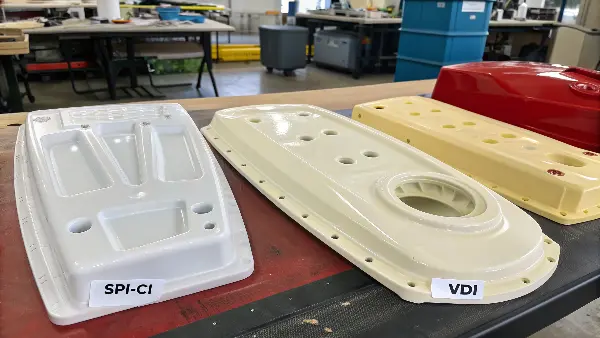
Getting the final look of a product right is where the magic happens. It’s what the customer sees and touches. I’ve seen countless projects where the engineering was brilliant, but the product failed in the market because the final finish felt cheap or looked poorly executed. The secret isn’t just in the secondary process itself; it’s about preparing the part for that process right from the mold design stage. Your choice of surface finish is a decision that ripples through the entire manufacturing chain. Let’s dig into how you can make the right choice every time.
How Does Your Surface Finish Choice Impact Paint Adhesion?
Have you ever seen paint peel or flake off a plastic part? It’s a common failure point that can doom a product. This issue often makes designers blame the painting process or the paint quality. But the real culprit is frequently a surface that wasn’t prepared for painting in the first place. You need a texture that allows the paint to form a strong mechanical bond, or you’re just setting yourself up for failure down the line.
The right surface finish creates microscopic peaks and valleys, increasing the surface area and giving the paint something to physically grab onto. A finish that’s too smooth, like a mirror-polished SPI-A1, offers poor mechanical adhesion. Conversely, a light texture, around an SPI-B1 to C1 or a VDI 24-27, is often ideal. It provides enough roughness for the paint to lock in, ensuring a durable, long-lasting coat without being so rough that it affects the final look.
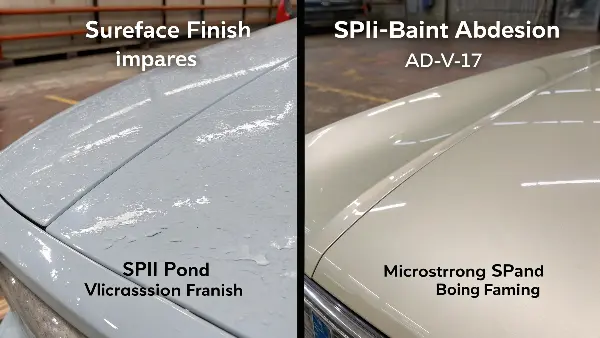
I remember a client years ago who was making high-end electronic enclosures. They insisted on a high-gloss, SPI-A2 mold finish because they wanted the unpainted parts to look premium. The problem was, some units needed to be painted a custom color. The paint just wouldn’t stick properly. We had to explain that for painting, a glossy finish is actually a disadvantage. We had to go back and lightly texture the mold, which solved the problem completely. This is a classic example of how thinking about the final step first is so important. Let’s break down how surface roughness, tooling, and material choice all play a part in getting your paint to stick.
The Science of Sticking: Mechanical vs. Chemical Bonding
The goal is to get the paint to stay put. This happens through two main forces: mechanical adhesion and chemical bonding. For most plastics, mechanical adhesion is your best friend.
- Mechanical Adhesion: Think of this like Velcro. A rougher surface has tiny hooks and crannies. The paint flows into these and hardens, physically locking itself onto the part.
- Chemical Bonding: This involves a chemical reaction between the paint and the plastic surface. It’s much stronger but harder to achieve. It often requires primers or special surface treatments like plasma or flame treatment, especially on low-surface-energy plastics like Polypropylene (PP) or Polyethylene (PE).
Your mold finish directly controls the potential for mechanical adhesion.
Finding the Sweet Spot for Paint
Too smooth is bad, but too rough can also cause problems. An overly aggressive texture can lead to an "orange peel" effect in the paint, where the final surface looks uneven and unprofessional. You need just enough texture to grip, but not so much that it shows through the paint.
Here’s a simple guide for choosing a texture based on the VDI 3400 standard:
| VDI Grade | Surface Roughness (Ra, µm) | Typical Application for Painting |
|---|---|---|
| VDI 12-18 | 0.40 – 0.80 | Generally too smooth. May require significant priming or surface treatment for good adhesion. |
| VDI 21-27 | 1.12 – 2.24 | Good for general painting. Provides excellent mechanical grip without showing significant texture. |
| VDI 30-33 | 3.15 – 4.50 | Use with caution. Best for thicker coatings or when a textured final appearance is desired. |
| VDI 36+ | 6.30+ | Not recommended. Texture is too deep and will likely cause uneven paint coverage and trap air. |
Ultimately, you are looking for that perfect balance. My go-to recommendation for most projects is a VDI 24 or 27. It’s a proven range that gives painters a great starting point, reduces the need for extra surface prep, and delivers a consistent, high-quality finish.
What Is the Perfect Texture for Flawless Printing on Plastic Parts?
You’ve designed a beautiful logo, but when it’s printed on your product, the edges are fuzzy and the details are lost. It’s incredibly frustrating. This smudging or poor definition is often due to an incompatible surface finish. The ink spreads, bleeds, or fails to transfer cleanly because the texture isn’t right for the printing method. Choosing the correct surface finish is the first step to ensuring your graphics look as sharp on the part as they do on your screen.
For high-quality, sharp printing, a smoother surface is generally better. The ideal finish is usually a semi-gloss or light matte, such as an SPI-B1 or VDI 21. This surface is smooth enough to allow for precise ink transfer without bleeding, yet it’s not so glossy that it causes adhesion issues. For methods like pad printing, a slight texture can help the ink release from the pad, but anything too rough will distort the image and make fine details impossible to reproduce.
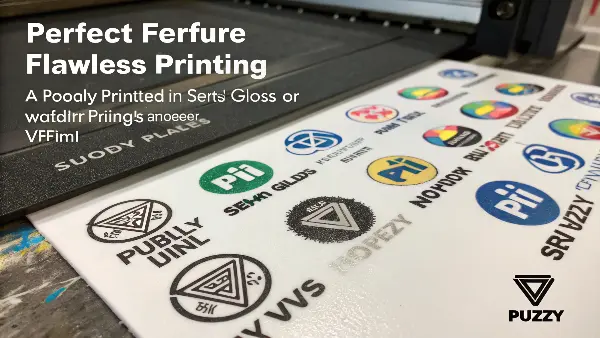
I worked on a project for a medical device that had critical warning symbols printed on it. The initial prototypes came back with blurry text. The designer had specified a VDI 30 texture for a better grip, but it was wrecking the legibility. We had to create a polished "island" in the mold where the printing would occur. This is a common strategy: using a different texture in a specific area just for printing. It adds a bit of complexity to the mold, but it ensures you get the best of both worlds—a good feel for the part and perfect, crisp graphics where they matter most.
Matching the Finish to the Printing Method
Not all printing processes are the same. The one you choose will have a big impact on the surface finish you need. The two most common methods for plastic parts are pad printing and screen printing.
- Pad Printing: A flexible silicone pad picks up ink from an etched plate and transfers it to the part. Because the pad is soft, it can conform to slightly curved or textured surfaces. However, for fine detail, a smoother surface is still best. A very light matte finish helps the ink release from the pad cleanly.
- Screen Printing: Ink is pushed through a mesh screen onto a flat or cylindrical surface. This method deposits a thicker layer of ink, which can sometimes fill in small textures. However, it requires a relatively flat and smooth area to get a clean print without gaps or fuzzy edges.
Texture Guidelines for Printing
Here’s how different surface finishes can affect your printing results. Think about the level of detail you need.
| SPI Finish | Description | Pad Printing Suitability | Screen Printing Suitability |
|---|---|---|---|
| A1-A3 | High to Good Gloss | Good for detail, but some inks may have trouble adhering. | Difficult. Ink can bead up or have adhesion problems. |
| B1-B3 | Semi-Gloss / Matte | Excellent. The "sweet spot" for sharp details and adhesion. | Very Good. Provides a great surface for clean ink transfer. |
| C1-C3 | Light Matte / Stone | Fair. Fine details and small text will start to lose clarity. | Poor. The uneven surface makes a clean print very difficult. |
| D1-D3 | Textured / Blasted | Poor to Unsuitable. Only for large, simple graphics. | Unsuitable. The screen cannot make proper contact. |
Pro-Tip: The "Polished Island"
What if your design requires a grippy texture but also a sharp logo? You don’t have to compromise. Talk to your mold maker about creating a "polished island." This involves polishing a specific, localized area of the mold cavity where the printing will occur, while leaving the rest of the mold with the desired texture. I’ve used this trick on dozens of projects, from remote controls to power tools. It’s a simple and effective way to ensure your branding always looks crisp, no matter the overall finish of the part.
Can You Really Achieve a Good Plated Finish on a Textured Surface?
You want the premium, metallic look of plating, but your design also calls for a textured grip. This puts many designers in a tough spot. They worry that plating a textured part will result in an uneven, blotchy mess, or that they have to sacrifice their desired texture for a smooth, mirror-like finish. It feels like you can’t have both. But is that actually true? Can you successfully combine texture with plating?
No, you cannot achieve a good, mirror-like chrome plating on a heavily textured surface. The plating process involves depositing a thin, uniform layer of metal, which magnifies every tiny imperfection on the base surface. For a classic bright chrome finish, the plastic part must be exceptionally smooth, equivalent to an SPI-A1 or diamond-buffed finish. Any texture will be visible and will disrupt the reflective quality, resulting in a dull or satin appearance instead of a mirror finish.
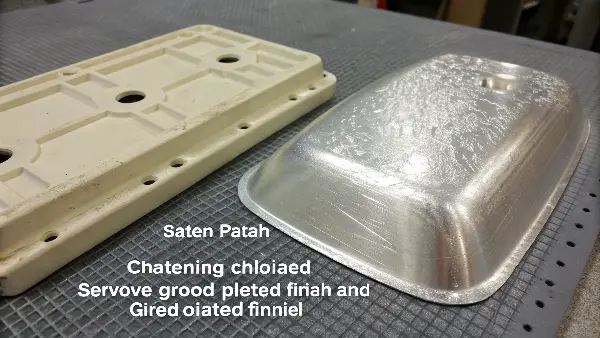
This is one area where there is very little room for error. I learned this the hard way on an early automotive project. We were designing an interior trim piece. The designer wanted a VDI 30 texture but also a bright chrome accent on a section of the part. We tried to plate the whole thing, hoping the chrome would "fill in" the texture. It was a disaster. The plated area looked frosty and cheap. The metal layer followed the texture perfectly, killing any mirror effect. The lesson was clear: for bright chrome, the surface underneath has to be flawless.
Why Plating Demands Perfection
Electroplating is a multi-step chemical process where metal ions are deposited onto a conductive surface. For plastics (which are not conductive), this first involves an electroless plating step (usually with nickel) to create a conductive base layer.
Here’s why texture is the enemy of a mirror finish:
- Magnification of Flaws: The thin, uniform layers of copper, nickel, and chrome act like a magnifying glass for the substrate. Any scratch, sink mark, or texture on the plastic will be highlighted, not hidden, by the plating.
- Light Reflection: A mirror finish works by reflecting light in a single, coherent direction. A textured surface, no matter how small the bumps, scatters the light in many directions. This is what creates a satin, matte, or frosty look.
- Cleaning and Activation: The pre-plating chemical baths must thoroughly clean and etch the surface. A deep texture can trap air bubbles or chemicals, leading to bare spots or poor adhesion of the metal layers.
What If You Want a Non-Mirror Finish?
While you can’t get a mirror finish on a texture, you can plate a textured surface to get other interesting metallic looks. This is often called "satin chrome" or "brushed chrome."
| Surface Finish Goal | Required Mold Finish | Appearance |
|---|---|---|
| Mirror Chrome | SPI-A1 / Diamond Polish (Ra < 0.05 µm) | Highly reflective, brilliant, mirror-like. |
| Bright Satin | SPI-B1 or VDI 18 (Ra ~0.8 µm) | Bright, but with a soft, diffused reflection. Hides fingerprints well. |
| Dull Satin | SPI-C1 or VDI 24-27 (Ra ~1.12-2.24 µm) | A low-gloss metallic finish. The texture is visible through the plating. |
| Textured Metallic | Deeper Textures (VDI 30+) | The original part texture is the dominant feature, with a metallic color and sheen. |
So, you can plate a textured surface, but you must manage your expectations. You are not creating a mirror; you are coating a texture with metal. This can be a desired aesthetic, especially in automotive interiors or consumer electronics where a non-reflective, premium metal feel is wanted. But if the goal is a classic, brilliant chrome finish, the only answer is a perfectly polished, SPI-A1 surface.
How Does Surface Roughness Control the Final Look of a Coating?
You chose a specific color and gloss level for your product, but the final painted parts don’t match the sample chip. The color looks darker, and the gloss is all wrong. This disconnect happens when you don’t account for how the underlying surface texture interacts with light and paint. The roughness of your part can dramatically alter the perception of both color and gloss, leading to a finish that misses the mark and fails to meet customer expectations.
Surface roughness controls the final look by changing how light reflects off the coated surface. A smooth substrate allows for a high-gloss finish because light reflects uniformly (specular reflection). A rougher substrate scatters light in many directions (diffuse reflection), which makes the color appear darker and the finish look matte. Even with a high-gloss paint, a textured base will always result in a lower-gloss appearance because the underlying topography is still present.
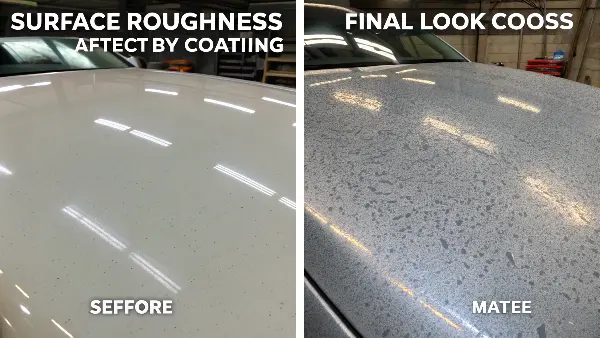
This is something that often surprises designers. I once had a client who was furious because the "fire-engine red" they specified for their product housing came out looking like a "dull brick red." They were ready to reject a huge batch of parts. I asked to see the master part they approved. It was a smooth, polished 3D print. The production parts, however, were molded with a VDI 27 texture for durability. Putting them side-by-side, it was obvious: the texture was scattering the light, absorbing more of it, and making the red appear darker and less vibrant.
The Physics of Gloss and Color Perception
It all comes down to how light behaves when it hits a surface. Imagine throwing a thousand tennis balls at a smooth wall versus a rocky cliff.
- On a Smooth Surface (e.g., SPI-A Finish): The light reflects in a predictable, single direction. This is called specular reflection. Our eyes perceive this as "gloss" or "shine." The color appears bright and saturated because the light is returned to our eyes efficiently.
- On a Rough Surface (e.g., VDI Finish): The light hits the countless microscopic peaks and valleys and scatters in every direction. This is diffuse reflection. This scattering makes the surface appear non-shiny, or "matte." Because less light is reflected directly back to the observer, the color is perceived as being darker or less intense.
Practical Impact on Your Design
This isn’t just theory; it has a direct impact on your part specifications. The thickness of the coating matters, but often not as much as you’d think. A standard layer of paint is only about 25-50 microns thick. A VDI 30 texture has features that are much deeper than that. The paint will coat the texture, but it won’t fill it in and make it smooth.
Here’s how to think about it when planning your finish:
| Desired Final Appearance | Substrate Texture Recommendation | Why It Works |
|---|---|---|
| High-Gloss, Vibrant Color | SPI-A or SPI-B (Smooth to Semi-Gloss) | Minimizes light scattering, allowing the paint’s true gloss and color to shine through. |
| Satin or Eggshell Finish | SPI-C or Light VDI (e.g., VDI 21-27) | Introduces just enough light scatter to cut down the gloss without significantly darkening the color. |
| Deep Matte Finish | Medium VDI (e.g., VDI 30-33) or a Bead Blast Finish | Maximizes diffuse reflection. The texture itself creates the matte look, not just the paint. |
| Textured Look | The texture that you want to see (e.g., Leather, Wood Grain) | Here, the paint’s job is to add color, but the physical texture of the mold provides the primary aesthetic. |
The key takeaway is this: you cannot paint a matte surface glossy. If you apply a gloss paint to a textured part, you will get a textured part that is shiny, not a smooth, glossy part. Always prepare your master color chips and approval samples on a plaque with the exact same surface texture as your final production part. This will save you from very expensive misunderstandings down the road.
Conclusion
The surface finish you choose in the mold is not just a minor detail; it is a foundational decision that dictates the success of all secondary operations. Whether you are painting, printing, or plating, the texture of your part will control adhesion, clarity, and the final aesthetic. By planning for these finishing steps from the very beginning, you can ensure your products not only function perfectly but also look and feel exactly as you intended.