
Choosing the right flexible material for your product can feel overwhelming. A wrong choice could lead to early product failure, customer complaints, and costly re-tooling. This isn’t just a technical problem; it’s a business problem that can damage your brand’s reputation. Let me help you navigate this complex family of materials so you can select the suitable one with confidence and avoid these expensive mistakes.
TPE often describes thermoplastic elastomers generally, while TPR is frequently used for styrenic-based rubber grades. These materials can offer soft touch, color, processability and overmolding options, but oil, heat, compression set, tear and bond performance vary significantly by formulation.
Related CKMOLD resources: insert molding and overmolding, production injection molding, mold design.
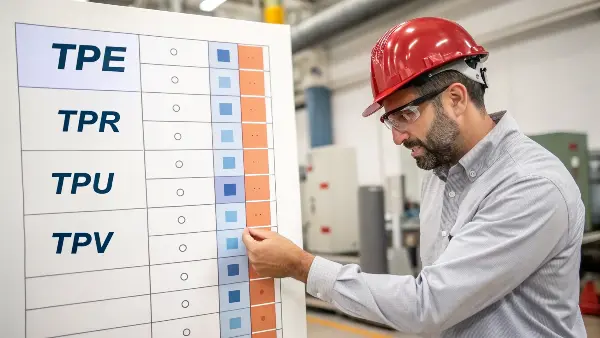
The key differences lie in their chemical composition, which dictates performance. TPE (Thermoplastic Elastomer) is a broad family name. TPR (Thermoplastic Rubber) is often a cost-effective, styrenic-based TPE. TPU (Thermoplastic Polyurethane) is prized for its exceptional toughness, abrasion resistance, and elasticity. TPV (Thermoplastic Vulcanizate) is a dynamically vulcanized alloy, offering excellent heat resistance, chemical resistance, and long-term sealing performance, making it a high-performance rubber replacement.
What Exactly Is a Thermoplastic Elastomer (TPE)?
You hear the term “TPE” used for all sorts of flexible materials, which can create a lot of confusion. This lack of clarity often leads to miscommunication with suppliers and specifying a material that isn’t quite right for the job. Let’s clear the air by defining what TPE is and why it serves as the foundation for this entire family of versatile materials.
TPE, or Thermoplastic Elastomer, refers to a class of materials that blends the processing ease of thermoplastics with the flexible, rubber-like properties of elastomers. Essentially, you get a material that can be melted and molded like plastic but behaves like rubber at room temperature. This unique duality makes TPEs incredibly versatile and suitable for countless applications, from soft-touch grips on power tools to flexible seals on consumer goods.
To really understand TPEs, think of them as a hybrid. On one side, you have traditional thermoset rubber, which, once cured (vulcanized), can’t be melted and reshaped. On the other side, you have rigid thermoplastics like polypropylene or ABS. TPEs bridge this gap. They are made of a mix of hard and soft polymer phases. The hard phase gives it processing stability and strength, while the soft phase provides elasticity.
I like to think of the general TPE category as a “base recipe” in a kitchen. It’s a fantastic starting point, but you can add different ingredients to create specialized materials. These special versions are what we know as TPR, TPU, and TPV. Each one takes the fundamental TPE concept and enhances specific properties.
Key Characteristics of the General TPE Family:
| Property | Description |
|---|---|
| Processing | Can be processed on standard thermoplastic equipment (injection molding). |
| Recyclability | Fully recyclable, as scrap can be re-melted and reused. |
| Hardness Range | Wide range available, from very soft (gel-like) to semi-rigid. |
| Colorability | Easily colored with standard masterbatches. |
| Overmolding | Excellent for overmolding onto rigid plastics like PP, ABS, and PC. |
Understanding this foundation is the first step.
How Is TPR Different From a Standard TPE?
It’s very common for people in the industry to use the terms TPE and TPR interchangeably. While they are closely related, assuming they are the same can lead you to choose a material that either underperforms or is unnecessarily expensive for your application. So let’s pinpoint the subtle but important distinctions between these two closely related materials.
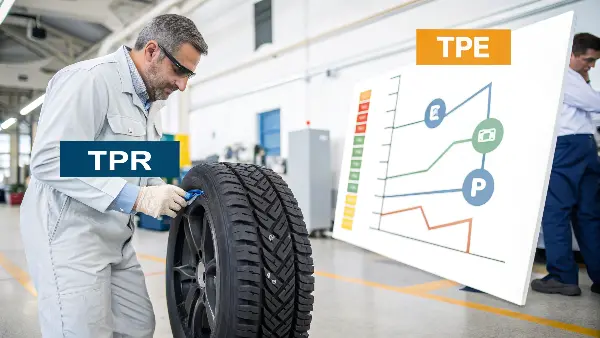
TPR, or Thermoplastic Rubber, is technically a type of TPE. The term most often refers to TPEs made from styrenic block copolymers (SBC), like SBS or SEBS. The key difference is often one of formulation and common usage. TPR generally implies a cost-effective, general-purpose material with a classic “rubbery” feel, suitable for applications like toy wheels, tool grips, and shoe soles where high heat or chemical resistance isn’t needed.
Choosing Between General TPE and TPR:
- Use TPR (specifically SBS-based) when: Cost is the primary driver, and the application is for indoor, non-critical parts like simple grips, coasters, or novelty items.
- Use a higher-grade TPE (like SEBS-based TPR) when: You need better durability, UV resistance, and a better feel for consumer products, but don’t need the extreme performance of TPU or TPV.
When Should You Choose TPU For Its Superior Durability?
Your product needs to be tough. It has to withstand being dropped, scraped, and stretched without failing. Standard TPEs or TPRs might be too soft or tear too easily, leading to a product that doesn’t live up to its promise of durability. This is where you need a material engineered specifically for resilience and strength.
You should choose TPU (Thermoplastic Polyurethane) when your application demands exceptional abrasion resistance, tear strength, and elasticity. TPU excels in dynamic applications that require toughness and flexibility, such as caster wheels, power tool components, protective phone cases, and drive belts. Its unique polymer structure gives it a superior ability to absorb impact and resist wear and tear far better than standard TPEs.
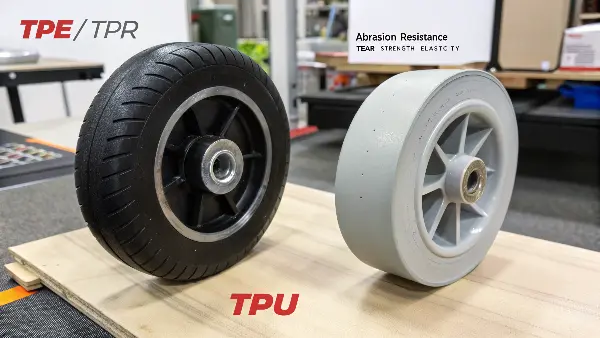
TPU stands apart from other TPEs because of its unique block copolymer structure. This structure creates alternating hard and soft segments that give it a fantastic combination of properties. The hard segments provide rigidity and toughness, while the soft segments deliver elasticity and flexibility. This is why a TPU phone case can be slim and sleek yet offer amazing impact protection.
Deciding on TPU: Key Performance Factors
| Performance Metric | TPU vs. Other TPEs |
|---|---|
| Abrasion Resistance | Exceptional. Significantly better than TPE, TPR, and TPV. |
| Tear Strength | Excellent. Resists tearing and propagation of cuts. |
| Tensile Strength | High. Can withstand significant pulling forces before breaking. |
| Oil & Grease Resistance | Very Good. Maintains integrity when exposed to many oils and solvents. |
| Temperature Range | Good low-temperature flexibility, but upper limits are lower than TPV. |
If your product’s success depends on it being tough, long-lasting, and able to withstand physical abuse, TPU is often the right answer.
What Makes TPV the Best Choice for High-Performance Applications?
Sometimes, good enough isn’t good enough. You might be designing a critical seal for an automotive engine or a part for medical equipment that needs to withstand harsh chemicals and high temperatures. In these cases, a standard TPE or even a tough TPU won’t cut it. You need a material that offers the sealing performance of rubber with the processing advantages of plastic.
TPV (Thermoplastic Vulcanizate) is the best choice for high-performance applications that require excellent chemical resistance, high-temperature performance, and long-term sealing ability. TPV is a special blend of a thermoplastic (like polypropylene) and a rubber (like EPDM) that has been dynamically vulcanized during compounding. This process creates a material with the robust performance of thermoset rubber but with the design flexibility and recyclability of a thermoplastic.
The magic of TPV is in the “dynamic vulcanization” process. Imagine you have a bowl of melted plastic (polypropylene) and you stir in tiny particles of rubber (EPDM). As you stir, you add a curing agent that cross-links the rubber particles. The result is a material where a network of stable, cured rubber particles is finely dispersed within a continuous plastic matrix. This gives you the best of both worlds: the plastic phase allows it to be melted and injection molded, while the vulcanized rubber phase provides superior compression set, heat resistance, and sealing.
When to Specify TPV:
- Automotive: Under-hood seals, gaskets, air ducts, and boots that see high heat and oil exposure.
- Industrial: Seals and gaskets for pumps and machinery, high-flexibility hoses, and vibration dampeners.
- Appliances: Seals for dishwashers and washing machines where heat and detergent resistance are key.
- Medical: Diaphragms, seals, and tubes that require chemical resistance and sterilization compatibility.
If your part acts like a traditional rubber component but you want the efficiency of thermoplastic processing, TPV is the premium material you’re looking for.
How Do You Select the Right Material for Your Project?
You now understand the key players in the TPE family. But theory is one thing; making the final call for your specific project is another. Choosing incorrectly can mean a functional failure or simply spending too much on a material when a cheaper alternative would have worked just fine. Let’s create a clear framework to help you make the right decision confidently.
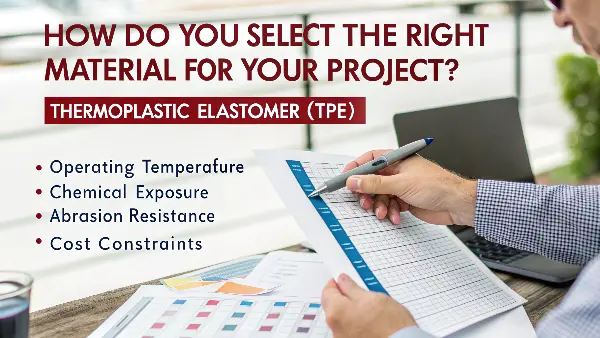
To select the right thermoplastic elastomer, you must systematically evaluate your project’s core requirements against each material’s strengths. Start by defining your non-negotiables: What is the operating temperature? What chemicals will it face? Does it need to resist abrasion? Is cost a primary driver? By answering these questions, you can quickly narrow down the choices from the broad TPE family to the specific grade that meets your performance and budget targets.
I guide my clients through a simple, four-step decision process. It helps cut through the noise and focuses on what truly matters for their product. It prevents over-engineering (paying for performance you don’t need) and under-engineering (having the part fail in the field).
A 4-Step Decision Framework:
-
Define the Operating Environment:
- Temperature: Will the part be in an engine bay (needs TPV) or an office (TPE/TPR is fine)?
- Chemical Exposure: Will it contact oils, acids, or cleaning agents? TPV and TPU offer superior resistance.
- UV Exposure: Is it an outdoor product? A SEBS-based TPE or a UV-stabilized TPU/TPV is necessary.
-
Identify Mechanical Requirements:
- Hardness (Durometer): How soft or hard does it need to feel? All TPEs offer a wide range, so this helps refine the grade.
- Abrasion/Tear Resistance: Is the part subject to physical wear and tear? If yes, TPU is your top candidate.
- Compression Set: Does it need to act as a seal and bounce back after being compressed for a long time? TPV is the champion here.
-
Consider Manufacturing and Aesthetics:
- Overmolding: Do you need to bond it to a rigid plastic? Check for TPE grades specifically designed for adhesion to your substrate (e.g., PP, ABS, PC).
- Color: Do you need crystal clear transparency or vibrant colors? Some grades offer better clarity and colorability than others.
-
Analyze the Cost:
- Finally, weigh the performance against the budget.
- TPR (SBS-based): Lowest Cost
- TPE/TPR (SEBS-based): Moderate Cost
- TPU: Higher Cost
- TPV: Highest Cost
By methodically going through these steps, you can move from a general query about “flexible plastic” to a specific material grade, ensuring your product is a success from both a performance and a business perspective.
TPE, TPR, TPU and TPV are related flexible-material terms, but they do not describe the same performance or processing behavior. TPE is a broad family, TPR is commonly used for styrenic thermoplastic rubber grades, TPU is polyurethane-based and often valued for abrasion and mechanical performance, while TPV combines a thermoplastic matrix with a crosslinked rubber phase. The exact grade matters more than the abbreviation.
TPE and TPR as Broad or Styrenic Families
TPU for Abrasion and Mechanical Demand
TPU is often selected for abrasion, tear, impact, flexibility and chemical resistance. Hardness, moisture, drying, shear, mold temperature and conditioning affect performance. It can be a strong choice where a soft material must survive repeated mechanical action.
TPV for Heat, Weather and Compression Applications
TPV is often evaluated for seals, gaskets and automotive or industrial components where a balance of elastic recovery, heat, weather and chemical resistance is needed. It may process differently from a styrenic TPE or TPU and requires grade-specific design and validation.
Compare Processing and Bonding
TPE, TPR, TPU and TPV can differ in drying, melt temperature, shrinkage, gate, venting, ejection, regrind and substrate bonding. A material pair that works for one TPE family may fail when the chemistry changes. Test the exact grade and substrate.
Choose From the Failure Mode
Define hardness, compression set, elongation, tear, abrasion, chemicals, heat, UV, odor, skin contact, sealing and service life. Then compare grades using molded samples, not only catalog labels or Shore hardness.
TPE vs. TPR vs. TPU vs. TPV: Buyer Review Checklist
- Define hardness, compression, tear, abrasion, heat, chemical, UV and service requirements.
- Distinguish broad TPE terminology from exact TPR, TPU and TPV grades.
- Review drying, flow, shrinkage, gate, venting, ejection and regrind behavior.
- Test overmold bond or mechanical lock with the actual substrate.
- Validate compression set, aging, abrasion, sealing and dimensions after conditioning.
FAQ
Is TPU a type of TPE?
TPU is a thermoplastic elastomer family based on polyurethane, while TPE is a broader category that includes several chemistries.
Is TPV generally better than TPR?
No. TPV may offer advantages in selected heat, weather or compression applications, while a TPR grade may offer different cost, feel or bonding benefits.
Conclusion
Understanding the thermoplastic elastomer family doesn’t have to be complicated. TPE is the broad category, TPR is your cost-effective workhorse, TPU is the tough and abrasion-resistant hero, and TPV is the high-performance specialist for harsh environments. By matching your product’s specific needs to the unique strengths of each material, you can make smarter, more reliable design choices that will save you time, money, and headaches down the road.