
Struggling to find a material with the flexibility of rubber and the processing ease of plastic? Choosing the wrong material can lead to product failures, costly redesigns, and production delays. Imagine selecting a thermoplastic elastomer (TPE) perfectly suited for your application, ensuring durability, performance, and cost-effectiveness from the start. Let’s walk through how to make that happen.
To choose the right TPE for injection molding, start by defining your product’s key requirements: hardness (durometer), operating temperature, chemical resistance, and UV stability. Then, match these needs with specific TPE grades like TPE-S (SBS/SEBS), TPE-V (TPV), TPE-E (COPE), or TPE-U (TPU). Each type offers a unique balance of properties and cost. Consulting your molder with a detailed spec sheet is crucial for success.
Making the right material choice feels like half the battle won. I’ve seen countless projects succeed or fail based on this single decision. But before we get into the nitty-gritty of different TPE grades, let’s address a more fundamental question that often comes up. It’s a simple one, but it’s the foundation for everything that follows.
Can TPE be injection molded?
Are you considering TPE for your next project but feel unsure if it’s compatible with your injection molding process? This uncertainty can halt innovation and keep you stuck with less-than-ideal materials. What if you could confidently specify TPE, knowing it’s not only possible but often ideal for injection molding, opening up new design possibilities and improving your product’s feel and function?
Yes, Thermoplastic Elastomers (TPEs) are an excellent material for injection molding. Because they are "thermoplastic," they melt when heated and solidify when cooled, just like standard plastics like ABS or Polypropylene. This allows them to be efficiently processed using standard injection molding equipment. Their unique properties combine the flexible, soft-touch characteristics of rubber with the high-volume manufacturing efficiency of plastics, making them a very popular choice for a wide range of applications.
The ability to injection mold TPE is one of its biggest advantages. Unlike traditional thermoset rubbers, which require a much slower and irreversible curing process called vulcanization, TPEs behave more like standard plastics. You can melt and re-melt them. This process efficiency is a huge win for any business owner like Michael who watches production timelines and costs. I remember working with a client who made handheld electronic devices. They were using a two-step process: molding a rigid plastic housing and then manually applying a rubber grip. It was slow and expensive. By switching to a two-shot overmolding process with a rigid plastic and a TPE, we cut their assembly time by 75% and significantly improved the product’s look and feel.
This highlights the key benefits of using TPE in injection molding:
Key Advantages
- Efficiency: Cycle times are much faster compared to thermoset rubbers, leading to higher output and lower per-part costs.
- Design Freedom: TPE allows for complex geometries and features, such as soft-touch grips, living hinges, and integrated seals, that are difficult or impossible with traditional rubber.
- Recyclability: Scrap material and reject parts can often be reground and reused, reducing material waste and improving cost-effectiveness, which is a big deal for sustainability and your bottom line.
How do you choose the right TPE grade for your project?
You know TPE is a good option, but which one? The market is filled with different TPE grades, and picking the wrong one can lead to a product that cracks under pressure, discolors in the sun, or simply feels cheap. You need a reliable method to navigate these options and land on the perfect TPE for your specific needs, ensuring your product performs exactly as designed.
To choose the right TPE grade, you must first create a detailed list of your product’s performance requirements. This involves defining the necessary hardness (durometer), the operating temperature range, and any required resistance to chemicals or UV light. With these specifications, you can compare different TPE families like TPE-S, TPE-V, TPE-E, or TPE-U. For example, if UV resistance and durability are critical, you might lean towards a TPE-V over a standard TPE-S.

Choosing the right TPE is a systematic process, not a guessing game. It always starts with the end product. I never begin a conversation about materials without first asking, "What does this part need to do, and where will it live?" The answer to that question forms the basis of our material selection checklist. It’s like being a detective; you gather all the clues about the application before identifying your suspect, in this case, the perfect material grade. For instance, a simple overmolded handle for an indoor power tool has very different requirements than a weather seal for an outdoor automotive part. The tool handle needs good grip and moderate chemical resistance, while the automotive seal needs exceptional UV resistance, a wide temperature range, and excellent compression set.
Let’s break down the selection process into actionable steps:
Application Requirements Checklist
- Define Mechanical Properties: What is the required hardness (Shore A or D)? Does it need high tensile strength, tear resistance, or abrasion resistance?
- Determine Environmental Exposure: Will the part be used indoors or outdoors? Will it be exposed to sunlight (UV radiation), water, oils, fuels, or cleaning agents?
- Specify Thermal Conditions: What is the maximum and minimum temperature the part will experience during its service life?
- Consider Bonding Needs: Does the TPE need to bond to another plastic substrate, like Polypropylene (PP) or ABS, in an overmolding application?
- Evaluate Aesthetics: Are color, surface finish, and feel important for the end user’s experience?
Once you have this information, you can start narrowing down the options effectively.
What key properties differentiate TPE grades?
You’ve got your requirements checklist, but now you’re facing a wall of technical data sheets with terms like TPE-S, TPE-V, and TPE-U. Feeling overwhelmed by the alphabet soup of options can lead to decision paralysis. What you need is a clear breakdown of what these grades mean and which properties make each one unique, so you can confidently match them to your project’s needs.
The main properties that differentiate TPE grades are their chemical structure, which dictates their performance. For example, TPE-S (styrenic block copolymers) grades like SEBS are excellent for soft-touch grips and offer good colorability but have limited high-temperature performance. TPE-V (TPV) grades are vulcanized alloys that provide superior heat and chemical resistance, behaving much like thermoset rubber. TPE-U (TPU) is known for its exceptional abrasion and tear resistance, making it ideal for high-wear applications.
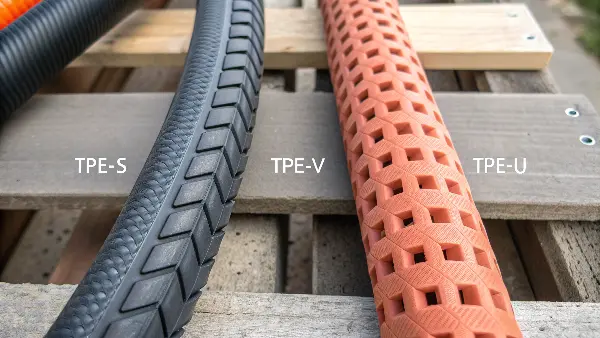
Understanding the different families of TPE is essential. Think of it like choosing the right kind of tire for a car. You wouldn’t put racing slicks on an off-road truck. Each TPE family has its own strengths tailored for specific environments. I once worked with a client developing a new scuba diving mouthpiece. They initially chose a standard TPE-S because it was soft and inexpensive. However, during testing, the material started to degrade from exposure to saltwater and sunlight. We switched them to a high-performance SEBS (a type of TPE-S) with a UV stabilizer package, solving the problem instantly. The initial cost was slightly higher, but it saved them from a product recall down the line. It’s a perfect example of how knowing the nuances between grades can make all the difference.
Let’s look at the most common TPE families in a table to make it clearer:
Common TPE Families and Their Properties
| TPE Family | Key Characteristics | Typical Applications |
|---|---|---|
| TPE-S (SBS, SEBS) | Soft-touch, good grip, excellent colorability, cost-effective. Limited heat/oil resistance. | Tool grips, toothbrush handles, soft toys, knobs & dials |
| TPE-V or TPV (PP+EPDM) | Excellent chemical and heat resistance, good compression set, rubber-like feel. | Automotive seals, pipe gaskets, wire & cable insulation |
| TPE-U or TPU (Polyester/Polyether) | High abrasion, tear, and puncture resistance. Good performance in oil and grease. | Caster wheels, power tool housings, durable phone cases |
| TPE-E or COPE (Copolyester) | High-temperature performance, good chemical resistance, high stiffness and strength. | Bellows, automotive air ducts, springs, shock absorbers |
| TPE-A or COPA (Polyamide) | Excellent heat resistance, good chemical stability, bonds well to Polyamide (Nylon). | Flexible tubing, sports equipment, silent gears |
This chart is my go-to starting point when helping clients narrow down their choices. It simplifies a complex field into a manageable set of options based on core performance needs.
How do you properly mold TPE material?
You’ve successfully selected the perfect TPE grade for your product. Now, the challenge shifts to manufacturing. If your molding parameters are wrong, you could end up with parts that are weak, warped, or have a poor surface finish, wasting all the effort you put into material selection. You need a clear set of guidelines to ensure the material is processed correctly, consistently producing high-quality parts.
To properly mold TPE, you must first ensure the material is thoroughly dried to the manufacturer’s specification, as moisture can cause cosmetic defects. Use a general-purpose screw with a low compression ratio (2.5:1 to 3.5:1) to avoid excessive shear heat. Set barrel temperatures according to the TPE grade’s data sheet, typically ranging from 175°C to 230°C. A moderate injection speed and sufficient back pressure are crucial for achieving a good surface finish and complete mold filling.
Processing TPE is where the theory of material science meets the reality of the factory floor. My insight about drying TPE isn’t just a recommendation; it comes from experience. I’ve seen production runs ruined by splay marks and silver streaking simply because the pellets weren’t dried properly before going into the hopper. Moisture turns to steam at processing temperatures, and that steam gets trapped in the plastic, causing those defects. It’s a simple step that is often overlooked but is absolutely critical for success. You treat TPE with the same care you would a moisture-sensitive engineering plastic like Nylon or Polycarbonate.
Beyond drying, several other parameters are key:
Critical TPE Molding Parameters
- Melt Temperature: This is the single most important variable. Too low, and the material won’t flow properly. Too high, and you risk material degradation, which can make parts brittle. Always start with the supplier’s recommendation and adjust in small increments.
- Mold Temperature: A warm mold (typically 25°C – 60°C) helps improve surface finish and allows the material to flow more easily into thin sections. It also helps control shrinkage and prevents warping.
- Injection Speed and Pressure: TPEs generally prefer a medium to fast injection speed to prevent premature freezing in the mold cavity. The hold pressure should be sufficient to pack out the part and compensate for shrinkage, but excessive pressure can cause flash.
- Venting: Because TPEs are often injected quickly, proper mold venting is crucial. Trapped air can cause burn marks and incomplete filling. Ensure vents are clean and adequately sized.
Getting these parameters dialed in requires a bit of trial and error, but starting with the material supplier’s guide is always the best first step.
Conclusion
Choosing the right TPE and molding it correctly is a process of careful planning and execution. By defining your product’s needs, understanding the differences between TPE grades, and following key processing guidelines, you can harness the full potential of this versatile material. This ensures your final product is not only functional and durable but also cost-effective to manufacture, setting your project up for success from the very beginning.